Sarga 7
पुष्पकविमानदर्शनम् — The Vision of the Pushpaka and Lanka’s Jewel-like Mansions
सुन्दरकाण्ड
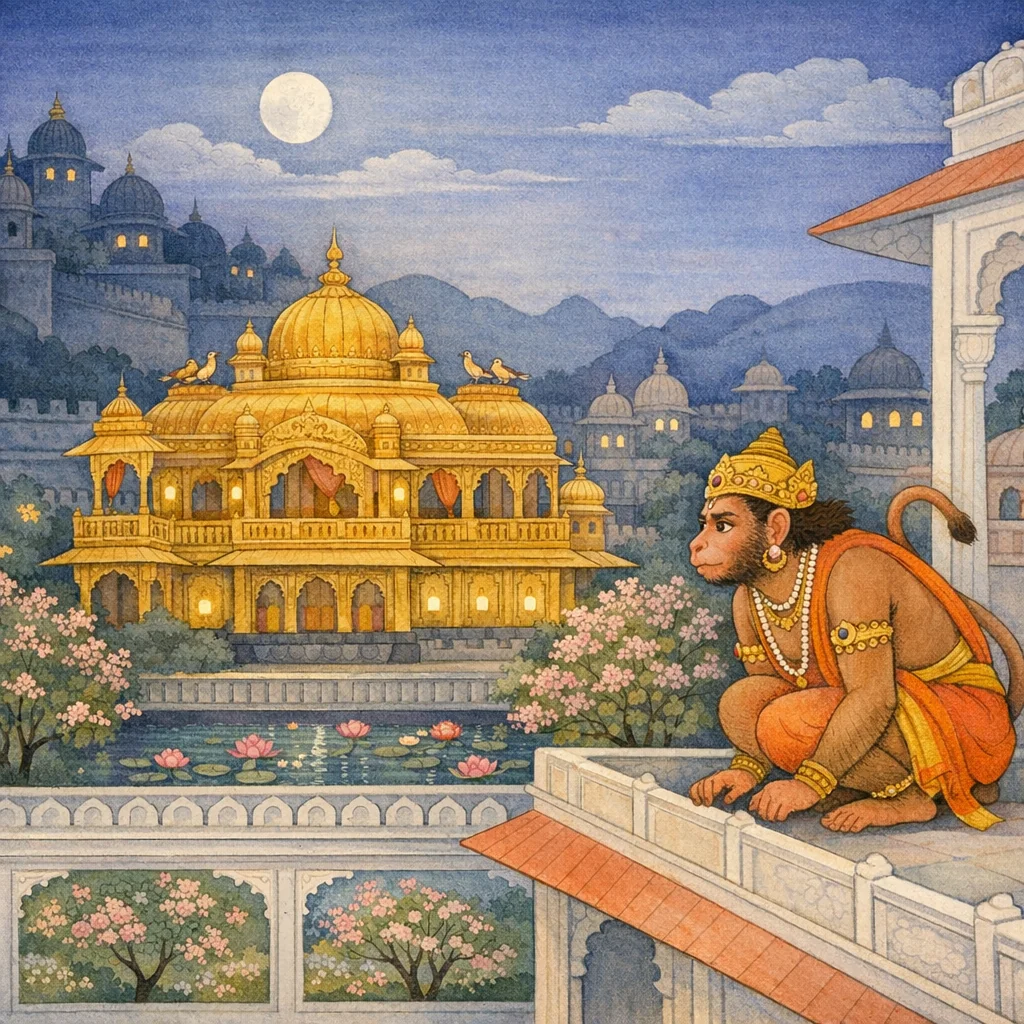
This sarga presents Hanumān’s close reconnaissance of Laṅkā’s elite architecture and the Pushpaka vimāna through a sequence of visual catalogues and extended similes. He observes a dense ‘network’ of mansions fitted with golden lattices and vaidūrya (cat’s-eye gem), likened to monsoon cloud-masses threaded with lightning and alive with birds (5.7.1). He notes specialized halls and armories for conches, weapons, bows, and arrows, and moonlit terraces crowning the attics (5.7.2). The houses appear treasure-laden, defect-free, and as if built by Māyā, the divine architect—an aesthetic of engineered wonder that signals Ravana’s amassed power (5.7.3–4). Hanumān then beholds a matchless golden palace and an aerial chariot described as heaven-like on earth, gem-studded, and cloud-and-sky-like in coloration (5.7.5–8). Interior ornamentation is rendered as pictorial cosmography: mountains, trees, flowers, ponds, lotuses, and gardens, along with gem-crafted birds, serpents, horses, elephants, and a Lakṣmī motif (5.7.9–14). Having reached this mountain-like, fragrant palace, Hanumān resumes searching the city for Sītā; failing to find her, his mind becomes deeply distressed, revealing the ethical tension between sensory splendor and the mission’s sorrowful urgency (5.7.15–17).
Shlokas
Verse 1
स वेश्मजालं बलवान् ददर्शव्यासक्तवैडूर्यसुवर्णजालम्।यथा महत् प्रावृषि मेघजालंविद्युत्पिनद्धं सविहङ्गजालम्।।5.7.1।।
Powerful Hanumān saw a vast network of mansions, latticed with gold and set with vaiḍūrya gems—like a great mass of monsoon clouds, streaked with lightning and filled with flocks of birds.
Verse 2
निवेशनानां विविधाश्च शालाःप्रधानशङ्खायुधचापशालाः।मनोहराश्चापि पुनर्विशालाःददर्श वेश्माद्रिषु चन्द्रशालाः।।5.7.2।।
He saw in those mansions many kinds of halls, including armories and store-rooms for prized conches, weapons, and bows; and again, upon the upper terraces of the lofty houses, he beheld broad and delightful moonlit balconies.
Verse 3
गृहाणि नानावसुराजितानि देवासुरैश्चापि सुपूजितानि।सर्वैश्च दोषैः परिवर्जितानि कपिर्ददर्श स्वबलार्जितानि।।5.7.3।।
The monkey beheld houses resplendent with many treasures—treasures admired even by gods and demons—dwellings free from every defect, obtained through the lord’s own might.
Verse 4
तानि प्रयत्नाभिसमाहितानि मयेन साक्षादिव निर्मितानि।महीतले सर्वगुणोत्तराणिददर्श लङ्काधिपतेर्गृहाणि।।5.7.4।।
He saw the lord of Laṅkā’s mansions—assembled with great effort and care upon the earth—excellent in every quality, as though the architect Maya himself had built them with his own hands.
Verse 5
ततो ददर्शोछ्रचितमेघरूपंमनोहरं काञ्चनचारुरूपम्।रक्षोऽधिपस्यात्मबलानुरूपंगृहोत्तमं ह्यप्रतिरूपरूपम्।।5.7.5।।
Then he beheld the finest of palaces—charming, golden, and cloud-like in its towering height—matchless in form, and befitting the very power of the lord of the rākṣasas.
Verse 6
महीतले स्वर्गमिव प्रकीर्णंश्रिया ज्वलन्तं बहुरत्नकीर्णम्।नानातरूणां कुसुमावकीर्णंगिरेरिवाग्रं रजसावकीर्णम्।।5.7.6।।
It seemed like a fragment of heaven scattered upon the earth—blazing with splendor and strewn with many gems; like a mountain summit dusted over with the pollen of flowers fallen from trees of every kind.
Verse 7
नारीप्रवेकैरिव दीप्यमानं तटिद्भिरम्भोदवदर्च्यमानम्।हंसप्रवेकैरिव वाह्यमानं श्रिया युतं खे सुकृतां विमानम्।।5.7.7।।
That aerial car shone as if lit by splendid women, like a rain-cloud honored by lightning; auspicious and radiant, it appeared as though borne through the sky by royal swans.
Verse 8
यथा नगाग्रं बहुधातुचित्रंयथा नभश्च ग्रहचन्द्रचित्रम्।ददर्शयुक्तीकृतमेघचित्रं विमानरत्नं बहुरत्नचित्रम्।।5.7.8।।
He saw that jewel among aerial cars—many-gemmed and richly variegated—like a mountain crest painted by many minerals, like the sky adorned with planets and moon, and like a gathered pageant of multicolored clouds.
Verse 9
मही कृता पर्वतराजिपूर्णा शैलाः कृता वृक्षवितानपूर्णाः।वृक्षाः कृताः पुष्पवितानपूर्णाःपुष्पं कृतं केसरपत्रपूर्णम्।।5.7.9।।
Upon it the earth was depicted, filled with ranges of mountains; the mountains were depicted, filled with canopies of trees; the trees were depicted, filled with canopies of blossoms; and the blossoms were depicted, complete with petals and filaments.
Verse 10
कृतानि वेश्मानि च पाण्डुराणि तथा सुपुष्पाण्यपि पुष्कराणि।पुनश्च पद्मानि सकेसराणि धन्यानि चित्राणि तथा वनानि।।5.7.10।।
There were depictions of white mansions, and also lotus-ponds brimming with lovely blossoms; again, lotuses with their filaments, auspicious paintings, and delightful gardens as well.
Verse 11
पुष्पाह्वयं नामविराजमानंरत्नप्रभाभिश्च विवर्धमानम्।वेश्मोत्तमानामपि चोच्यमानंमहाकपिस्तत्र महाविमानम्।।5.7.11।।
There the great monkey beheld a magnificent aerial chariot, splendidly famed as Puṣpaka, glowing ever more with the radiance of gems, and spoken of as loftier even than the finest mansions.
Verse 12
कृताश्च वैडूर्यमया विहङ्गाः रूप्यप्रवालैश्च तथा विहङ्गाः।चित्राश्च नानावसुभिर्भुजङ्गाः जात्यानुरूपास्तुरगाः शुभाङ्गाः।।5.7.12।।
There were crafted birds made of vaiḍūrya, and likewise birds fashioned of silver and coral; there were also colorful serpents made from many kinds of jewels, and fine-bred horses with auspicious limbs, true to their noble type.
Verse 13
प्रवालजाम्बूनदपुष्पपक्षाः सलीलमावर्जितजिह्मपक्षाः।कामस्य साक्षादिव भान्ति पक्षाः कृता विहङ्गाः सुमुखाः सुपक्षाः।।5.7.13।।
Bird-figures were fashioned with wings of coral and gold, their curved wings posed as if in playful motion; their wings seemed like the very wings of Kāma’s attendants—so vivid were these well-faced, fair-winged creations.
Verse 14
नियुज्यमानास्तु गजाः सुहस्ताः सकेसराश्चोत्पलपत्रहस्ताः।बभूवदेवी च कृता सुहस्तालक्ष्मी स्तथा पद्मिनि पद्महस्ता।।5.7.14।।
There were placed (depicted) elephants with graceful trunks, holding blue lotuses with their petals and filaments; and the goddess Lakṣmī too was portrayed—lovely-handed, lotus-like, in a lotus-pond, holding a lotus in her hand.
Verse 15
इतीव तद्गृहमभिगम्य शोभनम्सविस्मयो नगमिव चारुशोभनम्।पुनश्च तत्परमसुगन्धि सुन्दरम्हिमात्यये नगमिव चारुकन्दरम्।।5.7.15।।
Having thus reached that splendid palace—beautiful as a mountain—he stood astonished; and again he looked upon it: exquisitely fragrant and lovely, like a mountain at winter’s end, rich with charming caves.
Verse 16
ततः स तां कपिरभिपत्य पूजितां चरन् पुरीं दशमुखबाहुपालिताम्।अदृश्य तां जनकसुतां सुपूजितां सुदुःखितः पतिगुणवेगवर्जिताम्।।5.7.16।।
Then that monkey, having entered the revered city guarded by the might of the ten-headed one’s arms, wandered through it; but not seeing Janaka’s daughter—herself worthy of highest reverence, yet cut off from the living strength of her husband’s virtues—he became deeply sorrowful.
Verse 17
ततस्तदा बहुविधभावितात्मनः कृतात्मनो जनकसुतां सुवर्त्मनः।अपश्यतोऽभवदतिदुःखितं मनः सुचक्षुषः प्रविचरतो महात्मनः।।5.7.17।।
Then, as that great-souled, clear-sighted one—whose mind weighed many possibilities, whose self was disciplined, and who kept to the righteous path—moved about without finding Janaka’s daughter, his heart became exceedingly distressed.
Frequently Asked Questions
Hanuman must remain undistracted by the city’s overwhelming beauty and luxury while executing reconnaissance; the pivotal action is his continued movement through Ravana’s guarded capital despite rising distress from not finding Sita.
Splendor is not identical with righteousness: the sarga contrasts aesthetic magnificence with moral lack, teaching that a dharma-bound agent values purpose, restraint, and compassion over sensory fascination and political intimidation.
Laṅkā’s mansion complexes, moon-terraces (candraśālā), armory-halls for conches and weapons, and the Pushpaka vimāna itself function as cultural-architectural landmarks; lotus-pond imagery and Lakṣmī iconography mark elite prosperity motifs within the built environment.