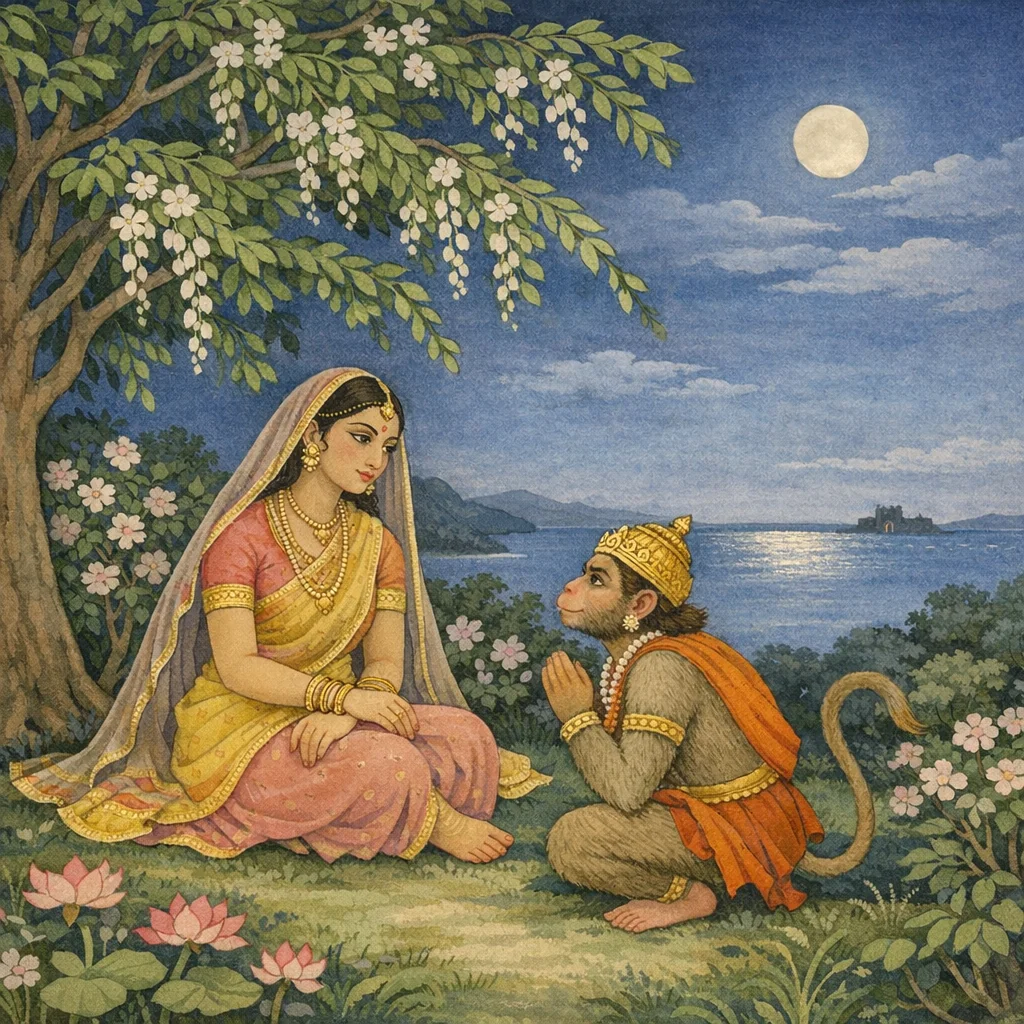
Sarga 68
सीताया यशोधर्मविचारः — Sita’s Counsel on Honor, Rescue-Strategy, and Hanuman’s Reassurance
सुन्दरकाण्ड
This sarga is a concentrated dialogue in which Sītā, moved by affection for Hanumān and love for Rāma, speaks with urgency about how the rescue should occur. She asks Hanumān to advise an expedient for a difficult undertaking, acknowledging his unique capacity to accomplish tasks single-handed, yet reframing the goal toward Rāma’s rightful glory. Sītā argues that her retrieval must not resemble Rāvaṇa’s fearful abduction by deceit; rather, Rāma should display fitting valor—subduing Laṅkā’s defenses and enemy forces in open contest—so that the restoration aligns with royal honor (yaśas) and maryādā. After hearing her courteous and reasoned words, Hanumān replies with operational assurance: Sugrīva, lord of the Vānara and Ṛkṣa hosts, is resolved; under his command are swift, powerful troops capable of unobstructed movement, even circumnavigating the earth. Hanumān counters Sītā’s anxiety about the ocean-crossing by emphasizing the army’s capability and promising that Rāma and Lakṣmaṇa will soon stand at Laṅkā’s gate. The chapter closes with Sītā gaining composure through Hanumān’s auspicious, calming speech, linking strategic confidence with emotional stabilization.
Shlokas
Verse 1
अथाहमुत्तरं देव्या पुनरुक्त स्ससम्भ्रमम्।तव स्नेहान्नरव्याघ्र सौहार्दादनुमान्य वै।।।।
Then I, reassured by the goddess Sītā’s affection and her regard for you, O tiger among men, replied once more—quickly and with urgency.
Verse 2
एवं बहुविधं वाच्यो रामो दाशरथिस्त्वया।यथा मामाप्नुयाच्छीघ्रं हत्वा रावणमाहवे।।।।
Thus, in many ways, you should urge Rāma, son of Daśaratha, so that—having slain Rāvaṇa in battle—he may swiftly regain me.
Verse 3
यदि वा मन्यसे वीर वसैकाहमरिन्दम।कस्मिंश्चित्संवृते देशे विक्रान्तश्श्वो गमिष्यसि।।।।
O heroic destroyer of enemies—if you agree, stay here for a single day in some concealed spot nearby; having rested, you may depart tomorrow.
Verse 4
मम चाप्यल्पभाग्यायास्सान्निध्यात्तव वीर्यवन्।अस्य शोकविपाकस्य मुहूर्तं स्याद्विमोक्षणम्।।।।
And for me—so ill-fated—your presence, O mighty one, would grant at least a moment’s release from this ripened burden of sorrow.
Verse 5
गते हि त्वयि विक्रान्ते पुनरागमनाय वै।प्राणानामपि सन्देहो मम स्यान्नात्र संशयः।।।।
For if you depart, O courageous one, then until your return there will be doubt even about my life—of this there is no doubt.
Verse 6
तवादर्शनजश्शोको भूयो मां परितापयेत्।दुःखाद्दुःखपराभूतां दुर्गतां दुःखभागिनीम्।।।।
The grief born of not seeing you would torment me even more—me, already overwhelmed by sorrow upon sorrow, fallen into misery, a sharer in suffering.
Verse 7
अयं च वीर सन्देहस्तिष्ठतीव ममाग्रतः।सुमहांस्त्वत्सहायेषु हर्यृक्षेषु हरीश्वर।।।।
And, O hero—O lord among monkeys—this great doubt stands before me: about your allies, the monkeys and bears.
Verse 8
कथं नु खलु दुष्पारं तरिष्यन्ति महोदधिम्।तानि हर्यृक्षसैन्यानि तौ वा नरवरात्मजौ।।।।
How indeed will those armies of monkeys and bears cross the great ocean, so hard to traverse? And how will those two princes, the sons of the best of men, cross it?
Verse 9
त्रयाणामेव भूतानां सागरस्यास्य लङ्घने।शक्तिस्स्याद्वैनतेयस्य तव वा मारुतस्य वा।।।।
Among all beings, only three have the power to leap across this ocean—Garuḍa, the Wind-god, or you.
Verse 10
तदस्मिन् कार्यनिर्योगे वीरैवं दुरतिक्रमे।किं पश्यसि समाधानं ब्रूहि कार्यविदां वरः।।।।
So then, O hero—when the undertaking is thus difficult to overcome—what practical resolution do you see? Tell me, for you are foremost among those skilled in accomplishing tasks.
Verse 11
काममस्य त्वमेवैकः कार्यस्य परिसाधने।पर्याप्तः परवीरघ्न यशस्यस्ते बलोदयः।।।।
Indeed, O slayer of enemy heroes, you alone are capable of accomplishing this task; success born of your strength would bring you renown.
Verse 12
बलै स्समग्रैर्यदि मां हत्वा रावणमाहवे।विजयी स्वां पुरीं रामो नयेत्तत्स्याद्यशस्करम्।।।।
If Rāma, after slaying Rāvaṇa in battle together with all his forces, returns victorious and takes me back to his own city, that would be truly glory-giving.
Verse 13
यथाऽहं तस्य वीरस्य वनादुपधिना हृता।रक्षसा तद्भयादेव तथा नार्हति राघवः।।।।
Just as I was taken from the forest from that hero by a rākṣasa through deceit—out of fear—so should Rāghava not take me back in such a manner; it would not be fitting for him.
Verse 14
बलैस्तु सङ्कुलां कृत्वा लङ्कां परबलार्दनः।मां नयेद्यदि काकुत्स्थस्तत्तस्य सदृशं भवेत्।।।।
But if Kakutstha—crusher of the enemy’s forces—were to overwhelm Laṅkā with his might and then lead me away, that would be worthy of him.
Verse 15
तद्यथा तस्य विक्रान्तमनुरूपं महात्मनः।भवेदाहवशूरस्य तथा त्वमुपपादय।।।।
Therefore, arrange matters so that the great-souled one—heroic in battle—may display valor befitting his true stature.
Verse 16
तदर्थोपहितं वाक्यं प्रश्रितं हेतुसंहितम्।निशम्याहं तत श्शेषं वाक्यमुत्तरमब्रुवम्।।।।
Having heard those words—full of purpose, courteous, and grounded in sound reasoning—I then spoke the remainder of my reply.
Verse 17
देवि हर्यृक्षसैन्यानामीश्वरः प्लवतां वरः।सुग्रीवस्सत्त्वसम्पन्नस्तवार्थे कृतनिश्चयः।।।।
O queen, Sugrīva—the lord of the hosts of monkeys and bears, foremost among leapers—richly endowed with strength, has firmly resolved to accomplish your cause.
Verse 18
तस्य विक्रमसम्पन्नास्सत्त्ववन्तो महाबलाः।मन स्सङ्कल्पसम्पाता निदेशे हरयः स्थिताः।।।।
Under his command stand monkeys endowed with prowess and great strength—swift in movement like the very speed of thought and intention.
Verse 19
येषां नोपरि नाधस्तान्न तिर्यक्सज्जते गतिः।न च कर्मसु सीदन्ति महत्स्वमिततेजसः।।।।
Their movement is not hindered—neither upward, nor downward, nor sideways; and, radiant with immeasurable energy, they do not falter even in the greatest undertakings.
Verse 20
असकृत्तैर्महाभागैर्वानरैर्बलदर्पितैः।प्रदक्षिणीकृता भूमिर्वायुमार्गानुसारिभिः।।।।
O noble lady, by those illustrious vānara heroes—proud in their might and moving along the pathways of the wind—the earth itself has been circled again and again.
Verse 21
मद्विशिष्टाश्च तुल्याश्च सन्ति तत्र वनौकसः।मत्तः प्रत्यवरः कश्चिन्नास्ति सुग्रीवसन्निधौ।।।।
Among those forest-dwellers there are some superior to me and some equal to me; in Sugrīva’s presence, there is none inferior to me in valor.
Verse 22
अहं तावदिह प्राप्तः किं पुनस्ते महाबलाः।न हि प्रकृष्टाः प्रेत्यन्ते प्रेष्यन्ते हीतरे जनाः।।।।
I have reached here; what then need be said of those far mightier than I? For the truly superior are not sent on errands—others are the ones dispatched.
Verse 23
तदलं परितापेन देवि मन्युर्व्यपैतु ते।एकोत्पातेन ते लङ्कामेष्यन्ति हरियूथपाः।।।।
Therefore, enough of torment, O queen—let your grief and anger subside. With a single leap the leaders of the monkey-hosts will come to Laṅkā.
Verse 24
मम पृष्ठगतौ तौ च चन्द्रसूर्याविवोदितौ।त्वत्सकाशं महाभागे नृसिंहावागमिष्यतः।।।।
O noble lady, those two lion-like men—like the risen moon and sun—will mount upon my back and come into your very presence.
Verse 25
अरिघ्नं सिंहसङ्काशं क्षिप्रं द्रक्ष्यसि राघवम्।लक्ष्मणं च धनुष्पाणिं लङ्काद्वारमुपस्थितम्।।।।
Very soon you will see Rāghava—lion-like and a slayer of foes—and also Lakṣmaṇa, bow in hand, standing at the gate of Laṅkā.
Verse 26
नखदंष्ट्रायुधान् वीरान् सिंहशार्दूलविक्रमान्।वानरान्वारणोन्द्राभान् क्षिप्रं द्रक्षसि सङ्गतान्।।।।शैलाम्बुदनिकाशानां लङ्कामलयसानुषु।नर्दतां कपिमुख्यानामचिराच्छ्रोष्यसि स्वनम्।।।।
Soon you will see the assembled monkey-heroes—armed with nails and teeth, possessed of the prowess of lions and tigers, and mighty as lordly elephants.
Verse 27
नखदंष्ट्रायुधान् वीरान् सिंहशार्दूलविक्रमान्।वानरान्वारणोन्द्राभान् क्षिप्रं द्रक्षसि सङ्गतान्।।5.68.26।।शैलाम्बुदनिकाशानां लङ्कामलयसानुषु।नर्दतां कपिमुख्यानामचिराच्छ्रोष्यसि स्वनम्।।5.68.27।।
Before long you will hear the roar of the foremost monkey-leaders—like rainclouds upon mountains—resounding on the slopes of Laṅkā’s Malaya range.
Verse 28
निवृत्तवनवासं च त्वया सार्धमरिन्दमम्।अभिषिक्तमयोध्यायां क्षिप्रं द्रक्ष्यसि राघवम्।।।।
Soon you will see Rāghava—the subduer of enemies—returned from forest-exile and crowned in Ayodhyā, together with you at his side.
Verse 29
ततो मया वाग्भिरदीनभाषिणा शिवाभिरिष्टाभिरभिप्रसादिता।जगाम शान्तिं मम मैथिलात्मजा तवापि शोकेन तदाभिपीडिता।।।।
Then the daughter of Mithilā—already oppressed at that time by grief for you as well—was consoled by my words, gentle in tone, auspicious and welcome; and she attained calm.
Frequently Asked Questions
Sītā frames a dharma-sensitive dilemma: her rescue must not replicate the unethical pattern of abduction. She urges that Rāma retrieve her through rightful, valorous conquest—so the act is publicly legitimate, honor-preserving, and consistent with royal maryādā.
The sarga teaches that ends do not sanctify means: even a just goal (rescue) must be executed through ethically intelligible action. Reputation (yaśas) is treated as a moral record of conduct, not mere acclaim, and strategy must serve dharma.
Key landmarks include Laṅkā and its gate (the anticipated site of confrontation), the Mahodadhi (ocean) as the logistical barrier, and the Malaya mountain in Laṅkā as a soundscape marker for the approaching Vānara host.