Sarga 65
सीतावृत्तान्तनिवेदनम् / Report of Sītā’s Condition and Tokens of Recognition
सुन्दरकाण्ड
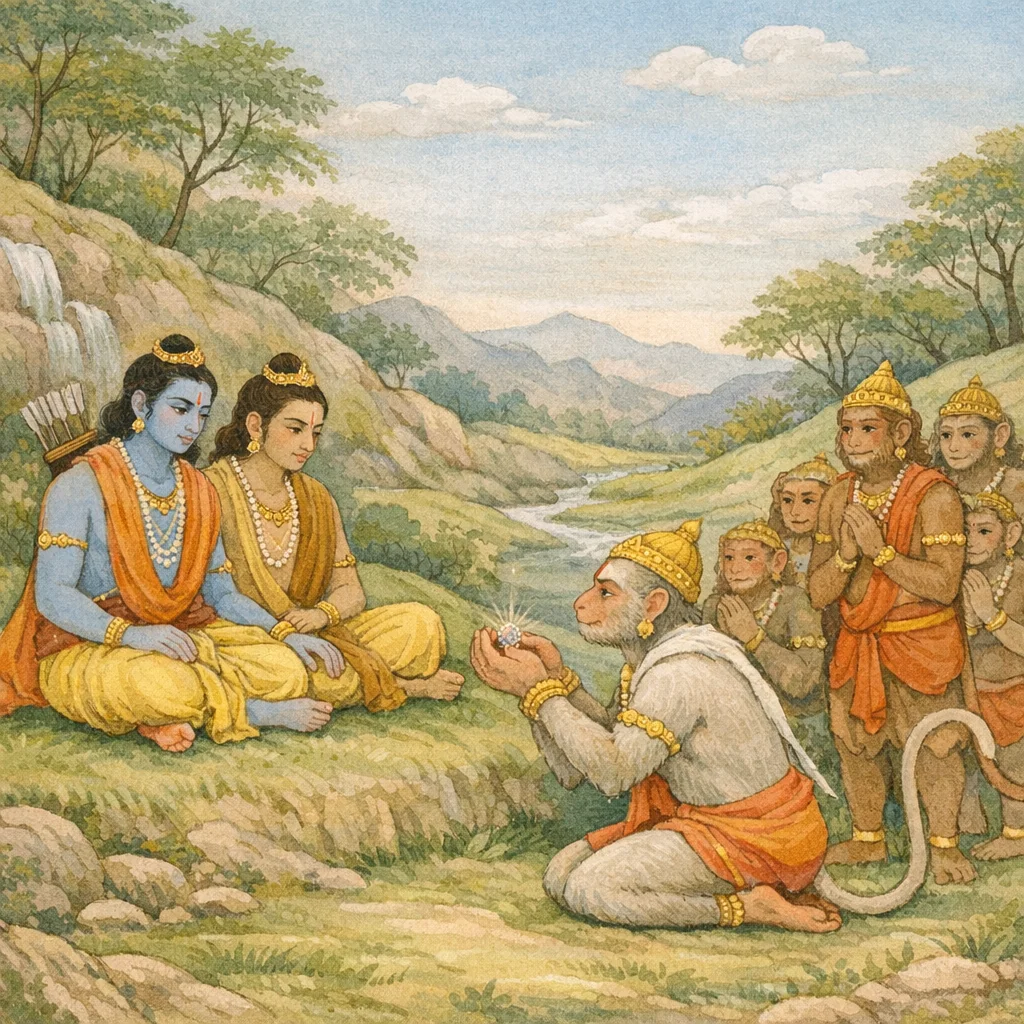
At Prasravaṇa mountain, the returning vānaras bow to Rāma, Lakṣmaṇa, and Sugrīva, placing the heir-apparent (yuvarāja, i.e., Aṅgada) respectfully in front as they begin the formal report on Sītā. Rāma, hearing that Vaidehī is alive and unharmed, requests precise details: where she is, and her disposition toward him. The group prompts Hanumān—expert in Sītā’s circumstances—to speak. Hanumān salutes Sītā directionally and narrates his ocean-crossing, Laṅkā’s location on the southern shore, and his sighting of Sītā in confinement: guarded by hideous rākṣasīs, repeatedly threatened, living in grief, with a single braid as a sign of desolation, lying on bare ground, pallid like a lotus in winter, rejecting Rāvaṇa and resolved to die. He explains how he established trust by praising the Ikṣvāku lineage and by communicating the Rāma–Sugrīva alliance. Sītā provides abhijñāna (recognition proofs): an anecdote from Citrakūṭa (the crow episode), and tangible tokens—especially the cūḍāmaṇi jewel—asking Hanumān to report everything to Rāma (with Sugrīva hearing) and warning she will endure only one more month. Hanumān then delivers the identification token to Rāma, completing the message in ordered sequence, and the princes’ relief is noted.
Shlokas
Verse 1
ततः प्रस्रवणं शैलं ते गत्वा चित्रकाननम्।प्रणम्य शिरसा रामं लक्ष्मणं च महाबलम्।।।।युवराजं पुरस्कृत्य सुग्रीवमभिवाद्य च।प्रवृत्तिमथ सीतायाः प्रवक्तुमुपचक्रमुः।।।।
Thereafter they went to Mount Prasravaṇa with its wondrous woodland. Bowing their heads, they paid homage to Rāma and to mighty Lakṣmaṇa; placing the heir-apparent in front, they saluted Sugrīva as well, and then began to relate the news of Sītā—what had happened to her and her present state.
Verse 2
ततः प्रस्रवणं शैलं ते गत्वा चित्रकाननम्।प्रणम्य शिरसा रामं लक्ष्मणं च महाबलम्।।5.65.1।।युवराजं पुरस्कृत्य सुग्रीवमभिवाद्य च।प्रवृत्तिमथ सीतायाः प्रवक्तुमुपचक्रमुः।।5.65.2।।
Thereafter they reached Mount Prasravaṇa, rich with the wondrous Chitra-forest. Bowing their heads, they paid homage to Rama and to mighty Lakshmana; and, placing the crown prince before them with due honor, they saluted Sugriva as well. Then they began to relate the full account of Sita—her condition and all that had occurred.
Verse 3
रावणान्तः पुरे रोधं राक्षसीभिश्च तर्जनम्।रामे समनुरागं च यश्चायं समयः कृतः।।।।एतदाख्यान्ति ते सर्वे हरयो रामसन्निधौ।
In Rama’s presence, all the vanaras reported these matters: Sita’s confinement within Ravana’s inner quarters, the threats hurled by the rākṣasīs, her steadfast love for Rama, and the deadline that had been imposed.
Verse 4
वैदेहीमक्षतां श्रुत्वा रामस्तूत्तरमब्रवीत्।।।।क्व सीता वर्तते देवी कथं च मयि वर्तते।एतन्मे सर्वमाख्यात वैदेहीं प्रति वानराः।।।।
Hearing that Vaidehī was unharmed, Rama responded: “Where is the divine Sita now, and how does she feel toward me? Tell me everything—especially her state of mind toward Vaidehī.”
Verse 5
वैदेहीमक्षतां श्रुत्वा रामस्तूत्तरमब्रवीत्।।5.65.4।।क्व सीता वर्तते देवी कथं च मयि वर्तते।एतन्मे सर्वमाख्यात वैदेहीं प्रति वानराः।।5.65.5।।
Hearing that Vaidehī was unharmed, Rama said: “Where is the divine Sita, and what is her disposition toward me? Tell me everything about Vaidehī.”
Verse 6
रामस्य गदितं श्रुत्वा हरयो रामसन्निधौ।चोदयन्ति हनूमन्तं सीतावृत्तान्तकोविदम्।।।।
Hearing Rama’s words in his presence, the vanaras urged Hanuman—skilled in the full account of Sita—to speak and relate it.
Verse 7
श्रुत्वा तु वचनं तेषां हनुमान्मारुतात्मजः।प्रणम्य शिरसा देव्यै सीतायै तां दिशं प्रति।।।।उवाच वाक्यं वाक्यज्ञस्सीताया दर्शनं यथा।
Having heard their request, Hanuman—the Wind-god’s son—bowed his head in reverence toward the direction where the divine Sita was, and then, skilled in speech, he began to relate how he had seen her.
Verse 8
समुद्रं लङ्घयित्वाहं शतयोजनमायतम्।।।।अगच्छं जानकीं सीतां मार्गमाणो दिदृक्षया।
After leaping across the ocean, a hundred yojanas wide, I went in search of Jānakī Sita, driven by the longing to see her.
Verse 9
तत्र लङ्केति नगरी रावणस्य दुरात्मनः।।।।दक्षिणस्य समुद्रस्य तीरे वसति दक्षिणे।
There stands the city called Laṅkā, belonging to the evil-minded Ravana, situated on the southern shore of the ocean.
Verse 10
तत्र दृष्टा मया सीता रावणान्तः पुरे सती।।।।सन्न्यस्य त्वयि जीवन्ती रामा राम मनोरथम्।
There I saw Sītā, your faithful wife, within Rāvaṇa’s inner palace. She lives with her hopes fixed on you alone, having set aside every other desire.
Verse 11
दृष्टा मे राक्षसीमध्ये तर्ज्यमाना मुहुर्मुहुः।।।।राक्षसीभिर्विरूपाभी रक्षिता प्रमदावने।
I saw her amid rākṣasī women, threatened again and again, guarded in the pleasure-grove by hideous ogresses.
Verse 12
दुःख मासाद्यते देवी तथाऽदुःखोचिता सती।।।।रावणान्तः पुरे रुद्धा राक्षसीभि स्सुरक्षिता।एकवेणीधरा दीना त्वयि चिन्तापरायणा।।।।अधःशय्या विवर्णाङ्गी पद्मिनीव हिमागमे।रावणाद्विनिवृत्तार्था मर्तव्यकृतनिश्चया।।।।देवी कथञ्चित्काकुत्स्थ त्वन्मना मार्गिता मया।
That noble lady—though worthy of happiness—has been made to suffer. Confined within Rāvaṇa’s inner palace and closely guarded by rākṣasīs, she wears a single braid in desolation, is wretched, and is wholly absorbed in thoughts of you.
Verse 13
दुःख मासाद्यते देवी तथाऽदुःखोचिता सती।।5.65.12।।रावणान्तः पुरे रुद्धा राक्षसीभि स्सुरक्षिता।एकवेणीधरा दीना त्वयि चिन्तापरायणा।।5.65.13।।अधःशय्या विवर्णाङ्गी पद्मिनीव हिमागमे।रावणाद्विनिवृत्तार्था मर्तव्यकृतनिश्चया।।5.65.14।।देवी कथञ्चित्काकुत्स्थ त्वन्मना मार्गिता मया।
She lies upon the bare ground, her limbs pale—like a lotus in the winter season. Rejecting Rāvaṇa utterly, she has resolved upon death.
Verse 14
दुःख मासाद्यते देवी तथाऽदुःखोचिता सती।।5.65.12।।रावणान्तः पुरे रुद्धा राक्षसीभि स्सुरक्षिता।एकवेणीधरा दीना त्वयि चिन्तापरायणा।।5.65.13।।अधःशय्या विवर्णाङ्गी पद्मिनीव हिमागमे।रावणाद्विनिवृत्तार्था मर्तव्यकृतनिश्चया।।5.65.14।।देवी कथञ्चित्काकुत्स्थ त्वन्मना मार्गिता मया।
O Kakutstha, that noble lady—her mind fixed on you—was found by me, somehow, after much seeking.
Verse 15
इक्ष्वाकुवंशविख्यातिं शनैः कीर्तयतानघ।।।।सा मया नरशार्दूल विश्वासमुपपादिता।
O blameless one, O tiger among men—by slowly recounting the renowned glory of the Ikṣvāku line, I enabled her to place trust in me.
Verse 16
तत स्सम्भाषिता देवी सर्वमर्थं च दर्शिता।।।।रामसुग्रीवसख्यं च श्रुत्वा प्रीतिमुपागता।नियत स्समुदाचारो भक्तिश्चास्यास्तथा त्वयि।।।।
Then, when the noble lady conversed with me, I laid out the entire matter. And on hearing of the friendship-alliance between Rama and Sugriva, she became filled with joy—her conduct steadfastly virtuous, and her devotion likewise firmly fixed upon you.
Verse 17
तत स्सम्भाषिता देवी सर्वमर्थं च दर्शिता।।5.65.16।।रामसुग्रीवसख्यं च श्रुत्वा प्रीतिमुपागता।नियत स्समुदाचारो भक्तिश्चास्यास्तथा त्वयि।।5.65.17।।
Then, as the noble lady spoke with me, I set forth the whole matter; and when she heard of the alliance between Rama and Sugriva, she was gladdened—her conduct unwaveringly righteous and her devotion firmly directed toward you.
Verse 18
एवं मया महाभागा दृष्टा जनकनन्दिनी।उग्रेण तपसा युक्ता त्वद्भक्त्या पुरुषर्षभ।।।।
Thus I beheld Janaka’s daughter—most fortunate and noble—enduring fierce austerity, and sustained by devotion to you, O best of men.
Verse 19
अभिज्ञानं च मे दत्तं यथा वृत्तं तवान्तिके।चित्रकूटे महाप्राज्ञ वायसं प्रति राघव।।।।
And she gave me a token for recognition—recounting, exactly as it happened in your presence, the episode of the crow at Chitrakuta, O wise Raghava.
Verse 20
विज्ञाप्यश्च नरव्याघ्रो रामो वायुसुत त्वया।अखिलेनेह यद्धृष्टमिति मामाह जानकी।।।।
Janaki said to me: “O son of the Wind, you must inform Rama—the tiger among men—of everything you have seen here.”
Verse 21
अयं चास्मै प्रदातव्यो यत्नात्सुपरिरक्षितः।ब्रुवता वचनान्येवं सुग्रीवस्योपशृण्वतः।।।।
“And this, carefully preserved with great effort, must be given to him. Speak these words in such a way that Sugriva also hears them.”
Verse 22
एष चूडामणिश्श्रीमान् मया सुपरिरक्षितः।मनश्शिलायास्तिलको गण्डपार्श्वे निवेशितः।।।।त्वया प्रणष्ठे तिलके तं किल स्मर्तुमर्हसि।
“This splendid crest-jewel (cūḍāmaṇi) has been kept safe by me with great care. And the red tilaka made from manaḥśilā, placed upon my cheek—when that mark was lost through your absence—do remind him of it; it is right that he should remember.”
Verse 23
एष निर्यातितश्श्रीमान्मया ते वारि सम्भवः।एतं दृष्ट्वा प्रहृष्यामि व्यसने त्वामिवानघ।।।।
“This splendid jewel, ocean-born, has been sent by me to you. In my distress, when I look upon it, I rejoice—as though I were seeing you yourself, O blameless one.”
Verse 24
जीवितं धारयिष्यामि मासं दशरथात्मज।।।।ऊर्ध्वं मासान्न जीवेयं रक्षसां वशमागता।
“O son of Dasharatha, I will sustain my life for one month. Beyond a month, having fallen under the power of the rakshasas, I shall not live.”
Verse 25
इति मामब्रवीत्सीता कृशाङ्गी धर्मचारिणी।।।।रावणान्तः पुरे रुद्धा मृगीवोत्फुल्ललोचना।
Thus Sita spoke to me—her body wasted thin, steadfast in dharma—confined within Ravana’s inner palace, her eyes wide with fear like a startled doe.
Verse 26
एतदेव मयाख्यातं सर्वं राघव यद्यथा।।।।सर्वथा सागरजले संतारः प्रविधीयताम्।
“Rāghava, I have told you everything exactly as it happened. By every means, let the crossing over the ocean be arranged.”
Verse 27
तौ जाताश्वासौ राजपुत्रौ विदित्वा तच्चाभिज्ञानं राघवाय प्रदाय।देव्या चाख्यातं सर्वमेवानुपूर्व्याद्वाचा सम्पूर्णं वायुपुत्त्र श्शशंस।।।।
Knowing that the two royal brothers had breathed freely in relief, the Wind-god’s son gave Rama the token of recognition and, in orderly sequence, fully conveyed all that the divine lady had said.
Frequently Asked Questions
The messenger’s duty is framed as ethically exact reporting: Hanumān must convey Sītā’s suffering without distortion, provide verifiable proofs (abhijñāna), and deliver the message in a way that supports strategic action while honoring courtly protocol (including reporting within Sugrīva’s hearing).
Dharma is sustained through truth, evidence, and steadfast loyalty: Sītā’s unwavering devotion and Hanumān’s disciplined speech convert grief into clarity, showing that moral endurance and reliable testimony are prerequisites for righteous intervention.
Prasravaṇa (the rendezvous site for debriefing), Laṅkā on the southern seashore, the Pramadāvana/Aśoka-grove setting of captivity, and Citrakūṭa (invoked via the crow anecdote) function as narrative coordinates for mapping the search, confinement, and verification chain.