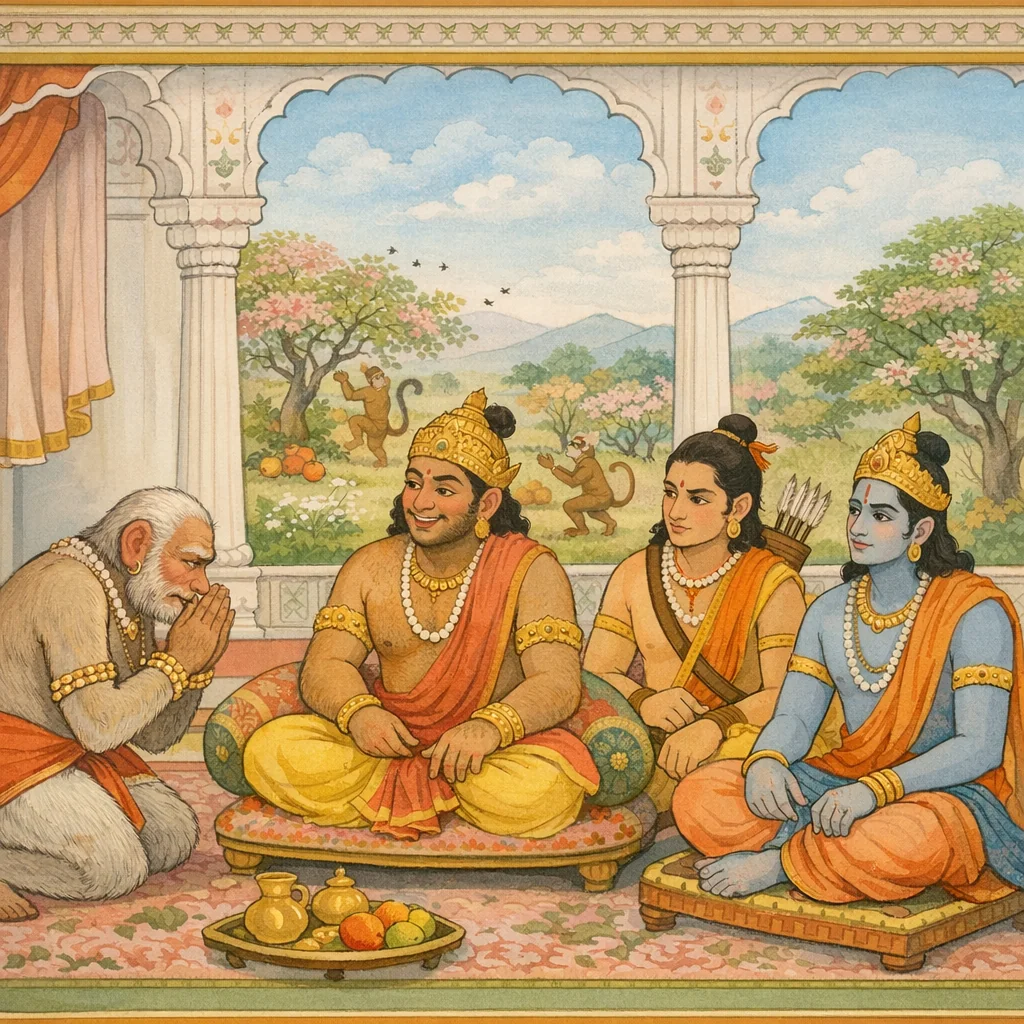
Sarga 63
दधिमुख-विज्ञापनम् / Dadhimukha Reports the Madhuvana Incident
सुन्दरकाण्ड
This sarga stages a courtly-legal inquiry within the vanara polity. Dadhimukha, the appointed guardian of Madhuvana, prostrates before Sugriva and reports that Angada and the returning search-party have entered the protected grove, consumed honey and fruit, and forcibly repelled the guards. Lakshmana questions the cause of Dadhimukha’s distress, prompting Sugriva’s interpretive judgment: such celebratory transgression would not occur without success in the mission. Sugriva infers that Sita has been seen—most likely by Hanuman—because the capacity (sādhana), resolve (vyavasāya), intellect (mati), and proven prowess required for the task are established in him. The chapter thus converts an apparent breach of discipline into evidence of accomplished duty, reframing disorder as a sign of fulfilled purpose. Rama and Lakshmana rejoice upon hearing this reasoning, and Sugriva orders that the leaders, headed by Hanuman, be brought quickly so that the details of Sita’s discovery can be heard directly.
Shlokas
Verse 1
ततो मूर्ध्ना निपतितं वानरं वानरर्षभः।दृष्ट्वैवोद्विग्नहृदयो वाक्यमेतदुवाच ह।।।।
Then the bull among the vanaras (Sugrīva), seeing a vanara fallen at his feet—touching the ground with his forehead—became anxious at heart and spoke these words.
Verse 2
उत्तिष्ठोत्तिष्ठ कस्मात्त्वं पादयोः पतितो मम।अभयं ते भवेद्वीर सर्वमेवाभिधीयताम्।।।।
Rise, rise—why have you fallen at my feet? Be fearless, O brave one; tell me everything, just as it is.
Verse 3
स तु विश्वासितस्तेन सुग्रीवेण महात्मना।उत्थाय सुमहाप्राज्ञो वाक्यं दधिमुखोऽब्रवीत्।।।।
Reassured by the great-souled Sugrīva, the very wise Dadhimukha rose and spoke these words.
Verse 4
नैवर्क्षरजसा राजन्न त्वया नापि वालिना।वनं निसृष्टपूर्वं हि भक्षितं तच्च वानरैः।।।।
“O King, neither in the time of Ṛkṣarāja, nor in your time, nor even in Vāli’s, was this grove ever opened for free entry—yet those vānaras have consumed and laid it waste.”
Verse 5
एभिः प्रधर्षिताश्चैव वानरा वनरक्षिभिः।मधून्यचिन्तयित्वेमान् भक्षयन्ति पिबन्ति च।।।।
“Though the grove-guards tried to restrain them by force, those vānaras ignored us and went on eating and drinking the honey.”
Verse 6
शिष्टमत्रापविध्यन्ति भक्षयन्ति तथापरे।निवार्यमाणास्ते सर्वे भ्रुवो वै दर्शयन्ति हि।।।।
“Some even fling aside what remains; others keep eating; and when restrained, they all show their arrogance—raising their brows in defiance.”
Verse 7
इमे हि संरब्धतरास्तथा तैस्सम्प्रधर्षिताः।वारयन्तो वनात्तस्मात्क्रुद्धैर्वानरपुङ्गवैः।।।।
When the guards tried to stop them and drive them out of that grove, the leading Vānaras—already more fiercely enraged and feeling insulted—responded in anger and harassed the guards.
Verse 8
ततस्तैर्बहुभिर्वीरैर्वानरैर्वानरर्षभ।संरक्तनयनैः क्रोधाद्धरयः प्रविचालिताः।।।।
Then, O bull among Vānaras, many heroic monkeys—eyes reddened with fury—drove the guards away in their anger.
Verse 9
पाणिभिर्निहताः केचित्केचिज्जानुभिराहताः।प्रकृष्टाश्च यथाकामं देवमार्गं च दर्शिताः।।।।
Some were struck with hands, others were hit with knees; some were dragged about at will and even subjected to humiliating indecencies.
Verse 10
एवमेते हताश्शूरास्त्वयि तिष्ठति भर्तरि।कृत्स्नं मधुवनं चैव प्रकामं तैः प्रभक्ष्यते।।।।
‘Thus those heroes, though you stand as our lord, have battered (the guards) and, at their pleasure, consumed the whole of Madhuvana.’
Verse 11
एवं विज्ञाप्यमानं तं सुग्रीवं वानरर्षभम्।अपृच्छत्तं महाप्राज्ञो लक्ष्मणः परवीरहा।।।।
As Sugrīva—the bull among the vanaras—was thus being informed, Lakṣmaṇa, wise and a destroyer of enemy-champions, questioned him.
Verse 12
किमयं वानरो राजन् वनपः प्रत्युपस्थितः।कं चार्थमभिनिर्दिश्य दुःखितो वाक्यमब्रवीत्।।।।
‘O King, why has this vanara—this guardian of the grove—come before you? Distressed, about what matter is he speaking?’
Verse 13
एवमुक्तस्तु सुग्रीवो लक्ष्मणेन महात्मना।लक्ष्मणं प्रत्युवाचेदं वाक्यं वाक्यविशारदः।।।।
Thus addressed by the noble Lakṣmaṇa, Sugrīva—skilled in speech—replied to Lakṣmaṇa with these words.
Verse 14
आर्य लक्ष्मण सम्प्राह वीरो दधिमुखः कपिः।अङ्गदप्रमुखैर्वीरैर्भक्षितं मधु वानरैः।।।।विचित्य दक्षिणामाशामागतैर्हरिपुङ्गवैः।
‘Venerable Lakṣmaṇa, the heroic monkey Dadhimukha reports that the honey has been consumed by the heroic vanaras led by Aṅgada—those foremost of monkeys who have returned after searching the southern quarter.’
Verse 15
नैषामकृत्यानामीदृशस्स्यादुपक्रमः।।।।आगतैश्च प्रमथितं यथा मधुवनं हि तैः।धर्षितं च वनं कृत्स्नमुपयुक्तं च वानरैः।।।।
Such conduct would not be found in them if their purpose had not been accomplished.
Verse 16
नैषामकृत्यानामीदृशस्स्यादुपक्रमः।।5.63.15।।आगतैश्च प्रमथितं यथा मधुवनं हि तैः।धर्षितं च वनं कृत्स्नमुपयुक्तं च वानरैः।।5.63.16।।
Those vānaras, having come back, have indeed stormed Madhuvana; the entire grove has been ravaged—and yet, in context, their boldness is understandable.
Verse 17
वनं यदाऽभिपन्नास्ते साधितं कर्म वानरैः।दृष्टा देवी न सन्देहो न चान्येन हनूमता।।।।
If they have entered the grove in that manner, then the vānaras must have achieved their task. There is no doubt: the Lady has been seen—by none other than Hanumān.
Verse 18
न ह्यन्यस्साधने हेतुः कर्मणोऽस्य हनूमतः।कार्यसिद्धिर्मतिश्चैव तस्मिन्वानरपुङ्गवे।।।।व्यवसायश्च वीर्यं च श्रुतं चापि प्रतिष्ठितम्।
For this task, no one else is truly a sufficient means—Hanumān alone is. In that foremost of vānaras are firmly established success in action, sound judgment, determined effort, strength, and tested capability.
Verse 19
जाम्बवान्यत्र नेता स्यादङ्गदश्च महाबलः।।।।हनुमांश्चाप्यधिष्ठाता न तस्य गतिरन्यथा।
Where Jāmbavān leads, mighty Aṅgada stands, and Hanumān directs, the outcome cannot be otherwise than success.
Verse 20
अङ्गदप्रमुखैर्वीरैर्हतं मधुवनं किल।।5.63.20।।वारयन्तश्च सहितास्तदा जानुभिराहताः।
It is said that Madhuvana has been laid waste by the heroes led by Aṅgada; and when the guards tried to stop them together, they were then struck down with knees.
Verse 21
एतदर्थमयं प्राप्तो वक्तुं मधुरवागिह।।।।नाम्ना दधिमुखो नाम हरिः प्रख्यातविक्रमः।
For this very reason he has come here to speak—this sweet-spoken monkey, famed for valor, named Dadhimukha.
Verse 22
दृष्टा सीता महाबाहो सौमित्रे पश्य तत्त्वतः।।।।अभिगम्य तथा सर्वे पिबन्ति मधु वानराः।
O strong-armed Saumitri, see the truth of it: Sītā has been seen—therefore all the vānaras, having returned, are drinking honey.
Verse 23
न चाप्यदृष्ट्वा वैदेहीं विश्रुताः पुरुषर्षभ।।।।वनं दत्तवरं दिव्यं धर्षयेयुर्वनौकसः।
O best of men, those renowned forest-dwellers would not violate this wondrous grove—granted as a boon—without having seen Vaidehī.
Verse 24
ततः प्रहृष्टो धर्मात्मा लक्ष्मणस्सह राघवः।।।।श्रुत्वा कर्णसुखां वाणीं सुग्रीववदनाच्च्युताम्।प्राहृष्यत भृशं रामो लक्ष्मणश्च महाबलः।।।।
Then righteous Rāma, together with Lakṣmaṇa, rejoiced greatly on hearing Sugrīva’s words—so pleasing to the ear; and mighty Lakṣmaṇa too was filled with joy.
Verse 25
ततः प्रहृष्टो धर्मात्मा लक्ष्मणस्सह राघवः।।5.63.24।।श्रुत्वा कर्णसुखां वाणीं सुग्रीववदनाच्च्युताम्।प्राहृष्यत भृशं रामो लक्ष्मणश्च महाबलः।।5.63.25।।
“O King, neither in the time of Ṛkṣarāja, nor in your time, nor even in Vāli’s, was this grove ever opened for free entry—yet those vānaras have consumed and laid it waste.”
Verse 26
श्रुत्वा दधिमुखस्येदं सुग्रीवस्सम्प्रहृष्य च।वनपालं पुनर्वाक्यं सुग्रीवः प्रत्यभाषत।।।।
Hearing Dadhimukha’s report, Sugrīva became exceedingly glad and again replied to the grove-guardian.
Verse 27
प्रीतोऽस्मि सोऽहं यद्भुक्तं वनं तैः कृतकर्मभिः।मर्षितं मर्षणीयं च चेष्टितं कृतकर्मणाम्।।।।
“I am pleased that they have enjoyed the grove—because it was done by those who have fulfilled their task. Their conduct is forgiven; indeed, it is pardonable in those who have accomplished the work.”
Verse 28
इच्छामि शीघ्रं हनुमत्प्रधानान् शाखामृगांस्तान् मृगराजदर्पान्।द्रष्टुं कृतार्थान् सह राघवाभ्यां श्रोतुं च सीताधिगमे प्रयत्नम्।।5.63.28।।
“I wish at once to see those tree-dwelling vānaras, led by Hanumān—lion-like in pride—who have achieved their aim; and, together with the two Rāghavas, to hear their effort in finding Sītā.”
Verse 29
प्रीतिस्फीताक्षौ सम्प्रहृष्टौ कुमारौ दृष्ट्वा सिद्धार्थौ वानराणां च राजा।अङ्गैः संहृष्टैः कर्मसिद्धिं विदित्वा बाह्वोरासन्नां सोऽतिमात्रं ननन्द।।।।
Seeing the two princes—Rāma and Lakṣmaṇa—exultant, their eyes brimming with joy at the goal’s fulfillment, the king of vānaras too rejoiced greatly; thrilled in every limb, he recognized that success was at hand.
Frequently Asked Questions
A protected royal grove (Madhuvana) is violated by returning vanaras, and the guards are assaulted. The dilemma is whether to punish the breach as indiscipline or interpret it as a mission-sign; Sugriva chooses a dharma-based royal discretion—pardon—because the conduct indicates accomplished duty.
Competence and success leave discernible marks: leaders should read outcomes, not only infractions. The sarga teaches that governance balances rule-enforcement with contextual judgment, and that exceptional tasks require recognizing the one most fit (Hanuman) without diminishing the collective.
Madhuvana is the key cultural landmark: a boon-protected, regulated grove associated with royal authority and communal resources (honey/fruit). The “southern direction” search context frames the episode as the return-point of the expedition that sought Sita.