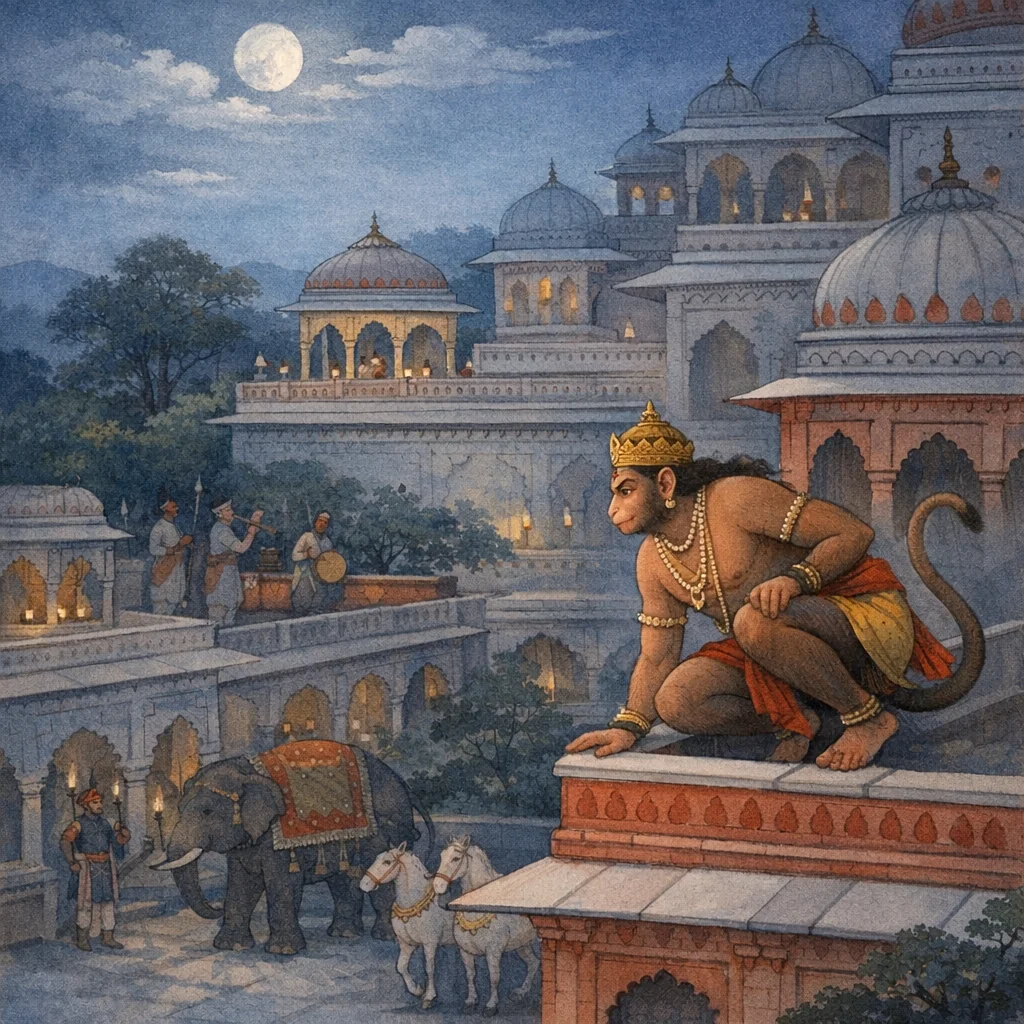
Sarga 6
राक्षसेन्द्रनिवेशनविचारः (Survey of Ravana’s Residence and Lanka’s Inner Quarters)
सुन्दरकाण्ड
Sarga 6 narrates Hanumān’s methodical yet rapid movement through Lanka after failing to find Sītā in earlier mansions. Assuming forms at will (kāmarūpa) and relying on lāghava (agility/quickness), he reaches the rākṣasa-king’s residence, described through layered architectural and sensory detail: blazing red ramparts, silver-and-gold toraṇas, inner apartments, and a constant clangor resembling the sea from ornaments, drums, conches, and ritual activity. The text maps the social and military ecology of the capital by listing prominent rākṣasa households (Prahasta, Mahāpārśva, Kumbhakarṇa, Vibhīṣaṇa, Indrajit, and many others), then returns to the palace core where Hanumān observes armed guards, troops, elite horses and war-elephants likened to clouds and mountains, and vast stores of gold, gems, vessels, palanquins, pleasure pavilions, and crafted landscapes. The chapter’s lesson emphasizes reconnaissance with restraint: accurate assessment of enemy wealth, ritual routine, and defenses, while maintaining the mission’s ethical focus—finding Sītā without reckless exposure.
Shlokas
Verse 1
स निकामं विमानेषु निषण्णः कामरूपधृत्।विचचार पुनर्लङ्कां लाघवेन समन्वितः।।।।
Able to assume any form at will, he—having sat (and reflected) in the lofty mansions without success—again began to range through Laṅkā, swift and unwearied.
Verse 2
आससादाथ लक्ष्मीवान्राक्षसेन्द्रनिवेशनम्।प्राकारेणार्कवर्णेन भास्वरेणाभिसम्वृतम्।।।।
Then Hanumān reached the dwelling of the lord of the rākṣasas, enclosed by a radiant boundary-wall, sun-red in hue and dazzling like the midday sun.
Verse 3
रक्षितं राक्षसैर्घोरैः सिंहैरिव महद्वनम्।समीक्षमाणो भवनं चकाशे कपिकुञ्जरः।।।।
That ‘elephant among monkeys’ (Hanumān) shone as he observed the mansion—guarded by dreadful rākṣasas, like a vast forest protected by lions.
Verse 4
रूप्यकोपहितै श्चित्रैस्तोरणैर्हेमभूषितैः।विचित्राभिश्च कक्ष्याभिर्द्वारैश्च रुचिरैर्वृतम्।।।।
It was surrounded by wondrous archways inlaid with silver and adorned with gold, and by richly ornamented inner enclosures and beautiful gateways.
Verse 5
गजास्थितैर्महामात्रैः शूरैश्च विगतश्रमैः।उपस्थितमसंहार्यैः र्हयैः स्यन्दनयायिभिः।।।।
He saw the approaches kept ready—manned by high officers stationed on elephants, and by tireless warriors who rode in chariots drawn by irresistible horses.
Verse 6
सिंहव्याघ्रतनुत्राणैर्दान्तकाञ्चनराजतैः।घोषवद्भिर्विचित्रैश्च सदा विचरितं रथैः।।।।
There were marvelous chariots constantly moving about—covered with lion- and tiger-skins, inlaid with ivory, gold, and silver, and ringing with sound.
Verse 7
बहुरत्नसमाकीर्णं परार्थ्यसनभाजनम्।महारथसमावासं महारथमहास्वनम्।।।।
It was strewn with many jewels, furnished with excellent seats and vessels, and had ample stations for great chariots—resounding with the deep tumult of mighty charioteers.
Verse 8
दृश्यैश्च परमोदारैस्तैस्तैश्च मृगपक्षिभिः।विविधै र्बहुसाहस्रैः परिपूर्णं समन्ततः।।।।
All around it was filled—by the thousands—with many kinds of pleasing and beautiful beasts and birds.
Verse 9
विनीतैरन्तपालैश्च रक्षोभिश्च सुरक्षितम्।मुख्याभिश्च वरस्त्रीभिः परिपूर्णं समन्ततः।।।।
It was well protected by disciplined guards and rākṣasas, and everywhere it was filled with prominent and beautiful women.
Verse 10
मुदितप्रमदारत्नं राक्षसेन्द्रनिवेशनम्।वराभरणसंह्रादैः समुद्रस्वनन्निस्वनम्।।।।
The dwelling of the lord of rākṣasas glittered with the jewels of delighted women, and it resounded with the ringing of fine ornaments—like the ceaseless sound of the sea.
Verse 11
तद्राजगुणसम्पन्नं मुख्यैश्चागुरुचन्दनैः।महाजनैः समाकीर्णां सिंहैरिव महद्वनम्।।।।
That place seemed endowed with royal qualities, fragrant with choice agaru and sandal, and crowded with eminent figures—like a vast forest thronged with lions.
Verse 12
भेरीमृदङ्गाभिरुतं शङ्खघोषनिनादितम्।नित्यार्चितं पर्वहुतं पूजितं राक्षसैः सदा।।।।
It rang with trumpets and drums, echoed with conch-calls, and was continually worshipped—offerings being made on festival and lunar occasions—ever honored by the rākṣasas.
Verse 13
समुद्रमिव गम्भीरं समुद्रमिव निस्स्वनम्।महात्मनो महाद्वेश्म महारत्नपरिच्छदम्।।।।महारत्नसमाकीर्णं ददर्श स महाकपिः।
Deep like the sea and loud like the sea, the great monkey beheld the vast mansion of that ‘great one’—adorned with superb gems and filled with precious treasures.
Verse 14
विराजमानं वपुषा गजाश्वरथसङ्कुलम्।।।।लङ्काभरणमित्येव सोऽमन्यत महाकपिः।चचार हनुमांस्तत्र रावणस्य समीपतः।।।।
Brilliant in appearance and crowded with elephants, horses, and chariots, it seemed to the great monkey to be the very ornament of Laṅkā. There Hanumān moved about, drawing near to Rāvaṇa’s quarters.
Verse 15
विराजमानं वपुषा गजाश्वरथसङ्कुलम्।।5.6.14।।लङ्काभरणमित्येव सोऽमन्यत महाकपिः।चचार हनुमांस्तत्र रावणस्य समीपतः।।5.6.15।।
Brilliant in appearance and crowded with elephants, horses, and chariots, it seemed to the great monkey to be the very ornament of Laṅkā. There Hanumān moved about, drawing near to Rāvaṇa’s quarters.
Verse 16
गृहाद्गृहं राक्षसानामुद्यानानि च वानरः।वीक्षमाणोऽह्यसंत्रस्तः प्रासादांश्च चचार सः।।।।
The vānara, undaunted, went from house to house among the rākṣasas, observing their pleasure-gardens and mansions as he moved about.
Verse 17
अवप्लुत्य महावेगः प्रहस्तस्य निवेशनम्।ततोऽन्यत्पुप्लुवे वेश्म महापार्श्वस्य वीर्यवान्।।।।
With great speed, the mighty one sprang from Prahasta’s residence; then he leapt to another dwelling—the house of Mahāpārśva.
Verse 18
अथ मेघप्रतीकाशं कुम्भकर्णनिवेशनम्।विभीषणस्य च तदा पुप्लुवे स महाकपिः।।।।
Then that great monkey leapt from Kumbhakarṇa’s cloud-like residence, and from there also to Vibhīṣaṇa’s, continuing his search.
Verse 19
महोदरस्य च गृहं विरूपाक्षस्य चैव हि।विद्युज्जिह्वस्य भवनं विद्युन्मालेस्तथैव च।।।।वज्रदंष्ट्रस्य च तथा पुप्लुवे स महाकपिः।
The great monkey leapt on—past Mahodara’s house and indeed Virūpākṣa’s, then to Vidyujjihva’s dwelling, likewise to Vidyunmālī’s, and so also to Vajradaṃṣṭra’s.
Verse 20
शुकस्य च महातेजाः सारणस्य च धीमतः।।।।तथा चेन्द्रजितो वेश्म जगाम हरियूथपः।
That radiant leader of the monkey-host went on to Śuka’s house, to the wise Sāraṇa’s, and likewise to Indrajit’s residence.
Verse 21
जम्बुमालेः सुमालेश्च जगाम हरिसत्तमः।।।।रश्मिकेतोश्च भवनं सूर्यकेतोस्तथैव च।वज्रकायस्य च तथा पुप्लुवे स महाकपिः।।।।
The best of the monkeys went to Jambumālī’s and Sumālī’s houses; he also leapt to Raśmiketu’s dwelling, likewise to Sūryaketu’s, and then to Vajrakāya’s.
Verse 22
जम्बुमालेः सुमालेश्च जगाम हरिसत्तमः।।5.6.21।।रश्मिकेतोश्च भवनं सूर्यकेतोस्तथैव च।वज्रकायस्य च तथा पुप्लुवे स महाकपिः।।5.6.22।।
The best of the monkeys went to Jambumālī’s and Sumālī’s houses; he also leapt to Raśmiketu’s dwelling, likewise to Sūryaketu’s, and then to Vajrakāya’s.
Verse 23
धूम्राक्षस्य च सम्पातेर्भवनं मारुतात्मजः।विद्युद्रूपस्य भीमस्य घनस्य विघनस्य च।।।।शुकनासस्य वक्रस्य शठस्य विकटस्य च।ब्रह्मकर्णस्य दंष्ट्रस्य रोमशस्य च रक्षसः।।।।युद्धोन्मत्तस्य मत्तस्य ध्वजग्रीवस्य नादिनः।विद्युज्जिह्वेन्द्रजिह्वानां तथा हस्तिमुखस्य च।।।।कराळस्य पिशाचस्य शोणिताक्षस्य चैव हि।
The son of the Wind-god leapt across the dwellings of Dhūmrākṣa and Sampāti, of Vidyudrūpa, Bhīma, Ghana and Vighana; of Śukanāsa, Vakra, Śaṭha and Vikaṭa; of Brahmakarṇa, Daṃṣṭra and Romaśa; of Yuddhonmatta, Matta, Dhvajagrīva and Nādī; of Vidyujjihva and Indrajihva; and also of Hastimukha, Karāla, Piśāca, and indeed Śoṇitākṣa.
Verse 24
धूम्राक्षस्य च सम्पातेर्भवनं मारुतात्मजः।विद्युद्रूपस्य भीमस्य घनस्य विघनस्य च।।5.6.23।।शुकनासस्य वक्रस्य शठस्य विकटस्य च।ब्रह्मकर्णस्य दंष्ट्रस्य रोमशस्य च रक्षसः।।5.6.24।।युद्धोन्मत्तस्य मत्तस्य ध्वजग्रीवस्य नादिनः।विद्युज्जिह्वेन्द्रजिह्वानां तथा हस्तिमुखस्य च।।5.6.25।।कराळस्य पिशाचस्य शोणिताक्षस्य चैव हि।
The son of the Wind-god leapt across the dwellings of Dhūmrākṣa and Sampāti, of Vidyudrūpa, Bhīma, Ghana and Vighana; of Śukanāsa, Vakra, Śaṭha and Vikaṭa; of Brahmakarṇa, Daṃṣṭra and Romaśa; of Yuddhonmatta, Matta, Dhvajagrīva and Nādī; of Vidyujjihva and Indrajihva; and also of Hastimukha, Karāla, Piśāca, and indeed Śoṇitākṣa.
Verse 25
धूम्राक्षस्य च सम्पातेर्भवनं मारुतात्मजः।विद्युद्रूपस्य भीमस्य घनस्य विघनस्य च।।5.6.23।।शुकनासस्य वक्रस्य शठस्य विकटस्य च।ब्रह्मकर्णस्य दंष्ट्रस्य रोमशस्य च रक्षसः।।5.6.24।।युद्धोन्मत्तस्य मत्तस्य ध्वजग्रीवस्य नादिनः।विद्युज्जिह्वेन्द्रजिह्वानां तथा हस्तिमुखस्य च।।5.6.25।।कराळस्य पिशाचस्य शोणिताक्षस्य चैव हि।
The son of the Wind-god leapt across the dwellings of Dhūmrākṣa and Sampāti, of Vidyudrūpa, Bhīma, Ghana and Vighana; of Śukanāsa, Vakra, Śaṭha and Vikaṭa; of Brahmakarṇa, Daṃṣṭra and Romaśa; of Yuddhonmatta, Matta, Dhvajagrīva and Nādī; of Vidyujjihva and Indrajihva; and also of Hastimukha, Karāla, Piśāca, and indeed Śoṇitākṣa.
Verse 26
भवनम् क्रममाणः णोऽसौ हनुमान्मारुतात्मजः।।।।तेषु तेषु महार्हेषु भवनेषु महायशाः।तेषामृद्धिमतामृद्धिं ददर्श स महाकपिः।।।।
Hanumān, the son of the Wind-god, leapt over the dwellings of the rākṣasas—Dhūmrākṣa and Sampāti; Vidyudrūpa, Bhīma, Ghana and Vighana; Śukanāsa, Vakra, Śaṭha and Vikaṭa; Brahmakarṇa, Daṃṣṭra and Romaśa; Yuddhonmatta and Matta; Dhvajagrīva and Nādin; Vidyujjihva and Indrajihva; as well as Hastimukha, Karāla, Piśāca, and also Śoṇitākṣa—indeed.
Verse 27
भवनम् क्रममाणः णोऽसौ हनुमान्मारुतात्मजः।।5.6.26।।तेषु तेषु महार्हेषु भवनेषु महायशाः।तेषामृद्धिमतामृद्धिं ददर्श स महाकपिः।।5.6.27।।
In those many splendid mansions, the illustrious great monkey saw the abundant prosperity of the wealthy.
Verse 28
सर्वेषां समतिक्रम्य भवनानि समन्ततः।आससादाथ लक्ष्मीवान् राक्षसेद्रनिवेशनम्।।।।
Having passed all the mansions on every side, the fortunate Hanumān then reached the residence of the lord of the rākṣasas (Rāvaṇa).
Verse 29
रावणस्योपशायिन्यो ददर्श हरिसत्तमः।विचरन्हरिशार्दूलो राक्षसीर्विकृतेक्षणाः।।।।शूलमुद्गरहस्ताश्च शक्तितोमरधारिणी:।
Moving about within, that best of monkeys—the tiger among the Vānaras—saw near Rāvaṇa’s bed demonesses with distorted, terrifying eyes, holding tridents and hammers, and bearing spears and javelins.
Verse 30
ददर्श विविधान् गुल्मान् तस्य रक्षःपतेर्गृहे।।।।राक्षसांश्च महाकायान्नानाप्रहरणोद्यतान्।
In the house of that lord of rākṣasas, he saw various armed detachments, and huge-bodied demons standing ready with many kinds of weapons.
Verse 31
रक्तान् श्वेतान् सितांश्चैव हरींश्चापि महाजवान्।।।।कुलीनान् रूपसम्पन्नान् गजान्परगजारुजान्।निष्ठितान् गजशिक्षयामैरावतसमान्युधि।।।।निहन्त्रून् परसैन्यानां गृहे तस्मिन् ददर्श सः।क्षरतश्च यथा मेघान् स्रवतश्च यथा गिरीन्।।।।मेघसन्ततिनिर्घोषान् दुर्धर्षान् समरे परैः।
He saw swift horses—red, white, and pale-colored as well.
Verse 32
रक्तान् श्वेतान् सितांश्चैव हरींश्चापि महाजवान्।।5.6.31।।कुलीनान् रूपसम्पन्नान् गजान्परगजारुजान्।निष्ठितान् गजशिक्षयामैरावतसमान्युधि।।5.6.32।।निहन्त्रून् परसैन्यानां गृहे तस्मिन् ददर्श सः।क्षरतश्च यथा मेघान् स्रवतश्च यथा गिरीन्।।5.6.33।।मेघसन्ततिनिर्घोषान् दुर्धर्षान् समरे परैः।
He saw noble, handsome elephants—able to match opposing elephants—thoroughly trained in elephant-discipline and equal to Airāvata in battle.
Verse 33
रक्तान् श्वेतान् सितांश्चैव हरींश्चापि महाजवान्।।5.6.31।।कुलीनान् रूपसम्पन्नान् गजान्परगजारुजान्।निष्ठितान् गजशिक्षयामैरावतसमान्युधि।।5.6.32।।निहन्त्रून् परसैन्यानां गृहे तस्मिन् ददर्श सः।क्षरतश्च यथा मेघान् स्रवतश्च यथा गिरीन्।।5.6.33।।मेघसन्ततिनिर्घोषान् दुर्धर्षान् समरे परैः।
There, in that house, he saw elephants that were destroyers of enemy armies—streaming rut like clouds shedding rain and like mountains pouring forth; in battle they roared like a mass of clouds and were unassailable by foes.
Verse 34
सहस्रं वाहिनीस्तत्र जाम्बूनदपरिष्कृताः।।।।हेमजालपरिच्छन्नास्तरुणादित्यसन्निभाः।ददर्श राक्षसेन्द्रस्य रावणस्य निवेशने।।।।
There, in the dwelling of Ravana, lord of the rakshasas, he saw thousands of troops—adorned with Jāmbūnada gold, covered in a net-like golden armor, shining like the newly risen sun.
Verse 35
सहस्रं वाहिनीस्तत्र जाम्बूनदपरिष्कृताः।।5.6.34।।हेमजालपरिच्छन्नास्तरुणादित्यसन्निभाः।ददर्श राक्षसेन्द्रस्य रावणस्य निवेशने।।5.6.35।।
In Ravana’s residence, he saw thousands of troops—adorned with Jāmbūnada gold, clad in golden mesh-like armor, radiant like the rising sun.
Verse 36
शिबिका विविधाकाराः स कपिर्मारुतात्मजः।लतागृहाणि चित्राणि चित्रशालागृहाणि च।।।।क्रीडागृहाणि चान्यानि दारुपर्वतकानपि।कामस्य गृहकं रम्यं दिवागृहकमेव च।।।।ददर्श राक्षसेन्द्रस्य रावणस्य निवेशने।
That monkey, the son of the Wind-god, saw palanquins of many forms, colorful vine-bowers, and houses with painted galleries within Ravana’s dwelling.
Verse 37
शिबिका विविधाकाराः स कपिर्मारुतात्मजः।लतागृहाणि चित्राणि चित्रशालागृहाणि च।।5.6.36।।क्रीडागृहाणि चान्यानि दारुपर्वतकानपि।कामस्य गृहकं रम्यं दिवागृहकमेव च।।5.6.37।।ददर्श राक्षसेन्द्रस्य रावणस्य निवेशने।
In the residence of Ravana, lord of the rakshasas, he also saw other pleasure-halls, artificial wooden hillocks, charming chambers meant for amorous play, and separate apartments for daytime leisure.
Verse 38
स मन्दरगिरिप्रख्यं मयूरस्थानसङ्कुलम्।।।।ध्वजयष्टिभिराकीर्णं ददर्श भवनोत्तमम्।अनेकरत्नसङ्कीर्णं निधिजालं समन्ततः।।।।धीरनिष्ठितकर्मान्तं गृहं भूतपतेरिव।
He saw a superb mansion, comparable to Mount Mandara—crowded with places where peacocks gathered, and filled everywhere with flagstaffs.
Verse 39
स मन्दरगिरिप्रख्यं मयूरस्थानसङ्कुलम्।।5.6.38।।ध्वजयष्टिभिराकीर्णं ददर्श भवनोत्तमम्।अनेकरत्नसङ्कीर्णं निधिजालं समन्ततः।।5.6.39।।धीरनिष्ठितकर्मान्तं गृहं भूतपतेरिव।
It was strewn with many kinds of gems and surrounded on all sides by stores of treasure—built with painstaking workmanship, like the dwelling of Bhūtapati (Śiva).
Verse 40
अर्चिर्भिश्चापि रत्नानां तेजसा रावणस्य च।।।।विरराजाथ तद्वेश्म रश्मिमानिव रश्मिभिः।
That palace then shone—by the gleams of its gems and by Ravana’s own splendor—like the radiant sun blazing with its rays.
Verse 41
जाम्बूनदमयान्येन शयनान्यासनानि च।।।।भाजनानि च मुख्यानि ददर्श हरियूथपः।
The vanara leader saw beds and seats made of Jāmbūnada gold, and also the finest vessels—all fashioned of gold.
Verse 42
मध्वासवकृतक्लेदं मणिभाजनसङ्कुलम्।।।।मनोरममसंबाधं कुबेरभवनं यथा।नूपुराणां च घोषेण काञ्चीनां निनदेन च।।।।मृदङ्तलघोषैश्च घोषवद्भिर्विनादितम्।प्रासादसङ्घातयुतं स्त्रीरत्नशतसङ्कुलम्।।।सुव्यूढकक्ष्यं हनुमान् प्रविवेश महागृहाम्।
Hanumān entered a vast and delightful great mansion, like Kubera’s own abode—its floors damp with mead and liquor, its halls strewn with gem-studded vessels. It rang with the sounds of anklets and girdles, and with the beat of drums; it was joined to clusters of palaces and filled with hundreds of exquisite women, its inner apartments carefully laid out.
Frequently Asked Questions
The pivotal action is covert reconnaissance: Hanumān must enter and traverse enemy palaces—rich with pleasures and guarded by armed rākṣasas—without losing mission focus (finding Sītā) or provoking premature confrontation.
Competence and devotion are shown as disciplined attention: true strength includes restraint, accurate perception, and freedom from distraction by wealth, spectacle, or fear while pursuing a righteous objective.
Landmarks include Lanka’s fortified royal quarter and Rāvaṇa’s gem-filled residence; culturally, the text highlights palace soundscapes (ornaments, drums, conches), ritual observances (daily worship and new/full-moon sacrifices), and the display of military assets (troops, elephants, horses, chariots).