Sarga 59
हनूमद्वृत्तान्तः—वानरबलप्रशंसा च (Hanuman’s Report and Praise of the Vanara Host)
सुन्दरकाण्ड
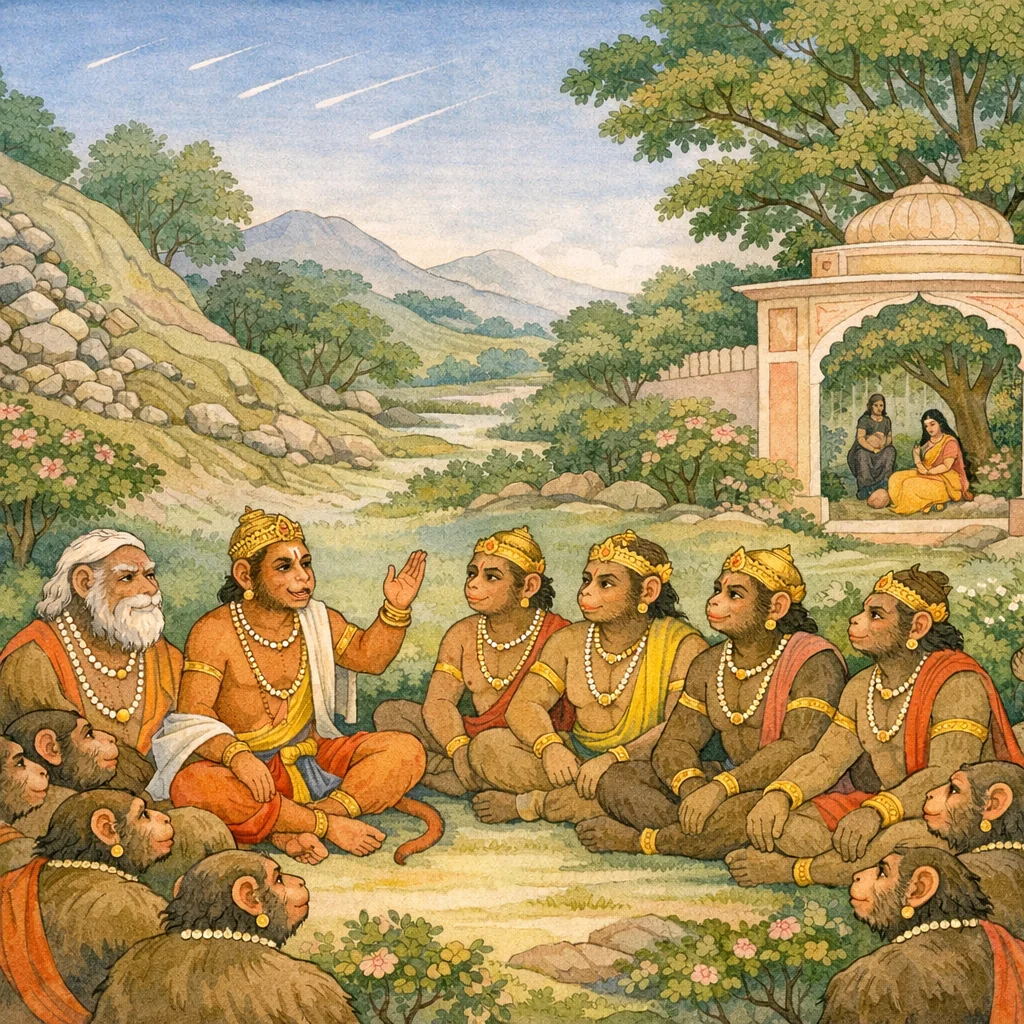
After completing his prior narration, Hanumān resumes with an expanded operational report to the senior vanaras led by Jāmbavān. He asserts capability to destroy Laṅkā and Rāvaṇa’s forces, even if Indrajit deploys formidable divine missiles (brahmāstra, aindrāstra, raudrāstra, vāyavyāstra, vāruṇāstra), and requests permission to counter them with overwhelming force, including a “ceaseless shower of rocks.” The discourse then widens into a calibrated catalogue of vanara martial assets: Jāmbavān’s immovability, Vāli’s son as sufficient for annihilating demon hosts, the thigh-speed of Panasa and Nīla, and the near-invulnerability of Mainda and Dvivida (Aśvinī-kumāra lineage, boons of Brahmā, nectar-drinking). Hanumān also records his public proclamation in Laṅkā—Rāma’s victory and his own identity as the Kosala king’s servant—thereby framing the mission as dharma-driven psychological warfare. He concludes with a precise description of Sītā in Aśokavanikā beneath the Śiṃśupā tree: surrounded by rākṣasīs, emaciated, steadfastly devoted to Rāma, rejecting Rāvaṇa, and at times resolved upon death; yet she is pacified into trust when informed of the Rāma–Sugrīva alliance. A theological-ethical rationale is added: Sītā’s chastity-power could destroy Rāvaṇa, but she refrains, leaving his death to Rāma, and the assembly is urged to proceed with the necessary next steps.
Shlokas
Verse 1
एतदाख्याय तत्सर्वं हनुमान्मारुतात्मजः।भूयस्समुपचक्राम वचनं वक्तुमुत्तरम्।।।।
After relating all of this, Hanumān—the son of the Wind-god—again began to speak further words in reply.
Verse 2
सफलो राघवोद्योग स्सुग्रीवस्य च सम्भ्रमः।शीलमासाद्य सीताया मम च प्रवणं मनः।।।।
Rāma’s effort has borne fruit, and Sugrīva’s eager initiative too has proved effective. Having witnessed Sītā’s noble conduct, my own mind has become even more inclined in devoted resolve (toward her cause).
Verse 3
तपसा निर्दहेल्लोकान्क्रुद्धो वा निर्दहेदपि।सर्वधातिप्रवृद्धोऽसौ रावणो राक्षसाधिपः ॥ ॥
That lord of the rākṣasas—Rāvaṇa—has grown mighty through austerities; if angered, he could burn the worlds by the force of his penance.
Verse 4
तस्य तां स्पृशतो गात्रं तपसा न विनाशितम्।न तदग्निशिखा कुर्यात्संस्पृष्टा पाणिना सती।।।।जनकस्यात्मजा कुर्याद्यत्क्रोधकलुषीकृता।
Even when he touched her, her body did not destroy him—held back by the force of his austerities. For what even a flame could not accomplish by a mere touch of the hand, Janaka’s daughter could accomplish if her wrath were unleashed—yet she restrained it.
Verse 5
जाम्बवत्प्रमुखान् सर्वाननुज्ञाप्य महाहरीन्।।5.59.5।।अस्मिन्नेवं गते कार्ये भवतां च निवेदिते।न्याय्यं स्म सह वैदेह्या द्रष्टुं तौ पार्थिवात्मजौ।।5.59.6।।
Having taken leave of all the great vanara heroes led by Jāmbavān, and after this matter had thus been conveyed to you, it is proper that the two princes should meet Vaidehī (Sita) together.
Verse 6
जाम्बवत्प्रमुखान् सर्वाननुज्ञाप्य महाहरीन्।।5.59.5।।अस्मिन्नेवं गते कार्ये भवतां च निवेदिते।न्याय्यं स्म सह वैदेह्या द्रष्टुं तौ पार्थिवात्मजौ।।5.59.6।।
Now that this task has reached this point and has been reported to you, it is only right that the two princes—Rāma and Lakṣmaṇa—should meet Vaidehī (Sītā) in person.
Verse 7
अहमेकोऽपि पर्याप्तस्सराक्षसगणां पुरीम्।तां लङ्कां तरसा हन्तुं रावणं च महाबलम्।।5.59.7।।
Even alone, I am sufficient to swiftly destroy that city of Laṅkā along with its hosts of rākṣasas—and to slay the mighty Rāvaṇa as well.
Verse 8
किं पुन स्सहितो वीरैर्बलवद्भिः कृतात्मभिः।कृतास्त्रै: प्लवगैश्शूरैर्भवद्भिविजयैषिभिः।।।।
How much more, then, when I am accompanied by heroes like you—strong, disciplined, weapon-skilled, and eager for victory?
Verse 9
अहं तु रावणं युद्धे ससैन्यं सपुरस्सरम्।सहपुत्त्रं वधिष्यामि सहोदरयुतं युधि।।।।
For my part, in battle I can slay Rāvaṇa—along with his army, his attendants, his sons, and his brothers—there on the field.
Verse 10
ब्राह्ममैन्द्रं च रौद्रं च वायव्यं वारणं तथा।यदि शक्रजितोऽस्त्राणि दुर्निरीक्षाणि संयुगे।।।।तान्यहं वधिष्यामि हनिष्यामि च राक्षसान्।
“Even if Indrajit employs in battle those hard-to-behold divine weapons—Brahmā’s, Indra’s, Rudra’s, the Wind-god’s, and Varuṇa’s—I will neutralize them and slay the Rākṣasas.”
Verse 11
भवतामभ्यनुज्ञातो विक्रमो मे रुणद्धि तम्।।।।मयातुला विसृष्टा हि शैलवृष्टिर्निरन्तरा।देवानपि रणे हन्यात्किं पुनस्तान्निशाचरान्।।।।
If you grant permission, my own prowess will check them and crush them. For the unceasing shower of rocks I can hurl in battle would be enough to slay even gods—how much more, then, those night-roaming rākṣasas.
Verse 12
भवतामभ्यनुज्ञातो विक्रमो मे रुणद्धि तम्।।5.59.11।।मयातुला विसृष्टा हि शैलवृष्टिर्निरन्तरा।देवानपि रणे हन्यात्किं पुनस्तान्निशाचरान्।।5.59.12।।
With your permission, my valor will hold them back and shatter them. The ceaseless rain of rocks I can unleash in battle could destroy even the gods—how much more those rākṣasas who roam by night.
Verse 13
सागरोऽप्यतियाद्वेलां मन्दरः प्रचलेदपि।न जाम्बवन्तं समरे कम्पयेदरिवाहिनी।।।।
Even if the ocean were to overstep its shore, even if Mount Mandara were to quake—no hostile host could make Jāmbavān tremble in battle.
Verse 14
सर्वराक्षससङ्घानां राक्षसा ये च पूर्वकाः।अलमेको विनाशाय वीरो वालिसुतः कपिः।।5.59.14।।
For the destruction of all the rākṣasa hordes—even those led by their foremost champions—the heroic monkey, Vāli’s son (Aṅgada), alone is sufficient.
Verse 15
पनसस्योरुवेगेन नीलस्य च महात्मनः।मन्दरोऽप्यवशीर्येत किंपुनर्युधि राक्षसाः।।।
By the tremendous force of Panasa—and of the great-souled Nīla—the very Mandara mountain could be shattered; how much more, then, the rākṣasas in battle?
Verse 16
सदेवासुरयक्षेषु गन्धर्वोरगपक्षिषु।मैन्दस्य प्रतियोद्धारं शंसत द्विविदस्य वा।।।।
Among gods, asuras, yakṣas—among gandharvas, nāgas, and even birds—tell me: who could stand as an opponent in battle to Mainda, or to Dvivida?
Verse 17
अश्विपुत्रौ महाभागावेतौ प्लवगसत्तमौ।एतयोः प्रतियोद्दारं न पश्यामि रणाजिरे।।।।
These two, the sons of the Aśvins, are greatly illustrious—the finest among the vānara warriors. On the battlefield, I see no one who could truly stand against them.
Verse 18
पितामहवरोत्सेकात्परमं दर्पमास्थितौ।अमृतप्राशिनावेतौ सर्ववानरसत्तमौ।।।।
Elated by the boons granted by the Grandsire, they stand in the height of confidence. These two have drunk nectar, and they are the foremost among all vānara warriors.
Verse 19
अश्विनोर्माननार्थं हि सर्वलोकपितामहः।सर्वावध्यत्वमतुलमनयोर्दत्तवान्पुरा।।।।
Indeed, to honor the Aśvins, the Grandsire of all worlds long ago bestowed upon these two an incomparable invulnerability—immunity from being slain by any.
Verse 20
वरोत्सेकेन मत्तौ च प्रमथ्य महतीं चमूम्।सुराणाममृतं वीरौ पीतवन्तौ प्लवङ्गमौ।।।।
Those two heroic monkeys, exultant with the pride of their boons and as if intoxicated thereby, crushed a vast host and drank the gods’ nectar of immortality.
Verse 21
एतावेव हि सङ्कृद्धौ सवाजिरथकुञ्जराम्।लङ्कां नाशयितुं शक्तौ सर्वे तिष्ठन्तु वानराः।।।।
Indeed, if only these two become enraged, they are capable of destroying Lanka together with its horses, chariots, and elephants—even if all the other Vanaras were to stand aside.
Verse 22
मयैव निहता लङ्का दग्धा भस्मीकृता पुनः।राजमार्गेषु सर्वत्र नाम विश्रावितं मया।।।।
By me alone Lanka was struck down—burned and again reduced to ashes; and along the royal highways everywhere, my name was proclaimed.
Verse 23
जयत्यतिबलो रामो लक्ष्मणश्च महाबलः।राजा जयति सुग्रीवो राघवेणाभिपालितः।।।।अहं कोसलराजस्य दासः पवनसम्भवः।हनुमानिति सर्वत्र नाम विश्रावितं मया।।।।
Victory to mighty Rama, and to great-armed Lakshmana; victory to King Sugriva, protected by Raghava. I am the servant of the king of Kosala, born of the Wind—Hanuman: thus everywhere I made my name known.
Verse 24
जयत्यतिबलो रामो लक्ष्मणश्च महाबलः।राजा जयति सुग्रीवो राघवेणाभिपालितः।।5.59.23।।अहं कोसलराजस्य दासः पवनसम्भवः।हनुमानिति सर्वत्र नाम विश्रावितं मया।।5.59.24।।
Victory to mighty Rama, and to great-armed Lakshmana; victory to King Sugriva, protected by Raghava. I am the servant of the king of Kosala, born of the Wind—Hanuman: thus everywhere I made my name known.
Verse 25
अशोकवनिकामध्ये रावणस्य दुरात्मनः।अध स्ताच्छिंशुपावृक्षे साध्वी करुणमास्थिता।।।।राक्षसीभिः परिवृता शोकसंतापकर्शिता।मेघलेखापरिवृता चन्द्रलेखेव निष्प्रभा।।।।।अचिन्तयन्ती वैदेही रावणं बलदर्पितम्।
In the midst of the wicked Ravana’s Ashoka grove, beneath the śiṃśupā tree, the noble lady sat in a pitiable state—surrounded by rākṣasīs, worn down by grief and torment, like a moonbeam dimmed by veils of cloud—giving no thought to Ravana, swollen with the pride of power.
Verse 26
अशोकवनिकामध्ये रावणस्य दुरात्मनः।अध स्ताच्छिंशुपावृक्षे साध्वी करुणमास्थिता।।5.59.25।।राक्षसीभिः परिवृता शोकसंतापकर्शिता।मेघलेखापरिवृता चन्द्रलेखेव निष्प्रभा।।5.59.26।।।अचिन्तयन्ती वैदेही रावणं बलदर्पितम्।
In the midst of the wicked Ravana’s Ashoka grove, beneath the śiṃśupā tree, the noble lady sat in a pitiable state—surrounded by rākṣasīs, worn down by grief and torment, like a moonbeam dimmed by veils of cloud—giving no thought to Ravana, swollen with the pride of power.
Verse 27
पतिव्रता च सुश्रोणी अवष्टब्धा च जानकी।।।।अनुरक्ता हि वैदेही रामं सर्वात्मना शुभा।अनन्यचित्ता रामे च पौलोमीव पुरन्दरे।।।।
Janaki—chaste and fair-hipped—though restrained, remained auspicious; Vaidehi was devoted to Rama with her whole being, her mind fixed on him alone, like Paulomi (Śacī) upon Purandara (Indra).
Verse 28
पतिव्रता च सुश्रोणी अवष्टब्धा च जानकी।।5.59.27।।अनुरक्ता हि वैदेही रामं सर्वात्मना शुभा।अनन्यचित्ता रामे च पौलोमीव पुरन्दरे।।5.59.28।।
Janaki—chaste and fair-hipped—though restrained, remained auspicious; Vaidehi was devoted to Rama with her whole being, her mind fixed on him alone, like Paulomi (Śacī) upon Purandara (Indra).
Verse 29
तदेकवासस्संवीता रजोध्वस्ता तथैव च।शोकसन्तापदीनाङ्गी सीता भर्तृहिते रता।।।।
Clad in that single garment alone, dust-covered as before, Sita—her body weakened by grief and anguish—remained intent upon her husband’s welfare.
Verse 30
सा मया राक्षसीमध्ये तर्ज्यमाना मुहुर्मुहुः।राक्षसीभिर्विरूपाभिर्दृष्टा हि प्रमदावने।।।।एकवेणीधरा दीना भर्तृचिन्तापरायणा।अधश्शय्या विवर्णाङ्गी पद्मिनीव हिमागमे।।।।रावणाद्विनिवृत्तार्था मर्तव्यकृतनिश्चया।
I saw her in the pleasure-grove, surrounded by rākṣasīs—again and again threatened by those hideous ogresses. With her hair in a single braid, wretched and wholly absorbed in thoughts of her husband, she lay upon the bare ground, her body drained of lustre like a lotus in winter. Rejecting Ravana’s advances, she had resolved upon death.
Verse 31
सा मया राक्षसीमध्ये तर्ज्यमाना मुहुर्मुहुः।राक्षसीभिर्विरूपाभिर्दृष्टा हि प्रमदावने।।5.59.30।।एकवेणीधरा दीना भर्तृचिन्तापरायणा।अधश्शय्या विवर्णाङ्गी पद्मिनीव हिमागमे।।5.59.31।।रावणाद्विनिवृत्तार्था मर्तव्यकृतनिश्चया।
I saw her in the pleasure-grove, surrounded by rākṣasīs—again and again threatened by those hideous ogresses. With her hair in a single braid, wretched and wholly absorbed in thoughts of her husband, she lay upon the bare ground, her body drained of lustre like a lotus in winter. Rejecting Ravana’s advances, she had resolved upon death.
Verse 32
कथञ्चिन्मृगशाबाक्षी विश्वासमुपपादिता।।।।ततः संभाषिता चैव सर्वमर्थं च दर्शिता।रामसुग्रीवसख्यं च श्रुत्वा प्रीतिमुपागता।।।।
With difficulty I won the fawn-eyed lady’s trust. Then I spoke with her and conveyed the whole matter, and when she heard of Rama’s alliance with Sugriva, she became glad.
Verse 33
कथञ्चिन्मृगशाबाक्षी विश्वासमुपपादिता।।5.59.32।।ततः संभाषिता चैव सर्वमर्थं च दर्शिता।रामसुग्रीवसख्यं च श्रुत्वा प्रीतिमुपागता।।5.59.33।।
Because she is disciplined in conduct and possesses supreme devotion to her husband, that great-souled woman does not slay Daśagrīva, even though he has wronged her.
Verse 34
नियतस्समुदाचारो भक्तिर्भर्तरि चोत्तमा।यन्न हन्ति दशग्रीवं सा महात्मा कृतागसम्।।।।
Because she is disciplined in conduct and possesses supreme devotion to her husband, that great-souled woman does not slay Daśagrīva, even though he has wronged her.
Verse 35
निमित्तमात्रं रामस्तु वधे तस्य भविष्यति।सा प्रकृत्यैव तन्वङ्गी तद्वियोगाच्च कर्शिता।।।।प्रतिपत्पाठशीलस्य विद्येव तनुमतां गता।
Rama will be but the instrument of his death. As for her—slender by nature and further emaciated by separation from him—she has grown thin like learning in a student who studies only on the first day (and then neglects it).
Verse 36
एवमास्ते महाभागा सीता शोकपरायणा।।।।यदत्र प्रतिकर्तव्यं तत्सर्वमुपपाद्यताम्।
Thus does the noble Sita remain, wholly given over to grief. Therefore, let everything that must be done in this matter be set in motion.
Frequently Asked Questions
The sarga articulates why Sītā, though portrayed as possessing chastity-derived power sufficient to destroy Rāvaṇa, does not kill him herself: she preserves maryādā by reserving that act for her husband Rāma, maintaining rightful agency and the ethical order of retribution.
Strength is subordinated to dharma: Hanumān’s confidence in force (even against unseen astras) is repeatedly framed by permission, proper roles, and truthful reporting—teaching that victory in itihāsa is legitimized by disciplined devotion and ethical restraint, not power alone.
Aśokavanikā (the grove within Laṅkā) and the Śiṃśupā tree function as precise cartographic anchors for Sītā’s location, while the royal roads of Laṅkā mark Hanumān’s public proclamation as a cultural-psychological intervention within the enemy capital.