Sarga 57
सप्तपञ्चाशः सर्गः — Hanumān’s Return, Roar of Success, and the Announcement “Sītā Seen”
सुन्दरकाण्ड
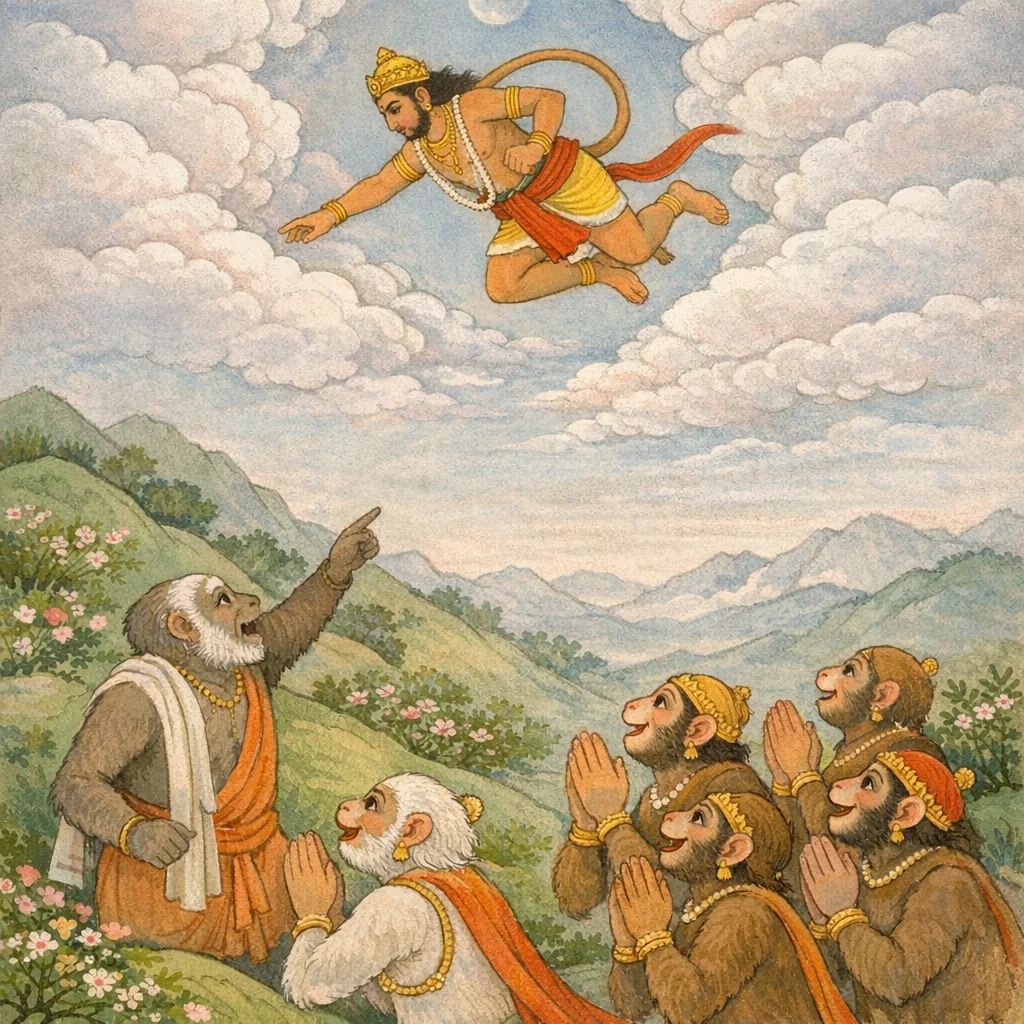
Sarga 57 narrates Hanumān’s return flight from Laṅkā toward the northern shore, rendered through a sustained astronomical-oceanic simile: the sky becomes an ‘ocean’ with Moon and Sun as lotuses and waterfowl, constellations as aquatic life, clouds as shoreline vegetation, and wind-made billows as waves. Hanumān repeatedly appears and disappears within cloud-masses, likened to the Moon veiled and revealed. His roar—compared to thunder—signals success even before visual contact, prompting the waiting vānaras to shift from dejection to eager anticipation. Jāmbavān infers accomplishment from the quality of the sound, articulating an evidentiary logic: such a triumphant nāda would not arise from failure. Hanumān lands on Mahendra mountain, is received with offerings and salutations, and then delivers the decisive, compressed report: “dṛṣṭā sītā”—Sītā has been seen—followed by brief descriptive markers of her condition in Aśokavanikā under rākṣasī guard. The sarga closes with communal rejoicing and readiness to hear the full operational account of Laṅkā, Sītā, and Rāvaṇa.
Shlokas
Verse 1
स चन्द्रकुमुदं रम्यं सार्ककारण्डवं शुभम्।तिष्यश्रवणकादम्बमभ्रशैवालशाद्वलम्।।।।पुनर्वसुमहामीनं लोहिताङ्गमहाग्रहम्।ऐरावतमहाद्वीपं स्वातिहंसविलोलितम्।।।।वातसङ्घातजातोर्मि चन्द्रांशुशिशिराम्बुमत्।भुजङ्गयक्षगन्धर्वप्रबुद्धकमलोत्पलम्।।।।हनुमान्मारुतगतिर्महानौरिव सागरम्।अपारमपरिश्रान्तः पुप्लुवे गगनार्णवम् ।।।।
Hanumān, swift as the Wind, unwearied, leapt across the sky-ocean as though a great ship were crossing the sea—where the moon shone like a white lotus, the sun like a waterfowl, auspicious stars like swans, clouds like floating weeds and grassy banks, constellations and planets like fish and crocodiles, and bright assemblies like fully blossomed lotuses.
Verse 2
स चन्द्रकुमुदं रम्यं सार्ककारण्डवं शुभम्।तिष्यश्रवणकादम्बमभ्रशैवालशाद्वलम्।।5.57.1।।पुनर्वसुमहामीनं लोहिताङ्गमहाग्रहम्।ऐरावतमहाद्वीपं स्वातिहंसविलोलितम्।।5.57.2।।वातसङ्घातजातोर्मि चन्द्रांशुशिशिराम्बुमत्।भुजङ्गयक्षगन्धर्वप्रबुद्धकमलोत्पलम्।।5.57.3।।हनुमान्मारुतगतिर्महानौरिव सागरम्।अपारमपरिश्रान्तः पुप्लुवे गगनार्णवम् ।।5.57.4।।
Hanumān, swift as the Wind, tireless, leapt across the sky as though it were an ocean crossed by a vast ship—an ocean whose moon was like a white lotus, whose sun was like a waterfowl, whose auspicious stars were like swans, whose clouds were like water-weeds and green banks; where Punarvasu was like a great fish, Mars like a mighty crocodile, Airāvata like a great island, and Svātī like a swan gliding—its billows raised by gusts, its waters cool as moonbeams, and its lotuses awakened like nāgas, yakṣas, and gandharvas.
Verse 3
स चन्द्रकुमुदं रम्यं सार्ककारण्डवं शुभम्।तिष्यश्रवणकादम्बमभ्रशैवालशाद्वलम्।।5.57.1।।पुनर्वसुमहामीनं लोहिताङ्गमहाग्रहम्।ऐरावतमहाद्वीपं स्वातिहंसविलोलितम्।।5.57.2।।वातसङ्घातजातोर्मि चन्द्रांशुशिशिराम्बुमत्।भुजङ्गयक्षगन्धर्वप्रबुद्धकमलोत्पलम्।।5.57.3।।हनुमान्मारुतगतिर्महानौरिव सागरम्।अपारमपरिश्रान्तः पुप्लुवे गगनार्णवम् ।।5.57.4।।
Across that ‘ocean of sky’ Hanumān—moving with the speed of the wind—leapt on without weariness, as a great ship crosses the sea. The heavens seemed like waters cooled by moonbeams, with billows raised by gusting winds, and with Nāgas, Yakṣas, and Gandharvas like fully awakened lotuses and water-lilies.
Verse 4
स चन्द्रकुमुदं रम्यं सार्ककारण्डवं शुभम्।तिष्यश्रवणकादम्बमभ्रशैवालशाद्वलम्।।5.57.1।।पुनर्वसुमहामीनं लोहिताङ्गमहाग्रहम्।ऐरावतमहाद्वीपं स्वातिहंसविलोलितम्।।5.57.2।।वातसङ्घातजातोर्मि चन्द्रांशुशिशिराम्बुमत्।भुजङ्गयक्षगन्धर्वप्रबुद्धकमलोत्पलम्।।5.57.3।।हनुमान्मारुतगतिर्महानौरिव सागरम्।अपारमपरिश्रान्तः पुप्लुवे गगनार्णवम् ।।5.57.4।।
Hanumān, swift as the Wind, tireless, crossed the boundless sky-ocean—like a great ship traversing the sea.
Verse 5
ग्रसमान इवाकाशं ताराधिपमिवोल्लिखन्।हरन्निव सनक्षत्रं गगनं सार्कमण्डलम्।।।।मारुतस्यात्मजः श्रीमान्कपिर्व्योमचरो महान्।हनुमान्मेघजालानि विकर्षन्निव गच्छति।।।।
That glorious Hanumān—the great monkey, son of Māruta, moving through the sky—went on as though swallowing space, as though scraping the moon, as though seizing the star-filled heavens with the sun’s sphere, and as though pulling along banks of clouds.
Verse 6
ग्रसमान इवाकाशं ताराधिपमिवोल्लिखन्।हरन्निव सनक्षत्रं गगनं सार्कमण्डलम्।।5.57.5।।मारुतस्यात्मजः श्रीमान्कपिर्व्योमचरो महान्।हनुमान्मेघजालानि विकर्षन्निव गच्छति।।5.57.6।।
This is a carried-over/duplicated presentation of the same poetic description of Hanumān’s flight: he moves through the sky with overwhelming speed and power, as though swallowing space and drawing clouds behind him.
Verse 7
पाण्डुरारुणवर्णानि नीलमाञ्जिष्ठकानि च।हरितारुणवर्णानि महाभ्राणि चकाशिरे।।।।
The great clouds shone forth in varied hues—pale and ruddy, blue and deep red, and greenish-red—brilliantly displaying their colors.
Verse 8
प्रविशन्नभ्रजालानि निष्पतंश्च पुनः पुनः।प्रच्छन्नश्च प्रकाशश्च चन्द्रमा इव लक्ष्यते।।।।
As he repeatedly entered the banks of clouds and emerged again and again—now hidden, now shining—he appeared like the moon.
Verse 9
विविधाभ्रघनापन्नगोचरो धवलाम्बरः।दृश्यादृश्यतनुर्वीरस्तदा चन्द्रायतेऽम्बरे।।।।
Moving through dense and varied cloud-masses, in the bright-white sky, the heroic one—his body appearing and vanishing—then looked like the moon in the heavens.
Verse 10
तार्क्ष्यायमाणो गगने बभासे वायुनन्दनः।दारयन्मेघबृन्दानि निष्पतंश्च पुनः पुनः।।।।नदन्नादेन महता मेघस्वनमहास्वनः।
The son of the Wind shone in the sky like Garuḍa, cleaving through clusters of clouds—vanishing and reappearing again and again—while roaring loudly like thunderclouds.
Verse 11
प्रवरान्राक्षसान् हत्वा नाम विश्राव्य चात्मनः।।।।आकुलां नगरीं कृत्वा व्यथयित्वा च रावणम्।अर्दयित्वा बलं घोरं वैदेहीमभिवाद्य च।।।।आजगाम महातेजाः पुनर्मध्येन सागरम्।
Having slain eminent Rākṣasas and made his own name widely known, having thrown the city into turmoil and pained Rāvaṇa by crushing his fierce forces, the mighty Hanumān saluted Vaidehī and set out again across mid-ocean.
Verse 12
प्रवरान्राक्षसान् हत्वा नाम विश्राव्य चात्मनः।।5.57.11।।आकुलां नगरीं कृत्वा व्यथयित्वा च रावणम्।अर्दयित्वा बलं घोरं वैदेहीमभिवाद्य च।।5.57.12।।आजगाम महातेजाः पुनर्मध्येन सागरम्।
Having slain eminent Rākṣasas and spread the fame of his own name, having thrown the city into confusion and distressed Rāvaṇa by crushing his dreadful forces, the radiant Hanumān saluted Vaidehī and proceeded again across mid-ocean.
Verse 13
पर्वतेन्द्रं सुनाभं च समुपस्पृश्य वीर्यवान्।।।।ज्यामुक्त इव नाराचो महावेगोऽभ्युपागतः।
The mighty one brushed past the lordly mountain Sunābha, and then surged forward at great speed like an arrow released from the bowstring.
Verse 14
स किञ्चिदनुसम्प्राप्तः समालोक्य महागिरिम्।।।।महेन्द्रं मेघसङ्काशं ननाद हरिपुङ्गवः।
When he had drawn a little nearer and beheld the great mountain Mahendra, cloud-like in appearance, that foremost of monkeys let out a triumphant roar.
Verse 15
स पूरयामास कपिर्दिशो दश समन्ततः।।।।नदन्नादेन महता मेघस्वनमहास्वनः।
Roaring with a mighty, thundercloud-like sound, the monkey filled all ten directions on every side.
Verse 16
स तं देशमनुप्राप्तः सुहृद्धर्शनलालसः।।।।ननाद हरिशार्दूलो लाङ्गूलं चाप्यकम्पयत्।
Reaching that place and longing to see his friends, the tiger among monkeys roared aloud and shook his tail as well.
Verse 17
तस्य नानद्यमानस्य सुपर्णचरिते पथि।।।।फलतीवास्य घोषेण गगनं सार्कमण्डलम्।
As he roared along the path trodden by Suparṇa (Garuḍa), the sky—together with the sun’s sphere—seemed, by that sound, as though it would split apart.
Verse 18
ये तु तत्रोत्तरे तीरे समुद्रस्य महाबलाः।।।।पूर्वं संविष्ठिताश्शूरा वायुपुत्रदिदृक्षवः।महतो वातनुन्नस्य तोयदस्येव गर्जितम्।।।।शुश्रुवुस्ते तदा घोषमूरुवेगं हनूमतः।
Then those brave, mighty vānaras who had been waiting earlier on the ocean’s northern shore, eager to see Vāyu’s son, heard Hanumān’s roar—like the thunder of a great storm-cloud driven by wind—rising from the tremendous speed of his thighs as he rushed onward.
Verse 19
ये तु तत्रोत्तरे तीरे समुद्रस्य महाबलाः।।5.57.18।।पूर्वं संविष्ठिताश्शूरा वायुपुत्रदिदृक्षवः।महतो वातनुन्नस्य तोयदस्येव गर्जितम्।।5.57.19।।शुश्रुवुस्ते तदा घोषमूरुवेगं हनूमतः।
Those mighty, heroic vānaras, already stationed on the ocean’s northern bank and longing to see Vāyu’s son, heard at that moment Hanumān’s great roar—like the thunder of a wind-driven rain-cloud—born of the force and speed of his rushing limbs.
Verse 20
ते दीनमनसस्सर्वे शुश्रुवुः काननौकसः।।।।वानरेन्द्रस्य निर्घोषं पर्जन्यनिनदोपमम्।
All those forest-dwelling vānaras, heavy-hearted, heard the mighty sound of their leader—like the rumble of thunderclouds.
Verse 21
निशम्य नदतो नादं वानरास्ते समन्ततः।।।।बभूवुरुत्सुकास्सर्वे सुहृद्धर्शनकाङ्क्षिणः।
Hearing that resounding cry, the vānaras all around became eager, longing to see their friend.
Verse 22
जाम्बवान् स हरिश्रेष्ठः प्रीतिसंहृष्टमानसः।।।।उपामन्त्र्य हरीन् सर्वानिदं वचनमब्रवीत्।
Then Jāmbavān, foremost among the vānaras, his heart uplifted with joy, called all the monkeys together and spoke these words.
Verse 23
सर्वथा कृतकार्योऽसौ हनुमान्नात्र संशयः।।।।न ह्यस्याकृतकार्यस्य नाद एवंविधो भवेत्।
“Hanumān has surely accomplished his task—there is no doubt. For if his work were unfinished, such a cry as this would not arise from him.”
Verse 24
तस्य बाहूरुवेगं च निनादं च महात्मनः।।।।निशम्य हरयो हृष्टाः समुत्पेतुस्ततस्ततः।
Hearing the great-souled one’s rushing force—of arms and thighs—and his resounding cry, the vānaras, delighted, sprang up here and there in joy.
Verse 25
ते नगाग्रान्नगाग्राणि शिखराच्छिखराणि च।।।।प्रहृष्टाः समपद्यन्त हनूमन्तं दिदृक्षवः।
Rejoicing, and eager to behold Hanumān, they sprang from one treetop to another, and from one mountain-peak to the next.
Verse 26
ते प्रीताः पादपाग्रेषु गृह्य शाखाः सुविष्ठिताः।।।।वासांसीव प्रशाखाश्च समाविध्यन्त वानराः।
Delighted, the vānaras took their places on the treetops, grasped the branches, and shook the spreading boughs as though they were garments being waved in welcome.
Verse 27
गिरिगह्वरसंलीनो यथा गर्जति मारुतः।।।।एवं जगर्ज बलवान् हनुमान्मारुतात्मजः।
Hanumān, the mighty son of the Wind-god, roared—like the wind thundering when confined within mountain caverns.
Verse 28
तमभ्रघनसङ्काशमापतन्तं महाकपिम्।।।।दृष्ट्वा ते वानरास्सर्वे तस्थुः प्राञ्जलयस्तदा।
Seeing that great monkey rushing in, resembling a dense mass of cloud, all the Vānaras then stood with folded hands.
Verse 29
ततस्तु वेगवांस्तस्य गिरेर्गिरिनिभः कपिः।।।।निपपात महेन्द्रस्य शिखरे पादपाकुले।
Then that swift monkey, mountain-like in form, descended upon the tree-filled summit of Mount Mahendra.
Verse 30
हर्षेणापूर्यमाणोऽसौ रम्ये पर्वतनिर्झरे।।।।छिन्नपक्ष इवाऽकाशात्पपात धरणीधरः।
Filled with joy, he dropped from the sky onto a lovely mountain-stream bank—like a wing-shorn mountain falling down.
Verse 31
ततस्ते प्रीतमनसस्सर्वे वानरपुङ्गवाः।।।।हनुमन्तं महात्मानं परिवार्योपतस्थिरे।परिवार्य च ते सर्वे परां प्रीतिमुपागताः।।।।
Then all the Vānara leaders, glad at heart, gathered around great-souled Hanumān and stood by him; and thus surrounding him, they were filled with the highest delight.
Verse 32
ततस्ते प्रीतमनसस्सर्वे वानरपुङ्गवाः।।5.57.31।।हनुमन्तं महात्मानं परिवार्योपतस्थिरे।परिवार्य च ते सर्वे परां प्रीतिमुपागताः।।5.57.32।।
Then all the Vānara leaders, joyful at heart, surrounded great-souled Hanumān and stood by him; and, gathered around him, they attained supreme happiness.
Verse 33
प्रहृष्टवदना स्सर्वे तमरोगमुपागतम्।उपायनानि चादाय मूलानि च फलानि च।।।।प्रत्यर्चयन् हरिश्रेष्ठं हरयो मारुतात्मजम्।
All the Vānaras, their faces bright with joy, seeing him returned unharmed, honored the Wind-god’s son—foremost among monkeys—offering gifts, roots, and fruits.
Verse 34
हनुमांस्तु गुरून् वृद्धाञ्जाम्बवत्प्रमुखांस्तदा।।।।कुमारमङ्गदं चैव सोऽवन्दत महाकपिः।
Then Hanumān, that great monkey, bowed to the elders and teachers—Jāmbavān at their head—and also saluted the young prince Aṅgada.
Verse 35
स ताभ्यां पूजितः पूज्यः कपिभिश्च प्रसादितः।।।।दृष्टा सीतेति विक्रान्त स्संक्षेपेण न्यवेदयत्।
Honored by those leaders and pleased also by the Vānaras, the valiant Hanumān reported succinctly: “Sītā has been seen.”
Verse 36
निषसाद च हस्तेन गृहीत्वा वालिनस्सुतम्।।।।रमणीये वनोद्देशे महेन्द्रस्य गिरेस्तदा।
Then, taking Vāli’s son by the hand, he sat down in a lovely wooded spot on Mount Mahendra.
Verse 37
हनुमानब्रवीद्धृष्टस्तदा तान्वानरर्षभान्।।।।अशोकवनिकासंस्था दृष्टा सा जनकात्मजा।रक्षमाणा सुघोराभी राक्षसीभिरनिन्दिता।।।।एकवेणीधरा बाला रामदर्शनलालसा।उपवासपरिश्रान्ता जटिला मलिना कृशा।।।।
Then Hanumān, delighted, spoke to those bull-like leaders among the vānaras: “I saw Janaka’s daughter Sītā in the Aśoka grove—blameless, yet guarded by very dreadful rākṣasīs. With a single braid, young and longing to see Rāma, she is worn down by fasting—hair matted, body soiled, and grown thin.”
Verse 38
हनुमानब्रवीद्धृष्टस्तदा तान्वानरर्षभान्।।5.57.37।।अशोकवनिकासंस्था दृष्टा सा जनकात्मजा।रक्षमाणा सुघोराभी राक्षसीभिरनिन्दिता।।5.57.38।।एकवेणीधरा बाला रामदर्शनलालसा।उपवासपरिश्रान्ता जटिला मलिना कृशा।।5.57.39।।
This verse line reiterates Hanumān’s report: Sītā, Janaka’s daughter, was seen in the Aśoka grove—blameless, but guarded by terrifying rākṣasīs.
Verse 39
हनुमानब्रवीद्धृष्टस्तदा तान्वानरर्षभान्।।5.57.37।।अशोकवनिकासंस्था दृष्टा सा जनकात्मजा।रक्षमाणा सुघोराभी राक्षसीभिरनिन्दिता।।5.57.38।।एकवेणीधरा बाला रामदर्शनलालसा।उपवासपरिश्रान्ता जटिला मलिना कृशा।।5.57.39।।
She wore a single braid; still young, she longed to see Rāma. Exhausted by fasting, with matted hair, soiled, and thin—such was her condition.
Verse 40
ततो दृष्टेति वचनं महार्थममृतोपमम्।निशम्य मारुतेस्सर्वे मुदिता वानराभवन्।।।।
Then, hearing Māruti’s words—“She has been seen”—so weighty and nectar-like, all the vānaras became joyful.
Verse 41
क्ष्वेलन्त्यन्ये नदन्त्यन्ये गर्जन्त्यन्ये महाबलाः।चक्रुः किलकिलामन्ये प्रतिगर्जन्ति चापरे।।।।
Some mighty vānaras howled, others chattered, others roared; some raised shrill cries, and others answered back with echoing roars.
Verse 42
केचिदुच्छ्रितलाङ्गूलाः प्रहृष्टाः कपिकुञ्जराः।आयताञ्चितदीर्घाणि लाङ्गूलानि प्रविव्यधुः।।।।
Some elephant-like monkeys, thrilled with joy, lifted their tails high and struck the ground with their long, fine tails.
Verse 43
अपरे च हनूमन्तं वानरा वारणोपमम्।आप्लुत्य गिरिशृङ्गेभ्यस्संस्पृशन्ति स्म हर्षिताः।।।।
Others, rejoicing, leapt down from the mountain peaks and embraced Hanumān, elephant-like in might.
Verse 44
उक्तवाक्यं हनूमन्तमङ्गदस्तमथाब्रवीत्।सर्वेषां हरिवीराणां मध्ये वचनमुत्तमम्।।।।
Then Aṅgada addressed Hanumān, whose words had been spoken; and, in the midst of all the monkey-heroes, he spoke an excellent reply.
Verse 45
सत्त्वे वीर्ये न ते कश्चित्समो वानर विद्यते।यदवप्लुत्य विस्तीर्णं सागरं पुनरागतः।।।।
O Vānara, none equals you in strength and valor, for you leapt across the vast ocean and returned again.
Verse 46
अहो स्वामिनि ते भक्तिरहो वीर्यमहो धृतिः।दिष्ट्या दृष्टा त्वया देवी रामपत्नी यशस्विनी।।।।दिष्ट्या त्यक्ष्यति काकुत्स्थ श्शोकं सीतावियोगजम्।
Ah—how great is your devotion to your lord; ah—your valor and your steadfast courage! By good fortune you have seen the illustrious queen, Rāma’s wife. By that same good fortune, the Kakutstha will cast off the grief born of separation from Sītā.
Verse 47
ततोऽङ्गदं हनूमन्तं जाम्बवन्तं च वानराः।।।।परिवार्य प्रमुदिता भेजिरे विपुलाश्शिलाः।
Then the vānaras, delighted, gathered around Aṅgada, Hanumān, and Jāmbavān, and in their joy took their places upon the broad rocks.
Verse 48
श्रोतुकामास्समुद्रस्य लङ्घनं वानरोत्तमाः।।।।दर्शनं चापि लङ्कायास्सीताया रावणस्य च।तस्थुः प्राञ्जलयस्सर्वे हनुमद्वचनोन्मुखाः।।।।
Eager to hear of the crossing of the ocean, and also of the sight of Laṅkā, of Sītā, and of Rāvaṇa, all the best of the vānaras stood with folded hands, their attention fixed on Hanumān’s words.
Verse 49
श्रोतुकामास्समुद्रस्य लङ्घनं वानरोत्तमाः।।5.57.48।।दर्शनं चापि लङ्कायास्सीताया रावणस्य च।तस्थुः प्राञ्जलयस्सर्वे हनुमद्वचनोन्मुखाः।।5.57.49।।
Eager to hear of the ocean-crossing and of what was seen in Laṅkā—Sītā and also Rāvaṇa—all the foremost vānaras stood with folded hands, focused on Hanumān’s words.
Verse 50
तस्थौ तत्राङ्गदः श्रीमान् वानरैर्बहुभिर्वृतः।उपास्यमानो विबुधैर्दिवि देवपतिर्यथा।।।।
There stood the splendid Aṅgada, surrounded by many vānaras, being attended like the lord of the gods in heaven attended by the celestials.
Verse 51
हनूमता कीर्तिमता यशस्विना तथाङ्गदेनाङ्गदबद्धबाहुना।मुदा तदाऽध्यासितमुन्नतं महन्महीधराग्रं ज्वलितं श्रियाभवत्।।।।
Then the lofty, great mountain-peak, joyfully occupied by the famed Hanumān and by the renowned Aṅgada—his arms adorned with armlets—shone with splendor.
Frequently Asked Questions
The pivotal action is truthful, disciplined reporting after a high-risk mission: Hanumān returns without fatigue, signals success without boasting, and delivers a concise, verifiable claim (“Sītā seen”), prioritizing mission integrity over self-display.
Success is communicated through reliable signs and accountable speech: Jāmbavān models inference grounded in observable evidence (the triumphant roar), while Hanumān models pramāṇa by giving the minimal decisive statement that transforms collective doubt into purposeful action.
Mahendra mountain on the northern shore serves as the rendezvous and morale-restoration site; Laṅkā and Aśokavanikā are referenced as operational targets; the ocean and sky are poetically mapped via nakṣatras (Svātī, Tiṣya, Śravaṇa, Punarvasu) and celestial bodies to frame the return journey.