Sarga 53
लाङ्गूलदाह-पर्यटनम् (The Burning Tail and the Parade through Laṅkā)
सुन्दरकाण्ड
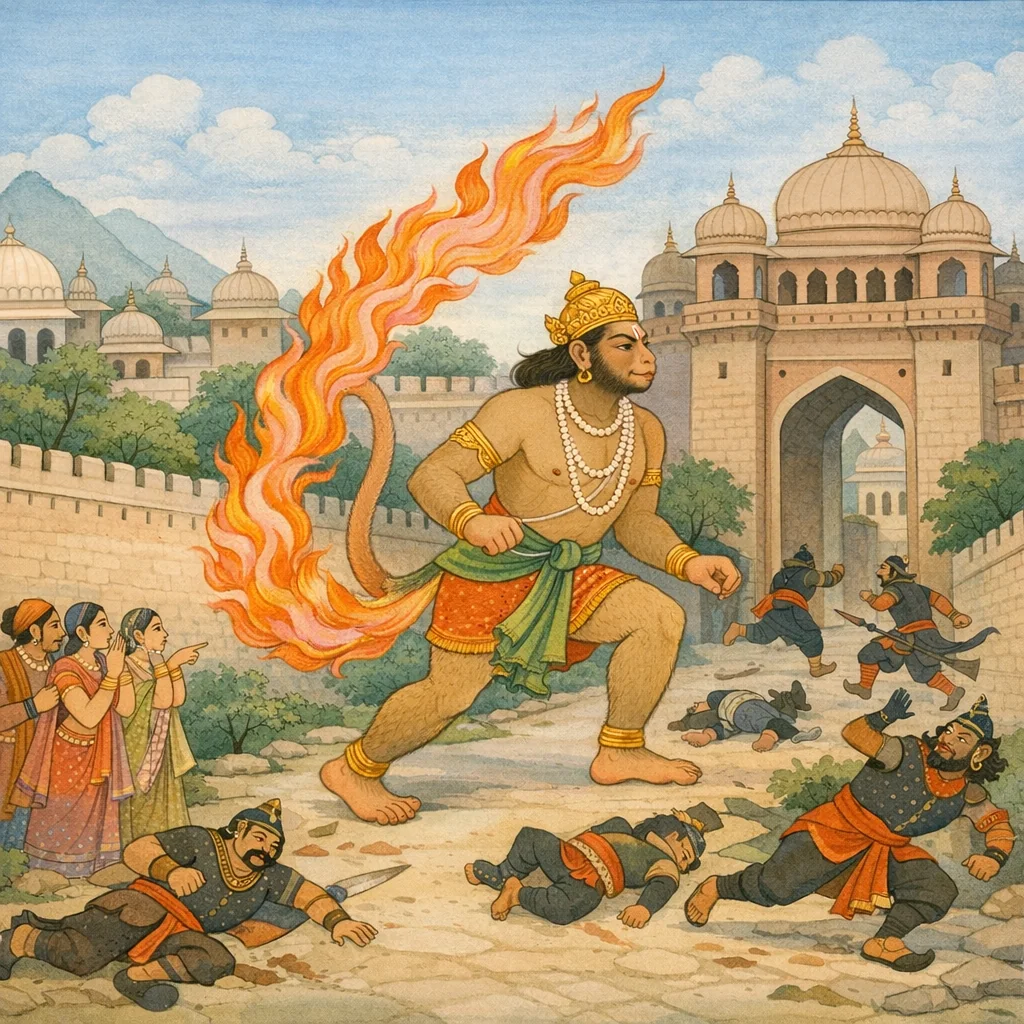
Sarga 53 stages a juridical-ethical and tactical sequence. Rāvaṇa, after hearing Vibhīṣaṇa’s counsel that killing an envoy is censured, orders a punishment short of execution: Hanumān’s tail—dear as an ornament to monkeys—is to be ignited and he is to be paraded across Laṅkā’s junctions and royal roads. Rakṣasas wrap the tail in cotton rags, soak it in oil, and set it aflame; crowds gather, and the city’s public space becomes a theater of state intimidation. Hanumān, bound again, performs situational reasoning: he can destroy the rakṣasas, yet endures humiliation to please Rāma and to re-observe Laṅkā’s fortifications by daylight. When Sītā hears the cruel report, she invokes the Fire-god with vows of fidelity and austerity, praying that the flames be cool to Hanumān; the fire indeed does not harm him, which Hanumān interprets as protection arising from Sītā’s virtue, Rāma’s tejas, and the Wind-god’s alliance. Reaching the city gate, Hanumān sheds bonds, enlarges his form, seizes an iron club near the archway, kills guards, and shines over Laṅkā like the sun garlanded with rays—poetically foreshadowing the coming conflagration and siege.
Shlokas
Verse 1
तस्य तद्वचनं श्रुत्वा दशग्रीवो महात्मनः।देशकालहितं वाक्यं भ्रातुरुत्तरमब्रवीत्।।5.53.1।।
Hearing those words—the timely, place-appropriate counsel of his great-souled brother—Daśagrīva (Rāvaṇa) replied in return.
Verse 2
सम्यगुक्तं हि भवता दूतवध्या विगर्हिता।अवश्यं तु वधादन्यः क्रियतामस्य निग्रहः।।5.53.2।।
What you have said is indeed right: the killing of an envoy is condemned. Yet some restraint must certainly be imposed on him—only, let it be a punishment other than death.
Verse 3
कपीनां किल लाङ्गूलमिष्टं भवति भूषणम्।तदस्य दीप्यतां शीघ्रं तेन दग्धेन गच्छतु।।5.53.3।।
“A monkey’s tail is said to be dear to him—indeed, it is his ornament. Set his tail alight at once, and let him go with that tail burning.”
Verse 4
ततः पश्यन्त्विमं दीनमङ्गवैरूप्यकर्शितम्।समित्रज्ञातयस्सर्वे बान्धवाः ससुहृज्जनाः।।5.53.4।।आज्ञापयद्राक्षसेन्द्रः पुरं सर्वं सचत्वरम्।लाङ्गूलेन प्रदीप्तेन रक्षोभिः परिणीयताम्।।5.53.5।।
“Then let all—friends, relatives, kinsmen, and close companions—look upon this wretch, maimed and disfigured.” Thus ordered the lord of rākṣasas: “Take him around the entire city, through its crossroads, with his tail set ablaze, escorted by the demons.”
Verse 5
ततः पश्यन्त्विमं दीनमङ्गवैरूप्यकर्शितम्।समित्रज्ञातयस्सर्वे बान्धवाः ससुहृज्जनाः।।5.53.4।।आज्ञापयद्राक्षसेन्द्रः पुरं सर्वं सचत्वरम्।लाङ्गूलेन प्रदीप्तेन रक्षोभिः परिणीयताम्।।5.53.5।।
Hearing his command, the rākṣasas—driven by savage anger—wrapped Hanumān’s tail with worn cotton rags.
Verse 6
तस्य तद्वचनं श्रुत्वा राक्षसाः कोपकर्शिताः।वेष्टयन्ति स्म लाङ्गूलं जीर्णैः कार्पासकैः पटैः।।5.53.6।।
Hearing his command, the rākṣasas—driven by savage anger—wrapped Hanumān’s tail with worn cotton rags.
Verse 7
संवेष्ट्यमाने लाङ्गूले व्यवर्धत महाकपिः।शुष्कमिन्धनमासाद्य वनेष्विव हुताशनः।।5.53.7।।
As his tail was being wrapped, the great monkey expanded in size—like a forest fire that flares up when it finds dry fuel in the woods.
Verse 8
तैलेन परिषिच्याथ तेऽग्निं तत्राभ्यपातयन्।लाङ्गूलेन प्रदीप्तेन राक्षसांस्तानपातयत्।।5.53.8।।रोषामर्षपरीतात्मा बालसूर्यसमाननः।
Then they drenched it with oil and set it alight. His face, like the rising sun, blazing with anger and indignation, Hanumān struck down those rākṣasas with his flaming tail.
Verse 9
लाङ्गूलं सम्प्रदीप्तं तु द्रष्टुं तस्य हनूमतः।।5.53.9।।सहस्त्रीबालवृद्धाश्च जग्मुः प्रीता निशाचराः।
To watch Hanumān’s tail fully ablaze, the night-roamers went out in delight—women, children, and the elderly along with them.
Verse 10
स भूयः सङ्गतैः क्रूरैर्राक्षसैर्हरिसत्तमः।।5.53.10।।निबद्धः कृतवान्वीरस्तत्कालसदृशीं मतिम्।
When the cruel rākṣasas gathered again and bound him once more, that heroic best of monkeys formed a resolve suited to the moment.
Verse 11
कामं खलु न मे शक्ता निबद्धस्यापि राक्षसाः।।5.53.11।।छित्त्वा पाशान् समुत्पत्य हन्यामहमिमान्पुनः।
Truly, these rākṣasas are not capable of holding me even when I am bound; cutting these bonds, I could leap up and kill them again.
Verse 12
यदि भर्तुर्हितार्थाय चरन्तं भर्तृशासनात्।।5.53.12।।बध्नन्त्येते दुरात्मनो न तु मे निष्कृतिः कृता।
If these wicked ones, acting under their master’s command, bind me while I move about for my lord’s welfare, then I will not grant them an easy escape from the consequences.
Verse 13
सर्वेषामेव पर्याप्तो राक्षसानामहं युधि।।5.53.13।।किंतु रामस्य प्रीत्यर्थं विषहिष्येऽहमीदृशम्।लङ्का चारयितव्या वै पुनरेव भवेदिति।।5.53.14।।
In battle I am sufficient to face all these rākṣasas; yet, for Rāma’s satisfaction, I will endure this kind of humiliation.
Verse 14
सर्वेषामेव पर्याप्तो राक्षसानामहं युधि।।5.53.13।।किंतु रामस्य प्रीत्यर्थं विषहिष्येऽहमीदृशम्।लङ्का चारयितव्या वै पुनरेव भवेदिति।।5.53.14।।
For in this way, I will surely gain the opportunity to move about Laṅkā once again and observe it further.
Verse 15
रात्रौ न हि सुदृष्टा मे दुर्गकर्मविधानतः।अवश्यमेव द्रष्टव्या मया लङ्का निशाक्षये।।5.53.15।।
At night I could not observe Laṅkā well with regard to its fortifications and defenses; therefore, when the night ends, I must certainly examine it again.
Verse 16
कामं बद्धस्य मे भूयः पुच्छस्योद्दीपनेन च।पीडां कुर्वन्तु रक्षांसि न मेऽस्ति मनसश्श्रमः।।5.53.16।।
Let the rākṣasas bind me again if they wish, and even torment me by setting my tail aflame—my mind feels no fatigue.
Verse 17
ततस्ते संवृताकारं सत्त्ववन्तं महाकपिम्।परिगृह्य ययुर्हृष्टा राक्षसाः कपिकुञ्जरम्।।5.53.17।।
Then those rākṣasas, delighted, seized the mighty great monkey—an elephant among monkeys—who had drawn his body in, and they set off with him.
Verse 18
शङ्खभेरीनिनादैस्तं घोषयन्तः स्वकर्मभिः।राक्षसाः क्रूरकर्माणश्चारयन्ति स्म तां पुरीम्।।5.53.18।।
With blasts of conches and the beating of drums, the rākṣasas—cruel in deed—proclaimed their ‘exploit’ and paraded him through that city.
Verse 19
अन्वीयमानो रक्षोभिर्ययौ सुखमरिन्दमः।हनुमांश्चारयामास राक्षसानां महापुरीम्।।5.53.19।।
Followed by the rākṣasas, Hanumān—the subduer of enemies—went along with ease, and thus traversed the great city of the rākṣasas.
Verse 20
अथापश्यद्विमानानि विचित्राणि महाकपिः।संवृतान् भूमिभागांश्च सुविभक्तांश्च चत्वरान्।।5.53.20।।
Then the great monkey saw wondrous mansions, securely enclosed stretches of ground, and squares laid out in orderly divisions.
Verse 21
वीथीश्च गृहसम्बाधाः कपिश्शृङ्गाटकानि च।तथा रथ्योपरथ्याश्च तथैव गृहकान्तरान्।।5.53.21।।गृहांश्च मेघसङ्काशान् ददर्श पवनात्मजः।
Pavana’s son saw streets crowded with houses, lofty junction-buildings and crossroads, main roads and side lanes, inner passages between houses, and dwellings that looked like clouds.
Verse 22
चत्वरेषु चतुष्केषु राजमार्गे तथैव च।।5.53.22।।घोषयन्ति कपिं सर्वे चारीक इति राक्षसाः।
At the squares, at the four-pillared junctions, and along the royal road, all the rākṣasas proclaim: “This monkey is a spy.”
Verse 23
स्त्रीबालवृद्धाः निर्जग्मुस्तत्र तत्र कुतूहलात्।।5.53.23।।तं प्रदीपितलाङ्गूलं हनुमन्तं दिदृक्षवः।
Driven by curiosity, women, children, and the aged came out here and there, eager to see Hanumān with his tail ablaze.
Verse 24
दीप्यमाने ततस्तत्र लाङ्गूलाग्रे हनूमतः।।5.53.24।।राक्षस्यस्ता विरूपाक्ष्य श्शंसुर्देव्यास्तदप्रियम्।
Then, when the tip of Hanumān’s tail was burning there, those ugly-eyed rākṣasī women reported that distressing news to the lady (Sītā).
Verse 25
यस्त्वया कृतसंवाद स्सीते ताम्रमुखः कपिः।।5.53.25।।लाङ्गूलेन प्रदीप्तेन स एष परिणीयते।
“O Sītā, that copper-faced monkey who spoke with you—he is now being led around with his tail set on fire.”
Verse 26
श्रुत्वा तद्वचनं क्रूरमात्मापहरणोपमम्।।5.53.26।।वैदेही शोकसन्तप्ता हुताशनमुपागमत्।
Hearing those cruel words—painful like her own abduction—Vaidehī, scorched by grief, turned to (invoked) the Fire-god.
Verse 27
मङ्गलाभिमुखी तस्य सा तदाऽसीन्महाकपेः।।5.53.27।।उपतस्थे विशालाक्षी प्रयता हव्यवाहनम्।
Then the large-eyed lady, intent and composed, invoked Havyavāhana (Agni), turning her heart toward the great monkey’s welfare.
Verse 28
यद्यस्ति पतिशुश्रूषा यद्यस्ति चरितं तपः।यदि चास्त्येकपत्नीत्वं शीतो भव हनूमतः।।5.53.28।।
“If there is truth in my service to my husband, if there is truth in the austerity I have practiced, and if there is truth in my single-hearted fidelity—then, O Fire, be cool to Hanumān.”
Verse 29
यदि किञ्चिदनुक्रोशस्तस्य मय्यस्ति धीमतः।।5.53.29।।यदि वा भाग्यशेषो मे शीतो भव हनूमतः।
“If the wise Rāma has even a little compassion toward me—if any remnant of good fortune still remains for me—then, O Fire, be cool toward Hanumān.”
Verse 30
यदि मां वृत्तसम्पन्नां तत्समागमलालसाम्।।5.53.30।।स विजानाति धर्मात्मा शीतो भव हनूमतः।
“If that righteous-souled Rāma knows me to be of spotless conduct, longing only for reunion with him—then, O Fire, be cool toward Hanumān.”
Verse 31
यदि मां तारयेदार्यस्सुग्रीवः सत्यसङ्गरः।।5.53.31।।अस्माद्धुःखाम्बुसंरोधाच्छीतो भव हनूमतः।
“If the noble Sugrīva—true to his pledged battle—will rescue me from this flood of sorrow, then, O Fire, be cool toward Hanumān.”
Verse 32
ततस्तीक्ष्णार्चिरव्यग्रः प्रदक्षिणशिखोऽनलः।।5.53.32।।जज्वाल मृगशाबाक्ष्या श्शंसन्निव शिवं कपेः।
Then the fire—its sharp flames steady, its tongues of flame turning auspiciously—blazed as though assuring the fawn-eyed Sītā of the monkey’s safety.
Verse 33
हनुमज्जनकश्चापि पुच्छानलयुतोऽनिलः।।5.53.33।।ववौ स्वास्थ्यकरो देव्याः प्रालेयानिलशीतलः।
And Anila, Hanumān’s father, accompanied that fire upon the tail and blew—cool as a snow-laden breeze—bringing calm and well-being to the divine lady.
Verse 34
दह्यमाने च लाङ्गूले चिन्तयामास वानरः।।5.53.34।।प्रदीप्तोऽग्निरयं कस्मान्न मां दहति सर्वतः।
While his tail was burning, the monkey reflected: “This fire is blazing all around—why does it not burn me?”
Verse 35
दृश्यते च महाज्वालः करोति न च मे रुजम्।।5.53.35।।शिशिरस्येव सङ्घातो लाङ्गूलाग्रे प्रतिष्ठितः।
“Though a great flame is visible, it causes me no pain—like a mass of coolness, as if ice itself were resting on the tip of my tail.”
Verse 36
अथवा तदिदं व्यक्तं यद्दृष्टं प्लवता मया।।5.53.36।।रामप्रभावादाश्चर्यं पर्वत स्सरितां पतौ।
“Or else, this is now clear: that wonder I saw while leaping—the mountain rising in the Lord of rivers (the sea)—was due to Rāma’s power; so too is this.”
Verse 37
यदि तावत्समुद्रस्य मैनाकस्य च धीमतः।।5.53.37।।रामार्थं सम्भ्रमस्तादृक्किमग्निर्न करिष्यति।
“If the ocean and the wise Maināka could show such eager concern for Rāma’s cause, then what could Fire not do (for that same cause)?”
Verse 38
सीतायाश्चानृशंस्येन तेजसा राघवस्य च।।5.53.38।।पितुश्च मम सख्येन न मां दहति पावकः।
Because of Sītā’s compassionate chastity, Rāghava’s radiant power, and the friendship between my father and the Fire-god, the fire does not burn me.
Verse 39
भूयस्स चिन्तयामास मुहूर्तं कपिकुञ्जरः।।5.53.39।।उत्पपाताथ वेगेन ननाद च महाकपिः।
The great monkey—like an elephant among monkeys—pondered again for a moment; then he sprang up with speed and roared aloud.
Verse 40
पुरद्वारं ततश्श्रीमान् शैलशृङ्गमिवोन्नतम्।।5.53.40।।विभक्तरक्षस्सम्बाधमाससादानिलात्मजः।
Then the illustrious son of the Wind-god reached the city-gate, lofty like a mountain peak, after forcing his way through the press of rākṣasas.
Verse 41
स भूत्वा शैलसङ्काशः क्षणेन पुनरात्मवान्।।5.53.41।।ह्रस्वतां परमां प्राप्तो बन्धनान्यवशातयत्।
Having become mountain-like, and then in an instant regaining self-mastery, he shrank to a very small size and cast off his bonds.
Verse 42
विमुक्तश्चाभवछ्रचीमान् पुनः पर्वतसन्निभः।।5.53.42।।वीक्षमाणश्च ददृशे परिघं तोरणाश्रितम्।
Freed from restraint, the illustrious one again became mountain-like; looking about, he saw a heavy iron bar/club lying by the gateway-arch.
Verse 43
स तं गृह्य महाबाहुः कालायसपरिष्कृतम्।।5.53.43।।रक्षिणस्तान् पुनस्सर्वान्सूदयामास मारुतिः।
Grasping that iron bar fashioned of dark metal, the strong-armed Māruti again struck down all those guards.
Verse 44
स तान्निहत्त्वा रणचण्डविक्रम स्समीक्षमाणः पुनरेव लङ्काम्।प्रदीप्तलाङ्गूलकृतार्चिमाली प्रकाशतादित्य इवार्चिमाली।।5.53.44।।
After slaying them, Hanumān—terrible in battle—looked once more upon Laṅkā. With his blazing tail forming a garland of flames, he shone like the sun wreathed in rays.
Frequently Asked Questions
The state must punish an enemy emissary without violating dūta-dharma: Vibhīṣaṇa’s counsel rejects envoy-killing, and Rāvaṇa chooses a humiliating punitive spectacle (burning the tail) instead—raising questions of lawful restraint versus cruel deterrence.
Power becomes dharmic when governed by purpose and restraint: Hanumān can annihilate his captors but tolerates indignity to serve Rāma’s larger aim and to gather intelligence; Sītā’s ethical steadfastness is portrayed as protective force that cools destructive fire.
Laṅkā’s urban grid and civic spaces—crossroads (catvara), four-pillared altars (catuṣka), royal roads (rājamārga), streets, squares, the city gate (puradvāra), and an archway (toraṇa)—are enumerated to map the city as both fortified capital and public stage.