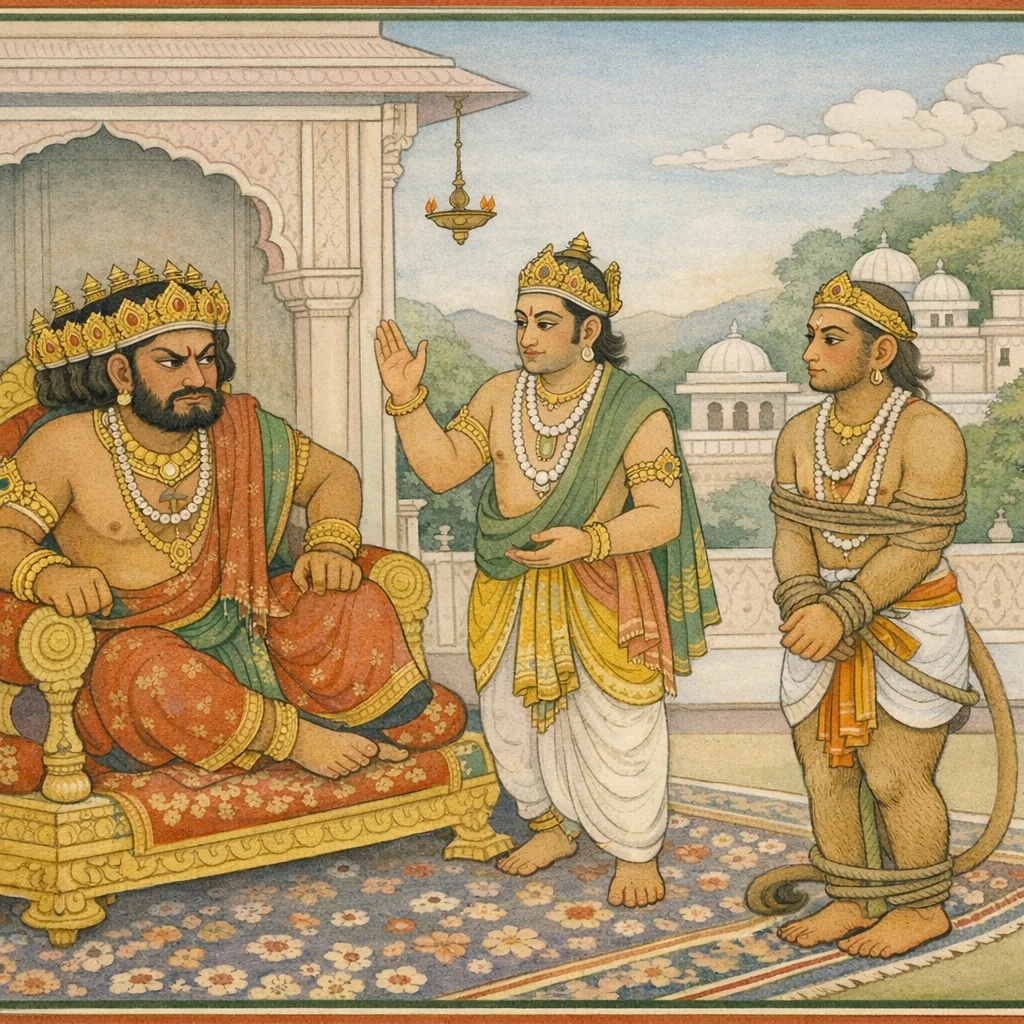
Sarga 50
रावण-प्रहस्त-हनूमद्वार्ता (Ravana and Prahasta Question Hanuman)
सुन्दरकाण्ड
Sarga 50 stages a court interrogation in Laṅkā. Rāvaṇa, angered yet inwardly uncertain, scrutinizes the radiant ‘tawny-eyed’ Vānara standing before him and privately considers whether this figure could be a cursed-returned Nandī or another formidable being. He orders his minister Prahasta to question the captive about origin, motive, the destruction of the royal garden, and the intimidation of rākṣasī guards. Prahasta adopts a calibrated diplomatic tone, offering reassurance and conditional release if the truth is spoken, while raising possibilities of foreign intelligence work (Indra, Yama, Varuṇa, Kubera/Vaiśravaṇa, or even Viṣṇu’s prompting). Hanumān replies with deliberate clarity: he is not sent by those deities, claims no alliance with Kubera, and asserts his Vānara birth. He frames the garden’s destruction and combat as instrumental to gaining audience and as self-defense against attacking rākṣasas. He explains his binding as voluntary compliance with Brahmā’s boon and states his mission: he is the dūta (messenger) of the powerful Rāghava, delivering welfare-oriented counsel to the king.
Shlokas
Verse 1
तमुद्वीक्ष्य महाबाहुः पिङ्गाक्षं पुरत स्थितम्।कोपेन महताऽविष्टो रावणो लोकरावणः।।।।शङ्काहृतात्मा दध्यौ स कपीन्द्रं तेजसावृतम्।
Seeing that tawny-eyed lord of monkeys standing before him, the mighty-armed Rāvaṇa—terror to the worlds—was seized by great anger; yet with his mind troubled by doubt, he pondered over the monkey-chief who was wrapped in splendour.
Verse 2
किमेष भगवान्नन्दी भवेत्साक्षादिहागतः।।।।येन शप्तोऽस्मि कैलासे मया सञ्चालिते पुरा।सोऽयं वानरमूर्तिस्स्यात्किंस्विद्बाणो महाऽसुरः।।।।
“Could this be the venerable Nandin himself, come here in person? It was he who cursed me long ago when I shook Mount Kailāsa. Or has he taken the form of a vanara? Or could this be the great asura Bāṇa?”
Verse 3
किमेष भगवान्नन्दी भवेत्साक्षादिहागतः।।5.50.2।।येन शप्तोऽस्मि कैलासे मया सञ्चालिते पुरा।सोऽयं वानरमूर्तिस्स्यात्किंस्विद्बाणो महाऽसुरः।।5.50.3।।
“Could this be the venerable Nandin himself, come here in person—he who once cursed me when I shook Kailāsa? Has he taken a vanara form, or is this perhaps the great asura Bāṇa?”
Verse 4
स राजा रोषताम्राक्षः प्रहस्तं मन्त्रिसत्तमम्।कालयुक्तमुवाचेदं वचोऽविपुलमर्थवत्।।।।
The king, his eyes reddened with anger, addressed Prahasta—foremost among ministers—with words that were timely, brief, and weighty in meaning.
Verse 5
दुरात्मा पृच्छ्यतामेष कुतः किं वात्र कारणम्।वनभङ्गे च कोऽस्यार्थो राक्षसीनां च तर्जने।।।।
“Question this wicked one: from where has he come, and for what reason is he here? What was his purpose in wrecking the grove and threatening the rākṣasī women?”
Verse 6
मत्पुरीमप्रधृष्यां वाऽगमने किं प्रयोजनम्।आयोधने वा किं कार्यं पृच्छयतामेष दुर्मतिः।।।।
“Ask this ill-minded one: what purpose brought him into my inviolable city? And what aim did he have in taking up battle?”
Verse 7
रावणस्य वचश्श्रुत्वा प्रहस्तो वाक्यमब्रवीत्।समाश्वसिहि भद्रं ते न भीः कार्या त्वया कपे।।।।
Hearing Rāvaṇa’s words, Prahasta spoke: “Be calm; let it be well with you. O monkey, you need not fear.”
Verse 8
यदि तावत्त्वमिन्द्रेण प्रेषितो रावणालयम्।तत्त्वमाख्याहि मा भूत्ते भयं वानर मोक्ष्यसे।।।।
“If indeed you have been sent by Indra to Rāvaṇa’s abode, then tell the truth. Do not fear, O vānara—you will be released.”
Verse 9
यदि वैश्रवणस्य त्वं यमस्य वरुणस्य च।चाररूपमिदं कृत्वा प्रविष्टो नः पुरीमिमाम्।।5.50.9।।विष्णुना प्रेषितो वाऽपि दूतो विजयकाङ्क्षिणा।
“Or if you, having assumed this spy-like guise, have entered our city as an agent of Vaiśravaṇa (Kubera), or of Yama, or of Varuṇa—or even as a messenger sent by Viṣṇu, seeking victory—say so.”
Verse 10
न हि ते वानरं तेजो रूपमात्रं तु वानरम्।।।।तत्त्वत: कथयस्वाद्य ततो वानर मोक्ष्यसे।
“Your form is only that of a vanara; but your splendour is not that of a vanara. Tell the truth today, exactly as it is—then, O vanara, you will be released.”
Verse 11
अनृतं वदतश्चापि दुर्लभं तव जीवितम्।।।।अथवा यन्निमित्तस्ते प्रवेशो रावणालये।
“If you speak falsehood, your life will be hard to obtain (i.e., you will scarcely live). Otherwise, tell for what purpose you have entered the abode of Rāvaṇa.”
Verse 12
एवमुक्तो हरिश्रेष्ठस्तदा रक्षोगणेश्वरम्।।।।अब्रवीन्नास्मि शक्रस्य यमस्य वरुणस्य वा।धनदेन न मे सख्यं विष्णुना नास्मि चोदितः।।।।जातिरेव मम त्वेषा वानरोऽहमिहागतः।
Thus addressed, the foremost of the vanaras said to the lord of the rākṣasa hosts: “I am not an envoy of Indra, nor of Yama, nor of Varuṇa. I have no friendship with Kubera, and I have not been sent by Viṣṇu. This is simply my birth: I am a vanara, and I have come here.”
Verse 13
एवमुक्तो हरिश्रेष्ठस्तदा रक्षोगणेश्वरम्।।5.50.12।।अब्रवीन्नास्मि शक्रस्य यमस्य वरुणस्य वा।धनदेन न मे सख्यं विष्णुना नास्मि चोदितः।।5.50.13।।जातिरेव मम त्वेषा वानरोऽहमिहागतः।
Thus addressed, the foremost of the vanaras said to the lord of the rākṣasa hosts: “I am not from Indra, Yama, or Varuṇa; I have no alliance with Kubera, and Viṣṇu has not dispatched me. By birth I am a vanara, and I have come here.”
Verse 14
दर्शने राक्षसेन्द्रस्य दुर्लभे तदिदं मया।।5.50.14।।वनं राक्षसराजस्य दर्शनार्थे विनाशितम्।
“Since an audience with the lord of the rākṣasas is hard to obtain, I destroyed the demon-king’s grove—only to secure a sight of you.”
Verse 15
ततस्ते राक्षसाः प्राप्ता बलिनो युद्धकाङ्क्षिणः।रक्षणार्थं तु देहस्य प्रतियुद्धा मया रणे।।।।
“Then those powerful rākṣasas came, eager to fight; and in battle I fought back only to protect my own body.”
Verse 16
अस्त्रपाशैर्न शक्योऽहं बद्धुं देवासुरैरपि।।।।पितामहादेष वरो मामाप्येषोऽभ्युपागतः।
“Even devas and asuras cannot bind me with the fetters of weapons. Such a boon—granted by the Grandfather (Brahmā)—has come to me as well.”
Verse 17
राजानं द्रष्टुकामेन मयास्त्रमनुवर्तितम्।।।।विमुक्तो ह्यहमस्त्रेण राक्षसैस्त्वभिपीडितः।केनचिद्राजकार्येण सम्प्राप्तोऽस्मि तवान्तिकम्।।।।
“Wishing to see the king, I submitted to that weapon’s power. Though harassed by the rākṣasas, I was released by the astra; and on some royal business I have come into your presence.”
Verse 18
राजानं द्रष्टुकामेन मयास्त्रमनुवर्तितम्।।5.50.17।।विमुक्तो ह्यहमस्त्रेण राक्षसैस्त्वभिपीडितः।केनचिद्राजकार्येण सम्प्राप्तोऽस्मि तवान्तिकम्।।5.50.18।।
“To see the king, I accepted the astra’s binding; though the rākṣasas tormented me, the astra released me. On a matter of royal duty, I have come before you.”
Verse 19
दूतोऽहमिति विज्ञेयो राघवस्यामितौजसः।श्रूयतां चापि वचनं मम पथ्यमिदं प्रभो।।।।
“Know me as a messenger of Rāghava, whose power is immeasurable. And, O lord, listen also to these words of mine—words meant for your good.”
Frequently Asked Questions
Hanumān must balance truthful disclosure with diplomatic strategy while under threat: he accepts questioning, explains violence as self-defense, and asserts envoy-status to shift the encounter from punishment to political dialogue.
Tejas (inner authority) is stabilized by satya (truth) and restraint: even in an enemy court, disciplined speech and procedural clarity can convert coercion into a lawful exchange of messages.
Laṅkā and Rāvaṇa’s palace-court setting frame the political culture of interrogation; Mount Kailāsa and Nandī appear as mythic memory shaping Rāvaṇa’s fear, while the destroyed royal garden functions as a symbolic breach prompting formal inquiry.