Sarga 5
चन्द्रप्रकाशे लङ्कानिरीक्षणम् — Moonlit Survey of Lanka and the Unfound Sita
सुन्दरकाण्ड
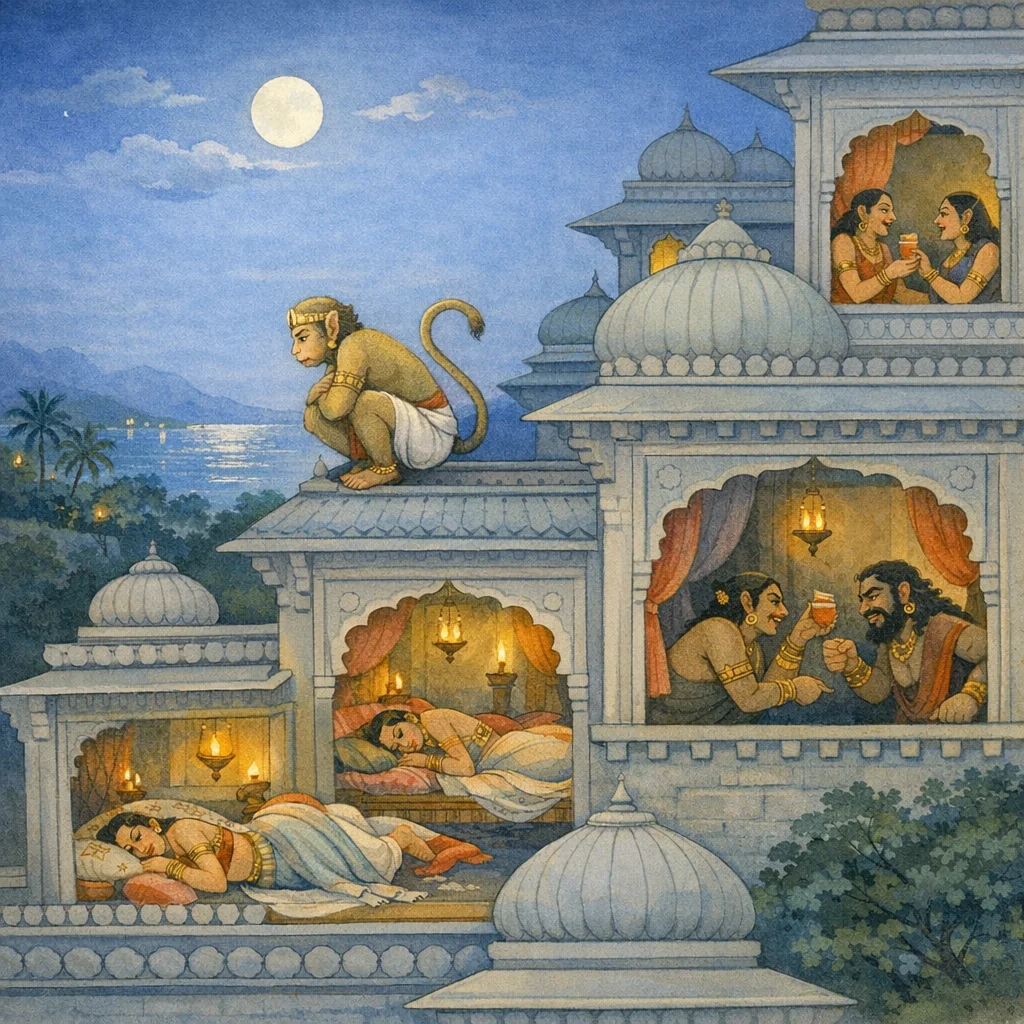
Sarga 5 frames Hanuman’s reconnaissance through a sustained moonlit tableau. The Moon is described at mid-sky as a canopy of light that calms beings, swells the ocean, and transforms night into a legible field for observation. Against this luminous backdrop, Hanuman inspects Lanka’s mansions and social interiors: intoxicated rakṣasas quarrel, boast, and display physical vigor; households are rich with chariots, horses, weapons, and ornamentation; women appear in varied states—sleeping with husbands, laughing, sighing, or embracing lovers—rendered with kāvya similes (stars, birds among flowers, lightning-like ornaments). The city is also shown as militarily alive: bows are drawn, warriors breathe heavily, elephants trumpet. Yet the reconnaissance culminates in a negative finding: despite searching through these spaces, Hanuman does not see Sita. The chapter closes with his inward projection of Sita’s qualities—noble birth, steadfast dharma, devotion to Rama—followed by a brief collapse into grief and dejection when she remains undiscovered.
Shlokas
Verse 1
ततः स मध्यंगतमंशुमन्तं ज्योत्स्नावितानं महदुद्वमन्तम्।ददर्श धीमान् दिवि भानुमन्तं गोष्ठे वृषं मत्तमिव भ्रमन्तम्।।5.5.1।।
Then the wise Hanumān saw the moon risen to mid-sky, pouring out a vast canopy of moonlight—bright like the sun in heaven—wandering as though a mighty bull, intoxicated, were roaming in a cattle-stall.
Verse 2
लोकस्य पापानि विनाशयन्तं महोदधिं चापि समेधयन्तम्।भूतानि सर्वाणि विराजयन्तं ददर्श शीतांशुमथाभियान्तम्।।5.5.2।।
As he moved onward, Hanumān beheld the Moon—dispelling the world’s afflictions, swelling even the great ocean’s tides, and casting its radiance upon all beings.
Verse 3
या भाति लक्ष्मीर्भुवि मन्दरस्था तथा प्रदोषेषु च सागरस्था।तथैव तोयेषु च पुष्करस्था रराज सा चारुनिशाकरस्था।।5.5.3।।
The same splendour that shines on earth upon Mount Mandara, and that gleams at twilight upon the ocean, and that abides in waters among lotuses—so too it shone there, seated upon the lovely moon.
Verse 4
हंसो यथा राजतपञ्जरस्थः सिंहो यथा मन्दरकन्दरस्थः।वीरो यथा गर्वितकुञ्जरस्थ चन्द्रोऽपि बभ्राज तथाम्बरस्थः।।5.5.4।।
As a swan shines in a silver cage, as a lion shines in a cave of Mandara, as a hero shines mounted upon a proud elephant—so too the Moon shone, stationed in the sky.
Verse 5
स्थितः ककुद्मानिव तीक्ष्णशृङ्गो महाचलः श्वेत इवोच्चशृङ्गः।हस्तीव जाम्बूनदबद्धशृङ्गो रराज चन्द्रः परिपूर्णशृङ्गः।।5.5.5।।
The full Moon shone—like a horned bull standing with sharp horns; like a white great mountain with lofty peaks; and like an elephant whose tusks are bound with Jāmbūnada gold.
Verse 6
विनष्टशीताम्बुतुषारपङ्को महाग्रहग्राहविनष्टपङ्कः।प्रकाशलक्ष्म्याश्रयनिर्मलाङ्क: रराज चन्द्रो भगवान् शशाङ्कः।।5.5.6।।
The divine Moon—Śaśāṅka—shone with a spotless disc, its radiance as its abode, as the chill-dew’s frost-like ‘mud’ had been wiped away by the grasp of the great luminary (the Sun).
Verse 7
शिलातलं प्राप्य यथा मृगेन्द्रो महारणं प्राप्य यथा गजेन्द्रः।राज्यं समासाद्य यथा नरेन्द्र स्तथाप्रकाशो विरराज चन्द्रः।।5.5.7।।
As a lion shines upon reaching a rocky height, as a lordly elephant shines upon entering the deep forest, and as a king shines upon attaining his kingdom—so the Moon shone, radiant.
Verse 8
प्रकाशचन्द्रोदयनष्टदोषः प्रवृत्तरक्षः पिशिताशदोषः।रामाभिरामेरितचित्तदोषः स्वर्गप्रकाशो भगवान् प्रदोषः।।5.5.8।।
At twilight, when the radiant Moon rose, the ‘fault’ of darkness was dispelled; the night-roaming rākṣasas set about their grim ways; and the hearts of women were stirred toward love—while the resplendent twilight spread a heaven-like brightness everywhere.
Verse 9
तन्त्रीस्वनाः कर्णसुखाः प्रवृत्ताः स्वपन्ति नार्यः पतिभिः सुवृत्ताः।नक्तंचराश्चापि तथा प्रवृत्ता: विहर्तुमत्यद्भुतरौद्रवृत्ताः।।5.5.9।।
Pleasing-to-the-ear sounds of stringed instruments began to be heard; virtuous women slept beside their husbands; and likewise the night-wanderers also began to roam about, their deeds wondrously fierce and cruel.
Verse 10
मत्तप्रमत्तानि समाकुलानि रथाश्वभद्रासनसङ्कुलानि।वीरश्रिया चापि समाकुलानि ददर्श धीमान् स कपिः कुलानि।।5.5.10।।
The wise monkey Hanumān saw mansions crowded with chariots and horses with fine seats, and also crowded with warriors’ splendor—yet filled too with rākṣasas drunken and stupefied.
Verse 11
परस्परं चाधिकमाक्षिपन्ति भुजांश्च पीनानधिकं क्षिपन्ति।मत्तप्रलापानधिकं क्षिपन्ति मत्तानि चान्योन्यमधिक्षिपन्ति।।5.5.11।।
Drunk, they mocked one another harshly; they flung their thick arms about in excess, and indulged in drunken babble—each insulting the other in their intoxication.
Verse 12
रक्षांसि वक्षांसि च विक्षिपन्ति गात्राणि कान्तासु च विक्षिपन्ति।रूपाणि चित्राणि च विक्षिपन्ति दृढानि चापानि च विक्षिपन्ति।।5.5.12।।
The rākṣasas thrust out their chests in display, flung their limbs upon their beloved women, assumed strange and wondrous forms, and bent their strong bows again and again.
Verse 13
ददर्श कान्ताश्च समालभन्त्य स्तथा परास्तत्र पुनः स्वपन्त्यः।सुरूपवक्त्राश्च तथा हसन्त्यः क्रुद्धाः पराश्चापि विनिःश्वसन्त्य।।5.5.13।।
He saw some women fondling their beloveds; others lay asleep there; some, with beautiful faces, laughed; and others, angered, breathed out heavily in vexation.
Verse 14
महागजैश्चापि तथा नदद्भि: सुपूजितैश्चापि तथा सुसद्भिः।रराज वीरैश्च विनिःश्वसद्भिः ह्रदो भुजङ्गैरिव निःश्वसद्भिः।।5.5.14।।
It shone with great elephants trumpeting, with honored and well-seated nobles, and with warriors breathing hard—like a lake that gleams while serpents hiss within it.
Verse 15
बुद्धिप्रधानान् रुचिराभिधानान् संश्रद्धधानान् जगतः प्रधानान्।नानाविधानान् रुचिराभिधानान् ददर्श तस्यां पुरि यातुधानान्।।5.5.15।।
In that city he saw yātudhānas—foremost in intellect, pleasant in speech and reputation, confident in their own convictions, eminent in the world, and of many different kinds.
Verse 16
ननन्द दृष्ट्वा स च तान् सुरूपान्नानागुणानात्मगुणानुरूपान्।विद्योतमानान्स तदानुरूपान् ददर्श कांश्चिच्च पुनर्विरूपान्।।5.5.16।।
Seeing those handsome ones—endowed with many qualities, their appearance matching their own merits, radiant—he felt delight; yet then he also saw some who were ugly, their looks likewise matching their nature.
Verse 17
ततो वरार्हाः सुविशुद्धभावा स्तेषां स्त्रियस्तत्र महानुभावाः।प्रियेषु पानेषु च सक्तभावा ददर्श तारा इव सुप्रभावाः।।5.5.17।।
Then he saw there the wives of those rākṣasas—women worthy of the finest adornments, of very pure disposition, noble in presence—devoted to their beloveds and also attached to drink, shining like stars.
Verse 18
श्रिया ज्वलन्तीस्त्रपयोपगूढा निशीथकाले रमणोपगूढाः।ददर्श काश्चित्प्रमदोपगूढा यथा विहङ्गाः कुसुमोपगूढाः।।5.5.18।।
He saw some women blazing with beauty, shyly held in embrace, clasped by their lovers in the deep of night; and he saw others wrapped in playful delight—like birds nestled amid flowers.
Verse 19
अन्याः पुनर्हर्म्यतलोपविष्टा स्तत्र प्रियाङ्केषु सुखोपविष्टाः।भर्तुः प्रिया धर्मपरा निविष्टा ददर्श धीमान् मदनाभिविष्टाः।।5.5.19।।
And again the intelligent Hanumān saw others—seated upon the mansion-terraces, happily settled upon the laps of their beloveds—wives devoted to their husbands, absorbed in love and overcome by passion.
Verse 20
अप्रावृताः काञ्चनराजिवर्णाः काश्चित्परार्थ्यास्तपनीयवर्णाः।पुनश्च काश्चिच्छशलक्ष्मवर्णाः कान्तप्रहीणा रुचिराङ्गवर्णाः।।5.5.20।।
Some were unveiled, streaked with a golden hue; some shone like refined gold; and again, some—though lovely-limbed—were separated from their husbands and looked pale, like the Moon’s mark.
Verse 21
ततः प्रियान् प्राप्य मनोभिरामाः सुप्रीतियुक्ताः प्रसमीक्ष्यरामाः।गृहेषु हृष्टाः परमाभिरामाः हरिप्रवीरः स ददर्श रामाः।।5.5.21।।
Then the heroic monkey saw those women—charming to the mind—who, having obtained their beloveds, were filled with delight and rejoiced within their homes.
Verse 22
चन्द्रप्रकाशाश्च हि वक्त्रमालाः वक्राक्षिपक्ष्माश्च सुनेत्रमालाः।विभूषणानां च ददर्श मालाः शतह्रदानामिव चारुमालाः।।5.5.22।।
He saw rows of faces bright as moonlight, rows of beautiful eyes with sidelong glances and graceful lashes, and garlands of ornaments—lovely in succession like many streaks of lightning.
Verse 23
न त्वेव सीतां परमाभिजातां पथि स्थिते राजकुले प्रजाताम्।लतां प्रपुल्लामिव साधु जातां ददर्श तन्वीं मनसाभिजाताम्।।5.5.23।।
But he did not see Sītā—nobly born in a royal line, steadfast on the right path—delicate as a blossoming creeper, pure-born and envisioned by him in his mind.
Verse 24
सनातने वर्त्मनि सन्निविष्टां रामेक्षणां तां मदनाभिविष्टाम्।भर्तुर्मनः श्रीमदनुप्रविष्टां स्त्रीभ्यो वराभ्यश्च सदा विशिष्टाम्।।5.5.24।।
Fixed upon the eternal path of righteousness, fair-eyed, and filled with love, her mind ever entered into her glorious husband—she would always stand distinguished among women, even the best of them.
Verse 25
उष्णार्दितां सानुसृतास्रकण्ठीम् पुरा वरार्होत्तमनिष्ककण्ठीम्।सुजातपक्ष्मामभिरक्तकण्ठीं वनेऽप्रवृत्तामिव नीलकण्ठीम्।।5.5.25।।
He imagined her now scorched by sorrow, her throat choked with unceasing tears—she who once wore the finest costly neck-ornaments; with beautiful lashes and a sweet, affectionate voice, like a peahen wandering in the forest.
Verse 26
अव्यक्तरेखामिव चन्द्ररेखां पांसुप्रदिग्धामिव हेमरेखाम्।क्षतप्ररूढामिव बाणरेखां वायुप्रभिन्नामिव मेघरेखाम्।।5.5.26।।
He pictured her as a faint line of moonlight; as a streak of gold smeared with dust; as an arrow-wound’s mark only superficially healed; and as a strip of cloud torn apart by the wind.
Verse 27
सीतामपश्यन् मनुजेश्वरस्य रामस्य पत्नीं वदतां वरस्य।बभूव दुःखाभिहतश्चिरस्य प्लवङ्गमो मन्द इवाचिरस्य।।5.5.27।।
Not finding Sītā, the wife of Rāma—the lord of men and best among speakers—Hanumān, after searching long, was struck by grief; for a short while he became as if dull and dispirited.
Frequently Asked Questions
Hanuman enters intimate domestic spaces of Lanka for reconnaissance while maintaining restraint: he observes rather than interferes, balancing the necessity of intelligence-gathering with a disciplined avoidance of harm or indulgence, even as the environment is saturated with intoxication, sensuality, and aggression.
The implied upadeśa is that clarity of purpose can coexist with emotional turbulence: even a highly capable agent may experience śoka when goals are unmet, yet dharma requires returning to discernment and continuing the mission without ethical compromise.
Lanka’s urban culture is mapped through mansions and terraces, elite conveyances (horse-drawn chariots), martial readiness (bows drawn), and sonic nightlife (string instruments). The Moon and the ocean function as cosmological landmarks—light as an enabling medium for surveillance and the sea as a living element affected by lunar force.