Sarga 49
रावणदर्शनम् — Hanuman Beholds Ravana in Court
सुन्दरकाण्ड
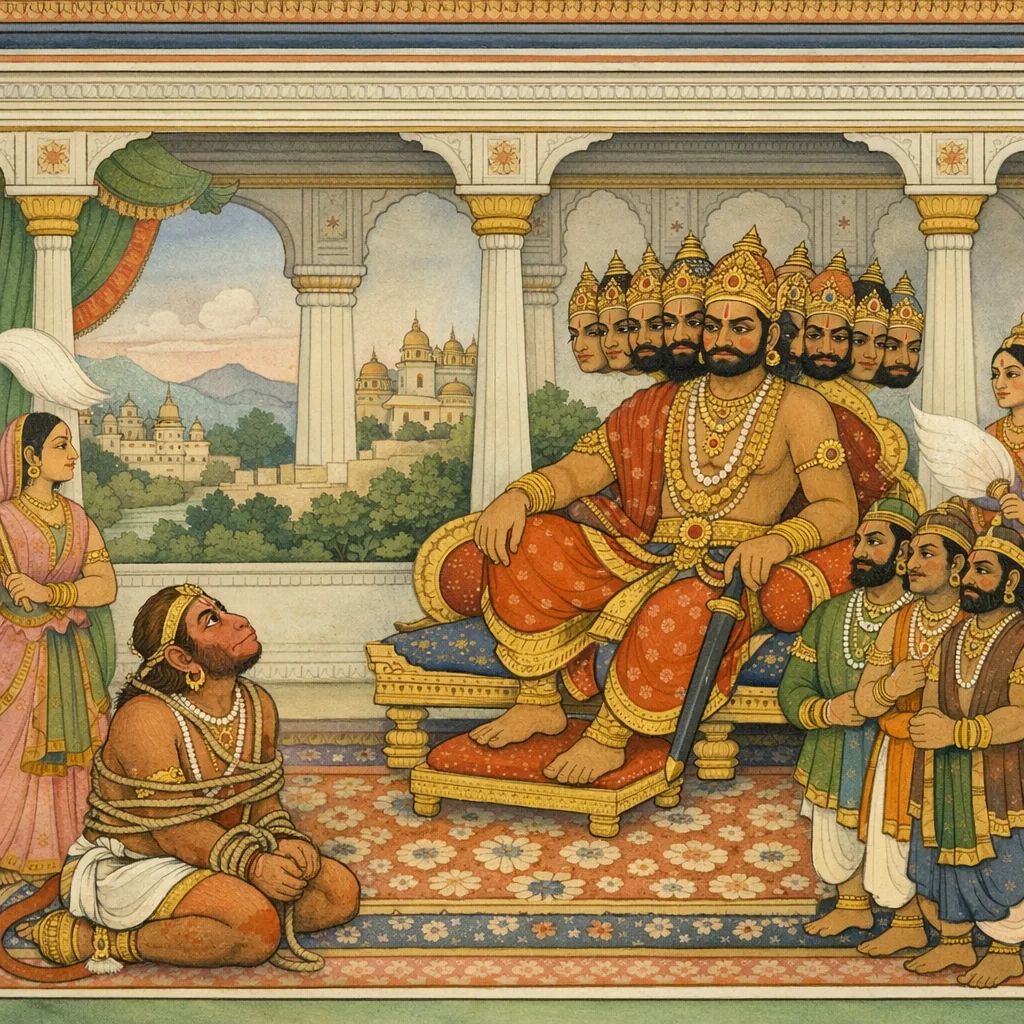
Sarga 49 stages Hanumān’s forced presentation before Rāvaṇa after the humiliating act of binding and dragging him, to which Hanumān responds with astonishment and controlled anger (eyes reddened). The narration shifts into a courtly spectacle: Rāvaṇa is described through dense visual catalogues—golden crown netted with pearls, diamond-studded ornaments, silk garments, red sandal paste, and elaborate bodily designs—establishing royal authority through material culture. His ten heads and terrifying physiognomy are compared to the peaks of Mount Mandara, while further similes liken him to a rain-laden cloud on Mount Meru and to the world encircled by four oceans, emphasizing sovereignty and scale. The court is populated by decorated attendants bearing yak-tail whisks, and by four prominent ministers—Durdhara, Prahasta, Mahāpārśva, and Nikumbha—portrayed as proud and counsel-skilled. Hanumān’s inner discourse then reframes the scene ethically: he acknowledges Rāvaṇa’s exceptional qualities (form, courage, strength, splendor) and concludes that only adharma prevents him from being a protector even of the gods; fear of Rāvaṇa arises from cruel, socially condemned deeds and his capacity for catastrophic wrath. The chapter thus juxtaposes political magnificence with moral failure, using descriptive poetics to support a dharma-centered evaluation of power.
Shlokas
Verse 1
ततस्स कर्मणा तस्य विस्मितो भीमविक्रमः।हनुमान्रोषताम्राक्षो रक्षोधिपमवैक्षत।।5.49.1।।
Then Hanuman—of fearsome prowess—astonished at that treatment, fixed his gaze on the lord of the Rakṣasas, his eyes reddened with anger.
Verse 2
भ्राजमानं महार्हेण काञ्चनेन विराजता।मुक्ताजालावृतेनाथ मकुटेन महाद्युतिम्।।5.49.2।।
Hanumān saw Rāvaṇa radiant—his innate splendor heightened by a gleaming golden crown, draped with nets of pearls, making him shine with great brilliance.
Verse 3
वज्रसंयोगसंयुक्तैर्महार्हमणिविग्रहैः।हैमैराभरणैश्चित्रैर्मनसेव प्रकल्पितैः।।5.49.3।।
He was adorned with marvelous golden ornaments—set with diamonds and fashioned with precious gem-figures—so exquisite they seemed as though created by imagination itself.
Verse 4
महार्हक्षौमसंवीतं रक्तचन्दनरूषितम्।स्वानुलिप्तं विचित्राभिर्विविधाभिश्च भक्तिभिः।।5.49.4।।
He was clothed in exquisite silk, anointed with red sandalpaste, and decorated with many kinds of intricate designs traced on his body with fragrant unguents.
Verse 5
विचित्रैर्दर्शनीयैश्च रक्ताक्षैर्भीमदर्शनैः।दीप्ततीक्ष्णमहादंष्ट्रैः प्रलम्बदशनच्छदैः।।5.49.5।।शिरोभिर्दशभिर्वीरं भ्राजमानं महौजसम्।नानाव्यालसमाकीर्णैश्शिखरैरिव मन्दरम्।।5.49.6।।
He looked fearsome—his eyes blood-red, his appearance dreadful, his great fangs sharp and gleaming, his lips hanging low. With ten heads he shone, heroic and mighty, like Mount Mandara with many peaks thronged by diverse serpents and beasts.
Verse 6
विचित्रैर्दर्शनीयैश्च रक्ताक्षैर्भीमदर्शनैः।दीप्ततीक्ष्णमहादंष्ट्रैः प्रलम्बदशनच्छदैः।।5.49.5।।शिरोभिर्दशभिर्वीरं भ्राजमानं महौजसम्।नानाव्यालसमाकीर्णैश्शिखरैरिव मन्दरम्।।5.49.6।।
He looked fearsome—his eyes blood-red, his appearance dreadful, his great fangs sharp and gleaming, his lips hanging low. With ten heads he shone, heroic and mighty, like Mount Mandara with many peaks thronged by diverse serpents and beasts.
Verse 7
नीलाञ्जनचयप्रख्यं हारेणोरसि राजता।पूर्णचन्द्राभवक्त्रेण सबलाकमिवाम्बुदम्।।5.49.7।।
Dark as a mass of collyrium, yet brightened on his chest by a pearl necklace, and with a face like the full moon, he resembled a cloud lit by moonlight with white cranes gliding across it.
Verse 8
बाहुभिर्बद्धकेयूरैश्चन्दनोत्तमरूषितैः।भ्राजमानाङ्गदैः पीनैः पञ्चशीर्षैरिवोरगैः।।5.49.8।।
His arms, bound with armlets and smeared with excellent sandalpaste, bore stout, shining ornaments—like five-hooded serpents coiled in gleaming strength.
Verse 9
महतिस्फाटिके चित्रे रत्नसंयोगसंस्कृते।उत्तमास्तरणास्तीर्णे सूपविष्टं वरासने।।5.49.9।।
He sat firmly upon a splendid throne—vast, crystal-like, inlaid with precious stones, and spread over with the finest coverings.
Verse 10
अलङ्कृताभिरत्यर्थं प्रमदाभिः समन्ततः।वालव्यजनहस्ताभिरारात्समुपसेवितम्।।5.49.10।।
He was closely attended on all sides by exquisitely adorned young women, standing near with yak-tail fans in their hands.
Verse 11
दुर्धरेण प्रहस्तेन महापार्श्वेन रक्षसा।मन्त्रिभिर्मन्त्रतत्त्वज्ञैर्निकुम्भेन च मन्त्रिणा।।5.49.11।।सुखोपविष्टं रक्षोभिश्चतुर्भिर्बलदर्पितैः।कृत्स्नं परिवृतं लोकं चतुर्भिरिव सागरैः।।5.49.12।।
He was attended by the Rakṣasa ministers—Durdhara, Prahasta, Mahāpārśva, and the counsellor Nikumbha—men skilled in the principles of counsel.
Verse 12
दुर्धरेण प्रहस्तेन महापार्श्वेन रक्षसा।मन्त्रिभिर्मन्त्रतत्त्वज्ञैर्निकुम्भेन च मन्त्रिणा।।5.49.11।।सुखोपविष्टं रक्षोभिश्चतुर्भिर्बलदर्पितैः।कृत्स्नं परिवृतं लोकं चतुर्भिरिव सागरैः।।5.49.12।।
Seated at ease and surrounded by four Rakṣasas arrogant in their strength, he appeared like the whole earth encircled by the four oceans.
Verse 13
मन्त्रिभिर्मन्त्रतत्त्वज्ञैरन्यैश्च शुभबुद्धिभिः।अन्वास्यमानं रक्षोभिः सुरैरिव सुरेश्वरम्।।5.49.13।।
Attended by ministers versed in counsel—and by other keen-minded Rakṣasas—he looked like Indra himself surrounded by the gods.
Verse 14
अपश्यद्राक्षसपतिं हनुमानतितेजसम्।विष्ठितं मेरुशिखरे सतोयमिव तोयदम्।।5.49.14।।
Hanuman saw the exceedingly radiant lord of the Rakṣasas, seated as though on Meru’s summit—like a rain-cloud heavy with water.
Verse 15
स तैस्सम्पीड्यमानोऽपि रक्षोभिर्भीमविक्रमैः।विस्मयं परमं गत्वा रक्षोधिपमवैक्षत।।5.49.15।।
Even while being roughly handled by Rakṣasas of fearsome prowess, he felt profound astonishment and kept looking upon the demon overlord.
Verse 16
भ्राजमानं ततो दृष्ट्वा हनुमान्राक्षसेश्वरम्।मनसा चिन्तयामास तेजसा तस्य मोहितः।।5.49.16।।
Seeing the lord of the Rakṣasas shining with splendor, Hanuman—momentarily overawed by that radiance—began reflecting within his mind.
Verse 17
अहो रूपमहो धैर्यमहो सत्त्वमहो द्युतिः।अहो राक्षसराजस्य सर्वलक्षणयुक्तता।।5.49.17।।
“Ah—what beauty! what courage! what strength! what radiance! How astonishing that this king of Rakṣasas possesses every mark of excellence!”
Verse 18
यद्यधर्मो न बलवान् स्यादयं राक्षसेश्वरः।स्यादयं सुरलोकस्य सशक्रस्यापि रक्षिता।।5.49.18।।
“If only unrighteousness were not so powerful in him, this lord of Rakṣasas could have become the very protector of the world of the gods—even of Indra himself.”
Verse 19
अस्य क्रूरैर्नृशंसैश्च कर्मभिर्लोककुत्सितैः।सर्वे बिभ्यति खल्वस्माल्लोकास्सामरदानवाः।।5.49.19।।अयं ह्युत्सहते क्रुद्धः कर्तुमेकार्णवं जगत्।
Because of his cruel, pitiless deeds—condemned by the world—all beings truly fear him, even along with gods and demons. When enraged, he would dare to turn the whole world into a single ocean.
Verse 20
इति चिन्तां बहुविधामकरोन्मतिमान् हरिः।।5.49.20।।दृष्ट्वा राक्षसराजस्य प्रभावममितौजसः।
Thus the wise Hanumān entertained many lines of thought after witnessing the might and imposing power of the rākṣasa-king, whose energy seemed immeasurable.
Frequently Asked Questions
The pivotal action is Hanuman’s binding and forced dragging to court, testing his restraint and mission-focus; the ethical tension lies in responding to humiliation without abandoning dharma or diplomatic purpose.
Power and excellence (tejas, vīrya, rūpa) are not self-justifying; without righteousness, even extraordinary capability becomes a source of fear and social condemnation, whereas dharma alone legitimizes sovereignty.
Meru and Mandara appear as similes to scale Ravana’s presence, while the four-oceans image frames imperial grandeur; culturally, the court’s whisks, jeweled crown, crystal throne, and ministerial circle map a classical royal protocol.