Sarga 46
षट्चत्वारिंशः सर्गः — Ravana Deploys Five Generals; Hanuman Destroys the Commanders and the Remaining Host
सुन्दरकाण्ड
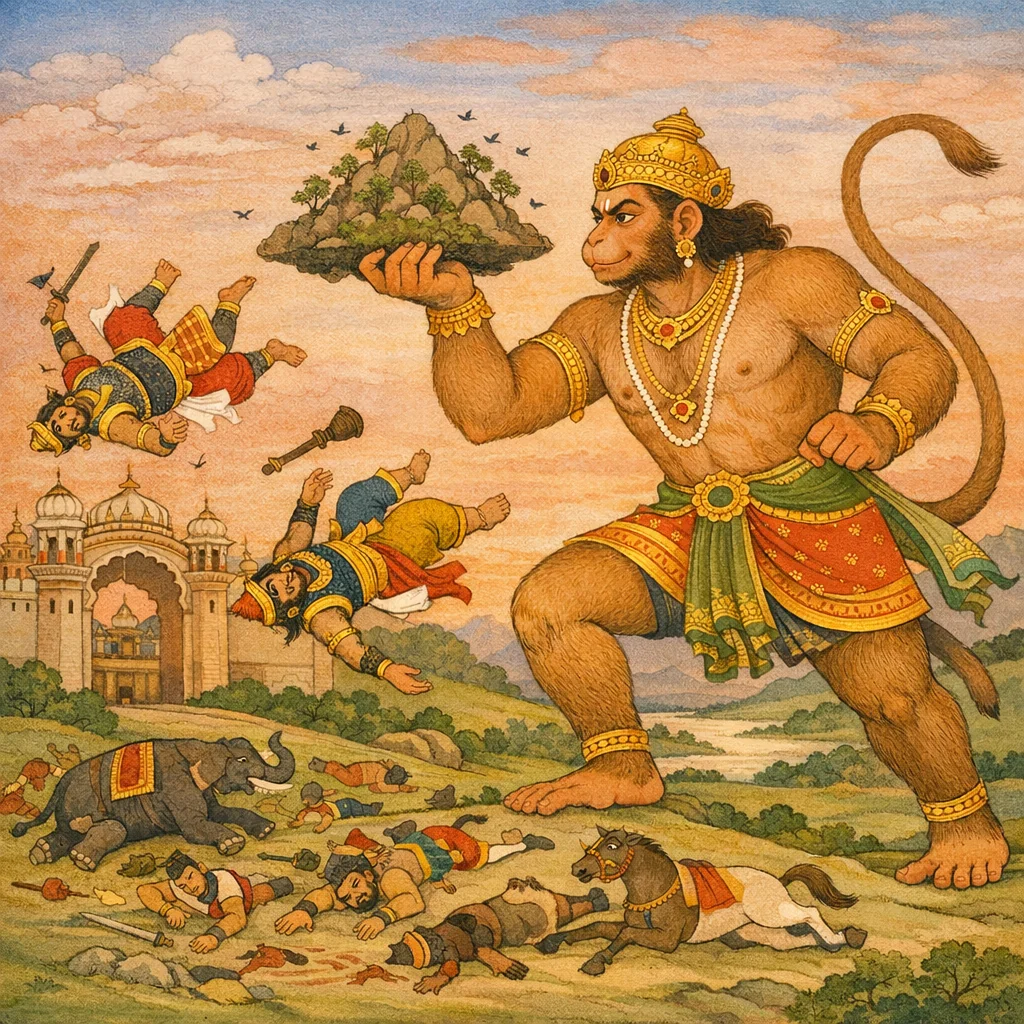
This chapter pivots from earlier setbacks to a tactical escalation. Ravana, concealing grief after learning that the ministers’ sons have been slain, formulates a measured plan: capture rather than dishonor or recklessly kill the intruding vanara, whom he suspects may be divinely engineered and therefore dangerous. He orders five senior field-commanders—Vīrūpākṣa, Yūpākṣa, Durdhara, Praghasa, and Bhāskarna—to march with a combined-arms force (chariots, elephants, horses, and infantry) and to act with strategy appropriate to time and place. Ravana’s speech explicitly compares Hanuman’s capabilities against earlier-seen vanara leaders (Vālī, Sugrīva, Jāmbavān, Nīla, Dvivida), concluding that this opponent exhibits unprecedented speed, radiance, intellect, strength, and transformative capacity, and that victory in war is uncertain unless one protects oneself through intelligent policy. The battle sequence then unfolds as a field report: the generals surround Hanuman at the city archway (toraṇa). Durdhara’s arrow-volley is neutralized; Hanuman enlarges his form, crashes onto the chariot like lightning, and kills Durdhara. Vīrūpākṣa and Yūpākṣa strike with iron hammers in midair; Hanuman counters and slays both using an uprooted śāla tree. Praghasa attacks with a sharp paṭṭisa weapon while Bhāskarna advances with a śūla (trident/spear); Hanuman, blood-smeared and blazing like the rising sun, uproots a mountain peak with its flora and fauna and kills both. With all five commanders fallen, he proceeds to annihilate the remaining army and returns to the archway, standing like Time (kāla) intent on destruction—an image that frames power as apocalyptic when opposed to dharma.
Shlokas
Verse 1
हतान्मन्त्रिसुतान् बुद्ध्वा वानरेण महात्मना।रावणस्संवृताकारश्चकार मतिमुत्तमाम्।।।।
Learning that the ministers’ sons had been slain by the great-souled monkey, Rāvaṇa—masking his inner agitation—devised an excellent plan.
Verse 2
स विरूपाक्षयूपाक्षौ दुर्धरं चैव राक्षसम्।प्रघसं भासकर्णं च पञ्चसेनाग्रनायकान्।।।।सन्दिदेश दशग्रीवो वीरान्नयविशारदान्।हनुमद्ग्रहणव्यग्रान्वायुवेगसमान्युधि।।।।
Daśagrīva (Rāvaṇa) ordered five vanguard generals—Vīrūpākṣa, Yūpākṣa, Durdhara, Praghāsa, and Bhāsakarṇa—valiant warriors skilled in strategy, eager to seize Hanumān, and in battle as swift as the wind.
Verse 3
स विरूपाक्षयूपाक्षौ दुर्धरं चैव राक्षसम्।प्रघसं भासकर्णं च पञ्चसेनाग्रनायकान्।।5.46.2।।सन्दिदेश दशग्रीवो वीरान्नयविशारदान्।हनुमद्ग्रहणव्यग्रान्वायुवेगसमान्युधि।।5.46.3।।
Daśagrīva (Rāvaṇa) then ordered five foremost leaders of his army—Virūpākṣa, Yūpākṣa, Durdhara, Praghasa, and Bhāsakarṇa—heroic men skilled in strategy, eager to seize Hanumān, and in battle swift as the wind.
Verse 4
यात सेनाग्रगास्सर्वे महाबलपरिग्रहाः।सवाजिरथमातङ्गास्स कपिश्शास्यतामिति।।।।
“Go forth, all you leaders at the army’s front, supported by a mighty force with horses, chariots, and elephants; let that monkey be punished,” (he commanded).
Verse 5
यत्नैश्च खलु भाव्यं स्यात्तमासाद्य वनालयम्।कर्म चापि समाधेयं देशकालाविरोधिनम्।।।।
“After reaching that forest-dweller, you must proceed with full effort; and the action you take should be one that accords with place and time.”
Verse 6
न ह्यहं तं कपिं मन्ये कर्मणा प्रतितर्कयन्।सर्वथा तन्महद्भूतं महाबलपरिग्रहम्।।।।
“For, judging by his deeds again and again, I do not consider that monkey ordinary in any way—he is a great being, endowed with immense strength.”
Verse 7
भवेदिन्द्रेण वा सृष्टमस्मदर्थं तपोबलात्।सनागयक्षगन्धर्वा देवासुरमहर्षयः।।।।युष्माभिस्सहितैस्सर्वैर्मया सह विनिर्जिताः।तैरवश्यं विधातव्यं व्यलीकं किञ्चिदेव नः।।।।तदेव नात्र सन्देहः प्रसह्य परिगृह्यताम्।नावमान्यो भवद्भिश्च हरिर्धीरपराक्रमः।।।।
“It may be that Indra, by the power of austerity, has created him for our sake (to punish us). With all of you aiding me, I have subdued nāgas, yakṣas, gandharvas, and even gods, asuras, and great seers—so by them some harm to us is surely being arranged. Of that there is no doubt: seize him by force and bring him under control; but do not insult this monkey of steady and heroic prowess.”
Verse 8
भवेदिन्द्रेण वा सृष्टमस्मदर्थं तपोबलात्।सनागयक्षगन्धर्वा देवासुरमहर्षयः।।5.46.7।।युष्माभिस्सहितैस्सर्वैर्मया सह विनिर्जिताः।तैरवश्यं विधातव्यं व्यलीकं किञ्चिदेव नः।।5.46.8।।तदेव नात्र सन्देहः प्रसह्य परिगृह्यताम्।नावमान्यो भवद्भिश्च हरिर्धीरपराक्रमः।।5.46.9।।
This entry preserves a Southern-Recension composite presentation of the same instruction: Rāvaṇa suspects Hanumān may be divinely empowered, recalls his former conquests, and orders Hanumān’s forcible capture—yet insists he must not be insulted.
Verse 9
भवेदिन्द्रेण वा सृष्टमस्मदर्थं तपोबलात्।सनागयक्षगन्धर्वा देवासुरमहर्षयः।।5.46.7।।युष्माभिस्सहितैस्सर्वैर्मया सह विनिर्जिताः।तैरवश्यं विधातव्यं व्यलीकं किञ्चिदेव नः।।5.46.8।।तदेव नात्र सन्देहः प्रसह्य परिगृह्यताम्।नावमान्यो भवद्भिश्च हरिर्धीरपराक्रमः।।5.46.9।।
There is no doubt about it: seize him by force and take him. Yet you must not insult that monkey—he is steadfast and mighty in valor.
Verse 10
दृष्टा हि हरयः पूर्वं मया विपुलविक्रमाः।वाली च सहसुग्रीवो जाम्बवांश्च महाबलः।।।।नीलस्सेनापतिश्चैव ये चान्ये द्विविदादयः।नैवं तेषां गतिर्भीमा न तेजो न पराक्रमः।।।।न मतिर्न बलोत्साहौ न रूपपरिकल्पनम्।
"Indeed, I have earlier seen monkeys of immense prowess—Vālī with Sugrīva, and mighty Jāmbavān; Nīla the army-chief too, and others such as Dvivida. Yet none of them had movement so fearsome, nor such splendor or valor—nor such intelligence, strength and ardor, nor this power of assuming forms at will."
Verse 11
दृष्टा हि हरयः पूर्वं मया विपुलविक्रमाः।वाली च सहसुग्रीवो जाम्बवांश्च महाबलः।।5.46.10।।नीलस्सेनापतिश्चैव ये चान्ये द्विविदादयः।नैवं तेषां गतिर्भीमा न तेजो न पराक्रमः।।5.46.11।।न मतिर्न बलोत्साहौ न रूपपरिकल्पनम्।
This record preserves the Southern Recension’s continuous citation spanning 5.46.10–11: Rāvaṇa states that although he has seen many mighty Vānara leaders before, none matched this being in terrifying speed, splendor, valor, intelligence, vigor, and shape-shifting power.
Verse 12
महत्सत्त्वमिदं ज्ञेयं कपिरूपं व्यवस्थितम्।।।।प्रयत्नं महदास्थाय क्रियतामस्य निग्रहः।
"Know this for certain: a great being stands here in the guise of a monkey. Therefore, exert extraordinary effort and take measures to subdue and capture him."
Verse 13
कामं लोकास्त्रयस्सेन्द्रास्ससुरासुरमानवाः।।।।भवतामग्रतः स्थातुं न पर्याप्ता रणाजिरे।
"Indeed, even the three worlds—together with Indra, with gods, demons, and humans—would be unequal to standing before you on the field of battle."
Verse 14
तथापि तु नयज्ञेन जयमाकाङ्क्षता रणे।।।।आत्मा रक्ष्यः प्रयत्नेन युद्धसिद्धिर्हि चञ्चला।
"Even so, one who seeks victory in war through intelligent strategy must guard himself with effort—for success in battle is indeed uncertain."
Verse 15
ते स्वामिवचनं सर्वे प्रतिगृह्य महौजसः।।।।समुत्पेतुर्महावेगा हुताशसमतेजसः।रथैर्मत्तैश्च मातङ्गैर्वाजिभिश्च महाजवैः।।।।शस्त्रैश्च विविधैस्तीक्ष्णैस्सर्वैश्चोपचिता बलैः।
Accepting their lord’s command, all those mighty, swift warriors—radiant like sacrificial fire—sallied forth with their assembled forces: with chariots, rutting elephants, and very swift horses, and with many kinds of keen weapons.
Verse 16
ते स्वामिवचनं सर्वे प्रतिगृह्य महौजसः।।5.46.15।।समुत्पेतुर्महावेगा हुताशसमतेजसः।रथैर्मत्तैश्च मातङ्गैर्वाजिभिश्च महाजवैः।।5.46.16।।शस्त्रैश्च विविधैस्तीक्ष्णैस्सर्वैश्चोपचिता बलैः।
This record reflects the Southern Recension’s verse-splitting/overlap: the same mobilization scene continues, describing the swift warriors blazing like fire as they advance with chariots, rutting elephants, swift horses, and sharp weapons, their forces fully assembled.
Verse 17
ततस्तं ददृशुर्वीरा दीप्यमानं महाकपिम्।।।।रश्मिमन्तमिवोद्यन्तं स्वतेजोरश्मिमालिनम्।तोरणस्थं महोत्साहं महासत्त्वं महाबलम्।।।।
Then the heroic rākṣasas saw that great monkey, blazing—like the rising sun wreathed in its own rays—standing at the gateway-arch, a being of immense resolve, keen intelligence, and tremendous strength.
Verse 18
ततस्तं ददृशुर्वीरा दीप्यमानं महाकपिम्।।5.46.17।।रश्मिमन्तमिवोद्यन्तं स्वतेजोरश्मिमालिनम्।तोरणस्थं महोत्साहं महासत्त्वं महाबलम्।।5.46.18।।
Then the heroic rākṣasas beheld the great monkey, blazing—like the rising sun ringed with its own rays—standing at the gateway-arch, possessed of immense resolve, noble intelligence, and vast strength.
Verse 19
महामतिं महावेगं महाकायं महाबलम्।तं समीक्ष्यैव ते सर्वे दिक्षु सर्वास्ववस्थिताः।।।।तै स्तै: प्रहरणैर्भीमैरभिपेतुस्ततस्ततः।
Seeing him—so intelligent, so swift, of immense body and strength—they all took positions in every direction and, from various sides, rushed upon him with dreadful weapons.
Verse 20
तस्य पञ्चायसास्तीक्ष्णाश्शिताः पीतमुखाश्शराः।।।।शिरस्युत्पलपत्राभा दुर्धरेण निपातिताः।
Upon him, Durdhara loosed five sharp iron arrows with golden tips, gleaming like lotus petals, and struck them into his head.
Verse 21
स तैः पञ्चभिराविद्धश्शरैश्शिरसि वानरः।।।।उत्पपात नदन् व्योम्नि दिशो दश विनादयन्।
With those five arrows embedded in his head, the monkey sprang into the sky, roaring so that the sound resounded through all ten directions.
Verse 22
ततस्तु दुर्धरो वीरस्सरथस्सज्यकार्मुकः।।।।किरन् शरशतैस्तीक्ष्णैरभिपेदे महाबलः।
Then the mighty hero Durdhara, mounted on his chariot with bow strung, assailed him again, pouring forth hundreds of sharp arrows.
Verse 23
स कपिर्वारयामास तं व्योम्नि शरवर्षिणम्।।।।वृष्टिमन्तं पयोदान्ते पयोदमिव मारुतः।
That monkey checked him in midair as he rained arrows—just as the wind drives back a rain-laden cloud at the close of the rainy season.
Verse 24
अर्ध्यमानस्ततस्तेन दुर्धरेणानिलात्मजः।।।।चकार कदनं भूयो व्यवर्धत च वेगवान्।
Assailed again by Durdhara, the swift son of the Wind grew larger once more and renewed the fierce fighting.
Verse 25
स दूरं सहसोत्पत्य दुर्धरस्य रथे हरिः।।।।निपपात महावेगो विद्युद्राशिर्गिराविव।
Then the swift monkey sprang far in an instant and crashed down upon Durdhara’s chariot—like a mass of lightning striking a mountain.
Verse 26
ततस्स मथिताष्टाश्वं रथं भग्नाक्षकूबरम्।।।।विहाय न्यपतद्भूमौ दुर्धरस्त्यक्तजीवितः।
Then Durdhara—his chariot shattered, its eight horses slain, and its axle and pole broken—abandoned the wreck and fell lifeless upon the ground.
Verse 27
तं विरूपाक्षयूपाक्षौ दृष्ट्वा निपतितं भुवि।।।।सञ्जातरोषौ दुर्धर्षावुत्पेतुररिन्दमौ।
Seeing Durdhara fallen upon the earth, Virūpākṣa and Yūpākṣa—unyielding and foe-crushing—were inflamed with anger and sprang forward.
Verse 28
स ताभ्यां सहसोत्पत्य विष्ठितो विमलेऽम्बरे।।।।मुद्गराभ्यां महाबाहुर्वक्षस्यभिहतः कपिः।
As the great-armed monkey stood poised in the clear sky, those two suddenly leapt up and struck his chest with their iron maces.
Verse 29
तयोर्वेगवतोर्वेगं विनिहत्य महाबलः।।।।निपपात पुनर्भूमौ सुपर्णसमविक्रमः।
The mighty one, whose prowess matched Suparṇa (Garuḍa), checked the rush of those swift foes—yet fell again to the ground.
Verse 30
स सालवृक्षमासाद्य तमुत्पाट्य च वानरः।।।।तावुभौ राक्षसौ वीरौ जघान पवनात्मजः।
Then the son of the Wind approached a śāla tree, tore it up, and with it struck down those two heroic rākṣasas.
Verse 31
ततस्तांस्त्रीन्हतान्ज्ञात्वा वानरेण तरस्विना।।।।अभिपेदे महावेगः प्रसह्य प्रघसो हरिम्।भासकर्णश्च सङ्कृद्धश्शूलमादाय वीर्यवान्।।।।
Then, learning that the swift monkey had slain those three, Praghasa—impetuous in assault—rushed violently at Hanumān; and Bhāsakarṇa too, enraged and valiant, advanced with a trident in hand.
Verse 32
ततस्तांस्त्रीन्हतान्ज्ञात्वा वानरेण तरस्विना।।5.46.31।।अभिपेदे महावेगः प्रसह्य प्रघसो हरिम्।भासकर्णश्च सङ्कृद्धश्शूलमादाय वीर्यवान्।।5.46.32।।
This is a Southern Recension duplication of the preceding statement: after learning the swift monkey had slain those three, Praghasa rushed violently at Hanumān, and Bhāsakarṇa, enraged, advanced wielding a trident.
Verse 33
एकतः कपिशार्दूलं यशस्विनमवस्थितम्।पट्टिसेन शिताग्रेण प्रघसः प्रत्ययोधयत्।।।।भासकर्णश्च शूलेन राक्षसः कपिसत्तमम्।
From one side Praghasa pressed the renowned tiger among monkeys with a sharp paṭṭiśa weapon, while from the other Bhāsakarṇa, the rākṣasa, assailed the foremost of monkeys with a trident.
Verse 34
स ताभ्यां विक्षतैर्गात्रैरसृग्दिग्धतनूरुहः।।।।अभवद्वानरः क्रुद्धो बालसूर्यसमप्रभः।
Wounded in his limbs by both of them, his body-hair smeared with blood, the monkey grew wrathful—shining like the young rising sun.
Verse 35
समुत्पाट्य गिरेश्शृङ्गं समृगव्यालपादपम्।।।।जघान हनुमान् वीरो राक्षसौ कपिकुञ्जरः।
The heroic Hanumān—like a great elephant among monkeys—uprooted a mountain-peak along with its trees and the creatures upon it, and with it struck down the two rākṣasas.
Verse 36
ततस्तेष्ववसन्नेषु सेनापतिषु पञ्चसु।।।।बलं तदवशेषं च नाशयामास वानरः।
Then, when the five commanders had fallen, the vānara set about destroying the remaining troops as well.
Verse 37
अश्वैरश्वान् गजैर्नागान् योधैर्योधान् रथैरथान्।।।।स कपिर्नाशयामास सहस्राक्ष इवासुरान्।
The monkey annihilated them in matched ranks—horses against horses, elephants against elephants, warriors against warriors, chariots against chariots—like the thousand-eyed Indra destroying the asuras.
Verse 38
हतैर्नागैश्च तुरगैर्भग्नाक्षैश्च महारथैः।।।।हतैश्च राक्षसैर्भूमी रुद्धमार्गा समन्ततः।
With slain elephants and horses, with great chariots whose axles were shattered, and with fallen rākṣasas, the ground was clogged on every side and the paths were blocked.
Verse 39
ततः कपिस्तान्ध्वजिनीपतीन् रणे निहत्य वीरान्सबलान्सवाहनान्।समीक्ष्य वीरः परिगृह्य तोरणं कृतक्षणः काल इव प्रजाक्षये।।।।
Then the heroic monkey, having slain those commanders in battle—together with their troops and conveyances—surveyed the field, seized the gateway-arch again, and stood ready like Time itself when it turns toward the destruction of beings.
Frequently Asked Questions
Ravana’s directive balances fear and policy: he orders Hanuman to be captured forcibly yet not insulted or harmed unnecessarily, implying a dharma-adjacent restraint motivated by uncertainty about Hanuman’s divine or extraordinary nature.
Power without prudent strategy is unstable: Ravana explicitly states that victory in war is uncertain (yuddhasiddhi is cañcalā), therefore intelligent nīti and self-protection are essential even for the mighty.
The toraṇa (city archway/gate structure) of Laṅkā functions as the tactical landmark and symbolic threshold—Hanuman holds this liminal space, turning the gateway into a stage for the collapse of Ravana’s command structure.