Sarga 41
प्रमदावनविध्वंसः | The Devastation of the Pleasure-Garden (Ashoka Vatika)
सुन्दरकाण्ड
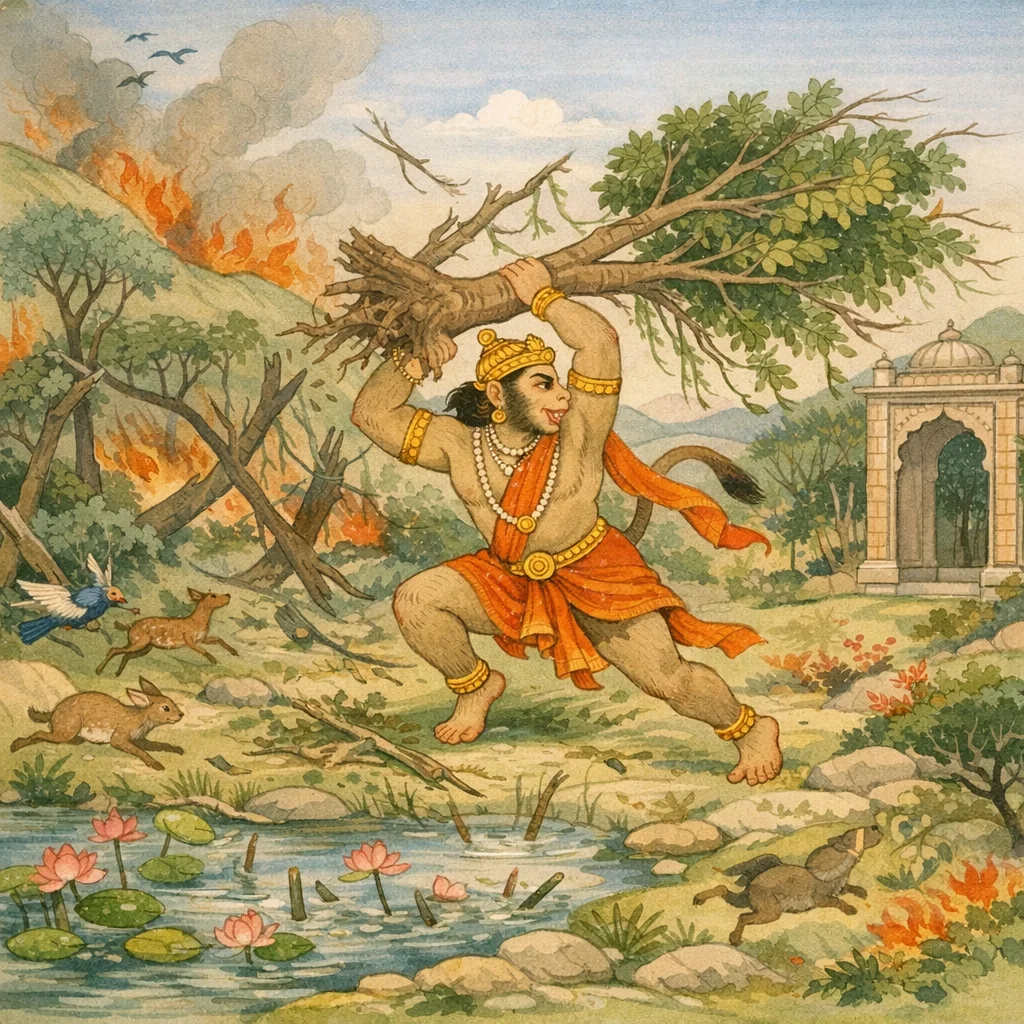
After being honored by Sītā’s words, Hanumān withdraws and reflects on the remaining objectives of the mission. He evaluates the classical upāyas—sāma (conciliation), dāna (gifts), and bheda (division)—and concludes that against force-proud rākṣasas only daṇḍa/parākrama (coercive power) will disclose their true strength and induce strategic softening. He frames a multi-goal action: without compromising the primary success (finding Sītā), he will generate a controlled disturbance to compel Rāvaṇa to mobilize. Hanumān then praises the Ashoka grove as Nandana-like in beauty, yet resolves to destroy it “like fire in a dry forest,” anticipating that the outrage will trigger deployment of troops with horses, chariots, and elephants, armed with tridents and iron spears. Acting on this intent, he uproots and fells trees, breaks ponds and structures, scatters animals and serpents, and turns the garden into a scene likened to a forest consumed by wildfire—creepers trembling like disarrayed women. Having caused grave displeasure to the lord of Laṅkā, he stations himself at the gateway, blazing in resolve, ready to fight many warriors single-handedly.
Shlokas
Verse 1
स च वाग्भिः प्रशस्ताभिर्गमिष्यन्पूजितस्तया।तस्माद्देशादपक्रम्य चिन्तयामास वानरः।।।।
Honoured by her excellent words and preparing to depart, the Vānara withdrew from that place and began to reflect.
Verse 2
अल्पशेषमिदं कार्यं दृष्टेयमसितेक्षणा।त्रीनुपायानतिक्रम्य चतुर्थ: इह विद्यते।।5.41.2।।
This task has only a little left: the black-eyed lady has been seen. Having passed beyond the three expedients, only the fourth means—punishment by force—now remains here.
Verse 3
न साम रक्षस्सु गुणाय कल्पते न दानमर्थोपचितेषु युज्यते।न भेदसाध्या बलदर्पिता जनाः पराक्रमस्त्वेव ममेह रोचते।।।।
Conciliation brings no benefit with demons; and gifts are not fitting for those already swollen with wealth. People intoxicated by strength do not yield to division either—here, I find only valour to be the effective course.
Verse 4
न चास्य कार्यस्य पराक्रमादृते विनिश्चयः कश्चिदिहोपपद्यते।हतप्रवीरा हि रणे हि राक्षसाः कथञ्चिदीयुर्यदिहाद्य मार्दवम्।।।।
And for this undertaking, apart from heroic force, no resolution truly holds. If, in battle, a few of the rākṣasas’ champions are struck down, they may somehow soften today and become pliable.
Verse 5
कार्ये कर्मणि निर्दिष्टे यो बहून्यपि साधयेत्।पूर्वकार्याविरोधेन स कार्यं कर्तुमर्हति।।।।
When a duty has been assigned, the one who can accomplish even many additional aims—without obstructing the original objective—is truly fit to act.
Verse 6
न ह्येकस्साधको हेतुस्स्वल्पस्यापीह कर्मणः।यो ह्यर्थं बहुधा वेद स समर्थोऽर्थसाधने।।।।
For even a small task here, there is not just one effective means. The one who understands the goal in many ways is capable of accomplishing it.
Verse 7
इहैव तावत्कृतनिश्चयो ह्यहं यदि व्रजेयं प्लवगेश्वरालयम्।परात्मसम्मर्दविशेषतत्त्ववित्ततः कृतं स्यान्मम भर्तृशासनम्।।।।
If, having settled my resolve here itself, I were to go back to Kiṣkindhā, the abode of the lord of the monkeys—after understanding the specific difference between the enemy’s strength and our own in battle—then my master’s command would have been duly fulfilled.
Verse 8
कथं नु खल्वद्य भवेत्सुखागतं प्रसह्य युद्धं मम राक्षसैः सह।तथैव खल्वात्मबलं च सारवत्सम्मानयेन्मां च रणे दशाननः।।।।
How, indeed, can my coming here end in a safe and happy return today, if I must endure war with the rākṣasas? Only thus, in battle, will Daśānana truly measure the substance of his own strength—and mine as well.
Verse 9
ततस्समासाद्य रणे दशाननं समन्त्रिवर्गं सबलप्रयायिनम्।हृदि स्थितं तस्य मतं बलं च वै सुखेन मत्त्वाऽहमितः पुनर्व्रजे।।।।
Therefore, having encountered Daśānana in battle—along with his ministers and those who advance with his forces—and having easily ascertained his settled intention and strength, I shall return from here in safety.
Verse 10
इदमस्य नृशंसस्य नन्दनोपममुत्तमम्।वनं नेत्रमनःकान्तं नानाद्रुमलतायुतम्।।।।
This excellent garden of that cruel one—like Indra’s Nandana—delights both eye and mind, filled with many kinds of trees and creepers.
Verse 11
इदं विध्वंसयिष्यामि शुष्कं वनमिवानलः।अस्मिन्भग्ने ततः कोपं करिष्यति दशाननः।।।।
I will destroy this place like fire consuming a dry forest; when it is devastated, Daśānana will then be provoked to anger.
Verse 12
ततो महत्साश्वमहारथद्विपं बलं समादेक्ष्यति राक्षसाधिपः।त्रिशूलकालायसपट्टिसायुधं ततो महद्युद्धमिदं भविष्यति।।।।
Then the lord of the Rākṣasas will marshal a great force—horses, mighty chariots, and elephants—armed with tridents and black-iron spears; and then a great battle will take place.
Verse 13
अहं तु तैः संयति चण्डविक्रमै स्समेत्य रक्षोभिरसह्य विक्रमः।निहत्य तद्रावणचोदितं बलं सुखं गमिष्यामि कपीश्वरालयम्।।।।
For my part, meeting those rākṣasas in battle—fighters of fierce might—I, whose valor is irresistible, will destroy that force dispatched by Rāvaṇa; and then I shall return gladly to the abode of the lord of the monkeys.
Verse 14
ततो मारुतवत्कृद्धो मारुतिर्भीमविक्रमः।ऊरुवेगेन महता द्रुमान्क्षेप्तुमथारभत्।।।।
Then Māruti, furious like the Wind-god and terrible in prowess, began hurling trees with a tremendous speed driven from his thighs.
Verse 15
ततस्तु हनुमान्वीरो बभञ्ज प्रमदावनम्।मत्तद्विजसमाघुष्टं नानाद्रुमलतायुतम्।।।।
Thereupon the hero Hanumān shattered the pleasure-grove—resounding with intoxicated birds and filled with many kinds of trees and creepers.
Verse 16
तद्वनं मथितैर्वृक्षैर्भिन्नैश्च सलिलाशयैः।चूर्णितैः पर्वताग्रैश्च बभूवाप्रियदर्शनम्।।।।
That grove became unsightly—its trees smashed, its ponds breached, and even its rocky heights crushed to powder.
Verse 17
नानाशकुन्तविरुतैः प्रभिन्नैस्सलिलाशयैः।ताम्रैः किसलयैः क्लान्तै: क्लान्तद्रुमलतायुतम्।।।।न बभौ तद्वनं तत्र दावानलहतं यथा।व्याकुलावरणा रेजुर्विह्वला इव ता लताः।।।।
With birds crying out in many ways, with its ponds shattered, and with its copper-red tender shoots withered—filled with exhausted trees and creepers—this grove no longer shone; it looked as though scorched by a forest fire. The creepers trembled, as if women in distress with their garments thrown into disorder.
Verse 18
नानाशकुन्तविरुतैः प्रभिन्नैस्सलिलाशयैः।ताम्रैः किसलयैः क्लान्तै: क्लान्तद्रुमलतायुतम्।।5.41.17।।न बभौ तद्वनं तत्र दावानलहतं यथा।व्याकुलावरणा रेजुर्विह्वला इव ता लताः।।5.41.18।।
This verse repeats the same description: the grove, broken with shattered ponds and withered shoots amid the cries of birds, looked like a forest burned by wildfire; the creepers quivered like distressed women with disordered garments.
Verse 19
लतागृहैश्चित्रगृहैश्च नाशितैर्महोरगैर्व्यालमृगैश्च निर्धुतैः।शिलागृहैरुन्मथितैस्तथा गृहैः प्रणष्टरूपं तदभून्महद्वनम्।।।।
That great grove was left disfigured: its vine-arbours and painted pavilions were ruined; great serpents and wild beasts were driven out in confusion; and its stone-houses and other structures were scattered and wrecked.
Verse 20
सा विह्वलाऽशोकलताप्रताना वनस्थली शोकलताप्रताना।जाता दशास्यप्रमदावनस्य कपेर्बलाद्धि प्रमदावनस्य।।।।
Thus the grove—once spread with Aśoka creepers—became a grove spreading creepers of sorrow. For by the sheer force of that monkey, Rāvaṇa’s pleasure-garden was laid waste.
Verse 21
स तस्य कृत्वार्थपतेर्महाकपिर्महद्व्यलीकं मनसो महात्मनः।युयुत्सुरेको बहुभिर्महाबलैश्शिया ज्वलंस्तोरणमास्थितः कपिः।।।।
Having thus caused great offense in the mind of that great-souled lord of wealth, the great monkey—burning with splendor—took his stand upon the gateway, eager to fight alone against many mighty warriors.
Frequently Asked Questions
Hanumān chooses deliberate destruction of the Ashoka grove as a controlled escalation: a forceful act intended to provoke a military response and measure enemy strength, while ensuring the primary dharmic objective—Sītā’s discovery and reassurance—remains uncompromised.
The sarga teaches calibrated means (upāya-jñāna): different contexts demand different instruments of action. When sāma, dāna, and bheda are ineffective against strength-intoxicated adversaries, disciplined daṇḍa guided by mission clarity becomes a legitimate tool for restoring moral order.
The Ashoka Vatika/Pramadāvanam in Laṅkā is central, described through the cultural simile of Indra’s Nandana garden; the torana (gateway) functions as the tactical threshold where Hanumān positions himself to initiate open conflict.