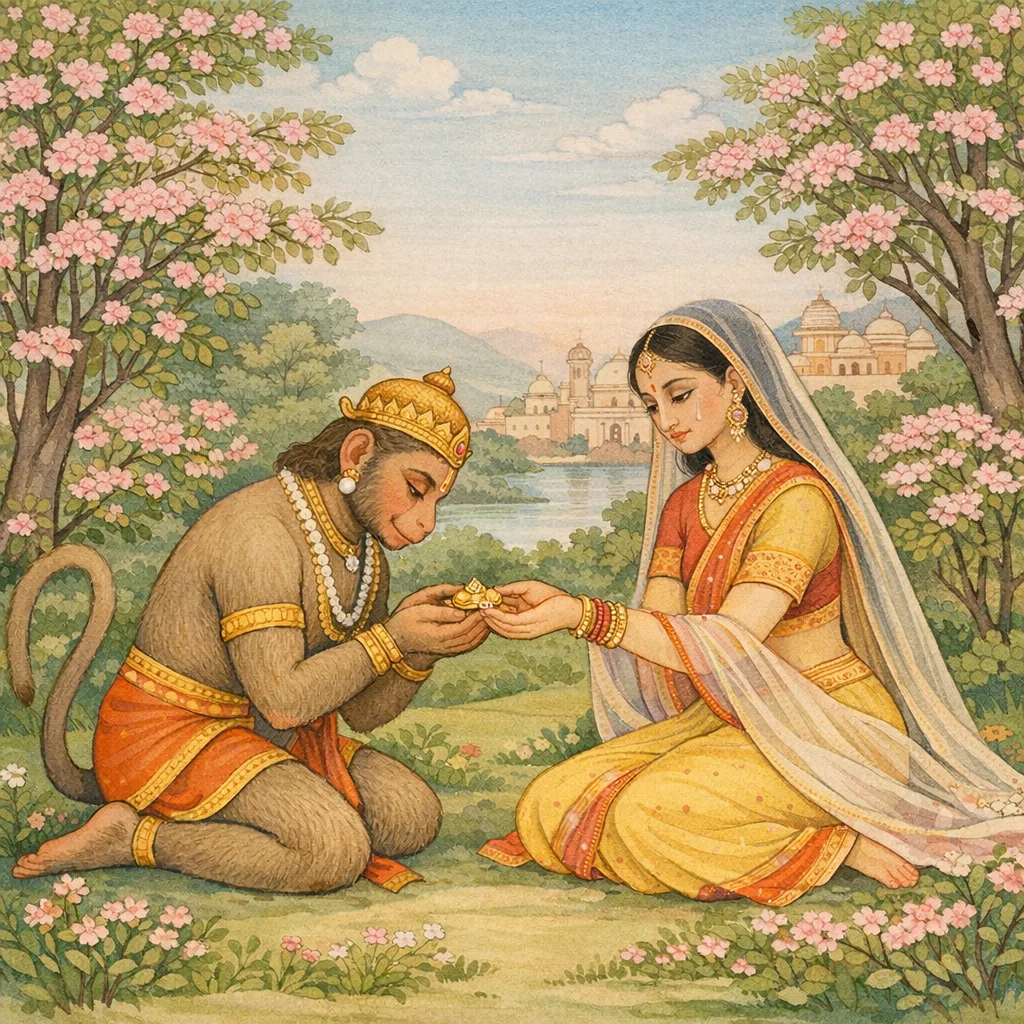
Sarga 40
अभिज्ञानदानम् / The Gift of Recognition (Sita’s Token and Resolve)
सुन्दरकाण्ड
Sarga 40 is structured as a tightly linked exchange between Sītā and Hanumān that converts emotion into verifiable mission data. After hearing Hanumān’s assurances, Sītā replies in a tone of karuṇā: she states a strict temporal limit on endurance—she will sustain life for only one month without Rāma—and describes Rāvaṇa’s predatory gaze and the unbearable psychological pressure. Hanumān responds with stabilizing counsel: he swears that Rāma and Lakṣmaṇa are consumed by separation, urges Sītā not to grieve now that contact is established, and forecasts the military reversal—Laṅkā will be reduced to ashes and Sītā restored after Rāvaṇa’s defeat. He then requests an additional abhijñāna (proof-token) that will generate confidence and joy for Rāma. Sītā indicates she has already provided the best identification and gives her cūḍāmaṇi (hair-jewel), emphasizing its evidentiary value. Hanumān receives it with reverence, prostrates, and prepares to depart. As he enlarges his body to leap away, Sītā—tearful and choked with emotion—sends benedictions to Rāma, Lakṣmaṇa, Sugrīva and the ministers, and asks Hanumān to report her suffering and the demons’ threats, framing the rescue as a crossing from an ‘ocean of sorrow’ into restored order.
Shlokas
Verse 1
श्रुत्वा तु वचनं तस्य वायुसूनोर्महात्मनः।उवाचात्महितं वाक्यं सीता सुरसुतोपमा।।5.40.1।।
Having heard the words of that great-souled son of the Wind, Sītā—like a daughter of the gods—spoke words intended for her own true welfare.
Verse 2
त्वां दृष्ट्वा प्रियवक्तारं सम्प्रहृष्यामि वानरः।अर्धसञ्जातसस्येव वृष्टिं प्राप्य वसुन्धरा।।5.40.2।।
O Vānara, seeing you—one who speaks kindly—I feel joy, just as the earth rejoices when half-grown crops receive rain.
Verse 3
यथा तं पुरुषव्याघ्रं गात्रैश्शोकाभिकर्शितैः।संस्पृशेयं सकामाहं तथा कुरु दयां मयि।।5.40.3।।
Have compassion on me and act so that I may touch and embrace that tiger among men (Rāma) with my limbs worn thin by sorrow—embracing him with the longing of a devoted wife.
Verse 4
अभिज्ञानं च रामस्य दद्या हरिगणोत्तम।क्षिप्तामिषीकां काकस्य कोपादेकाक्षिशातनीम्।।5.40.4।।
O best of the Vānara leaders, give Rāma this token of recognition: remind him of the episode when, in anger, he hurled a blade of grass that struck the crow and destroyed one of its eyes.
Verse 5
मनश्शिलायास्तिलको गण्डपार्श्वे निवेशितः।त्वया प्रणष्टे तिलके तं किल स्मर्तुमर्हसि।।5.40.5।।
And remind him of this too: when my tilaka-mark had been rubbed away, you indeed placed a tilaka again on the side of my cheek using red pigment from manaḥśilā; he should remember that incident.
Verse 6
स वीर्यवान्कथं सीतां हृतां समनुमन्यसे।वसन्तीं रक्षसां मध्ये महेन्द्रवरुणोपमः।।5.40.6।।
How can you, so valiant—like Mahendra and Varuṇa—endure that Sītā has been abducted and is living in the midst of the Rākṣasas?
Verse 7
एष चूडामणिर्दिव्यो मया सुपरिरक्षितः।एतं दृष्ट्वा प्रहृष्यामि व्यसने त्वामिवानघ।।5.40.7।।
O sinless one, this divine crest-gem (cūḍāmaṇi) has been carefully preserved by me; seeing it brings me joy in my calamity, as though I were seeing you yourself.
Verse 8
एष निर्यातितश्श्रीमान्मया ते वारिसम्भवः।अतः परं न शक्ष्यामि जीवितुं शोकलालसा।।5.40.8।।
This glorious jewel, born from the sea, I now send forth to you. Beyond this, consumed with grief, I do not think I can continue to live.
Verse 9
असह्यानि च दुःखानि वाचश्च हृदयच्छिदः।राक्षसीनां सुघोराणां त्वत्कृते मर्षयाम्यहम्।।5.40.9।।
I endure unbearable pain—and the heart-piercing words of those most dreadful rākṣasīs—only for your sake.
Verse 10
धारयिष्यामि मासं तु जीवितं शत्रुसूदन।ऊर्ध्वं मासान्न जीविष्ये त्वया हीना नृपात्मज।।5.40.10।।
“O subduer of enemies, O prince: I will sustain my life for only one month. Beyond that month, separated from you, I shall not live.”
Verse 11
घोरो राक्षसराजोऽयं दृष्टिश्च न सुखा मयि।त्वां च श्रुत्वा विपद्यन्तं न जीवेयमहं क्षणम्।।5.40.11।।
“This king of rākṣasas is fearsome, and his gaze upon me is not wholesome. And if I were to hear that you have fallen into calamity, I would not live even for a moment.”
Verse 12
वैदेह्या वचनं श्रुत्वा करुणं साश्रु भाषितम्।अथाब्रवीन्महातेजा हनुमान्मारुतात्मजः।।5.40.12।।
Hearing Vaidehī’s piteous words, spoken with tears, the radiant Hanumān—the son of the Wind—then replied.
Verse 13
त्वच्छोकविमुखो रामो देवि सत्येन ते शपे।रामे दुःखाभिभूते तु लक्ष्मणः परितप्यते।।5.40.13।।
“O lady, I swear to you in truth: Rāma has become indifferent to everything, overwhelmed by grief for you. And when Rāma is crushed by sorrow, even Lakṣmaṇa burns with anguish.”
Verse 14
कथञ्चिद्भवती दृष्टा न कालः परिशोचितुम्।इमं मुहूर्तं दुःखानामन्तं द्रक्ष्यसि भामिनि।।5.40.14।।
“O fair lady, I have somehow found you; this is not the time for lamentation. In this very moment you will behold the end of your sufferings.”
Verse 15
तावुभौ पुरुषव्याघ्रौ राजपुत्रावरिन्दमौ।त्वद्दर्शनकृतोत्साहौ लङ्कां भस्मीकरिष्यतः।।5.40.15।।
“Those two princes—tigers among men, crushers of foes—made resolute by the desire to see you, will reduce Laṅkā to ashes.”
Verse 16
हत्त्वा च समरे क्रूरं रावणं सहबान्धवम्।राघवौ त्वां विशालाक्षि स्वां पुरीं प्रापयिष्यतः।।5.40.16।।
“O large-eyed lady, after killing the cruel Rāvaṇa in battle along with his kinsmen, the two Rāghavas will bring you back to your own city.”
Verse 17
यत्तु रामो विजानीयादभिज्ञानमनिन्दिते।प्रीतिसञ्जननं तस्य भूयस्त्वं दातुमर्हसि।।5.40.17।।
“O blameless lady, you should give again some token of recognition by which Rāma may know (and trust)—something that will awaken his joy all the more.”
Verse 18
साब्रवीद्दत्तमेवेति मयाभिज्ञानमुत्तमम्।एतदेव हि रामस्य दृष्ट्वा मत्केशभूषणम्।।5.40.18।।श्रद्धेयं हनुमन्वाक्यं तव वीर भविष्यति।
She said: “I have already given you the finest token of recognition. When the hero Rāma sees this ornament of mine for the hair, he will trust your words, O Hanumān.”
Verse 19
स तं मणिवरं गृह्य श्रीमान्प्लवगसत्तमः।।5.40.19।।प्रणम्य शिरसा देवीं गमनायोपचक्रमे।
That illustrious best of the Vānara race took the excellent jewel, bowed his head to the goddess-like lady, and set himself to depart.
Verse 20
तमुत्पातकृतोत्साहमवेक्ष्य हरिपुङ्गवम्।।5.40.20।।वर्धमानं महावेगमुवाच जनकात्मजा।अश्रुपूर्णमुखी दीना बाष्पगद्गदया गिरा।।5.40.21।।
Seeing that leader of the Vānaras, eager to leap and rapidly enlarging his body with great speed, Janaka’s daughter spoke—wretched, her face filled with tears, her voice choked with sobs.
Verse 21
तमुत्पातकृतोत्साहमवेक्ष्य हरिपुङ्गवम्।।5.40.20।।वर्धमानं महावेगमुवाच जनकात्मजा।अश्रुपूर्णमुखी दीना बाष्पगद्गदया गिरा।।5.40.21।।
Seeing that leader of the Vānaras, eager to leap and rapidly enlarging his body with great speed, Janaka’s daughter spoke—wretched, her face filled with tears, her voice choked with sobs.
Verse 22
हनुमन्सिंहसङ्काशौ भ्रातरौ रामलक्ष्मणौ।सुग्रीवं च सहामात्यं सर्वान् ब्रूयाह्यनामयम्।।5.40.22।।
O Hanumān, convey my welfare to the two brothers Rāma and Lakṣmaṇa, lion-like in valor, and also to Sugrīva together with his ministers—to all of them.
Verse 23
यथा च स महाबाहुर्मां तारयति राघवः।अस्माद्दु:खाम्बुसम्रोधात्त्वं समाधातुमर्हसि।।5.40.23।।
You should make your efforts in such a way that the mighty-armed Rāghava may rescue me from this barrier of sorrow—like a flood of grief hemming me in.
Verse 24
इमं च तीव्रं मम शोकवेगं रक्षोभिरेभिः परिभर्त्सनं च।ब्रूयास्तु रामस्य गतस्समीपम् शिवश्च तेऽध्वाऽस्तु हरिप्रवीर।।5.40.24।।
When you reach Rāma’s presence, tell him of this fierce surge of my grief and of the threats made by these Rākṣasas. And may your journey be safe and auspicious, O foremost of Vānaras.
Verse 25
स राजपुत्र्य्राप्रतिवेदितार्थः कपिः कृतार्थः परिहृष्टचेताः।अल्पावशेषं प्रसमीक्ष्य कार्यं दिशं ह्युदीचीं मनसा जगाम।।5.40.25।।
Thus the monkey, having received and understood the princess’s message, felt his purpose fulfilled and his heart delighted. Considering that only a little remained to be done, he turned his mind toward the northern direction (toward Rāma’s side).
Frequently Asked Questions
The ethical pressure-point is Sītā’s endurance under coercion: she must preserve fidelity and life amid threats and harassment, while also enabling rescue through lawful proof. The pivotal action is her transfer of the cūḍāmaṇi as abhijñāna—choosing verifiable evidence over mere emotion to support a dharma-aligned recovery.
Sorrow is not denied but disciplined: Hanumān models counsel that converts grief into clarity, and Sītā models steadfastness that sets boundaries (the one-month limit) while still acting wisely for the mission. The chapter foregrounds pramāṇa-like verification (token + testimony) as essential for trust in high-stakes communication.
Laṅkā is the implied captivity setting and strategic target; the ‘northern direction’ is referenced as Hanumān mentally turns toward the shore aligned with Rāma’s waiting-place. Culturally, the cūḍāmaṇi functions as a recognized ornament-token, and ‘abhijñāna’ reflects a narrative protocol for authentication in epic diplomacy.