Sarga 36
सीताप्रत्यय-प्रदानम् (Sita’s Recognition and Reassurance by the Envoy)
सुन्दरकाण्ड
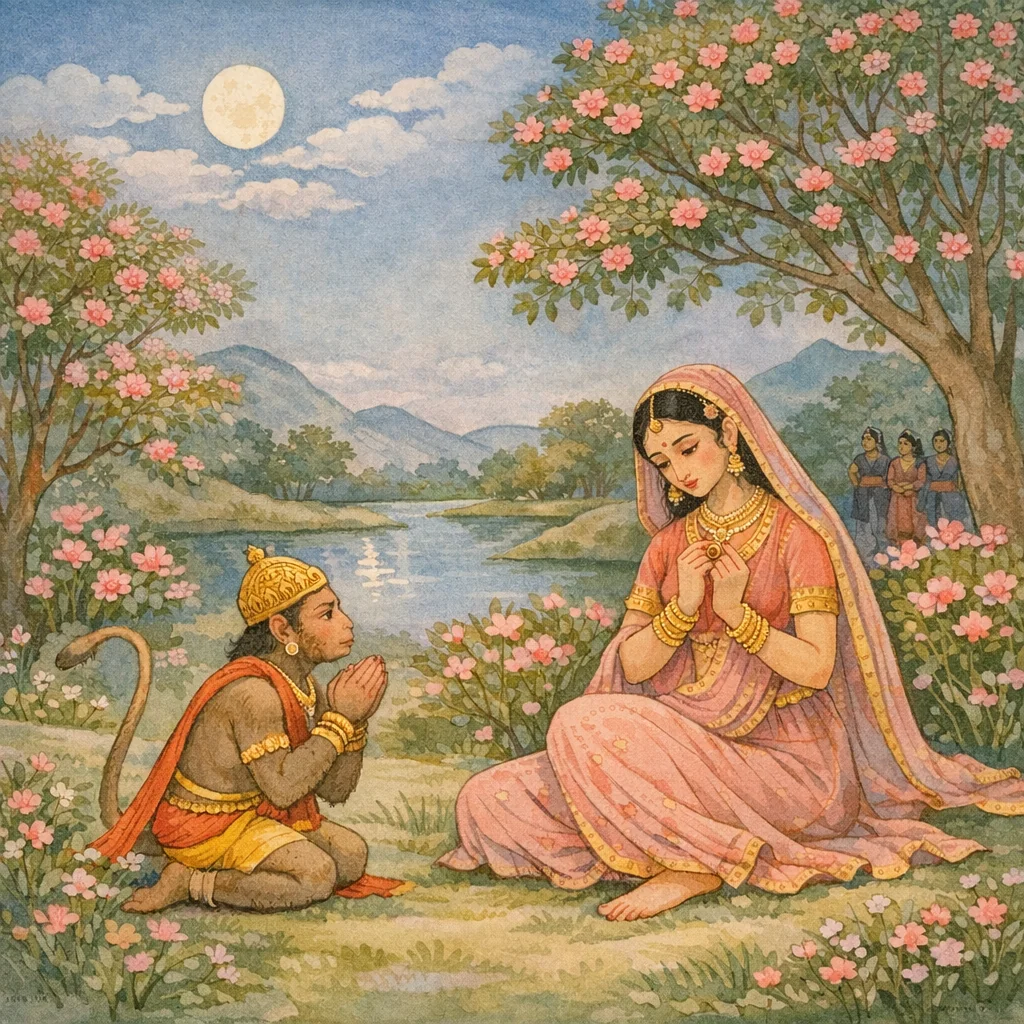
This sarga formalizes recognition (pratyaya) between envoy and captive queen through a carefully staged diplomatic exchange. Hanumān, to inspire trust, identifies himself as Rāma’s messenger and presents the signet-ring inscribed with Rāma’s name, a material token that functions as evidentiary proof. Sītā’s affect shifts from guarded doubt to relief and reverent praise: she acknowledges Hanumān’s extraordinary crossing of the hundred-yojana ocean and his fearlessness in the rākṣasa stronghold. The discourse then pivots to Sītā’s interrogatives (kaccit…): a structured sequence of welfare-questions regarding Rāma’s composure, strategic policy (twofold/threefold upāya), alliances, divine favor, and the readiness of Bharata, Sugrīva, and Lakṣmaṇa. Hanumān replies with assurances of Rāma’s imminent advance with a vast vānarā-bear host, his capacity to still even the ocean, and his unstoppable resolve against any obstruction. He also reports Rāma’s ascetic restraint and intense viraha—wakefulness, repeated utterance of Sītā’s name, and single-minded effort to recover her. The chapter closes with Sītā’s sorrow mitigated yet deepened by empathy for Rāma’s suffering, rendered through seasonal moon-and-cloud imagery; the Southern Recension preserves an oath-and-promise passage with repeated verse-numbering that reinforces the vow of reunion.
Shlokas
Verse 1
भूय एव महातेजा हनूमान्पवनात्मजः।अब्रवीत्प्रश्रितं वाक्यं सीताप्रत्ययकारणात्।।।।
Again, mighty Hanumān, the son of the Wind-god, spoke humbly—so as to become a cause for Sītā’s trust.
Verse 2
वानरोऽहं महाभागे दूतो रामस्य धीमतः।रामनामाङ्कितं चेदं पश्य देव्यङ्गुलीयकम्।।।।
O noble lady, I am a Vānara—an envoy of wise Rāma. Look, O queen: this ring bears Rāma’s name inscribed upon it.
Verse 3
प्रत्ययार्थं तवाऽनीतं तेन दत्तं महात्मना।समाश्वसिहि भद्रं ते क्षीणदुःखफला ह्यसि।।।।
This has been brought to you as a token of trust—given by the great-souled Rāma. Be at ease; blessings upon you: truly, the fruit of your sorrow is coming to an end.
Verse 4
गृहीत्वा प्रेक्षमाणा सा भर्तुः करविभूषणम्।भर्तारमिव सम्प्राप्ता जानकी मुदिताऽभवत्।।।।
Taking the ornament that adorned her husband’s hand and gazing at it, Jānakī became joyful, as though she had truly reached her husband himself.
Verse 5
चारु तद्वदनं तस्यास्ताम्रशुक्लायतेक्षणम्।अशोभत विशालाक्ष्या राहुमुक्त इवोडुराट्।।।।
Her lovely face—her wide eyes bright, white with a reddish tinge—shone like the moon released from Rāhu.
Verse 6
ततस्सा ह्रीमती बाला भर्तृसन्देशहर्षिता।परितुष्टा प्रियं कृत्वा प्रशशंस महाकपिम्।।।।
Then that young lady Sītā, bashful and delighted by her husband’s message, satisfied and wishing to respond graciously, praised the great ape (Hanumān).
Verse 7
विक्रान्तस्त्वं समर्थस्त्वं प्राज्ञस्त्वं वानरोत्तम।येनेदं राक्षसपदं त्वयैकेन प्रधर्षितम्।।।।
“You are valiant, you are capable, you are wise, O best of Vānaras—by you alone this stronghold of the Rākṣasas has been boldly assailed.”
Verse 8
शतयोजनविस्तीर्ण स्सागरो मकरालयः।विक्रमश्लाघनीयेन क्रमता गोष्पदीकृतः।।।।
“The ocean—spread across a hundred yojanas, a dwelling of makaras—has been made as small as a cow’s hoofprint by you as you strode with praiseworthy prowess.”
Verse 9
न हि त्वां प्राकृतं मन्ये वानरं वानरर्षभ।यस्य ते नास्ति सन्त्रासो रावणान्नापि सम्भ्रमः।।।।
“I do not think you are an ordinary Vānara, O bull among Vānaras—for you have neither fear of Rāvaṇa nor even anxious agitation.”
Verse 10
अर्हसे च कपिश्रेष्ठ मया समभिभाषितुम्।यद्यसि प्रेषितस्तेन रामेण विदितात्मना।।।।
O best of monkeys, it is fitting that I speak with you—if indeed you have been sent by that Rāma, the self-possessed knower of his own nature.
Verse 11
प्रेषयिष्यति दुर्धर्षो रामो न ह्यपरीक्षितम्।पराक्रममविज्ञाय मत्सकाशं विशेषतः।।।।
Formidable Rāma would not send someone untested—without knowing his valor—especially to my presence.
Verse 12
दिष्ट्या च कुशली रामो धर्मात्मा सत्यसङ्गरः।लक्ष्मणश्च महातेजास्सुमित्रानन्दवर्धनः।।।।
By good fortune, is Rāma well—righteous-souled and steadfast in truth? And is the radiant Lakṣmaṇa also well, he who increases Sumitrā’s joy?
Verse 13
कुशली यदि काकुत्स्थः किं नु सागरमेखलाम्।महीं दहति कोपेन युगान्ताग्निरिवोत्थितः।।।।
If the Kakutstha is indeed well, then why does he not, in anger, burn the ocean-girdled earth—like the risen fire at the end of an age?
Verse 14
अथवा शक्तिमन्तौ तौ सुराणामपि निग्रहे।ममैव तु न दुःखानामस्ति मन्ये विपर्ययः।।।।
Or else—those two are powerful enough even to subdue the gods; yet I think it is only my sorrow that has not met its reversal.
Verse 15
कच्चिन्न व्यथितो रामः कच्चिन्न परितप्यते।उत्तराणि च कार्याणि कुरुते पुरुषोत्तमः।।।।
Is Rāma not shaken by distress—does he not burn with grief? Is that best of men undertaking the further steps that must be done?
Verse 16
कच्चिन्न दीन स्सम्भ्रान्तः कार्येषु न च मुह्यति।कच्चित्पुरुषकार्याणि कुरुते नृपतेस्सुतः।।।।
Is the king’s son not dejected, not confused—does he not falter in his undertakings? Is he indeed performing the deeds expected of a man of resolve?
Verse 17
द्विविधं त्रिविधोपायमुपायमपि सेवते।विजिगीषुस्सुहृत्कच्चिन्मित्रेषु च परन्तपः।।।।
I hope Rāma—the scorcher of foes—who seeks victory, is adopting sound policy: employing even the twofold and the threefold strategic approaches as needed, and maintaining goodwill and wise counsel among his friends and allies.
Verse 18
कच्चिन्मित्राणि लभते मित्रैश्चाप्यभिगम्यते।कच्चित्कल्याणमित्त्रश्च मित्रत्त्रैश्चापि पुरस्कृतः।।।।
I hope he is gaining allies, and that allies also seek his friendship; I hope he has noble friends and is duly honored and supported by them.
Verse 19
कच्चिदाशास्ति देवानां प्रसादं पार्थिवात्मजः।कच्चित्पुरुषकारं च दैवं च प्रतिपद्यते।।।।
Does the prince seek the gods’ favor, and does he also rely on both human effort and destiny—holding them together in right measure?
Verse 20
कच्चिन्न विगतस्नेहः प्रवासान्मयि राघवः।कच्चिन्मां व्यसनादस्मान्मोक्षयिष्यति वानर।।।।
I hope Rāghava has not lost his love for me because of this long separation. O Vānara, I hope he will free me from this calamity.
Verse 21
सुखानामुचितो नित्यमसुखानामनौचितः।दुःखमुत्तरमासाद्य कच्चिद्रामो न सीदति।।।।
Rāma is ever worthy of happiness and not of suffering. After meeting with yet more sorrow, I hope he has not sunk into despair.
Verse 22
कौसल्यायास्तथा कच्चित्सुमित्रायास्तथैव च।अभीक्ष्णं श्रूयते कच्चित्कुशलं भरतस्य च।।।।
I hope he regularly hears good news of Kauśalyā’s welfare, and likewise of Sumitrā’s—and of Bharata’s well-being too.
Verse 23
मन्निमित्तेन मानार्हः कच्चिच्छोकेन राघवः।कच्चिन्नान्यमना रामः कच्चिन्मां तारयिष्यति।।।।
Because of me, I hope Rāghava—so worthy of honor—is not overwhelmed by grief. I hope Rāma is not distracted in mind, and that he will bring me safely through this ordeal.
Verse 24
कच्चिदक्षौहिणीं भीमां भरतो भ्रातृवत्सलः।ध्वजिनीं मन्त्रिभिर्गुप्तां प्रेषयिष्यति मत्कृते।।।।
I hope Bharata—so devoted to his brother—will send, for my sake, a formidable akṣauhiṇī army, a bannered host safeguarded by ministers.
Verse 25
वानराधिपतिश्शीमान्सुग्रीवः कच्चिदेष्यति।मत्कृते हरिभिर्वीरैर्वृतो दन्तनखायुधैः।।।।
I hope the illustrious lord of the Vānaras, Sugrīva, will come here for my sake—surrounded by heroic monkeys whose weapons are their teeth and nails.
Verse 26
कच्चिच्छ लक्ष्मणश्शूरस्सुमित्रानन्दवर्धनः।अस्त्रविच्छरजालेन राक्षसान्विधमिष्यति।।।।
May that heroic Lakṣmaṇa—who increases Sumitrā’s joy, and is skilled in weapons—surely scatter the rākṣasas with a net of arrows.
Verse 27
रौद्रेण कच्चिदस्त्रेण ज्वलता निहतं रणे।द्रक्ष्याम्यल्पेन कालेन रावणं ससुहृज्जनम्।।।।
Will I, in a short time, behold Rāvaṇa—together with his allies and kinsmen—slain in battle by blazing, wrathful weapons?
Verse 28
कच्चिन्न तद्धेमसमानवर्णं तस्याननं पद्मसमानगन्धि।मया विना शुष्यति शोकदीनं जलक्षये पद्ममिवातपेन।।।।
I pray that his face—golden in hue and lotus-fragrant—has not withered in grief without me, like a lotus drying up when the water is gone, scorched by the sun’s heat.
Verse 29
धर्मापदेशात्त्यजतश्च राज्यं मां चाप्यरण्यं नयतः पदातिम्।नासीद्व्यथा यस्य न भीर्न शोकः कच्चित्स धैर्यं हृदये करोति।।।।
He who, for the sake of dharma, renounced his kingdom and led me on foot into the forest—he in whom there was then neither anguish, nor fear, nor grief—I pray that he still sustains that courage within his heart.
Verse 30
न चास्य माता न पिता च नान्यः स्नेहाद्विशिष्टोऽस्ति मया समो वा।तावत्त्वहं दूत जिजीविषेयं यावत्प्रवृत्तिं शृणुयां प्रियस्य।।।।
Neither his mother nor his father—nor anyone else—surpasses me in his affection, nor is anyone equal. O messenger, I would wish to live only until I hear news of my beloved.
Verse 31
इतीव देवी वचनं महार्थं तं वानरेन्द्रं मधुरार्थमुक्त्वा।श्रोतुं पुनस्तस्य वचोऽभिरामं रामार्थयुक्तं विरराम रामा।।।।
Having thus spoken to the lord of the vānaras—words weighty in meaning and sweet in expression—Sītā fell silent again, wishing to hear once more his pleasing speech, filled with matters concerning Rāma.
Verse 32
सीताया वचनं श्रुत्वा मारुतिर्भीमविक्रमः।शिरस्यञ्जलिमाधाय वाक्यमुत्तरमब्रवीत्।।।।
Hearing Sītā’s words, Māruti—of formidable prowess—placed his joined palms upon his head in reverence and spoke his reply.
Verse 33
न त्वामिहस्थां जानीते रामः कमललोचने।तेन त्वां नानयत्याशु शचीमिव पुरन्दरः।।।।
O lotus-eyed one, Rāma does not know that you are here; therefore he has not at once carried you away—just as Purandara (Indra) carried off Śacī.
Verse 34
श्रुत्वैव तु वचो मह्यं क्षिप्रमेष्यति राघवः।चमूं प्रकर्षन्महतीं हर्यृक्षगणसङ्कुलाम्।।।।
But as soon as he hears my message, Rāghava will come swiftly—leading a vast army crowded with troops of vānaras and bears.
Verse 35
विष्टम्भयित्वा बाणौघैरक्षोभ्यं वरुणालयम्।करिष्यति पुरीं लङ्कां काकुत्स्थः शान्तराक्षसाम्।।।।
Kākutstha (Rāma) will, by a torrent of arrows, subdue even the unshakable abode of Varuṇa—the ocean—and he will make the city of Laṅkā free from rākṣasas.
Verse 36
तत्र यद्यन्तरा मृत्युर्यदि देवास्सहासुराः।स्थास्यन्ति पथि रामस्य स तानपि वधिष्यति।।।।
If, in that enterprise, even Death itself—or gods together with asuras—should stand in Rāma’s way, he will strike down even them.
Verse 37
तवादर्शनजेनार्ये शोकेन स परिप्लुतः।न शर्म लभते रामस्सिंहार्दित इव द्विपः।।।।
O noble lady, from not seeing you he is flooded by grief; Rāma finds no peace—like an elephant tormented by a lion.
Verse 38
मलयेन च विन्ध्येन मेरुणा मन्दरेण च।दर्दुरेण च ते देवि शपे मूलफलेन च।।।।यथा सुनयनं वल्गु बिम्बोष्ठं चारु कुण्डलम् ।मुखं द्रक्ष्यसि रामस्य पूर्णचन्द्रमिवोदितम्।।।।
O goddess-like Sītā, I swear to you by Malaya, Vindhya, Meru, Mandara, and Dardura, and by the roots and fruits (that sustain us): you will behold Rāma’s face—beautiful-eyed, with bimba-red lips and lovely earrings—shining like the risen full moon.
Verse 39
मलयेन च विन्ध्येन मेरुणा मन्दरेण च।दर्दुरेण च ते देवि शपे मूलफलेन च।।5.36.38।।यथा सुनयनं वल्गु बिम्बोष्ठं चारु कुण्डलम् ।मुखं द्रक्ष्यसि रामस्य पूर्णचन्द्रमिवोदितम्।।5.36.39।।
O Sītā, I swear by Malaya, Vindhya, Meru, Mandara, and Dardura, and by the roots and fruits (our fare): you will see Rāma’s moonlike face, radiant like a risen full moon—beautiful-eyed, with bimba-red lips and lovely earrings.
Verse 40
क्षिप्रं द्रक्ष्यसि वैदेहि रामं प्रस्रवणे गिरौ।शतक्रतुमिवासीनं नागराजस्य मूर्धनि।।।।
Soon, O Vaidehī, you will see Rāma on Mount Prasravaṇa—like Śatakratu (Indra) seated upon the head of the lord of elephants.
Verse 41
न मांसं राघवो भुङक्ते न चाऽपि मधु सेवते।वन्यं सुविहितं नित्यं भक्तमश्नाति पञ्चमम्।।।।
Rāghava does not eat meat, nor does he partake of wine; he consistently eats only the forest fare, in the measured portion prescribed (for an ascetic discipline).
Verse 42
नैव दंशान्न मशकान्न कीटान्न सरीसृपान्।राघवोऽपनयेद्गात्रात्त्वद्गतेनान्तरात्मना।।।।
With his inmost mind fixed on you, Rāghava does not even brush away from his body flies, mosquitoes, insects, or creeping creatures.
Verse 43
नित्यं ध्यानपरो रामो नित्यं शोकपरायणः।नान्यच्चिन्तयते किञ्चित्स तु कामवशं गतः।।।।
Rāma is continually absorbed in meditation (upon you) and continually devoted to grief; he thinks of nothing else at all—so completely has love taken hold of him.
Verse 44
अनिद्रस्सततं रामस्सुप्तोऽपि च नरोत्तमः।सीतेति मधुरां वाणीं व्याहरन्प्रतिबुध्यते।।।।
Rāma, the best of men, remains ever wakeful; and even if he falls asleep, he wakes again while softly uttering in a sweet voice, “Sītā.”
Verse 45
दृष्ट्वा फलं वा पुष्पं वा यद्वाऽन्यत्सुमनोहरम्।बहुशो हा प्रियेत्येवं श्वसंस्त्वामभिभाषते।।।।
Whenever he sees a fruit, a flower, or anything else that delights the mind, he sighs and speaks to you again and again: “Alas, my beloved!”
Verse 46
स देवि नित्यं परितप्यमान स्त्वामेव सीतेत्यभिभाषमाणः।धृतव्रतो राजसुतो महात्मा तवैव लाभाय कृतप्रयत्नः।।।।
O noble lady, he suffers ceaselessly, speaking as though only to you—‘Sītā!’ That great-souled prince, firm in his vow, strives solely for your recovery.
Verse 47
सा रामसङ्कीर्तनवीतशोका रामस्य शोकेन समानशोका।शरन्मुखे साम्बुदशेषचन्द्रा निशेव वैदेहसुता बभूव।।।।
Thus Vaidehī—her grief eased by the recounting of Rāma—yet grieving equally at Rāma’s grief, appeared like an autumn night, with the moon partly veiled by lingering clouds.
Frequently Asked Questions
The pivotal action is pratyaya-sādhana: Hanumān must authenticate himself without pressuring Sītā. He uses a lawful token (Rāma’s name-inscribed ring) and humble speech, aligning proof with respectful dūta-dharma rather than emotional manipulation.
The dialogue teaches that trust is established through verifiable signs and consistent conduct, while endurance in separation is sustained by truthful communication, disciplined living, and unwavering intention toward dharma-driven reunion.
Key landmarks include the ocean (Varuṇālaya) as the strategic barrier, Mount Prasravaṇa as the projected rendezvous setting, and the oath-invoked mountains (Malaya, Vindhya, Meru, Mandara, Dardura) reflecting vānarā cultural geography and credibility formulas.