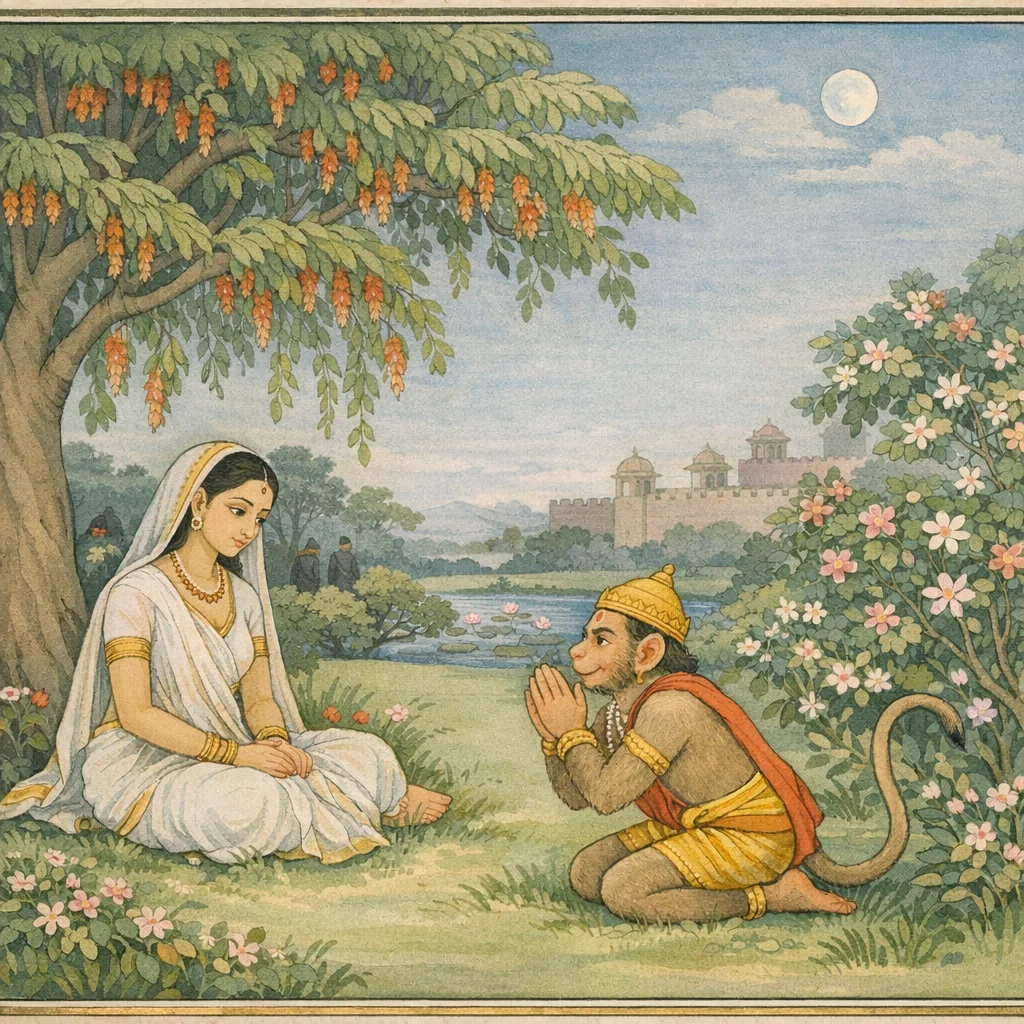
Sarga 34
सीताहनूमद्भाषणम् — Sita Tests the Messenger; Hanuman Offers Reassurance
सुन्दरकाण्ड
Sarga 34 stages a high-stakes verification dialogue in Aśoka-vāṭikā. After Hanumān approaches and prostrates, Sītā—overwhelmed by grief and fear—suspects he may be Rāvaṇa in disguise, recalling the earlier deception at Jana-sthāna. Her speech oscillates between dread (the rākṣasas’ kāma-rūpatva, ‘shape-shifting’) and an emergent intuitive trust, articulated as a subtle psychological criterion: her mind experiences prīti (calm pleasure) in his presence, which argues against a hostile illusion. Hanumān responds as an ideal envoy: he identifies himself as Rāma’s dūta, conveys welfare inquiries from Rāma, Lakṣmaṇa, and Sugrīva, and praises Rāma’s qualities through cosmological similes (Sun/Moon/Viṣṇu/Vaiśravaṇa), thereby grounding credibility in recognizable dharmic rhetoric. Sītā’s internal debate continues—dream vs. reality, delusion vs. sanity—until Hanumān explicitly requests that suspicion be set aside and trust granted. The chapter’s lesson is epistemic as well as ethical: in crisis, verification must be rigorous, yet compassion and truthful speech can rebuild confidence without coercion.
Shlokas
Verse 1
तस्यास्तद्वचनं श्रुत्वा हनुमान्हरिपुङ्गवः।दुःखाद्दुःखाभिभूताया स्सान्त्वमुत्तरमब्रवीत्।।।।
Hearing her words—she who was overwhelmed by grief—Hanumān, foremost among the monkeys, himself pained, replied with words meant to comfort.
Verse 2
अहं रामस्य सन्देशाद्देवि दूतस्तवागतः।वैदेहि कुशली रामस्त्वां च कौशलमब्रवीत्।।।।
O queen—Vaidehī—I have come to you as a messenger, by Rāma’s command. Rāma is well, and he has spoken wishes for your welfare as well.
Verse 3
यो ब्रह्ममस्त्रं वेदांश्च वेद वेदविदांवरः।स त्वां दाशरथी रामो देवि कौशलमब्रवीत्।।।।
“O noble lady! Rāma, Daśaratha’s son—foremost among knowers of the Vedas and skilled in the Brahmāstra—has asked after your welfare.”
Verse 4
लक्ष्मणश्च महातेजा भर्तुस्तेऽनुचरः प्रियः।कृतवान्शोकसन्तप्तश्शिरसा तेऽभिवादनम्।।।।
Lakṣmaṇa too—mighty, dear, and devoted as your husband’s close follower—though scorched by grief, bows to you in reverence and sends his salutation.
Verse 5
सा तयोः कुशलं देवी निशम्य नरसिंहयोः।प्रीतिसंहृष्टसर्वाङ्गी हनुमन्तमथाब्रवीत्।।।।
Hearing of the well-being of those two lion-like men, the queen was thrilled with joy in every limb; then she spoke to Hanumān.
Verse 6
कल्याणी बत गाथेयं लौकिकी प्रतिभाति मा।एति जीवन्तमानन्दो नरं वर्षशतादपि।।।।
Ah—this common saying seems auspiciously true to me: joy comes to one who still lives, even after a hundred years.
Verse 7
तया समागते तस्मिन्प्रीतिरुत्पादिताऽद्भुता।परस्परेण चालापं विश्वस्तौ तौ प्रचक्रतुः।।।।
When he had thus met with her, a wondrous joy arose. Trusting one another, the two began to speak together in mutual confidence.
Verse 8
तस्यास्तद्वचनं श्रुत्वा हनुमान्हरियूथपः।सीतायाश्शोकदीनायास्समीपमुपचक्रमे।।।।
Having heard her words, Hanumān, the leader among the monkey-troops, moved closer to Sītā, who was piteous with grief.
Verse 9
यथा यथा समीपं स हनुमानुपसर्पति।तथा तथा रावणं सा तं सीता परिशङ्कते।।।।
As Hanumān drew nearer and nearer, Sītā, in the same measure, suspected him to be Rāvaṇa.
Verse 10
अहो धिग्दुष्कृतमिदं कथितं हि यदस्य मे।रूपान्तरमुपागम्य स एवायं हि रावणः।।।।
Alas—shame on me! I have told him what should not have been told. Having assumed another form, this must indeed be Rāvaṇa himself.
Verse 11
तामशोकस्य शाखां सा विमुक्त्वा शोककर्शिता।तस्यामेवानवद्याङ्गी धरण्यां समुपाविशत्।।।।
Sītā—her body worn by sorrow—released that branch of the Aśoka tree; the flawless-limbed lady sat down on the ground there.
Verse 12
हनुमानपि दुःखार्तां तां दृष्ट्वा भयमोहिताम्।अवन्दत महाबाहुस्ततस्तां जनकात्मजाम्।।।।सा चैनं भयवित्रस्ता भूयो नैवाभ्युदैक्षत।
Seeing her afflicted with sorrow and bewildered by fear, mighty-armed Hanumān bowed down to Janaka’s daughter. Yet Sītā, trembling with fear, did not look at him again.
Verse 13
तं दृष्ट्वा वन्दमानं तु सीता शशिनिभानना।।।।अब्रवीद्धीर्घमुच्छवस्य वानरं मधुरस्वरा।
Seeing him bowing, Sītā—moon-faced—sighed deeply and then spoke to the monkey in a gentle, sweet voice.
Verse 14
मायां प्रविष्टो मायावी यदि त्वं रावणस्स्वयम्।।।।उत्पादयसि मे भूयस्सन्तापं तन्न शोभनम्।
If you are that deceiver Rāvaṇa himself, entering here through illusion and disguise, you are stirring up my anguish again—this is not fitting.
Verse 15
स्वं परित्यज्य रूपं यः परिव्राजकरूपध्रुत्।जनस्थाने मया दृष्टस्त्वं स एवासि रावणः।।।।
You are that very Rāvaṇa whom I saw in Jana-sthāna—who abandoned his own form and wore the guise of a wandering mendicant.
Verse 16
उपवासकृशां दीनां कामरूप निशाचर।सन्तापयसि मां भूयस्सन्तप्तां तन्न शोभनम्।।।।
O night-roamer who can assume any form at will—tormenting me again, when I am pitiable, emaciated by fasting, and already burned by grief, is not fitting.
Verse 17
अथवा नैतदेवं हि यन्मया परिशङ्कितम्।।।।मनसो हि मम प्रीतिरुत्पन्ना तव दर्शनात्।
Or perhaps my suspicion is not true; for, on seeing you, a gladness has arisen in my very mind.
Verse 18
यदि रामस्य दूतस्त्वमागतो भद्रमस्तु ते।।।।पृच्छामि त्वां हरिश्रेष्ठ प्रिया रामकथा हि मे।
If you have come as Rāma’s messenger, blessings be upon you. O best of vanaras, I ask you—dear to me indeed is the tale of Rāma.
Verse 19
गुणान्रामस्य कथय प्रियस्य मम वानर।।।।चित्तं हरसि मे सौम्य नदीकूलं यथा रयः।
Tell me of the virtues of Rāma, who is dear to me, O vanara. Gentle one, you draw away my mind—like a river’s current carrying off its bank.
Verse 20
अहो स्वप्नस्य सुखता याहमेवं चिराहृता।।।।प्रेषितं नाम पश्यामि राघवेण वनौकसम्।
Ah—how pleasant a dream this is, that after so long I seem to behold a forest-dwelling vanara said to be sent by Rāghava.
Verse 21
स्वप्नेऽपि यद्यहं वीरं राघवं सहलक्ष्मणम्।।।।पश्येयं नावसीदेयं स्वप्नोऽपि मम मत्सरी।
If even in a dream I could behold the heroic Rāghava together with Lakṣmaṇa, I would not sink into despair. Yet even sleep—and dream—seems hostile to me.
Verse 22
नाहं स्वप्नमिमं मन्ये स्वप्ने दृष्ट्वा हि वानरम्।।।।न शक्योऽभ्युदयः प्राप्तुं प्राप्तश्चाभ्युदयो मम।
I do not think this is a dream; for, by seeing a vanara in a dream, well-being is not gained—yet well-being has indeed come upon me now.
Verse 23
किन्नु स्याचित्तमोहोऽयं भवेद्वातगतिस्त्वियम्।।।।उन्मादजो विकारो वा स्यादियं मृगतृष्णिका।
What then is this—delusion of the mind? Or could this be a disturbance of the inner winds? Or a change born of madness? Or is this but a mirage?
Verse 24
अथवा नायमुन्मादो मोहोऽप्युन्मादलक्षणः।।।।सम्बुध्ये चाहमात्मानमियं चापि वनौकसम्।
Or else—this is not madness, nor even a delusion marked by madness. I am fully aware of myself, and of this forest-dweller too.
Verse 25
इत्येवं बहुधा सीता सम्प्रधार्य बलाबलम्।।।।रक्षसां कामरूपत्वान्मेने तं राक्षसाधिपम्।
Thus Sītā, deliberating in many ways upon strength and weakness, and remembering that the rākṣasas can assume forms at will, suspected him to be the lord of rākṣasas.
Verse 26
एतां बुद्धिं तदा कृत्वा सीता सा तनुमध्यमा।।।।न प्रतिव्याजहाराथ वानरं जनकात्मजा।
Having formed this resolve in her mind, Sītā—slender-waisted, Janaka’s daughter—did not reply to the vanara.
Verse 27
सीतायाश्चिन्तितं बुद्ध्वा हनुमान्मारुतात्मजः।।।।श्रोत्रानुकूलैर्वचनैस्तदा तां संप्रहर्षयत्।
Understanding what Sītā was thinking, Hanumān—the son of the Wind-god—then gladdened her with words pleasant to hear.
Verse 28
आदित्य इव तेजस्वी लोककान्तश्शशी यथा।।।।राजा सर्वस्य लोकस्य देवो वैश्रवणो यथा।विक्रमेणोपपन्नश्च यथा विष्णुर्महायशाः।।।।
“Rāma is radiant like the Sun; he delights the world like the Moon. He is king over the world like the lord Vaiśravaṇa, and—great in fame—he is endowed with valor like Viṣṇu.”
Verse 29
आदित्य इव तेजस्वी लोककान्तश्शशी यथा।।5.34.28।।राजा सर्वस्य लोकस्य देवो वैश्रवणो यथा।विक्रमेणोपपन्नश्च यथा विष्णुर्महायशाः।।5.34.29।।
This verse repeats the same praise: “Rāma is radiant like the Sun, beloved like the Moon, kingly like Vaiśravaṇa, and famed and valorous like Viṣṇu.”
Verse 30
सत्यवादी मधुरवाग्देवो वाचस्पतिर्यथा।रूपवान्सुभग श्रीमान् कन्दर्प इव मूर्तिमान्।।।।
“He speaks truth, and his words are sweet—like Vācaspati. He is handsome, fortunate, and radiant, like Love-god himself embodied.”
Verse 31
स्थानक्रोधः प्रहर्ता च श्रेष्ठो लोके महारथः।बाहुच्छायामवष्टब्धो यस्य लोको महात्मनः।।।।
“His anger falls only where it is due, and he punishes the guilty. He is the foremost great charioteer in the world; under the shelter of that great soul’s arms, the world finds refuge.”
Verse 32
अपकृष्याश्रमपदान्मृगरूपेण राघवम्।शून्ये येनापनीतासि तस्य द्रक्ष्यसि यत्फलम्।।।।
“You will see the consequence of the one who, luring Rāghava away from the hermitage by a deer-form, carried you off into a desolate place.”
Verse 33
न चिराद्रावणं संख्ये यो वधिष्यति वीर्यवान्।रोषप्रमुक्तैरिषुभिर्ज्वलद्भिरिव पावकैः।।।।तेनाहं प्रेषितो दूत स्त्वत्सकाशमिहागतः।त्वद्वियोगेन दुःखार्त स्स त्वां कौशलमब्रवीत्।।।।
“Before long, the heroic one will slay Rāvaṇa in battle with arrows loosed in wrath, blazing like fire. Therefore I have been sent as a messenger and have come here into your presence. Tormented by sorrow from separation from you, he asks after your welfare.”
Verse 34
न चिराद्रावणं संख्ये यो वधिष्यति वीर्यवान्।रोषप्रमुक्तैरिषुभिर्ज्वलद्भिरिव पावकैः।।5.34.33।।तेनाहं प्रेषितो दूत स्त्वत्सकाशमिहागतः।त्वद्वियोगेन दुःखार्त स्स त्वां कौशलमब्रवीत्।।5.34.34।।
This record repeats the preceding statement: “Soon the heroic one will slay Rāvaṇa with blazing arrows; therefore I have come as a messenger to you, conveying Rāma’s inquiry about your welfare in his grief of separation.”
Verse 35
लक्ष्मणश्च महातेजास्सुमित्रानन्दवर्धनः।अभिवाद्य महाबाहुस्स त्वां कौशलमब्रवीत्।।।।
Brilliant Lakṣmaṇa—long-armed and the joy of Sumitrā—offers you his salutations and asks after your welfare.
Verse 36
रामस्य च सखा देवि सुग्रीवो नाम वानरः।राजा वानरमुख्यानां स त्वां कौशलमब्रवीत्।।।।
O देवी, Sugrīva by name—the vanara who is Rāma’s friend and the king of the vanara leaders—also asks after your well-being.
Verse 37
नित्यं स्मरति रामस्त्वां ससुग्रीव स्सलक्ष्मणः।दिष्ट्या जीवसि वैदेहि राक्षसीवशमागता।।।।
Vaidehī, Rāma—together with Sugrīva and Lakṣmaṇa—remembers you constantly. By good fortune you still live, though you have fallen under the power of the rākṣasīs.
Verse 38
नचिराद्द्रक्ष्यसे रामं लक्ष्मणं च महाबलम्।मध्ये वानरकोटीनां सुग्रीवं चामितौजसम्।।।।
Before long you will see Rāma and mighty Lakṣmaṇa, and also Sugrīva of immeasurable prowess, standing amid crores of vanaras.
Verse 39
अहं सुग्रीवसचिवो हनुमान्नाम वानरः।प्रविष्टो नगरीं लङ्कां लङ्घयित्वा महोदधिम्।।।।
I am the vanara named Hanumān, minister to Sugrīva; having leapt across the great ocean, I have entered the city of Laṅkā.
Verse 40
कृत्वा मूर्ध्नि पदन्यासं रावणस्य दुरात्मनः।त्वां द्रष्टुमुपयातोऽहं समाश्रित्य पराक्रमम्।।।।
Relying on my valor, I have come to see you—having, as it were, set my foot upon the head of the wicked-souled Rāvaṇa.
Verse 41
नाहमस्मि तथा देवि यथा मामवगच्छसि।विशङ्का त्यज्यतामेषा श्रद्धत्स्व वदतो मम।।।।
O देवी, I am not as you suspect me to be. Cast off this doubt, and trust my words as I speak.
Frequently Asked Questions
The dilemma is trust under coercive conditions: Sītā must decide whether the approaching vanara is a genuine messenger or Rāvaṇa using māyā (disguise). Hanumān’s key action is to respond with non-threatening reverence (prostration) and verifiable, welfare-centered speech rather than force, aligning with envoy ethics.
The chapter teaches disciplined discernment: suspicion is rational when adversaries can manipulate appearances, yet inner indicators (calm prīti), consistent truthful speech, and dharmic conduct can serve as practical criteria for validation. Compassionate language becomes a method of restoring agency and clarity in grief.
Aśoka-vāṭikā in Laṅkā is the primary landmark, with the Aśoka tree branch marking Sītā’s captivity setting. The episode also references Jana-sthāna (site of earlier deception) and the Mahodadhi (ocean) that Hanumān crosses, mapping the mission’s route and cultural memory of disguise and abduction.