Sarga 32
Sundarakāṇḍa Sarga 32 — Sītā’s Perplexity and Recognition of Hanumān
सुन्दरकाण्ड
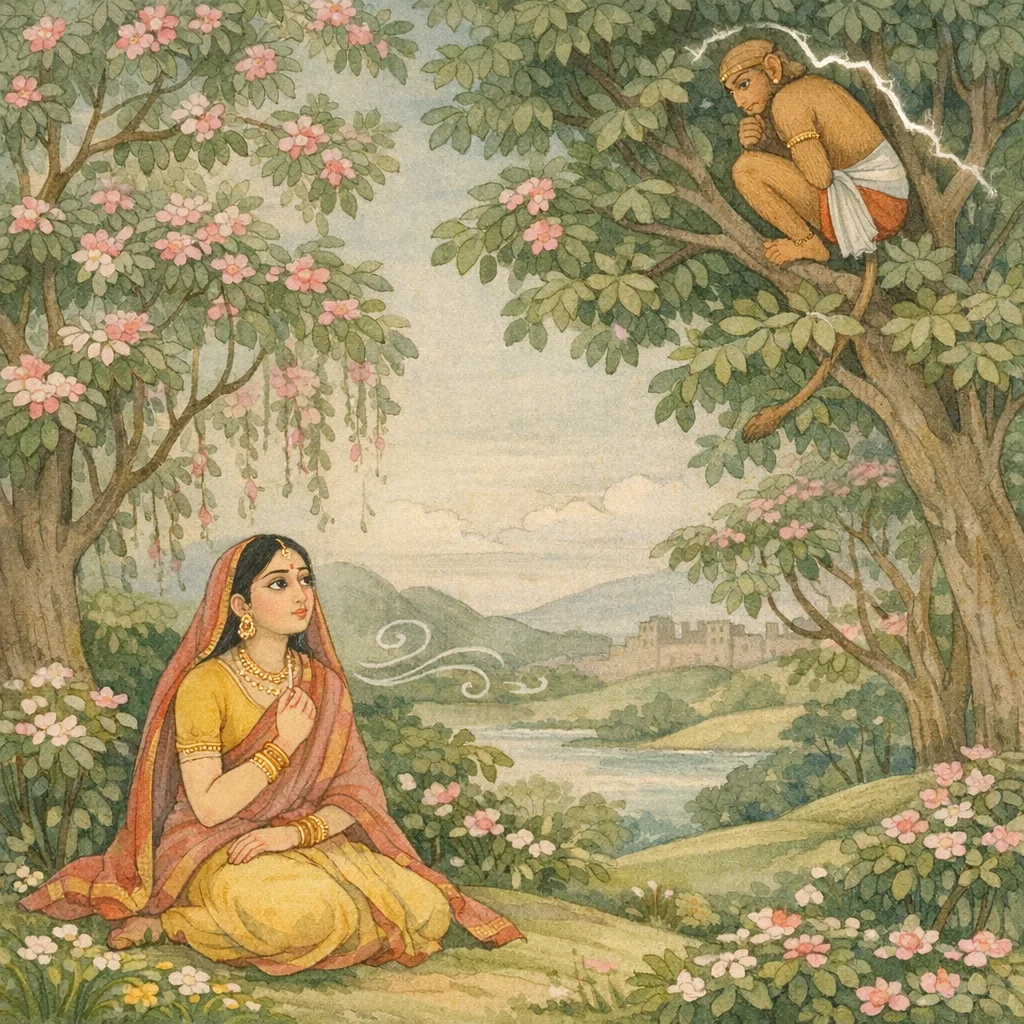
This sarga stages the first psychologically complex moments of Sītā’s encounter with Hanumān in the Aśoka grove. She sees a tawny vanara figure, lightning-like in brilliance and clad in pale/white coverings, concealed among branches; the sight destabilizes her already grief-stricken mind. Alternating between fear, fainting, and reflective analysis, Sītā tests whether the experience is dream, omen, or hallucination, citing her sleeplessness under sorrow and separation from the “full-moon-faced” Rāma. She repeatedly verbalizes Rāma’s name and Lakṣmaṇa’s, then reasons: desire (manoratha) is formless, yet the speaker before her has a manifest form—therefore the experience demands a different explanation than mere mental projection. The chapter closes with her reverential invocation to deities associated with speech, sovereignty, creation, and fire (Indra, Bṛhaspati/Vācaspati, Brahmā/Svayambhū, and Agni), wishing that the vanara’s words prove true. The sarga thus combines close interior monologue with ethical-epistemic scrutiny: how a traumatized witness verifies truth when perception is impaired by grief.
Shlokas
Verse 1
ततश्शाखान्तरे लीनं दृष्ट्वा चलितमानसा।वेष्टितार्जुनवस्त्रं तं विद्युत्सङ्घातपिङ्गलम्।।।।
Then, seeing him hidden between the branches—clad in white and tawny like a mass of lightning—Sītā’s mind grew unsettled and uncertain.
Verse 2
सा ददर्श कपिं तत्र प्रश्रितं प्रियवादिनम्।फुल्लाशोकोत्कराभासं तप्तचामीकरेक्षणम्।।।।
There she saw a monkey who approached with humility and spoke in pleasing words—radiant like a cluster of fully blossomed aśoka flowers, his eyes gleaming like molten gold.
Verse 3
मैथिली चिन्तयामास विस्मयं परमं गता।अहो भीममिदं रूपं वानरस्य दुरासदम्।।।।दुर्निरीक्षमिति ज्ञात्वा पुनरेव मुमोह सा।
Maithilī, overcome with great astonishment, began to ponder: “Alas—this form of the vanara is terrifying, hard to approach, and difficult to look upon.” Thinking so, she fainted once again.
Verse 4
विललाप भृशं सीता करुणं भयमोहिता।।।।रामरामेति दुःखार्ता लक्ष्मणेति च भामिनी।रुरोद बहुधा सीता मन्दं मन्दस्वरा सती।।।।
Overcome by fear and confusion, Sītā lamented piteously. In her sorrow she cried, “Rāma, Rāma,” and “Lakṣmaṇa,” weeping again and again in a faint, subdued voice.
Verse 5
विललाप भृशं सीता करुणं भयमोहिता।।5.32.4।।रामरामेति दुःखार्ता लक्ष्मणेति च भामिनी।रुरोद बहुधा सीता मन्दं मन्दस्वरा सती।।5.32.5।।
For now I am tormented by love for him, with my whole being absorbed in him. Constantly thinking only of him, I seem likewise to see him—and likewise to hear him.
Verse 6
सा तं दृष्ट्वा हरिश्रेष्ठं विनीतवदुपस्थितम्।मैथिली चिन्तयामास स्वप्नोऽयमिति भामिनी।।।।
Seeing the best of the monkeys standing near with humility, the noble Maithilī reflected, “Is this a dream?”
Verse 7
सा वीक्षमाणा पृथुभुग्नवक्त्रं शाखामृगेन्द्रस्य यथोक्तकारम्।ददर्श पिङ्गाधिपते रमात्यं वातात्मजं बुद्धिमतां वरिष्ठम्।।।।
As she looked about, she saw the son of the Wind-god—broad, with a curved face—an obedient servant and minister of the tawny monkey-lord, foremost among the intelligent.
Verse 8
सा तं समीक्ष्यैव भृशं विसंज्ञा गतासुकल्पेन बभूव सीता।चिरेण संज्ञां प्रतिलभ्य भूयो विचिन्तयामास विशालनेत्रा।।।।
At the very sight of him Sītā lost consciousness, as though life itself were departing. After a long while, regaining her senses, the large-eyed lady began to reflect once more.
Verse 9
स्वप्ने मयाऽयं विकृतोऽद्य दृष्टश्शाखामृगश्शास्त्रगणैर्निषिद्धः।स्वस्त्यस्तु रामाय स लक्ष्मणाय तथा पितुर्मे जनकस्य राज्ञः।।।।
Today I saw, in a dream, a deformed monkey—an omen forbidden as inauspicious by the teachings of the śāstras. Yet may there be well-being and auspiciousness for Rama and for Lakshmana, and likewise for my father, King Janaka.
Verse 10
स्वप्नोऽपि नायं नहि मेऽस्ति निद्रा शोकेन दुःखेन च पीडितायाः।सुखं हि मे नास्ति यतोऽस्मि हीना तेनेन्दुपूर्णप्रतिमाननेन।।।।
This is not a dream—sleep does not come to me, tormented by grief and pain. I have no happiness, for I am separated from him whose face is like the full moon.
Verse 11
रामेति रामेति सदैव बुद्ध्या विचिन्त्य वाचा ब्रुवती तमेव।तस्यानुरूपां च कथां तदर्थमेवं प्रपश्यामि तथा शृणोमि।।।।
‘Rāma, Rāma’—thus I think of him always in my mind and speak of him alone with my voice. And for his sake, fitting tales of him arise: so I seem to see him, and so I seem to hear him.
Verse 12
अहं हि तस्याद्य मनोभवेन सम्पीडिता तद्गतसर्वभावा।विचिन्तयन्ती सततं तमेव तथैव पश्यामि तथा शृणोमि।।।।
For now I am tormented by love for him, with my whole being absorbed in him. Constantly thinking only of him, I seem likewise to see him—and likewise to hear him.
Verse 13
मनोरथस्स्यादिति चिन्तयामि तथापि बुद्ध्या च वितर्कयामि।किं कारणं तस्य हि नास्ति रूपं सुव्यक्तरूपश्च वदत्ययं माम्।।।।
I think, “Perhaps this is only a longing of the mind.” Yet I reason with my understanding: what is the cause? For that longing has no form—whereas this one, clearly embodied, is speaking to me.
Verse 14
नमोऽस्तु वाचस्पतये सवज्रिणे स्वयंभुवे चैव हुताशनाय च।अनेन चोक्तं यदिदं ममाग्रतो वनौकसा तच्छ तथास्तु नान्यथा।।।।
Salutations be to Bṛhaspati, to Indra the wielder of the thunderbolt, to self-born Brahmā, and to Agni. May what has been spoken here before me by this forest-dweller be true—so it be, and not otherwise.
Frequently Asked Questions
Sītā faces an epistemic-ethical dilemma: how to respond to an unknown messenger while her perception is compromised by trauma and grief. Her action is cautious verification—she withholds assent, tests the experience against her condition (sleeplessness, sorrow), and evaluates whether the speaker’s manifested form can be reduced to mere desire or hallucination.
The sarga teaches discernment (viveka) under suffering: authentic hope is not blind optimism but reasoned trust built through signs, coherent speech, and ethical consistency. It also frames nāma-smaraṇa (constant remembrance of Rama) as both devotion and a psychological anchor amid distress.
The setting is the arboreal space of the Aśoka grove (implied via Aśoka blossoms and branch concealment), emphasizing Lanka’s garden enclosure as a cultural motif of captivity and surveillance, while the invocations to Indra, Bṛhaspati, Brahmā, and Agni reflect a pan-Indic ritual vocabulary for truth, speech, and auspicious verification.