Sarga 30
हनुमता सीतासंवादोपायचिन्ता — Hanuman’s Deliberation on How to Address Sita
सुन्दरकाण्ड
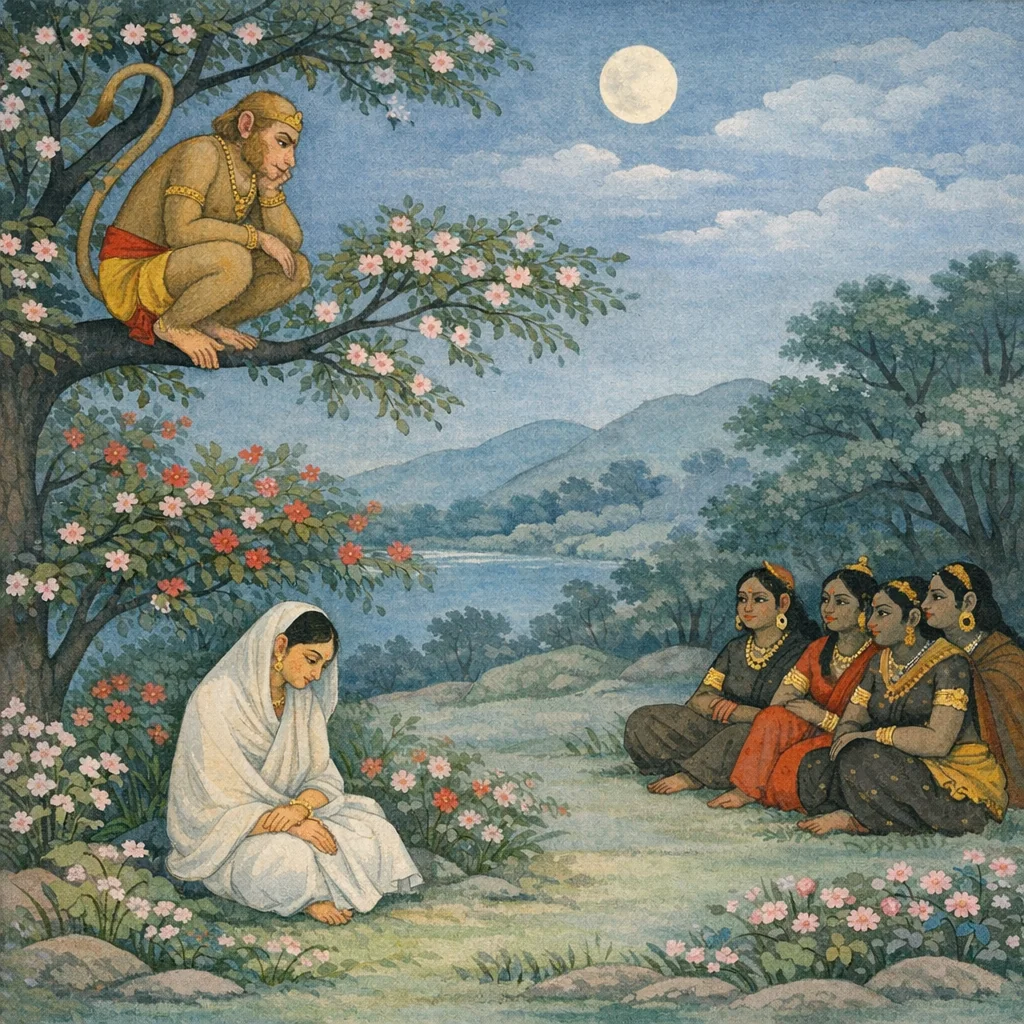
This sarga is a technical portrait of messenger-dharma (dūta-nīti) under surveillance. Hanumān, concealed in Aśoka-vana, hears the exchange involving Sītā, Trijaṭā’s dream, and the rākṣasīs’ threats (5.30.1), and then undertakes a layered risk analysis. He recognizes that returning without Sītā’s message would jeopardize accountability before Rāma and render the vānaras’ mobilization futile (5.30.13–15). Yet speaking openly risks triggering Sītā’s fear—she may suspect a disguised Rāvaṇa—leading to alarm, armed response, capture, and exhaustion that would prevent the ocean-crossing return (5.30.18–29, 34). The chapter’s central dilemma is thus dual: silence may cause Vaidehī’s despair unto death, while ill-timed speech may collapse the mission (5.30.12, 36). Hanumān resolves to approach through gentle, dharma-aligned praise of Rāma, selecting humanly intelligible, sweet, confidence-building language so Sītā can listen without agitation (5.30.40–44).
Shlokas
Verse 1
हनुमानपि विक्रान्तः सर्वं शुश्राव तत्त्वतः।सीतायास्त्रिजटायाश्च राक्षसीनां च तर्जनम्।।।।
Hanumān too—valiant—heard everything clearly: Sītā’s words, Trijaṭā’s words, and the threatening taunts of the rākṣasīs.
Verse 2
अवेक्षमाणस्तां देवीं देवतामिव नन्दने।ततो बहुविधां चिन्तां चिन्तयामास वानरः।।।।
Gazing upon that divine lady, who appeared like a goddess in a celestial garden, the Vānara then fell into many kinds of reflection.
Verse 3
यां कपीनां सहस्राणि सुबहून्ययुतानि च।दिक्षु सर्वासु मार्गन्ते सेयमासादिता मया।।।।
She whom thousands of monkeys—indeed many tens of thousands—have been searching for in every direction: that very Sītā has been found by me.
Verse 4
चारेण तु सुयुक्तेन शत्रोश्शक्तिमवेक्षता।गूढेन चरता तावदवेक्षितमिदं मया।।।।
Moving about in careful disguise like a well-prepared scout, and assessing the enemy’s strength, I have now observed this entire place.
Verse 5
राक्षसानां विशेषश्च पुरी चेयमवेक्षिता।राक्षसाधिपतेरस्य प्रभावो रावणस्य च।।।।
I have observed the distinctive strengths of the rākṣasas, and I have also surveyed this city. I have seen as well the might of Rāvaṇa, the lord of the rākṣasas.
Verse 6
युक्तं तस्याप्रमेयस्य सर्वसत्त्वदयावतः।समाश्वासयितुं भार्यां पतिदर्शनकाङ्क्षिणीम्।।।।
It is fitting that I should console his wife—he whose prowess is immeasurable and who is compassionate to all beings—she who longs to see her husband.
Verse 7
अहमाश्वासयाम्येनां पूर्णचन्द्रनिभाननाम्।अदृष्टदुःखां दुःखार्तां दुःखस्यान्तमगच्छतीम्।।।।
I will console her—she whose face is like the full moon—who had never known such suffering before, and who now, afflicted by grief, sees no end to her sorrow.
Verse 8
यद्यप्यहमिमां देवीं शोकोपहतचेतनाम्।अनाश्वास्य गमिष्यामि दोषवद्गमनं भवेत्।।।।
Even if I were to depart, if I leave this noble lady—her mind struck down by grief—without consoling her, my going would be blameworthy.
Verse 9
गते हि मयि तत्रेयं राजपुत्री यशस्विनी।परित्राणमविन्दन्ती जानकी जीवितं त्यजेत्।।।।
For if I depart from here, this illustrious princess Jānakī—finding no means of rescue—may abandon her life.
Verse 10
मया च स महाबाहुः पूर्णचन्द्रनिभाननः।समाश्यासयितुं न्याय्यस्सीतादर्शनलालसः।।।।
And it is fitting that I bring reassurance to that strong-armed Rāma—his face like the full moon—who longs to see Sītā.
Verse 11
निशाचरीणां प्रत्यक्षमनर्हं चाभिभाषितम्।कथन्नु खलु कर्तव्यमिदं कृच्छ्रगतो ह्यहम्।।।।
To speak to her openly in the presence of these night-roamers is improper. What, then, should I do, caught as I am in this difficulty?
Verse 12
अनेन रात्रिशेषेण यदि नाश्वास्यते मया।सर्वथा नास्ति सन्देहः परित्यक्ष्यति जीवितम्।।।।
If I do not console her while this remainder of the night still lasts, then there is no doubt at all—she will give up her life.
Verse 13
रामश्च यदि पृच्छेन्मां किं मां सीताब्रवीद्वचः।किमहं तं प्रति ब्रूयामसंभाष्य सुमध्यमाम्।।।।
And if Rāma were to ask me, ‘What message did Sītā speak to you?’ what could I truthfully tell him without having met and spoken with that fair-waisted lady?
Verse 14
सीतासन्देशरहितं मामितस्त्वरयाऽगतम्।निर्दहेदपि काकुत्स्य क्रुद्धस्तीव्रेण चक्षुषा।।।।
If I were to leave here and return quickly without Sītā’s message, the son of Kakutstha—angered—would burn me with the sharpness of his gaze.
Verse 15
यदि चोद्योजयिष्यामि भर्तारं रामकारणात्।व्यर्थमागमनं तस्य ससैन्यस्य भविष्यति।।।।
If, for Rāma’s sake, I were to rouse the Vānara lord (and bring him) with his army without first securing Sītā’s assurance, then his coming with the host would become futile.
Verse 16
अन्तरं त्वहमासाद्य राक्षसीनामिह स्थितः।शनैराश्वासयिष्यामि सन्तापबहुळामिमाम्।।।।
Remaining here, once I find an opening among these Rākṣasīs, I shall gently console this woman overwhelmed by sorrow.
Verse 17
अहं त्वतितनुश्चैव वानरश्च विशेषतः।वाचं चोदाहरिष्यामि मानुषीमिह संस्कृताम्।।।।
Though I am very small in body—and, above all, a Vānara—I shall here adopt human speech in refined Sanskrit.
Verse 18
यदि वाचं प्रदास्यामि द्विजातिरिव संस्कृताम्।रावणं मन्यमाना मां सीता भीता भविष्यति।।।।वानरस्य विशेषेण कथं स्यादभिभाषणम्।
If I speak refined Sanskrit like a Brahmin, Sītā may become afraid, suspecting me to be Rāvaṇa—for how, especially, could a Vānara speak in such a manner?
Verse 19
अवश्यमेव वक्तव्यं मानुषं वाक्यमर्थवत्।।।।मया सान्त्वयितुं शक्या नान्यथेयमनिन्दिता।
Therefore I must certainly speak meaningful words in human speech; only thus can I console this blameless lady—there is no other way.
Verse 20
सेयमालोक्य मे रूपं जानकी भाषितं तथा।।।।रक्षोभिस्त्रासिता पूर्वं भूयस्त्रासं गमिष्यति।
This Jānakī—already frightened earlier by the Rākṣasas—may, on seeing my form and hearing me speak in that manner, fall again into fear.
Verse 21
ततो जातपरित्रासा शब्दं कुर्यान्मनस्विनी।।।।जानमाना विशालाक्षी रावणं कामरूपिणम्।
Then the sensitive, large-eyed lady, struck with fear, might cry out—thinking me to be Rāvaṇa, who can assume forms at will.
Verse 22
सीतया च कृते शब्दे सहसा राक्षसीगणा:।नानाप्रहरणो घोर: समेयादन्तकोपम:।।।।
And if Sītā were to cry out, the dreadful troop of Rākṣasī-guards would at once assemble, bearing various weapons, fearsome like Death itself.
Verse 23
ततो मां सम्परिक्षिप्य सर्वतो विकृताननाः।।।।वधे च ग्रहणे चैव कुर्युर्यत्नं यथाबलम्।
Then those hideous-faced demonesses, surrounding me from every side, would exert themselves—according to their strength—to seize me or kill me.
Verse 24
गृह्य शाखाः प्रशाखाश्च स्कन्धांश्चोत्तमशाखिनाम्।।।।दृष्ट्वा विपरिधावन्तं भवेयुर्भयशङ्किताः।
Seeing me seize the branches, side-branches, and trunks of lofty trees and dart about, the rākṣasī-guards would become alarmed with fear.
Verse 25
मम रूपं च सम्प्रेक्ष्य वने विचरतो महत्।।।।राक्षस्यो भयवित्रस्ता भवेयुर्विकृताननाः।
And seeing my great form roaming in the grove, those hideous-faced rākṣasīs would be thrown into panic with fear.
Verse 26
ततः कुर्युस्समाह्वानं राक्षस्यो रक्षसामपि।।।।राक्षसेन्द्रनियुक्तानां राक्षसेन्द्रनिवेशने।
Then those rākṣasīs would raise an alarm, summoning even the demon-guards appointed by the lord of rākṣasas within the demon-king’s residence.
Verse 27
ते शूलशक्तिनिस्त्रिंशविविधायुधपाणयः।।।।आपतेयुर्विमर्देऽस्मिन्वेगेनोद्वेगकारणात्।
Then they—hands bearing tridents, spears, swords, and various weapons—would rush swiftly into this clash, driven by agitation and fear.
Verse 28
समृद्धस्तैस्तु परितो विधमन् रक्षसां बलम्।।।।शक्नुयां न तु संप्राप्तुं परं पारं महोदधेः।
Surrounded by them on all sides, even if I were to scatter the demons’ forces, I might not be able to reach the farther shore of the great ocean (my strength being consumed in the fight).
Verse 29
मां वा गृह्णीयुराप्लुत्य बहवश्शीघ्रकारिणः।।।।स्यादियं चागृहीतार्था मम च ग्रहणं भवेत्।
Or many of them—quick to act—might leap up and seize me; then she would remain without receiving the message, and I myself would be taken captive.
Verse 30
हिंसाभिरुचयो हिंस्युरिमां वा जनकात्मजाम्।।।।विपन्नं स्यात्ततः कार्यं रामसुग्रीवयोरिदम्।
Those who delight in violence might harm this daughter of Janaka; and then this undertaking of Rāma and Sugrīva would come to ruin.
Verse 31
उद्देशे नष्टमार्गेऽस्मिन् राक्षसैः परिवारिते।।।।सागरेण परिक्षिप्ते गुप्ते वसति जानकी।
In this place whose access is obscured—surrounded by rākṣasas and encircled by the sea—Jānakī dwells in concealment.
Verse 32
विशस्ते वा गृहीते वा रक्षोभिर्मयि संयुगे।।।।नान्यं पश्यामि रामस्य सहायं कार्यसाधने।
If, in battle, I were slain or captured by the rākṣasas, I see no other helper for Rāma who could accomplish this task.
Verse 33
विमृशंश्च न पश्यामि यो हते मयि वानरः।।।।शतयोजनविस्तीर्णं लङ्घयेत महोदधिम्।
Even after careful reflection, I do not see any other Vānara who—if I were slain—could leap across the vast ocean, a hundred yojanas wide, to reach here again.
Verse 34
कामं हन्तुं समर्थोऽस्मि सहस्राण्यपि रक्षसाम्।।।।न तु शक्ष्यामि सम्प्राप्तुं परं पारं महोदधेः।
I could, if I chose, slay even thousands of Rākṣasas; yet after that I might not be able to reach the far shore of the great ocean again.
Verse 35
असत्यानि च युद्धानि संशयो मे न रोचते।।।।कश्च निस्संशयं कार्यं कुर्यात्प्राज्ञः ससंशयम्।
And battles are uncertain; I do not approve of doubt. What wise person would undertake a task while it remains fraught with uncertainty?
Verse 36
प्राणत्यागश्च वैदेह्या भवेदनभिभाषणे।।।।एष दोषो महान्हि स्यान्मम सीताभिभाषणे।
If I do not speak, Vaidehī may abandon her life; yet speaking to Sītā also carries a grave risk for me—this is the great fault I must weigh.
Verse 37
भूताश्चार्था विनश्यन्ति देशकालविरोधिताः।।।।विक्लबं दूतमासाद्य तमः सूर्योदये यथा।
Even a sure undertaking is ruined when place and time run contrary—especially if one relies on a confused messenger—just as darkness vanishes at sunrise.
Verse 38
अर्थानर्थान्तरे बुद्धिनिश्चितापि न शोभते।।।।घातयन्ति हि कार्याणि दूताः पण्डितमानिनः।
Even a resolved intelligence does not look well if it wavers between benefit and disaster; for messengers who fancy themselves learned often ruin the very mission.
Verse 39
न विनश्येत्कथं कार्यं वैक्लब्यं न कथं भवेत्।।।।लङ्घनं च समुद्रस्य कथं नु न वृथा भवेत्।
How can the task avoid ruin? How can failure be prevented? And how can my crossing of the ocean not end up wasted?
Verse 40
कथं नु खलु वाक्यं मे शृणुयान्नोद्विजेत वा।इति सञ्चिन्त्य हनुमांश्चकार मतिमान्मतिम्।।।।
Thinking, “How can she listen to my words and not be frightened?”, wise Hanumān formed a careful plan in his mind.
Verse 41
राममक्लिष्टकर्माणं सुबन्धुमनुकीर्तयन्।।।।नैनामुद्वेजयिष्यामि तद्बन्धुगतमानसाम्।
By speaking in praise of Rāma—steadfast in action and dearly loved by her—I will not alarm her, for her mind is fixed upon that beloved kinsman.
Verse 42
इक्ष्वाकूणां वरिष्ठस्य रामस्य विदितात्मनः।।।।शुभानि धर्मयुक्तानि वचनानि समर्पयन्।श्रावयिष्यामि सर्वाणि मधुरां प्रब्रुवन् गिरम्।।।।श्रद्धास्यति यथाहीयं तथा सर्वं समादधे।
I will present to her the auspicious, dharma-aligned words concerning Rāma—the foremost of the Ikṣvāku line, the self-possessed knower of truth—and I will make her hear everything, speaking in a sweet voice, so that she may trust me; thus will I convey it all.
Verse 43
इक्ष्वाकूणां वरिष्ठस्य रामस्य विदितात्मनः।।5.30.42।।शुभानि धर्मयुक्तानि वचनानि समर्पयन्।श्रावयिष्यामि सर्वाणि मधुरां प्रब्रुवन् गिरम्।।5.30.43।।श्रद्धास्यति यथाहीयं तथा सर्वं समादधे।
It is fitting that I should console his wife—he whose prowess is immeasurable and who is compassionate to all beings—she who longs to see her husband.
Verse 44
इति स बहुविधं महानुभावोजगतिपतेः प्रमदामवेक्षमाणः।मधुरमवितथं जगाद वाक्यंद्रुमविटपान्तरमास्थितो हनूमान्।।।।
Thus, that great-souled Hanumān, stationed amid the branches of a tree and watching the beloved consort of the Lord of the world, spoke words that were sweet and yet unfailingly true, praising him in many ways.
Frequently Asked Questions
Hanumān faces a dharma-sankat: if he does not speak, Sītā may abandon life in despair; if he speaks improperly or at the wrong time, she may panic, summon the rākṣasīs and guards, and the mission may end in capture or futile combat that prevents his return across the ocean.
Right action depends on deśa-kāla (place and time) and the recipient’s state of mind: compassion must be executed with discernment. The text frames successful dharma as truthful intent plus skillful means—speech that is sweet, confidence-building, and aligned with righteousness.
Laṅkā’s fortified environment and Aśoka-vana (the grove where Sītā is held) are central, with the Mahodadhi/Sāgara (the great ocean) functioning as the logistical boundary that makes needless combat a strategic failure for the return journey.