Sarga 26
सीताविलापः — Sita’s Lament and Prophecy of Lanka’s Ruin
सुन्दरकाण्ड
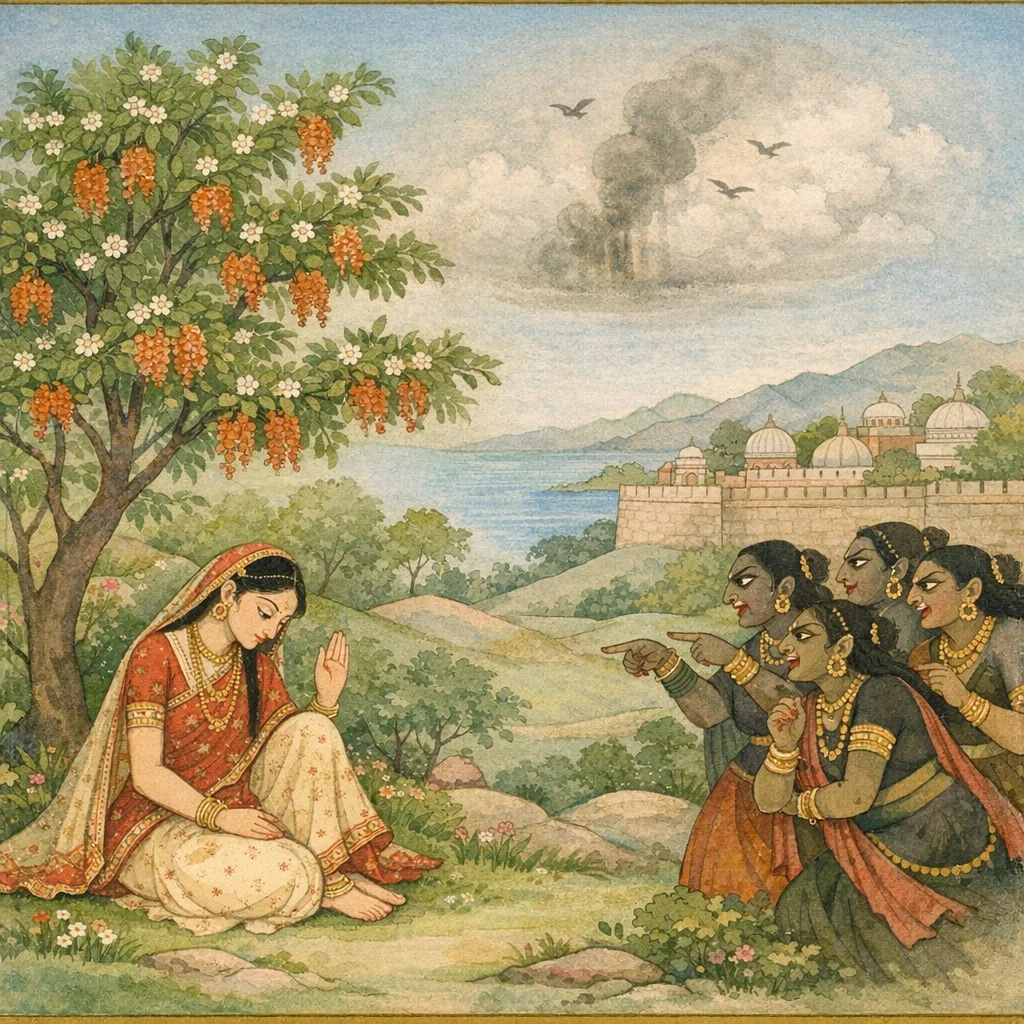
Sarga 26 presents a sustained psychological and ethical monologue of Sītā (Janakātmajā) in captivity. She begins with visible grief—tears, lowered face, and disoriented movement—signaling trauma under rākṣasī intimidation. She then articulates an uncompromising rejection of Rāvaṇa: she will not touch him even with her left foot, and she prefers death (cut, broken, or burnt) to acceptance. The discourse shifts to interpretive reasoning about Rāma’s delay: she considers possibilities ranging from ignorance of her location to a feared (but contested) indifference, and she recalls Rāma’s prior feats (Janasthāna’s rākṣasas, Virādha’s slaying) to argue that Laṅkā’s oceanic position cannot obstruct Rāma’s arrows. Sītā forecasts Laṅkā’s imminent desolation—funeral smoke, vultures, widowed rākṣasī households—linking adharma to inevitable calamity. The chapter culminates in existential despair and suicidal ideation (seeking poison), while still affirming Rāma’s character and the moral law that condemns rākṣasa wrongdoing.
Shlokas
Verse 1
प्रसक्ताश्रुमुखीत्यवं ब्रुवन्ती जनकात्मजा।आधोगतमुखी बाला विलप्तुमुपचक्रमे।।।।
Speaking thus, Janaka’s young daughter—her face wet with unceasing tears, her head bowed—began to lament aloud.
Verse 2
उन्मत्तेव प्रमत्तेव भ्रान्तचित्तेव शोचती।उपावृत्ता किशोरीव विवेष्टन्ती महीतले।।।।
Wailing as though mad, as though delirious, as though her mind were bewildered, the young woman rolled and writhed upon the ground like a young mare.
Verse 3
राघवस्य प्रमत्तस्य रक्षसा कामरूपिणा।रावणेन प्रमथ्याहमानीता क्रोशती बलात्।।।।
When Rāghava was off his guard, I—crying out—was tormented and forcibly carried away by the shape-shifting demon Rāvaṇa.
Verse 4
राक्षसीवशमापन्ना भर्त्स्यमाना सुदारुणम्।चिन्तयन्ती सुदुःखार्ता नाहं जीवितुमुत्सुहे।।।।
Fallen under the power of the demonesses, harshly threatened, and consumed by anxious thoughts in overwhelming sorrow, I no longer have the will to live.
Verse 5
न हि मे जीवितेनार्थो नैवार्थेर्न च भूषणैः।वसन्त्या राक्षसीमध्ये विना रामं महारथम्।।।।
Without Rāma, the great charioteer, what value is life to me while I live among rākṣasīs? I have no need of wealth, nor of ornaments.
Verse 6
अश्मसारमिदं नूनमथवाप्यजरामरम्।हृदयं मम येनेदं न दुःखेनावशीर्यते।।।।
Surely my heart must be stone-hard—or else free from decay and death—for it is not torn apart even by such grief.
Verse 7
धिङ्मामनार्यामसतीं याहं तेना विना कृता।मुहूर्तमपि रक्षामि जीवितं पापजीविता।।।।
Shame on me—ignoble and faithless—that, though separated from him, I still preserve my life even for a moment, living as one with a sinful life.
Verse 8
का च मे जीविते श्रद्धा सुखे वा तं प्रियं विना।भर्तारं सागरान्ताया वसुधायाः प्रियंवदम्।।।।
What interest can I have in life—or in any pleasure—without my beloved, my sweet-speaking husband, the lord of the earth bounded by the ocean?
Verse 9
भिद्यतां भक्ष्यतां वापि शरीरं विसृजाम्यहम्।न चाप्यहं चिरं दुःखं सहेयं प्रियवर्जिता।।।।
Let my body be cut to pieces or even devoured—I will abandon it. Bereft of my beloved, I cannot endure this sorrow any longer.
Verse 10
चरणेनापि सव्येन न स्पृशेयं निशाचरम्।रावणं किं पुनरहं काममेयं विगर्हितम्।।।।
“I would not even touch that vile night-roamer Rāvaṇa with my left foot—how much less could I ever desire him in love?”
Verse 11
प्रत्याख्यातं न जानाति नात्मानं नात्मनः कुलम्।यो नृशंसस्वभावेन मां प्रार्थयितुमिच्छति।।।।
“He who, by a cruel nature, seeks to plead for me does not understand rejection—nor does he understand himself or his own lineage.”
Verse 12
छिन्ना भिन्ना विभक्ता वा दीप्तेवाग्नौ प्रदीपिता।रावणं नोपतिष्ठेयं किं प्रलापेन वश्चिरम्।।।।
“Cut apart, shattered, or burned in blazing fire—I still would not submit to Rāvaṇa. What is the use of your long, empty talk?”
Verse 13
ख्यातः प्राज्ञः कृतज्ञश्च सानुक्रोशश्च राघवः।सद्वृत्तो निरनुक्रोशश्शङ्के मद्भाग्यसङ्क्षयात्।।।।
“Rāghava is renowned—wise, grateful, compassionate, and of good conduct; yet I fear that, through the waning of my own fortune, he has become unpitying toward me.”
Verse 14
राक्षसानां सहस्राणि जनस्थाने चतुर्दश।येनैकेन निरस्तानि स मां किं नाभिपद्यते।।।।
“He who, all alone, destroyed fourteen thousand rākṣasas at Janasthāna—why does he not come to rescue me?”
Verse 15
निरुद्धा रावणेनाहमल्पवीर्येण रक्षसा।समर्थः खलु मे भर्ता रावणं हन्तुमाहवे।।।।
I am held captive by Rāvaṇa, a rākṣasa of paltry valor; yet my husband is surely able to slay Rāvaṇa in battle.
Verse 16
विराधो दण्डकारण्ये येन राक्षसपुङ्गवः।रणे रामेण निहतस्स मां किं नाभिपद्यते।।।।
Why does that Rāma not come to reach and rescue me—he who, in the Daṇḍaka forest, killed Virādha, a foremost among rākṣasas, in battle?
Verse 17
कामं मध्ये समुद्रस्य लङ्केयं दुष्प्रधर्षणा।न तु राघवबाणानां गतिरोधो भविष्यति ।।।।
Granted—this Laṅkā, set in the midst of the ocean, is hard to assail; yet there will be no stopping the course of Rāghava’s arrows.
Verse 18
किन्नु तत्कारणं येन रामो दृढपराक्रमः।रक्षसापहृतां भार्यामिष्टां नाभ्यवपद्यते।।।।
What could be the reason that Rāma—firm in valor—has not yet reached his beloved wife, abducted by a rākṣasa?
Verse 19
इहस्थां मां न जानीते शङ्के लक्ष्मणपूर्वजः।जानन्नपि हि तेजस्वी धर्षणं मर्षयिष्यति।।।।
I suspect the elder brother of Lakṣmaṇa does not know I am here; or else—though radiant—he knows, and yet endures this outrage.
Verse 20
हृतेति योऽधिगत्वा मां राघवाय निवेदयेत्।गृध्रराजोऽपि स रणे रावणेन निपातितः।।।।
Even the king of vultures—who, learning that I had been carried off, could have reported it to Rāghava—was struck down in battle by Rāvaṇa.
Verse 21
कृतं कर्म महत्तेन मां तथाऽभ्यवपद्यता।तिष्ठता रावणद्वन्द्वे वृद्धेनापि जटायुषा।।।।
Great was the deed done for me by that Jaṭāyu—old though he was—when he advanced and stood firm in single combat with Rāvaṇa.
Verse 22
यदि मामिह जानीयाद्वर्तमानां स राघवः।अद्य बाणैरभिक्रुद्धः कुर्याल्लोकमराक्षसम्।।।।
If Rāghava knew that I am here, then today—angered—he would, with his arrows, make the world free of rākṣasas.
Verse 23
विधमेच्च पुरीं लङ्कां शोषयेच्च महोदधिम्।रावणस्य च नीचस्य कीर्तिं नाम च नाशयेत्।।।।
He would scatter the city of Laṅkā, dry up the great ocean, and destroy the very name and fame of the base Rāvaṇa.
Verse 24
ततो निहतनाथानां राक्षसीनां गृहे गृहे।यथाहमेवं रुदती तथा भूयो न संशयः।।।।
Then, in every house, the ogresses—bereft of their lords—will wail just as I do; of this there is no doubt.
Verse 25
अन्विष्य रक्षसां लङ्कां कुर्याद्रामस्सलक्ष्मणः।न हि ताभ्यां रिपुर्दृष्टो मुहूर्तमपि जीवति।।।।
If Rāma, with Lakṣmaṇa, were to find this Laṅkā of the rākṣasas and take action, no enemy seen by those two would live even for a moment.
Verse 26
चिताधूमाकुलपथा गृध्रमण्डलसङ्कुला।अचिरेण तु लङ्केयं श्मशानसदृशी भवेत्।।।।
Before long, this Laṅkā will have its roads choked with smoke from funeral pyres, crowded with circling vultures, and will resemble a cremation-ground.
Verse 27
अचिरेणैव कालेन प्राप्स्याम्येव मनोरथम्।दुष्प्रस्थानोऽयामाख्याति सर्वेषां वो विपर्ययम्।।।।
In a very short time I shall surely attain what I long for; this wicked course of conduct of yours foretells a reversal of fortune for you all.
Verse 28
यादृशानीह दृश्यन्ते लङ्कायामशुभानि वै।अचिरेणैव कालेन भविष्यति हतप्रभा।।।।
Such inauspicious signs as are seen here in Laṅkā—indeed, before long this city will lose its radiance.
Verse 29
नूनं लङ्का हते पापे रावणे राक्षसाधमे।शोषं यास्यति दुर्धर्षा प्रमदा विधवा यथा।।।।
Surely, when that sinful Rāvaṇa—the vilest of rākṣasas—is slain, this once-impregnable Laṅkā will waste away, like a woman widowed.
Verse 30
पुण्योत्सवसमुत्था च नष्टभर्त्री सराक्षसी।भविष्यति पुरी लङ्का नष्टभर्त्री यथाङ्गना।।।।
Laṅkā-city—though raised up in auspicious festivities—will become husbandless, along with its rākṣasī women, like a woman bereft of her lord.
Verse 31
नूनं राक्षसकन्यानां रुदन्तीनां गृहे गृहे।श्रोष्यामि नचिरादेव दुःखार्तानामिह ध्वनिम्।।।।
Surely, very soon I shall hear here—in house after house—the sounds of the rākṣasa maidens crying out in distress.
Verse 32
सान्थकारा हतद्योता हतराक्षसपुङ्गवा।भविष्यति पुरी लङ्का निर्दग्धा रामसायकैः।।।।
Burned down by Rāma’s arrows, Laṅkā-city will become shrouded in darkness, its radiance destroyed, its foremost rākṣasas slain.
Verse 33
यदि नाम स शूरो मां रामो रक्तान्तलोचनः।जानीयाद्वर्तमानां हि रावणस्य निवेशने।।।।अनेन तु नृशंसेन रावणेनाधमेन मे।समयो यस्तु निर्दिष्टस्तस्य कालोऽयमागतः।।।।स च मे विहितो मृत्युरस्मिन् दुष्टे न वर्तते।
If that heroic Rāma, whose eyes grow bloodshot in wrath, were to learn that I am here, present within Rāvaṇa’s dwelling…
Verse 34
यदि नाम स शूरो मां रामो रक्तान्तलोचनः।जानीयाद्वर्तमानां हि रावणस्य निवेशने।।5.26.33।।अनेन तु नृशंसेन रावणेनाधमेन मे।समयो यस्तु निर्दिष्टस्तस्य कालोऽयमागतः।।5.26.34।।स च मे विहितो मृत्युरस्मिन् दुष्टे न वर्तते।
But as for this cruel and base Rāvaṇa—the deadline he set for me has now arrived; and the death he ordained for me will not remain confined to me alone: it will come to rest upon that wicked one.
Verse 35
अकार्यं ये न जानन्ति नैर्ऋताः पापकारिणः।।।।अधर्मात्तु महोत्पातो भविष्यति हि सांप्रतम्।नैते धर्मं विजानन्ति राक्षसाः पिशिताशनाः।।।।
These sinful Rākṣasas do not even recognize what must not be done—what is forbidden.
Verse 36
अकार्यं ये न जानन्ति नैर्ऋताः पापकारिणः।।5.26.35।। अधर्मात्तु महोत्पातो भविष्यति हि सांप्रतम्। नैते धर्मं विजानन्ति राक्षसाः पिशिताशनाः।।5.26.36।।
From adharma, a great calamity will arise—indeed, even now. These flesh-eating Rākṣasas do not understand dharma at all.
Verse 37
ध्रुवं मां प्रातराशार्थे राक्षसः कल्पयिष्यति।साहं कथं करिष्यामि तं विना प्रियदर्शनम्।।।।रामं रक्तान्तनयनमपश्यन्ती सुदुःखिता।
Surely this Rākṣasa intends to make me his morning meal. And without him—my beloved of pleasing presence—what can I do? Not seeing Rāma, whose eyes redden at the corners, I am plunged into deep sorrow.
Verse 38
यदि कश्चित् प्रदाता मे विषस्याद्य भवेदिह।।।।क्षिप्रं वैवस्वतं देवं पश्येयं पतिना विना।
If only someone here today would give me poison, I would quickly behold Vaivasvata, the god of death—without my husband.
Verse 38
यदि कश्चित् प्रदाता मे विषस्याद्य भवेदिह।।।।क्षिप्रं वैवस्वतं देवं पश्येयं पतिना विना।
If only someone here today would give me poison, I would quickly behold Vaivasvata, the god of death—without my husband.
Verse 39
नाजानाज्जीवतीं रामस्स मां लक्ष्मणपूर्वजः।।।।जानन्तौ तौ न कुर्यातां नोर्य्वां हि मम मार्गणम्।
Rāma, the elder brother of Lakṣmaṇa, does not know that I am alive here. If those two knew, they would not refrain from searching for me across the earth.
Verse 40
नूनं ममैव शोकेन स वीरो लक्ष्मणाग्रजः।।।।देवलोकमितो यातस्त्यक्त्वा देहं महीतले।
Surely, stricken by grief for me, that hero—the elder brother of Lakṣmaṇa—has left this world, abandoning his body upon the earth, and gone to the realm of the gods.
Verse 41
धन्या देवास्सगन्धर्वाः सिद्धाश्च परमर्षयः।।।।मम पश्यन्ति ये नाथं रामं राजीवलोचनम्।
Blessed are the gods with the Gandharvas, the Siddhas, and the great seers—those who behold my lord Rāma, lotus-eyed.
Verse 42
अथवा न हि तस्यार्थो धर्मकामस्य धीमतः।।।।मया रामस्य राजर्षेर्भार्यया परमात्मनः।
Or else—could it be that wise Rāma, that royal sage devoted to dharma, has no concern for me anymore, even though I am his wife?
Verse 43
दृश्यमाने भवेत्प्रीति स्सौहृदं नास्त्यपश्यतः।।।।नाशयन्ति कृतघ्नास्तु न रामो नाशयिष्यति।
Love grows when one is seen before the eyes; friendship does not endure when one is not seen. Ungrateful people destroy such bonds—but Rāma will not destroy them.
Verse 44
किं नु मे न गुणाः केचित्किं वा भाग्यक्षयो मम।।।। याहं सीदामि रामेण हीना मुख्येन भामिनी।
Is it that I have no virtues at all—or has my good fortune been exhausted—since I, a woman of standing, am sinking in misery, separated from foremost Rāma?
Verse 45
श्रेयो मे जीवितान्मर्तुं विहीनाया महात्मनः।।।।रामादक्लिष्टचारित्राच्छूराच्छत्रुनिबर्हणात्।
For me, separated from great-souled Rāma—of unblemished conduct, heroic, and a destroyer of enemies—death is better than life.
Verse 46
अथवा न्यस्तशत्रौ तौ वने मूलफलाशिनौ।।।।भ्रातरौ हि नरश्रेष्ठौ संवृत्तौ वनगोचरौ।
Or else, perhaps those two brothers—foremost among men—have laid aside hostility and now roam the forest, living on roots and fruits.
Verse 47
अथवा राक्षसेन्द्रेण रावणेन दुरात्मना।।।।छद्मना घातितौ शूरौ भ्रातरौ रामलक्ष्मणौ।
Or else—has the wicked Rāvaṇa, lord of rākṣasas, slain the heroic brothers Rāma and Lakṣmaṇa by some deceit?
Verse 48
साऽहमेवङ्गते काले मर्तुमिच्छामि सर्वथा।।।।न च मे विहितो मृत्युरस्मिन् दुःखेऽपि वर्तते।
In such circumstances, at such a time, I wish to die by any means; yet even in this misery, death does not come to me as if it were not ordained.
Verse 49
धन्याः खलु महात्मानो मुनयस्त्यक्तकिल्बिषाः।।।।जितात्मनो महाभागा येषां न स्तः प्रियाप्रिये।
Blessed indeed are the great sages who have cast off sin—self-controlled and fortunate—for whom ‘dear’ and ‘not dear’ do not exist.
Verse 50
प्रियान्न संभवेद्दुःखमप्रियादधिकं भयम्।।।।ताभ्यां हि ये वियुज्यन्ते नमस्तेषां महात्मनाम्।
From what is pleasant, sorrow does not arise; from what is unpleasant, excessive fear does not arise—for those great souls who have separated themselves from both. Salutations to them.
Verse 51
साहं त्यक्ता प्रियार्हेण रामेण विदितात्मना।।।।प्राणांस्त्यक्ष्यामि पापस्य रावणस्य गता वशम्।
Abandoned by Rama—wise in self-knowledge and worthy of all that is dear—I, having fallen into the power of the sinful Ravana, will now give up my life.
Frequently Asked Questions
Sītā confronts coercion to accept Rāvaṇa and answers with an absolute ethical refusal: she will not even touch him “with the left foot,” and she prefers violent death to complicity. The dharma-sankat is survival under threat versus integrity; the chapter resolves it by prioritizing moral inviolability over bodily preservation.
The chapter teaches that adharma is self-defeating: coercion and moral transgression generate inevitable downfall, while dharma is maintained through inner firmness even when external agency is constrained. Sītā’s speech also models reasoned endurance—she interprets events, tests hypotheses about Rāma’s absence, and anchors hope in proven virtue and capability.
Laṅkā is emphasized as ocean-encircled and reputedly unassailable, yet declared penetrable to Rāma’s arrows; Janasthāna and Daṇḍakāraṇya appear as memory-landmarks of Rāma’s prior victories (including Virādha). The ocean (Mahodadhi) and the imagery of cremation smoke and vultures function as cultural signs of impending societal collapse within Laṅkā.