Sarga 25
सीताविलापः (Sita’s Lament amid Rākṣasī Threats)
सुन्दरकाण्ड
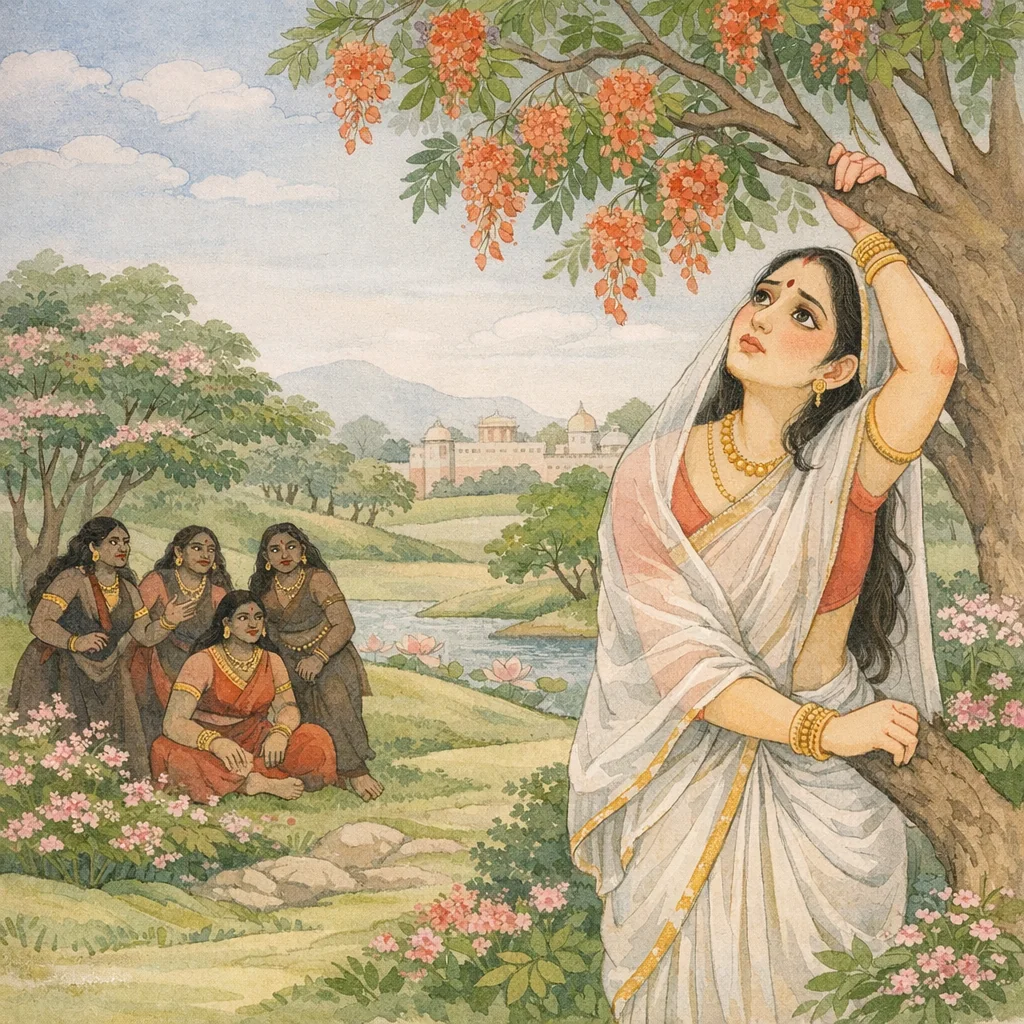
Sarga 25 presents a concentrated psychological portrait of Sītā in Aśokavatikā after hearing repeated harsh threats from the rākṣasī guards. She weeps, trembles, and physically withdraws into herself; the narration intensifies through a sequence of similes (doe beset by wolves, banana plant felled by wind, braid like a serpent) to map fear onto bodily signs. Clinging to a blossoming Aśoka branch, she broods on Rāma and breaks into lament, calling out to Rāma, Lakṣmaṇa, and her mothers-in-law (Kauśalyā, Sumitrā). She articulates a reflective proverb-like observation: untimely death is said to be rare or impossible, even when life feels unendurable—thereby framing captivity as a prolonged ethical trial rather than a momentary crisis. The chapter underscores her refusal to accept a rākṣasa marriage, her isolation under surveillance, and the moral steadfastness that persists despite despair and the wish to relinquish life.
Shlokas
Verse 1
अथ तासां वदन्तीनां परुषं दारुणं बहु।राक्षसीनामासौम्यानां रुरोद जनकात्मजा।।5.25.1।।
Then, as the ugly ogresses spoke many harsh and dreadful words, Janaka’s daughter began to weep.
Verse 2
एवमुक्ता तु वैदेही राक्षसीभिर्मनस्विनी।उवाच परमत्रस्ता भाष्पग्द्गदया गिरा।।5.25.2।।
Thus addressed by the rākṣasīs, Vaidehī—noble-minded and terribly afraid—spoke in a voice choked with tears.
Verse 3
न मानुषी राक्षसस्य भार्या भवितुमर्हति। कामं खादत मां सर्वा न करिष्यामि वो वचः।।5.25.3।।
A human woman is not fit to become a rākṣasa’s wife. Eat me if you wish—all of you; I will not do as you command.
Verse 4
सा राक्षसीमध्यगता सीता सुरसुतोपमा।न शर्म लेभे दुःखार्ता रावणेन च तर्जिता।।5.25.4।।
Sītā—like a daughter of the gods—caught amid the rākṣasīs, distressed and threatened by Rāvaṇa, found no peace of mind.
Verse 5
वेपते स्माधिकं सीता विशन्ती वाङ्गमात्मनः।वने यूथपरिभ्रष्टा मृगी कोकैरिवार्दिता।।5.25.5।।
Sītā trembled intensely, drawing her limbs inward—like a doe in the forest, separated from its herd and harried by wolves.
Verse 6
सा त्वशोकस्य विपुलां शाखामालम्ब्य पुष्पिताम्।चिन्तयामास शोकेन भर्तारं भग्नमानसा।।5.25.6।।
Clinging to a large, flowering branch of the Aśoka tree, Sītā—her heart broken by grief—thought only of her husband.
Verse 7
सा स्नापयन्ती विपुलौ स्तनौ नेत्रजलस्रवैः।चिन्तयन्ती न शोकस्य तदान्तमधिगच्छति।।5.25.7।।
As tears streamed from her eyes and drenched her full breasts, she kept brooding—and could find no end to her sorrow.
Verse 8
सा वेपमाना पतिता प्रवाते कदली यथा।राक्षसीनां भयत्रस्ता विवर्णवदनाभवत्।।5.25.8।।
Trembling like a banana plant felled by a fierce wind, Sītā—terrified of the rākṣasīs—became pale of face.
Verse 9
तस्याः सा दीर्घविपुला वेपन्त्या सीतया तदा।ददृशे कम्पिनी वेणी व्यालीव परिसर्पती।।5.25.9।।
Then, as Sītā trembled, her long, thick braid—shaking—seemed like a she-serpent crawling along.
Verse 10
सा निःश्वसन्ती दुःखार्ता शोकोपहतचेतना।आर्ता व्यसृजदश्रूणि मैथिली विललाप च।।5.25.10।।
Sighing, afflicted by sorrow—her mind struck down by grief—Maithilī, in distress, let her tears flow and lamented aloud.
Verse 11
हा रामेति च दुःखार्ता हा पुनर्लक्ष्मणेति च।हा श्वश्रु मम कौसल्ये हा सुमित्रेति भामिनी।।5.25.11।।
In her anguish the radiant lady cried, “Alas, Rāma!” and again, “Alas, Lakṣmaṇa!”—“Alas, my mother-in-law Kauśalyā! Alas, Sumitrā!”
Verse 12
लोकप्रवादः सत्योऽयं पण्डितैः समुदाहृतः।अकाले दुर्लभो मृत्युः स्त्रिया वा पुरुषस्य वा।।5.25.12।।यदहमेवं क्रूराभी राक्षसीभिरिहार्दिता।जीवामि हीना रामेण मुहूर्तमपि दुःखिता।।5.25.13।।
“This common saying, spoken of by the learned, is indeed true: death is hard to obtain before its time—whether for a woman or for a man.”
Verse 13
लोकप्रवादः सत्योऽयं पण्डितैः समुदाहृतः।अकाले दुर्लभो मृत्युः स्त्रिया वा पुरुषस्य वा।।5.25.12।।यदहमेवं क्रूराभी राक्षसीभिरिहार्दिता।जीवामि हीना रामेण मुहूर्तमपि दुःखिता।।5.25.13।।
“And yet I live—here, tormented by these cruel ogresses, separated from Rāma, miserable even for a single moment.”
Verse 14
एषाल्पपुण्या कृपणा विनशिष्याम्यनाथवत्।समुद्रमध्ये नौः पूर्णा वायुवेगैरिवाहता।।5.25.14।।
“I—of scant merit, wretched, like one without refuge—shall be destroyed, like a fully laden boat struck by gale-forces in the midst of the sea.”
Verse 15
भर्तारं तमपश्यन्ती राक्षसीवशमागता।सीदामि खलु शोकेन कूलं तोयहतं यथा।।5.25.15।।
Not seeing my husband, and fallen under the control of these rākṣasīs, I truly sink with grief—like a riverbank worn away by rushing waters.
Verse 16
तं पद्मदलपत्राक्षं सिंहविक्रान्तगामिनम्।धन्याः पश्यन्ति मे नाथं कृतज्ञं प्रियवादिनम्।।5.25.16।।
Blessed are those who can see my lord—lotus-petaled in his eyes, lion-like in his majestic stride, grateful in heart, and gentle in speech.
Verse 17
सर्वथा तेन हीनाया रामेण विदितात्मना।तीक्ष्णं विषमिवास्वाद्य दुर्लभं मम जीवितम्।।5.25.17।।
In every way separated from Rāma—self-knowing and steadfast—my life is hard to sustain, as if I had swallowed a sharp poison.
Verse 18
कीदृशं तु महापापं मया जन्मान्तरे कृतम्।यनेदं प्राप्यते दुःखं मया घोरं सुदारुणम्।।5.25.18।।
What great sin, indeed, did I commit in a former life, that I must now undergo this terrible and most cruel suffering?
Verse 19
जीवितं त्यक्तुमिच्छामि शोकेन महता वृता।राक्षसीभिश्च रक्षन्त्या रामो नासाद्यते मया।।5.25.19।।
Enveloped by great grief, I wish to abandon my life; guarded by these rākṣasīs, I cannot reach Rāma.
Verse 20
धिगस्तु खलु मानुष्यं धिगस्तु परवश्यताम्।न शक्यं यत्परित्यक्तुमात्मच्छन्देन जीवितम्।।5.25.20।।
Fie, indeed, upon human life; fie upon dependence on another’s power. For it is not possible to cast off life according to one’s own will.
Frequently Asked Questions
Sītā confronts coercive pressure to accept a rākṣasa marriage; she explicitly refuses, asserting that a human woman is not fit to become a demon’s wife, even if threatened with death—an ethical boundary grounded in fidelity and personal moral agency.
The chapter frames suffering as an extended moral test: even when life appears unbearable, dharma is maintained through refusal of unethical compromise, remembrance of rightful relationships, and endurance when one cannot control outcomes (including life and death).
The Aśoka tree and its blossoming branch function as the immediate landmark of captivity in the grove (Aśokavatikā), serving as a narrative anchor for Sītā’s lament and as a symbolic space where steadfastness is preserved under surveillance.