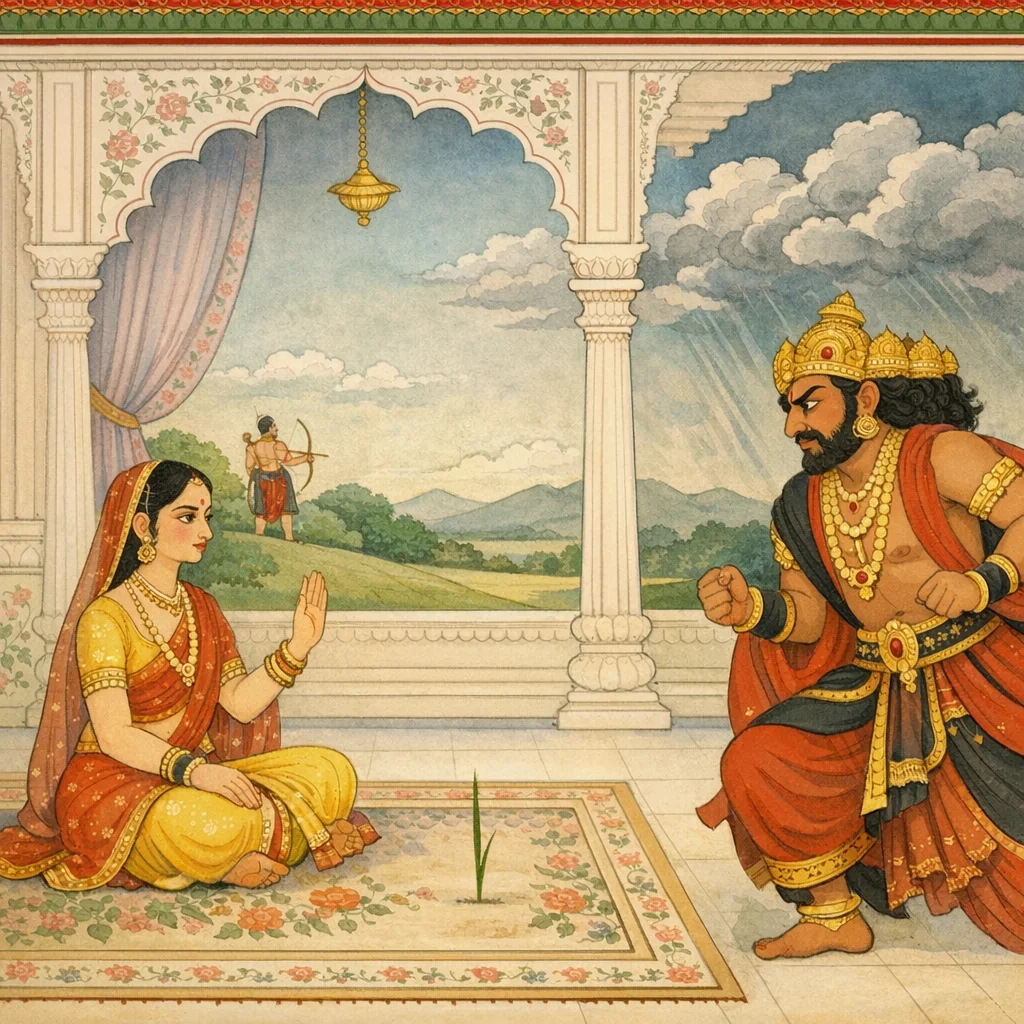
Sarga 21
सीताया रावणं प्रति धर्मोपदेशः (Sita’s Dharmic Admonition to Ravana)
सुन्दरकाण्ड
Sarga 21 presents Sītā’s measured yet uncompromising reply after hearing Rāvaṇa’s aggressive proposal. She establishes a protective boundary (placing a blade of grass between them) and articulates a layered dharma-critique: a king must restrain desire, protect others’ wives as his own, and heed wise counsel. She predicts political ruin for realms led by unjust rulers, frames Rāvaṇa as the agent of his clan’s destruction, and asserts her inseparability from Rāghava through tightly drawn similes (light and sun; knowledge and the realized brāhmaṇa). The discourse turns from moral instruction to strategic counsel—urging friendship with Rāma and the return of Sītā as the only path to welfare—then escalates into a forewarning of Rāma’s martial arrival: the bow’s thunder-like twang, arrow-rain over Laṅkā, and the inevitable extraction of Sītā as Viṣṇu-Vāmana reclaimed prosperity from the asuras. The chapter closes by condemning the cowardly circumstance of her abduction and asserting that no refuge can avert Rāma’s retribution.
Shlokas
Verse 1
तस्य तद्वचनं श्रुत्वा सीता रौद्रस्य रक्षसः।आर्ता दीनस्वरा दीनं प्रत्युवाच शनैर्वचः।।।।
Having heard those words of the furious rākṣasa, Sītā—distressed, her voice faint with sorrow—replied slowly, in a pitiable tone.
Verse 2
दुःखार्ता रुदती सीता वेपमाना तपस्विनी।चिन्तयन्ती वरारोहा पतिमेव पतिव्रता।।।।तृणमन्तरतः कृत्वा प्रत्युवाच शुचिस्मिता।
Sītā—stricken with grief, sobbing, trembling, austere and fair-hipped, ever devoted to her husband alone—placed a blade of grass between herself and (Rāvaṇa), and then replied with a pure, gentle smile.
Verse 3
निवर्तय मनो मत्तः स्वजने क्रियतां मनः।।।।न मां प्रार्थयितुं युक्तं सुसिद्धिमिव पापकृत्।
Turn your mind away from me; set your desire upon your own women. It is not fitting for you to seek me—just as an evildoer cannot rightly hope for blessed attainment.
Verse 4
अकार्यं न मया कार्यमेकपत्न्या विगर्हितम्।।।।कुलं सम्प्राप्तया पुण्यं कुले महति जातया।
Born in a noble lineage and wedded into a virtuous family, I am devoted to one husband alone; I must not do this forbidden, shameful deed.
Verse 5
एवमुक्त्वा तु वैदेही रावणं तं यशस्विनी।।।।राक्षसं पृष्ठतः कृत्वा भूयो वचनमब्रवीत्।
Having spoken thus, the illustrious Vaidehī turned that rākṣasa Rāvaṇa behind her and spoke again.
Verse 6
नाहमौपयिकी भार्या परभार्या सती तव।।।।साधु धर्ममवेक्षस्व साधु साधुव्रतं चर।
I cannot be a wife gained by your effort; I am another man’s lawful wife, a chaste woman. As a king, look rightly to dharma and follow a truly righteous vow of conduct.
Verse 7
यथा तव तथान्येषां दारा रक्ष्या निशाचर।।।।आत्मानमुपमां कृत्वा स्वेषु दारेषु रम्यताम्।
O night-roamer, as your own wives must be protected, so too must the wives of others be protected. Taking yourself as the measure, delight in your own wives.
Verse 8
अतुष्टं स्वेषु दारेषु चपलं चलितेन्द्रियम्।।।।नयन्ति निकृतिप्रज्ञं परदाराः पराभवम्।
A man who is dissatisfied with his own wives, fickle and uncontrolled in his senses—whose mind is bent on deceit—will be led to humiliation by pursuing other men’s wives.
Verse 9
इह सन्तो न वा सन्ति सतो वा नानुवर्तसे।।।।तथाहि विपरीता ते बुद्धिराचारवर्जिता।
Are there no good people here—or, though they exist, do you not follow them? For your understanding has turned perverse, stripped of right conduct.
Verse 10
वचो मिथ्याप्रणीतात्मा पथ्यमुक्तं विचक्षणैः।।।।राक्षसानामभावाय त्वं वा न प्रतिपद्यसे।
You, whose mind is led by false and unrighteous ways, do not accept the wholesome counsel spoken by the discerning; thus you become the cause of the rākṣasas’ ruin.
Verse 11
अकृतात्मानमासाद्य राजानमनये रतम्।।।।समृद्धानि विनश्यन्ति राष्ट्राणि नगराणि च।
When a king lacking self-mastery, devoted to unjust ways, comes to power—prosperous realms and even cities fall into ruin.
Verse 12
तथेयं त्वां समासाद्य लङ्का रत्नौघसङ्कुला।।।।अपराधात्तवैकस्य नचिराद्विनशिष्यति।
In the same way, this Laṅkā—crowded with heaps of jewels—having obtained you, will soon be destroyed because of the crime of you alone.
Verse 13
स्वकृतैर्हन्यमानस्य रावणादीर्घदर्शिनः।।।।अभिनन्दन्ति भूतानि विनाशे पापकर्मणः।
O Rāvaṇa, you who are short-sighted: when a sinner is struck down by the consequences of his own deeds, living beings rejoice at his destruction.
Verse 14
एवं त्वां पापकर्माणं वक्ष्यन्ति निकृता जनाः।।।।दिष्ट्यैतद्व्यसनं प्राप्तो रौद्र इत्येव हर्षिताः।
Thus will people—those whom you have wronged and humiliated—speak of you: “At last, that cruel and wrathful sinner has met his calamity,” and they will rejoice.
Verse 15
शक्या लोभयितुं नाहमैश्वर्येण धनेन वा।।।।अनन्या राघवेणाहं भास्करेण प्रभा यथा।
I cannot be tempted—neither by power nor by wealth. I belong to Rāghava alone, inseparable from him as radiance is from the sun.
Verse 16
उपधाय भुजं तस्य लोकनाथस्य सत्कृतम्।।।।कथं नामोपधास्यामि भुजमन्यस्य कस्य चित्।
Having rested upon the honored arm of that Lord of the world, how could I ever lay my head upon the arm of anyone else?
Verse 17
अहमौपयिकी भार्या तस्यैव वसुधापतेः।।।।व्रतस्नातस्य विप्रस्य विद्येव विदितात्मनः।
I am the rightful wife of that lord of the earth alone—like sacred knowledge that properly belongs to a disciplined brāhmaṇa who has completed his vows and knows the self.
Verse 18
साधु रावण रामेण मां समानय दुःखिताम्।।।।वने वाशितया सार्धं करेण्वेव गजाधिपम्।
Do what is right, O Rāvaṇa—reunite me, sorrowing, with Rāma, as one reunites a she-elephant separated in the forest with the lordly elephant.
Verse 19
मित्रमौपयिकं कर्तुं रामः स्थानं परीप्सता।।।।वधं चानिच्छता घोरं त्वयासौ पुरुषर्षभः।
That bull among men—Rāma—would be willing to establish a proper friendship with you, if you seek what is fitting and wish to avoid a dreadful death.
Verse 20
विदितः स हि धर्मज्ञः शरणागतवत्सलः।।।।तेन मैत्री भवतु ते यदि जीवितुमिच्छसि।
He is well known as one who knows dharma and who cherishes those who seek refuge. If you wish to live, let there be friendship between you and him.
Verse 21
प्रसादयस्व त्वं चैनं शरणागतवत्सलम्।।।।मां चास्मै नियतो भूत्वा निर्यातयितुमर्हसि।
Therefore, seek his grace—he is compassionate to those who take refuge. Restrain yourself, and you ought to return me to him.
Verse 22
एवं हि ते भवेत्स्वस्ति सम्प्रदाय रघूत्तमे।।।।अन्यथा त्वं हि कुर्वाणो वधं प्राप्स्यसि रावण।
Only thus will there be welfare for you—by handing me back to Raghūttama (Rāma). Otherwise, if you persist, you will surely meet your death, O Rāvaṇa.
Verse 23
वर्जयेद्वज्रमुत्सृष्टं वर्जयेदन्तकश्चिरम्।।।।त्वद्विधं तु न सङ्कृद्धो लोकनाथः स राघवः।
A thunderbolt, once released, may yet spare its mark; even Death may delay for a time. But when Rāghava—lord of the world—becomes enraged, he will not spare one like you.
Verse 24
रामस्य धनुषः शब्दं श्रोष्यसि त्वं महास्वनम्।।।।शतक्रतुविसृष्टस्य निर्घोषमशनेरिव।
You will hear the mighty, dreadful twang of Rāma’s bow—like the thunderous rumble of the lightning-bolt released by Śatakratu (Indra).
Verse 25
इह शीघ्रं सुपर्वाणो ज्वलितास्या इवोरगा: ।।।।इषवो निपतिष्यन्ति रामलक्ष्मणलक्षणाः।
Here, before long, well-jointed arrows—marked with the names of Rāma and Lakṣmaṇa—will rain down like serpents with flaming mouths.
Verse 26
रक्षांसि परिनिघ्नन्तः पुर्यामस्यां समन्ततः।।।।असंपातं करिष्यन्ति पतन्तः कङ्कवाससः।
Falling everywhere through this city, those shafts—fletched with kaṅka-feathers—will strike down the rākṣasas on all sides, leaving no room for any other missiles to fall.
Verse 27
राक्षसेन्द्रमहासर्पान् स रामगरुडो महान्।।।।उद्धरिष्यति वेगेन वैनतेय इवोरगान्।
That great ‘Garuda of Rāma’ will swiftly tear away the mighty serpent-like demon-lords—just as Vainateya (Garuda) carries off serpents.
Verse 28
अपनेष्यति मां भर्ता त्वत्तः शीघ्रमरिन्दमः।।।।असुरेभ्यः श्रियं दीप्तां विष्णुस्त्रिभिरिव क्रमैः।
My husband, the subduer of foes, will soon take me back from you—just as Viṣṇu, with three strides, took away the radiant fortune from the asuras.
Verse 29
जनस्थाने हतस्थाने निहते रक्षसां बले।।।।अशक्तेन त्वया रक्षः कृतमेतदसाधु वै।
When the rākṣasa host was slain at Jana-sthāna—the very place of death—you, powerless to defend them, committed this truly shameful act, O rākṣasa.
Verse 30
आश्रमं तु तयोः शून्यं प्रविश्य नरसिंहयोः।।।।गोचरं गतयोर्भ्रात्रोरपनीता त्वयाधम।
Entering the empty hermitage when those two lion-like men—the brothers—had gone out of range, you abducted me, you vile one.
Verse 31
न हि गन्धमुपाघ्राय रामलक्ष्मणयोस्त्वया।।।।शक्यं संदर्शने स्थातुं शुना शार्दूलयोरिव।
Had you even caught the scent of Rāma and Lakṣmaṇa, you could not have stood before them—like a dog before two tigers.
Verse 32
तस्य ते विग्रहे ताभ्यां युगग्रहणमस्थिरम्।।।।वृत्रस्येवेन्द्रबाहुभ्यां बाहोरेकस्य विग्रहे।
In battle with those two, you will not be able to stand firm. You will meet the fate of one-armed Vṛtra when he faced Indra with his two mighty arms.
Verse 33
क्षिप्रं तव स नाथो मे रामः सौमित्रिणा सह।।।।तोयमल्पमिवादित्यः प्राणानादास्यते शरैः।
Swiftly, my lord Rāma—together with Saumitrī—will take away your life with his arrows, as the Sun quickly draws up a little water.
Verse 34
गिरिं कुबेरस्य गतोऽथ वालयं सभां गतो वा वरुणस्य राज्ञः।असंशयं दाशरथेर्न मोक्ष्यसे महाद्रुमः कालहतोऽशनेरिव।।।।
Even if you were to flee to Kubera’s mountain, or to the abode or assembly-hall of King Varuṇa, you will surely not escape Dāśarathi (Rāma)—just as a great tree, when struck by fate, cannot evade a thunderbolt.
Frequently Asked Questions
The dilemma is coercive appropriation versus lawful marriage and royal restraint: Rāvaṇa seeks Sītā against dharma, while Sītā refuses, marks a boundary with a blade of grass, and insists that a ruler must protect others’ spouses rather than violate them.
Adharma is self-destructive: a king who ignores wise counsel, indulges uncontrolled desire, and rules through unfair means causes the ruin of cities and clans; welfare lies in returning to dharma—here, by seeking friendship with Rāma and restoring Sītā.
Laṅkā is framed as a gem-filled polity endangered by one ruler’s crime; Janasthāna is recalled as the earlier site of demon defeat; and cosmic-political refuges (Kubera’s mountain/Kailāsa, Varuṇa’s oceanic realm) are invoked to stress that no sanctuary can avert the consequences of unrighteous action.