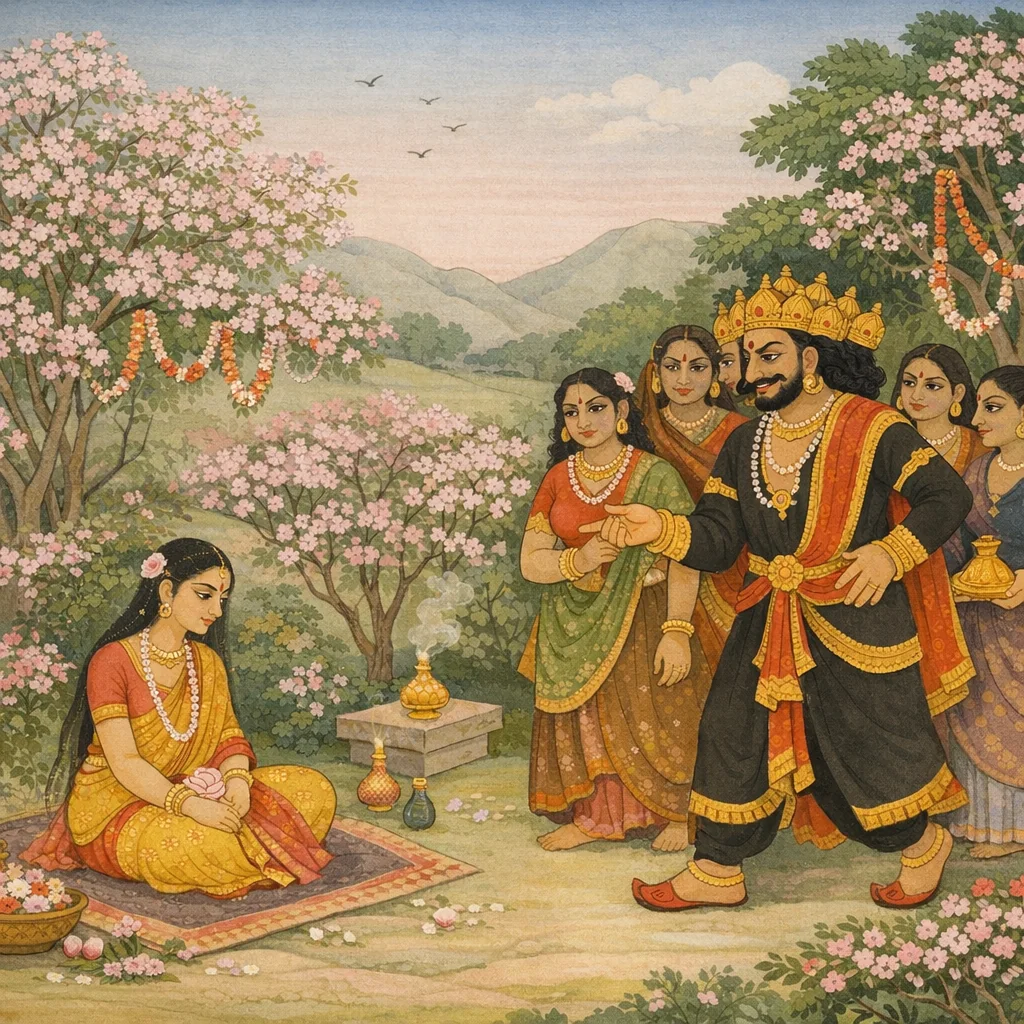
Sarga 20
रावणस्य सीताप्रलोभनम् (Ravana’s Persuasion and Coercive Courtship of Sita)
सुन्दरकाण्ड
Sarga 20 presents a sustained rhetorical sequence in which Rāvaṇa addresses Sītā—described as grief-stricken, ascetic, and surrounded by rākṣasī guards—with “sweet, animated words” that alternate between inducement and intimidation. He offers material luxuries (garlands, sandal, incense, garments, ornaments), sensory entertainments (song, dance, instruments), and political power (authority over his harem; wealth and lands; even the promise of conquest and gifts to Janaka). He intensifies flattery by asserting her unmatched beauty, urging adornment, and using the trope of fleeting youth. Parallel to seduction, he asserts unrivalled martial power and minimizes Rāma’s capacity, portraying him as impoverished, forest-bound, and possibly dead, and claims Rāma cannot retrieve her from Laṅkā. The chapter thus functions as a literary anatomy of coercive persuasion: lavish promises, aesthetic praise, and strategic disparagement of the rightful spouse, set against Sītā’s visible austerity and refusal context.
Shlokas
Verse 1
स तां परिवृतां दीनां निरानन्दां तपस्विनीम्।साकारैर्मधुरैर्वाक्यैर्न्यदर्शयत रावणः।।5.20.1।।
Ravana addressed her—Sita the ascetic—surrounded (by guards), downcast and joyless, speaking in sweet, artful words to press his intent upon her.
Verse 2
मां दृष्ट्वा नागनासोरु गूहमाना स्तनोदरम्।अदर्शनमिवात्मानं भयान्नेतुं त्वमिच्छसि।।5.20.2।।
Seeing me, O woman with thighs like an elephant’s trunk, you hide your breasts and belly, as though—out of fear—you wish to make yourself unseen to me.
Verse 3
कामये त्वां विशालाक्षि बहुमन्यस्व मां प्रिये।सर्वाङ्गगुणसम्पन्ने सर्वलोकमनोहरे।।5.20.3।।
O large-eyed one, dear to me—complete in beauty in every limb and captivating to all the worlds—I desire you. Show me favor; accept my suit.
Verse 4
नेह केचिन्मनुष्या वा राक्षसाः कामरूपिणः।व्यपसर्पतु ते सीते भयं मत्तः समुत्थितम्।।5.20.4।।
O Sītā, here there is no man, nor any shapeshifting rākṣasa, who can remove the fear in you that arises because of me.
Verse 5
स्वधर्मो रक्षसां भीरु सर्वथैव न संशयः।गमनं वा परस्त्रीणां हरणं सम्प्रमथ्य वा।।5.20.5।।
O timid lady, for rākṣasas this is, in every way, their very nature—there is no doubt: to approach other men’s wives, or to seize them by force through abduction.
Verse 6
एवं चैतदकामां तु न त्वां स्प्रक्ष्यामि मैथिलि।कामं कामः शरीरे मे यथाकामं प्रवर्तताम्।।5.20.6।।
So be it; yet, O Maithilī, since you are unwilling, I will not touch you. Let desire indeed course through my body as it pleases.
Verse 7
देवि नेह भयं कार्यं मयि विश्वसि हि प्रिये।प्रणयस्व च तत्त्वेन मैवं भूः शोकलालसा।।5.20.7।।
O lady, there is no need for fear here; trust in me, dear one. Show affection truly, and do not remain one who clings to grief.
Verse 8
एकवेणी धराशय्या ध्यानं मलिनमम्बरम्।अस्थानेऽप्युपवासश्च नैतान्यौपयिकानि ते।।5.20.8।।
With your hair in a single braid, lying on the bare ground, brooding, wearing soiled garments, and fasting without proper occasion—none of this is fitting for you.
Verse 9
विचित्राणि च माल्यानि चन्दनान्यगरूणि च।विविधानि च वासांसि दिव्यान्याभरणानि च।।5.20.9।।महार्हाणि च पानानि शयनान्यासनानि च।गीतं नृत्तं च वाद्यं च लभ मां प्राप्य मैथिलि।।5.20.10।।
O Maithilī, having obtained me, you may enjoy splendid garlands, sandal and aloe-wood perfumes, many kinds of garments, and divine ornaments; also costly drinks, beds and seats—and song, dance, and music as well.
Verse 10
विचित्राणि च माल्यानि चन्दनान्यगरूणि च।विविधानि च वासांसि दिव्यान्याभरणानि च।।5.20.9।।महार्हाणि च पानानि शयनान्यासनानि च।गीतं नृत्तं च वाद्यं च लभ मां प्राप्य मैथिलि।।5.20.10।।
O Maithilī, once you have obtained me, enjoy costly drinks, beds and seats, and also singing, dancing, and music.
Verse 11
स्त्रीरत्नमसि मैवं भूः कुरु गात्रेषु भूषणम्।मां प्राप्य हि कथं नु स्वास्त्वमनर्हा सुविग्रहे।।5.20.11।।
You are a jewel among women—do not remain thus; adorn your limbs with ornaments. O fair-bodied one, having obtained me, how could you ever be unworthy of prosperity and well-being?
Verse 12
इदं ते चारु सञ्जातं यौवनं व्यतिवर्तते।यदतीतं पुनर्नैति स्रोतः शीघ्रमपामिव।।5.20.12।।
This lovely youth that has arisen in you is passing away; what has gone does not return again—like the swift current of water.
Verse 13
त्वां कृत्वोपरतो मन्ये रूपकर्ता स विश्वसृक्।न हि रूपोपमा त्वन्या तवास्ति शुभदर्शने।।5.20.13।।
O auspicious-looking woman, I think the creator of forms—the world-maker—ceased his work after creating you; for no other woman exists who can be compared with your beauty.
Verse 14
त्वां समासाद्य वैदेहि रूपयौवनशालिनीम्।कः पुमानतिवर्तेत साक्षादपि पितामहः।।5.20.14।।
O Vaidehī, endowed with beauty and youth—who could keep his composure after obtaining you, even if he were Pitāmaha (Brahmā) himself?
Verse 15
यद्यत्पश्यामि ते गात्रं शीतांशुसदृशानने।तस्मिंस्तस्मिन् पृथुश्रोणि चक्षुर्मम निबध्यते।।5.20.15।।
O moon-faced woman, O broad-hipped one—whichever limb of yours I look upon, upon that very part my eyes become fixed.
Verse 16
भव मैथिलि भार्या मे मोहमेनं विसर्जय।बह्वीनामुत्तमस्त्रीणामाहृतानामितस्ततः।।5.20.16।।सर्वासामेव भद्रं ते ममाग्रमहिषी भव।
O Maithilī, become my wife; cast away this delusion. Among the many excellent women brought from here and there, be—blessed be you—my foremost queen-consort.
Verse 17
लोकेभ्यो यानि रत्नानि सम्प्रमथ्याहृतानि वै।।5.20.17।।तानि मे भीरु सर्वाणि राज्यं चैतदहं च ते।
O timid one, all the gems that have been brought by force from the worlds—those, this kingdom, and even I myself are yours.
Verse 18
विजित्य पृथिवीं सर्वां नानानगरमालिनीम्।।5.20.18।।जनकाय प्रदास्यामि तव हेतोर्विलासिनि।
O graceful lady, having conquered the entire earth—adorned with garlands of many cities—I will give it to Janaka for your sake.
Verse 19
नेह पश्यामि लोकेऽन्यं यो मे प्रतिबलो भवेत्।पश्य मे सुमहद्वीर्यमप्रतिद्वन्द्वमाहवे।।5.20.19।।
Here in this world I see no other who could be my equal in strength. Behold my immense prowess—unrivalled in battle.
Verse 20
असकृत्संयुगे भग्ना मया विमृदितध्वजाः।।5.20.20।।अशक्ताः प्रत्यनीकेषु स्थातुं मम सुरासुराः।
Again and again in battle, gods and demons were shattered by me, their standards crushed; in encounters against me they were unable to stand their ground.
Verse 21
इच्छ मां क्रियतामद्य प्रतिकर्म तवोत्तमम्।।5.20.21।।सप्रभाण्यवसज्यन्तां तवाङ्गे भूषणानि च।साधु पश्यामि ते रूपं संयुक्तं प्रतिकर्मणा।।5.20.22।।
Desire me; let your finest adornment be done today.
Verse 22
इच्छ मां क्रियतामद्य प्रतिकर्म तवोत्तमम्।।5.20.21।।सप्रभाण्यवसज्यन्तां तवाङ्गे भूषणानि च।साधु पश्यामि ते रूपं संयुक्तं प्रतिकर्मणा।।5.20.22।।
Let radiant ornaments be worn upon your limbs; I wish to see your beauty well arrayed with adornment.
Verse 23
प्रतिकर्माभिसंयुक्ता दाक्षिण्येन वरानने।भुंक्ष्व भोगान्यथाकामं पिब भीरु रमस्व च।।5.20.23।।
O fair-faced one, adorned lavishly, enjoy pleasures as you wish—eat, drink, and take your delight, O timid lady.
Verse 24
यथेष्टं च प्रयच्छ त्वं पृथिवीं वा धनानि च।ललस्व मयि विस्रब्धा धृष्टमाज्ञापयस्व च।।5.20.24।।
Bestow land or wealth as you please; be at ease with me and enjoy—command me boldly as well.
Verse 25
मत्प्रसादाल्ललन्त्याश्च ललन्तां बान्धवास्तव।ऋद्धिं ममानुपश्य त्वं श्रियं भद्रे यशश्च मे।।5.20.25।।
By my favor, while you live in enjoyment, let your kinsmen also enjoy; behold my prosperity, O gentle lady—my splendor and my fame.
Verse 26
किं करिष्यसि रामेण सुभगे चीरवाससा।निक्षिप्तविजयो रामो गतश्रीर्वनगोचरः।।5.20.26।।व्रती स्थण्डिलशायी च शङ्के जीवति वा न वा।
What will you do with Rāma, O fortunate lady, who wears bark-cloth? Rāma has set aside the triumphs of kingship, has lost his splendor, and roams the forest—an ascetic, sleeping on bare ground; I even doubt whether he lives or not.
Verse 27
न हि वैदेहि रामस्त्वां द्रष्टुं वा प्युपलप्स्यते।पुरोबलाकैरसितैर्मेघैर्ज्योत्स्नामिवावृताम्।।5.20.27।।
O Vaidehī, Rāma will not be able even to see you—like moonlight veiled by dark clouds with cranes flying before them.
Verse 28
न चापि मम हस्तात्त्वां प्राप्तुमर्हति राघवः।।5.20.28।।हिरण्यकशिपुः कीर्तिमिन्द्रहस्तगतामिव।
Nor is Rāghava fit to win you back from my hands—any more than Hiraṇyakaśipu could seize the fame that lay in Indra’s grasp.
Verse 29
चारुस्मिते चारुदति चारुनेत्रे विलासिनि।।5.20.29।।मनो हरसि मे भीरु सुपर्णः पन्नगं यथा।
O woman of charming smile, lovely teeth, and beautiful eyes—O graceful one! Timid as you are, you steal my mind, as Suparṇa (Garuḍa) snatches up a serpent.
Verse 30
क्लिष्टकौशेयवसनां तन्वीमप्यनलङ्कृताम्।।5.20.30।।त्वां दृष्ट्वा स्वेषु दारेषु रतिं नोपलभाम्यहम्।
Even seeing you in soiled silk, even without ornaments—after looking upon you, I find no desire for my own wives.
Verse 31
अन्तःपुरनिवासिन्यः स्त्रियः सर्वगुणान्विताः।।5.20.31।।यावन्त्यो मम सर्वासामैश्वर्यम् कुरु जानकि।
O Jānakī, many women—endowed with every accomplishment—live within my inner palace. Exercise sovereignty over them all.
Verse 32
मम ह्यसितकेशान्ते त्रैलोक्यप्रवराः स्त्रियः।।5.20.32।।तास्त्वां परिचरिष्यन्ति श्रियमप्सरसो यथा।
O lady of dark tresses, the finest women in the three worlds belong to me; they will attend upon you as apsarases attend upon Śrī (Lakṣmī).
Verse 33
यानि वैश्रवणे सुभ्रु रत्नानि च धनानि च।।5.20.33।।तानि लोकांश्च सुश्रोणि मां च भुङ्क्ष्व यथासुखम्।
O fair-browed, full-hipped lady—enjoy, as you please, the gems and riches that came from Vaiśravaṇa, and these worlds as well, and me.
Verse 34
न रामस्तपसा देवि न बलेन न विक्रमैः।।5.20.34।।न धनेन मया तुल्यस्तेजसा यशसापि वा।
O queen, Rāma is not my equal—neither in austerity, nor in strength, nor in valor; not in wealth, nor in splendor, nor even in fame.
Verse 35
पिब विहर रमस्व भुङ्क्ष्व भोगान् धननिचयं प्रदिशामि मेदिनीं च।मयि लल ललने यथासुखं त्वं त्वयि च समेत्य ललन्तु बान्धवास्ते।।5.20.35।।
Drink, sport, take your pleasure, enjoy delights—I will grant you heaps of wealth and land. Sport with me, O lovely woman, as you wish; and let your kinsfolk also gather around you and rejoice.
Verse 36
कुसुमिततरुजालसन्ततानि भ्रमरयुतानि समुद्रतीरजानि।कनकविमलहारभूषिताङ्गी विहर मया सह भीरु काननानि।।5.20.36।।
In forest groves by the seashore—where stretches of blossoming trees are filled with bees—adorned with a pure golden garland, roam with me, O timid lady.
Frequently Asked Questions
The pivotal action is Rāvaṇa’s attempt to convert captivity into consent through a blend of seductive promises and implicit menace. The ethical dilemma centers on coercion masked as courtship—wealth, status, and pleasure are offered while the captive’s fear and isolation remain the underlying pressure.
The chapter illustrates that desire ungoverned by dharma becomes rhetorically sophisticated yet ethically hollow. It also frames steadfastness as an inner discipline: Sītā’s ascetic posture and refusal-context stand as a counter-ethic to power that seeks legitimacy through persuasion without consent.
The setting is Laṅkā’s royal sphere (implicitly the guarded grove where Sītā is held), highlighted culturally through courtly luxury markers—perfumes, ornaments, music, dance, and harem hierarchy—used as instruments of persuasion rather than as neutral descriptions of place.