Sarga 2
लङ्कादर्शनं तथा रात्रौ सूक्ष्मरूपेण प्रवेशोपायचिन्तनम् (Vision of Lanka and Strategy for Nocturnal Entry)
सुन्दरकाण्ड
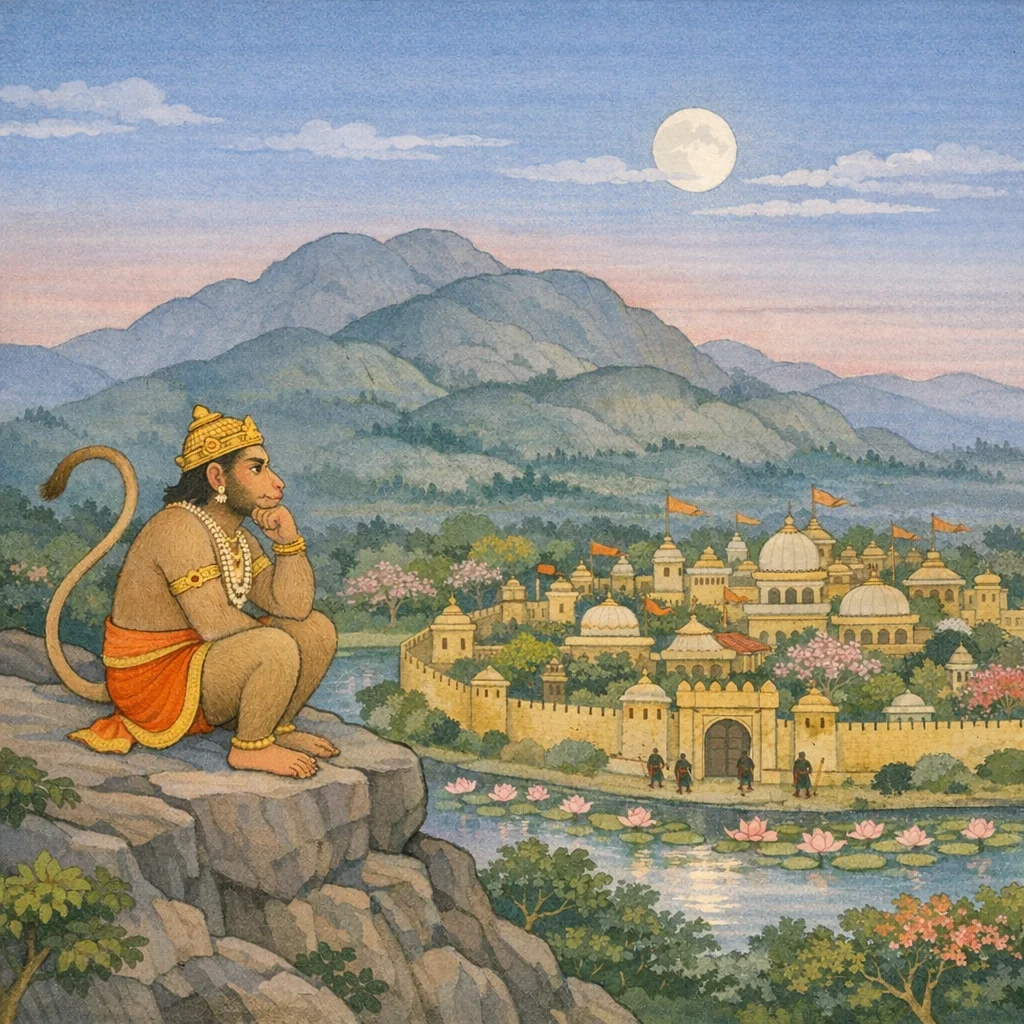
This sarga narrates Hanuman’s arrival at Trikūṭa, his first sustained visual survey of Laṅkā, and his internal strategic reasoning. He observes luxuriant groves, ponds, and pleasure-gardens surrounding the city, then shifts to a fortified-city assessment: moats with lotuses, golden ramparts, towering mansions, banners, archways, and the sense of a ‘deva-purī’ likeness. The text intensifies security imagery—rākṣasas with fierce weapons, the city compared to Bhogavatī and a serpent-guarded cavern—prompting Hanuman’s dharma-centered deliberation as a messenger. He evaluates feasibility: open war is untenable; even the wind cannot pass undetected; only a few vanaras could reach this place. He concludes that success depends on deśa-kāla alignment: shrinking to an inconspicuous form, entering at dusk/night, and searching systematically for Vaidehī without alerting Ravana. The chapter ends with the moonrise imagery, reinforcing nocturnal timing and the poised transition from observation to covert action.
Shlokas
Verse 1
स सागरमनादृष्यमतिक्रम्य महाबलः।त्रिकूटशिखरे लङ्कां स्थितां स्वस्थो ददर्श ह।।।।
That mighty one, having crossed the inviolable ocean, stood composed upon the peak of Trikūṭa and beheld Laṅkā set there.
Verse 2
ततः पादपमुक्तेन पुष्पवर्षेण वीर्यवान्।अभिवृष्टः स्थितस्तत्र बभौ पुष्पमयो यथा।।।।
Then the heroic one stood there, drenched by a rain of flowers released from the trees, appearing as though he were made of flowers.
Verse 3
योजनानां शतं श्रीमांस्तीर्त्वाप्युत्तमविक्रमः।अनिःश्वसन् कपिस्तत्र न ग्लानिमधिगच्छति।।।।
The glorious monkey of unsurpassed prowess, even after crossing a hundred yojanas, did not gasp for breath there, nor did he feel fatigue.
Verse 4
शतान्यहं योजनानां क्रमेयं सुबहून्यपि।किं पुनः सागरस्यान्तं संख्यातं शतयोजनम्।।।।
I can traverse even many hundreds of yojanas—what then of the ocean’s span, reckoned as a mere hundred yojanas?
Verse 5
स तु वीर्यवतां श्रेष्ठः प्लवतामपि चोत्तमः।जगाम वेगवान् लङ्कां लङ्घयित्वा महोदधिम्।।।।
He—foremost among the mighty and best even among leapers—swiftly reached Laṅkā after crossing the great ocean.
Verse 6
शाद्वलानि च नीलानि गन्धवन्ति वनानि च।गण्डवन्ति च मध्येन जगाम नगवन्ति च।।।।
He went on through dark, grassy stretches, through fragrant forests, and along the way past craggy places and mountains thick with trees.
Verse 7
शैलांश्च तरुसंछन्नान् वनाराजीश्च पुष्पिताः।अभिचक्राम तेजस्वी हनुमान् प्लवगर्षभः।।।।
Brilliant Hanuman—the bull among vanaras—traversed mountains thick with trees and forest-ranges blooming with flowers.
Verse 8
स तस्मिन्नचले तिष्ठन्वनान्युपवनानि च।स नगाग्रे च तां लङ्कां ददर्श पवनात्मजः।।।।
Standing upon that mountain, the Wind-god’s son looked out and saw the forests and groves, and there—on the mountain’s crest—Lanka itself.
Verse 9
सरलान् कर्णिकारांश्च खर्जूरांश्च सुपुष्पितान्।प्रियालून्मुचुलिन्दांश्च कुटजान् केतकानपि।।।।प्रियंङ्गून् गन्धपूर्णांश्च नीपान् सप्तच्छदांस्तथा।आसनान् कोविदारांश्च करवीरांश्च पुष्पितान्।।।।पुष्पभारनिबद्धांश्च तथा मुकुलितानपि।पादपान् विहगाकीर्णान् पवनाधूतमस्तकान्।।।।हंसकारण्डवाकीर्णा वापीः पद्मोत्मलायुताः।आक्रीडान् विविधान् रम्यावन् विविधांश्च जलाशयान्।।।।सन्ततान् विविधैर्वृक्षैः सर्वर्तुफलपुष्पितैः।उद्यानानि च रम्याणि ददर्श कपिकुञ्जरः।।।।
The elephant-like vanara saw delightful gardens spread with many kinds of trees—sarala, karṇikāra, and date-palms in full bloom; priyāla, muculinda, kuṭaja, and ketaka; fragrant priyaṅgu, nīpa, and saptacchada; and flowering āsana, kovidāra, and karavīra—some weighed down with blossoms, others budding, all alive with birds and their tops shaken by the wind. He also saw ponds filled with swans and waterfowl, lotus and water-lilies, and many charming pleasure-grounds and water-resorts, where fruits and flowers appeared in every season.
Verse 10
सरलान् कर्णिकारांश्च खर्जूरांश्च सुपुष्पितान्।प्रियालून्मुचुलिन्दांश्च कुटजान् केतकानपि।।5.2.9।।प्रियंङ्गून् गन्धपूर्णांश्च नीपान् सप्तच्छदांस्तथा।आसनान् कोविदारांश्च करवीरांश्च पुष्पितान्।।5.2.10।।पुष्पभारनिबद्धांश्च तथा मुकुलितानपि।पादपान् विहगाकीर्णान् पवनाधूतमस्तकान्।।5.2.11।।हंसकारण्डवाकीर्णा वापीः पद्मोत्मलायुताः।आक्रीडान् विविधान् रम्यावन् विविधांश्च जलाशयान्।।5.2.12।।सन्ततान् विविधैर्वृक्षैः सर्वर्तुफलपुष्पितैः।उद्यानानि च रम्याणि ददर्श कपिकुञ्जरः।।5.2.13।।
He saw priyaṅgu trees heavy with fragrance, and also nīpa and saptacchada, along with flowering āsana, kovidāra, and karavīra.
Verse 11
सरलान् कर्णिकारांश्च खर्जूरांश्च सुपुष्पितान्।प्रियालून्मुचुलिन्दांश्च कुटजान् केतकानपि।।5.2.9।।प्रियंङ्गून् गन्धपूर्णांश्च नीपान् सप्तच्छदांस्तथा।आसनान् कोविदारांश्च करवीरांश्च पुष्पितान्।।5.2.10।।पुष्पभारनिबद्धांश्च तथा मुकुलितानपि।पादपान् विहगाकीर्णान् पवनाधूतमस्तकान्।।5.2.11।।हंसकारण्डवाकीर्णा वापीः पद्मोत्मलायुताः।आक्रीडान् विविधान् रम्यावन् विविधांश्च जलाशयान्।।5.2.12।।सन्ततान् विविधैर्वृक्षैः सर्वर्तुफलपुष्पितैः।उद्यानानि च रम्याणि ददर्श कपिकुञ्जरः।।5.2.13।।
He saw trees weighed down by loads of blossoms, and others still in bud—trees filled with birds, their tops swayed by the wind.
Verse 12
सरलान् कर्णिकारांश्च खर्जूरांश्च सुपुष्पितान्।प्रियालून्मुचुलिन्दांश्च कुटजान् केतकानपि।।5.2.9।।प्रियंङ्गून् गन्धपूर्णांश्च नीपान् सप्तच्छदांस्तथा।आसनान् कोविदारांश्च करवीरांश्च पुष्पितान्।।5.2.10।।पुष्पभारनिबद्धांश्च तथा मुकुलितानपि।पादपान् विहगाकीर्णान् पवनाधूतमस्तकान्।।5.2.11।।हंसकारण्डवाकीर्णा वापीः पद्मोत्मलायुताः।आक्रीडान् विविधान् रम्यावन् विविधांश्च जलाशयान्।।5.2.12।।सन्ततान् विविधैर्वृक्षैः सर्वर्तुफलपुष्पितैः।उद्यानानि च रम्याणि ददर्श कपिकुञ्जरः।।5.2.13।।
He saw ponds crowded with swans and kāraṇḍava birds, adorned with lotuses and blue lotuses; and many delightful pleasure-groves and varied reservoirs of water.
Verse 13
सरलान् कर्णिकारांश्च खर्जूरांश्च सुपुष्पितान्।प्रियालून्मुचुलिन्दांश्च कुटजान् केतकानपि।।5.2.9।।प्रियंङ्गून् गन्धपूर्णांश्च नीपान् सप्तच्छदांस्तथा।आसनान् कोविदारांश्च करवीरांश्च पुष्पितान्।।5.2.10।।पुष्पभारनिबद्धांश्च तथा मुकुलितानपि।पादपान् विहगाकीर्णान् पवनाधूतमस्तकान्।।5.2.11।।हंसकारण्डवाकीर्णा वापीः पद्मोत्मलायुताः।आक्रीडान् विविधान् रम्यावन् विविधांश्च जलाशयान्।।5.2.12।।सन्ततान् विविधैर्वृक्षैः सर्वर्तुफलपुष्पितैः।उद्यानानि च रम्याणि ददर्श कपिकुञ्जरः।।5.2.13।।
The elephant-like monkey-warrior saw delightful gardens, spread out with many kinds of trees bearing fruits and blossoms in every season.
Verse 14
समासाद्य च लक्ष्मीवान् लङ्कां रावणपालिताम्।परिखाभिः सपद्माभिः सोत्पलाभिरलङ्कृताम्।।।।सीतापहरणार्थेन रावणेन सुरक्षिताम्।समन्ताद्विचरद्भिश्च राक्षसैरुग्रधन्विभिः।।।।काञ्चनेनावृतां रम्यां प्राकारेण महापुरीम्।गृहैश्च ग्रहसंकाशैः शारदाम्बुदसन्निभैः।।।।पाण्डुराभिः प्रतोलीभिरुच्चाभिरभिसंवृताम्।अट्टालकशताकीर्णां पताकाध्वजमालिनीम्।।।।तोरणैः काञ्चनैर्दिव्यैर्लतापङ्त्किविचित्रितैः।ददर्श हनुमान् लङ्कां दिवि देवपुरीं यथा।।।।
And that fortunate one, having reached Laṅkā ruled by Rāvaṇa, saw it adorned with moats filled with lotuses and blue lotuses.
Verse 15
समासाद्य च लक्ष्मीवान् लङ्कां रावणपालिताम्।परिखाभिः सपद्माभिः सोत्पलाभिरलङ्कृताम्।।5.2.14।।सीतापहरणार्थेन रावणेन सुरक्षिताम्।समन्ताद्विचरद्भिश्च राक्षसैरुग्रधन्विभिः।।5.2.15।।काञ्चनेनावृतां रम्यां प्राकारेण महापुरीम्।गृहैश्च ग्रहसंकाशैः शारदाम्बुदसन्निभैः।।5.2.16।।पाण्डुराभिः प्रतोलीभिरुच्चाभिरभिसंवृताम्।अट्टालकशताकीर्णां पताकाध्वजमालिनीम्।।5.2.17।।तोरणैः काञ्चनैर्दिव्यैर्लतापङ्त्किविचित्रितैः।ददर्श हनुमान् लङ्कां दिवि देवपुरीं यथा।।5.2.18।।
It was heavily guarded by Rāvaṇa for the sake of Sītā’s abduction, and on all sides it was patrolled by rākṣasas bearing dreadful bows.
Verse 16
समासाद्य च लक्ष्मीवान् लङ्कां रावणपालिताम्।परिखाभिः सपद्माभिः सोत्पलाभिरलङ्कृताम्।।5.2.14।।सीतापहरणार्थेन रावणेन सुरक्षिताम्।समन्ताद्विचरद्भिश्च राक्षसैरुग्रधन्विभिः।।5.2.15।।काञ्चनेनावृतां रम्यां प्राकारेण महापुरीम्।गृहैश्च ग्रहसंकाशैः शारदाम्बुदसन्निभैः।।5.2.16।।पाण्डुराभिः प्रतोलीभिरुच्चाभिरभिसंवृताम्।अट्टालकशताकीर्णां पताकाध्वजमालिनीम्।।5.2.17।।तोरणैः काञ्चनैर्दिव्यैर्लतापङ्त्किविचित्रितैः।ददर्श हनुमान् लङ्कां दिवि देवपुरीं यथा।।5.2.18।।
That great and lovely city was enclosed by a golden rampart, and it had houses that looked like clusters of planets, resembling autumn clouds.
Verse 17
समासाद्य च लक्ष्मीवान् लङ्कां रावणपालिताम्।परिखाभिः सपद्माभिः सोत्पलाभिरलङ्कृताम्।।5.2.14।।सीतापहरणार्थेन रावणेन सुरक्षिताम्।समन्ताद्विचरद्भिश्च राक्षसैरुग्रधन्विभिः।।5.2.15।।काञ्चनेनावृतां रम्यां प्राकारेण महापुरीम्।गृहैश्च ग्रहसंकाशैः शारदाम्बुदसन्निभैः।।5.2.16।।पाण्डुराभिः प्रतोलीभिरुच्चाभिरभिसंवृताम्।अट्टालकशताकीर्णां पताकाध्वजमालिनीम्।।5.2.17।।तोरणैः काञ्चनैर्दिव्यैर्लतापङ्त्किविचित्रितैः।ददर्श हनुमान् लङ्कां दिवि देवपुरीं यथा।।5.2.18।।
It was ringed with lofty white gateways, crowded with hundreds of watchtowers, and adorned with garlands of banners and flags.
Verse 18
समासाद्य च लक्ष्मीवान् लङ्कां रावणपालिताम्।परिखाभिः सपद्माभिः सोत्पलाभिरलङ्कृताम्।।5.2.14।।सीतापहरणार्थेन रावणेन सुरक्षिताम्।समन्ताद्विचरद्भिश्च राक्षसैरुग्रधन्विभिः।।5.2.15।।काञ्चनेनावृतां रम्यां प्राकारेण महापुरीम्।गृहैश्च ग्रहसंकाशैः शारदाम्बुदसन्निभैः।।5.2.16।।पाण्डुराभिः प्रतोलीभिरुच्चाभिरभिसंवृताम्।अट्टालकशताकीर्णां पताकाध्वजमालिनीम्।।5.2.17।।तोरणैः काञ्चनैर्दिव्यैर्लतापङ्त्किविचित्रितैः।ददर्श हनुमान् लङ्कां दिवि देवपुरीं यथा।।5.2.18।।
Hanumān beheld Laṅkā adorned with splendid golden arches, made lovely by patterned rows of creepers—like a city of the gods in heaven.
Verse 19
गिरिमूर्ध्निं स्थितां लङ्कां पाण्डुरैर्भवनैः शुभैः।ददर्श स कपिश्रेष्ठः पुरमाकाशगं यथा।।।।
That foremost of monkeys saw Laṅkā set upon a mountain peak, with auspicious pale mansions, like a city that rose into the sky.
Verse 20
पालितां राक्षसेन्द्रेण निर्मितां विश्वकर्मणा।प्लवमानमिवाकाशे ददर्श हनुमान् पुरीम्।।।।
Hanumān saw that city—ruled by the lord of rākṣasas and built by Viśvakarman—appearing as though it floated in the sky.
Verse 21
वप्रप्राकारजघनां विपुलाम्बुनवाम्बराम्।शतघ्नीशूलकेशान्तामट्टालकवतंसकाम्।।।।मनसेव कृतां लङ्कां निर्मितां विश्वकर्मणा।द्वारमुत्तरमासाद्य चिन्तयामास वानरः।।।।
Reaching the northern gate, the vānara reflected that Viśvakarman had fashioned Laṅkā as though she were a woman: her hips and loins were the ramparts and walls, her garment the broad water-filled moats, her hair the lines of weapons—sataghnīs and tridents—and her earrings the tall towers.
Verse 22
वप्रप्राकारजघनां विपुलाम्बुनवाम्बराम्।शतघ्नीशूलकेशान्तामट्टालकवतंसकाम्।।5.2.21।।मनसेव कृतां लङ्कां निर्मितां विश्वकर्मणा।द्वारमुत्तरमासाद्य चिन्तयामास वानरः।।5.2.22।।
Reaching the northern gate, the vānara reflected that Viśvakarman had fashioned Laṅkā as though she were a woman: her hips and loins were the ramparts and walls, her garment the broad water-filled moats, her hair the lines of weapons—sataghnīs and tridents—and her earrings the tall towers.
Verse 23
कैलासशिखरप्रख्यामालिखन्तीमिवाम्बरम्।डीयमानामिवाकाशमुच्छ्रितैर्भवनोत्तमैः।।।।सम्पूर्णां राक्षसैर्घोरैर्नागैर्भोगवतीमिव।अचिन्त्यां सुकृतां स्पष्टां कुबेराध्युषितां पुरा।।।।दंष्ट्रिभिर्बहुभिः शूरैः शूलपट्टसपाणिभिः।रक्षितां राक्षसैर्घोरैर्गुहामाशीविषैरिव।।।।तस्याश्च महतीं गुप्तिं सागरं च निरीक्ष्य सः।रावणं च रिपुं घोरं चिन्तयामास वानरः।।।।
He observed Laṅkā, like a peak of Kailāsa, seeming to scrape the sky, her finest mansions rising as though in flight. She was packed with dreadful rākṣasas and nāgas, like Bhogavatī; inconceivably and expertly built, once inhabited by Kubera. Guarded by fierce rākṣasas—many-fanged heroes holding tridents and spears—she looked like a cave protected by venomous serpents. Seeing her massive security and the surrounding ocean, the vānara began to think upon Rāvaṇa, the terrifying enemy.
Verse 24
कैलासशिखरप्रख्यामालिखन्तीमिवाम्बरम्।डीयमानामिवाकाशमुच्छ्रितैर्भवनोत्तमैः।।5.2.23।।सम्पूर्णां राक्षसैर्घोरैर्नागैर्भोगवतीमिव।अचिन्त्यां सुकृतां स्पष्टां कुबेराध्युषितां पुरा।।5.2.24।।दंष्ट्रिभिर्बहुभिः शूरैः शूलपट्टसपाणिभिः।रक्षितां राक्षसैर्घोरैर्गुहामाशीविषैरिव।।5.2.25।।तस्याश्च महतीं गुप्तिं सागरं च निरीक्ष्य सः।रावणं च रिपुं घोरं चिन्तयामास वानरः।।5.2.26।।
He observed Laṅkā, like a peak of Kailāsa, seeming to scrape the sky, her finest mansions rising as though in flight. She was packed with dreadful rākṣasas and nāgas, like Bhogavatī; inconceivably and expertly built, once inhabited by Kubera. Guarded by fierce rākṣasas—many-fanged heroes holding tridents and spears—she looked like a cave protected by venomous serpents. Seeing her massive security and the surrounding ocean, the vānara began to think upon Rāvaṇa, the terrifying enemy.
Verse 25
कैलासशिखरप्रख्यामालिखन्तीमिवाम्बरम्।डीयमानामिवाकाशमुच्छ्रितैर्भवनोत्तमैः।।5.2.23।।सम्पूर्णां राक्षसैर्घोरैर्नागैर्भोगवतीमिव।अचिन्त्यां सुकृतां स्पष्टां कुबेराध्युषितां पुरा।।5.2.24।।दंष्ट्रिभिर्बहुभिः शूरैः शूलपट्टसपाणिभिः।रक्षितां राक्षसैर्घोरैर्गुहामाशीविषैरिव।।5.2.25।।तस्याश्च महतीं गुप्तिं सागरं च निरीक्ष्य सः।रावणं च रिपुं घोरं चिन्तयामास वानरः।।5.2.26।।
He observed Laṅkā, like a peak of Kailāsa, seeming to scrape the sky, her finest mansions rising as though in flight. She was packed with dreadful rākṣasas and nāgas, like Bhogavatī; inconceivably and expertly built, once inhabited by Kubera. Guarded by fierce rākṣasas—many-fanged heroes holding tridents and spears—she looked like a cave protected by venomous serpents. Seeing her massive security and the surrounding ocean, the vānara began to think upon Rāvaṇa, the terrifying enemy.
Verse 26
कैलासशिखरप्रख्यामालिखन्तीमिवाम्बरम्।डीयमानामिवाकाशमुच्छ्रितैर्भवनोत्तमैः।।5.2.23।।सम्पूर्णां राक्षसैर्घोरैर्नागैर्भोगवतीमिव।अचिन्त्यां सुकृतां स्पष्टां कुबेराध्युषितां पुरा।।5.2.24।।दंष्ट्रिभिर्बहुभिः शूरैः शूलपट्टसपाणिभिः।रक्षितां राक्षसैर्घोरैर्गुहामाशीविषैरिव।।5.2.25।।तस्याश्च महतीं गुप्तिं सागरं च निरीक्ष्य सः।रावणं च रिपुं घोरं चिन्तयामास वानरः।।5.2.26।।
He observed Laṅkā, like a peak of Kailāsa, seeming to scrape the sky, her finest mansions rising as though in flight. She was packed with dreadful rākṣasas and nāgas, like Bhogavatī; inconceivably and expertly built, once inhabited by Kubera. Guarded by fierce rākṣasas—many-fanged heroes holding tridents and spears—she looked like a cave protected by venomous serpents. Seeing her massive security and the surrounding ocean, the vānara began to think upon Rāvaṇa, the terrifying enemy.
Verse 27
आगत्यापीह हरयो भविष्यन्ति निरर्थकाः।न हि युद्धेन वै लङ्का शक्या जेतुं सुरैरपि।।।।
Even if the monkeys were to come here, they would prove of no use; for by war Lanka cannot be conquered—not even by the gods.
Verse 28
इमां तु विषमां दुर्गां लङ्कां रावणपालिताम्।प्राप्यापि स महाबाहुः किं करिष्यति राघवः।।।।
Even if the mighty-armed Rāghava were to reach this perilous, impregnable Lanka guarded under Rāvaṇa’s rule—what could he accomplish here?
Verse 29
अवकाशो नसान्त्वस्य राक्षसेष्वभिगम्यते।न दानस्य न भेदस्य नैव युद्धस्य दृश्यते।।।।
Among the rākṣasas there appears no opening for conciliation—nor for winning them by gifts, nor for splitting them by dissension; and even war seems to offer no clear path.
Verse 30
चतुर्णामेव हि गतिर्वानराणां महात्मनाम्।वालिपुत्रस्य नीलस्य मम राज्ञश्च धीमतः।।।।
Only four great-souled vanaras truly have the capacity to reach this place—Vāli’s son, Nīla, the wise king, and I.
Verse 31
यावज्जानामि वैदेहीं यदि जीवति वा न वा।तत्रैव चिन्तयिष्यामि दृष्ट्वा तां जनकात्मजाम्।।।।
Until I know whether Vaidehī lives or not, I will decide my course only after seeing Janaka’s daughter there with my own eyes.
Verse 32
ततः स चिन्तयामास मुहूर्तं कपिकुञ्जरः।गिरिशृङ्गे स्थितस्तस्मिन् रामस्याभ्युदये रतः।।।।
Then that elephant among monkeys stood upon the mountain peak and reflected for a while—intent on what would bring about Rama’s success.
Verse 33
अनेन रूपेण मया न शक्या रक्षसां पुरी।प्रवेष्टुं राक्षसैर्गुप्ता क्रूरैर्बलसमन्वितैः।।।।
In this form, I cannot enter the city of the rākṣasas—guarded as it is by fierce and powerful demons.
Verse 34
उग्रौजसो महावीर्या बलवन्तश्च राक्षसाः।वञ्चनीया मया सर्वे जानकीं परिमार्गता।।5.2.34।।
These rākṣasas—fierce in energy, great in valor, and strong—must all be outwitted by me as I search for Jānakī.
Verse 35
लक्ष्यालक्ष्येण रूपेण रात्रौ लङ्का पुरी मया।प्रवेष्टुं प्राप्तकालं मे कृत्यं साधयितुं महत्।।।।
To accomplish this great duty, the right time has come for me to enter the city of Lanka at night, assuming a form that is both seen and unseen—noticed by none.
Verse 36
तां पुरीं तादृशीं दृष्ट्वा दुराधर्षां सुरासुरैः।हनुमान् चिन्तयामास विनिश्चित्य मुहुर्मुहुः।।।।
Seeing that city—so formidable that even gods and demons could not assail it—Hanumān repeatedly reflected, weighing the matter again and again with a deep resolve.
Verse 37
केनोपायेन पश्येयं मैथिलीं जनकात्मजाम्।अदृष्टो राक्षसेन्द्रेण रावणेन दुरात्मना।।।।
By what means can I find Maithilī, Janaka’s daughter, without being seen by the evil-minded Rāvaṇa, lord of the rākṣasas?
Verse 38
न विनश्येत्कथं कार्यं रामस्य विदितात्मनः।एकामेकश्च वश्येयं रहिते जनकात्मजाम्।।।।
How can Rāma’s purpose—he who is self-knowing—remain unharmed? And how may I, alone, meet Janaka’s daughter in a secluded moment?
Verse 39
भूताश्चार्था विपद्यन्ते देशकालविरोधिताः।विक्लबं दूतमासाद्य तमः सूर्योदये यथा।।।।
Plans already set in motion perish when they run against the proper place and time—especially when they fall into the hands of a confused messenger—just as darkness vanishes at sunrise.
Verse 40
अर्थानर्थान्तरे बुद्धिर्निश्चितापि न शोभते।घातयन्ति हि कार्याणि दूताः पण्डितमानिनः।।।।
Even a settled intention does not shine when it wavers between the beneficial and the harmful; for messengers who fancy themselves wise often ruin the very work they are meant to accomplish.
Verse 41
न विनश्येत्कथं कार्यं वैक्लब्यं न कथं भवेत्।लङ्घनं च समुद्रस्य कथं नु न वृथा भवेत्।।।।
How can the task be kept from ruin? How can I avoid confusion and rashness? And how can my crossing of the ocean not become futile?
Verse 42
मयि दृष्टे तु रक्षोभी रामस्य विदितात्मनः।भवेद्व्यर्थमिदं कार्यं रावणानर्थमिच्छतः।।।।
If the rākṣasas were to see me, this undertaking of self-knowing Rāma—who seeks Rāvaṇa’s downfall—would become fruitless.
Verse 43
न हि शक्यं क्वचित् स्थातुमविज्ञातेन राक्षसैः।अपि राक्षसरूपेण किमुतान्येन केनचित्।।।।
It is not possible to remain anywhere here without being recognized by the rākṣasas—even if one assumes a rākṣasa form; how much less in any other guise.
Verse 44
वायुरप्यत्र नाज्ञातश्चरेदिति मतिर्मम।न ह्य स्त्यविदितं किञ्चिद्राक्षसानां बलीयसाम्।।।।
My thought is that even the wind could not move here without being noticed; for to these powerful rākṣasas, nothing at all remains unknown.
Verse 45
इहाहं यदि तिष्ठामि स्वेन रूपेण संवृतः।विनाशमुपयास्यामि भर्तुरर्थश्च हीयते।।।।
If I remain here concealed in my own (full) form, I will come to ruin—and my lord’s mission will also be lost.
Verse 46
तदहं स्वेन रूपेण रजन्यां ह्रस्वतां गतः।लङ्कामभिपतिष्यामि राघवस्यार्थसिद्धये।।।।
Therefore, taking on a diminutive form in the night, I shall move about in Laṅkā to accomplish Rāghava’s purpose.
Verse 47
रावणस्य पुरीं रात्रौ प्रविश्य सुदुरासदाम्।विचिन्वन् भवनं सर्वं द्रक्ष्यामि जनकात्मजाम्।।।।
Entering by night Rāvaṇa’s city—so hard to approach—I shall search every residence and behold Janaka’s daughter.
Verse 48
इति सञ्चिन्त्य हनुमान् सूर्यस्यास्तमयं कपिः।आचकाङ्क्षे तदा वीरो वैदेह्या दर्शनोत्सुकः।।।।
Having thus reflected, Hanumān—the heroic vānarā—eager to see Vaidehī, waited for the sun’s setting.
Verse 49
सूर्ये चास्तं गते रात्रौ देहं सङ्क्षिप्य मारुतिः।पृषदंशकमात्रः सन् बभूवाद्भुतदर्शनः।।।।
When the sun had set and night had come, Māruti compressed his body and became no larger than a small creature—yet wondrous to behold.
Verse 50
प्रदोषकाले हनुमांस्तूर्णमुत्प्लुत्य वीर्यवान्।प्रविवेश पुरीं रम्यां सुविभक्तमहापथाम्।।।।
At dusk, the mighty Hanumān leapt swiftly and entered the lovely city, with its great roads laid out in fine order.
Verse 51
प्रासादमालाविततां स्तम्भैः काञ्चनराजतैः।शातकुम्भमयैर्जालैर्गन्थर्वनगरोपमाम्।।।।सप्तभौमाष्टभौमैश्च स ददर्श महापुरीम्।तलैः स्फाटिकसंकीर्णैः कार्तस्वरविभूषितैः।।।।
He beheld the great city spread out with rows of mansions—pillars of gold and silver, latticed windows of pure gold—like a Gandharva-city; with seven- and eight-storied palaces, crystal-inlaid floors, and adornments of gleaming gold.
Verse 52
प्रासादमालाविततां स्तम्भैः काञ्चनराजतैः।शातकुम्भमयैर्जालैर्गन्थर्वनगरोपमाम्।।5.2.51।।सप्तभौमाष्टभौमैश्च स ददर्श महापुरीम्।तलैः स्फाटिकसंकीर्णैः कार्तस्वरविभूषितैः।।5.2.52।।
He saw the great city, extended with continuous rows of mansions—gold-and-silver pillars, golden latticework, Gandharva-city-like—filled with seven- and eight-storied buildings, crystal-inlaid floors, and decorations of fine gold.
Verse 53
वैडूर्यमणिचित्रैश्च मुक्ताजालविभूषितैः।तलैः शुशुभिरे तानि भवनान्यत्र रक्षसाम्।।।।
There, the rākṣasas’ mansions shone splendidly—floors adorned with vaiḍūrya gems and decorated with pearl-lattice ornamentation.
Verse 54
काञ्चनानि च चित्राणि तोरणानि च रक्षसाम्।लङ्कामुद्योतयामासुः सर्वतः समलङ्कृताम्।।।।
The demons’ archways—golden and richly variegated—cast their light everywhere, making Lanka, adorned on all sides, shine.
Verse 55
अचिन्त्यामद्भुताकारां दृष्टवा लङ्कां महाकपिः।आसीद्विषण्णो हृष्टश्च वैदेह्या दर्शनोत्सुकः।।।।
Seeing Lanka—unimaginable and wondrous in form—the great monkey, eager for Vaidehi’s sight, became at once downcast and delighted.
Verse 56
स पाण्डुराविद्धविमानमालिनीं महार्हजाम्बूनदजालतोरणाम्।यशस्विनीं रावणबाहुपालितां क्षपाचरैर्भीमबलैः समावृताम्।।।।
He saw that famed city—garlanded with pale, lofty mansions, with precious toranas and latticed gold-work—ruled under Ravana’s might and ringed round by night-roaming demons of dreadful strength.
Verse 57
चन्द्रोऽपि साचिव्यमिवास्य कुर्वंस्तारागणैर्मध्यगतो विराजन्।ज्योत्स्नावितानेन वितत्य लोक मुत्तिष्ठते नैकसहस्ररश्मि:।।।।
Even the moon—thousand-rayed—rose shining in the midst of the host of stars, spreading a canopy of moonlight over the world, as though offering ministerial aid to him (Hanuman).
Verse 58
शङ्खप्रभं क्षीरमृणालवर्ण मुद्गच्छमानं व्यवभासमानम्।ददर्श चन्द्रं स हरिप्रवीरः पोप्लूयमानं सरसीव हंसम्।।।।
That heroic vanara beheld the moon rising—conch-white, milk-and-lotus-stalk pale—glimmering as it emerged, like a swan floating upon a lake (the sky).
Frequently Asked Questions
Hanuman confronts the dilemma of mission success versus exposure: entering Laṅkā openly would endanger Rama’s objective, so he chooses covert entry—shrinking his body and moving at night—prioritizing dūta-dharma and the protection of the larger campaign.
The sarga teaches that even great strength must be governed by discernment: strategies fail when opposed to proper time and place, and a ‘thoughtless messenger’ can ruin well-formed plans; hence prudence and secrecy are virtues equal to valor.
Key landmarks include Trikūṭa peak as the observation point, the northern gate of Laṅkā, lotus-filled moats and golden ramparts, pleasure-gardens with diverse trees and ponds, and the city’s mythic associations (Amarāvatī-like splendor; Bhogavatī and serpent-guarded imagery).