Sarga 19
सीताव्यथा-वर्णनम् / Sītā’s Distress and Rāvaṇa’s Attempt at Coercive Allurement
सुन्दरकाण्ड
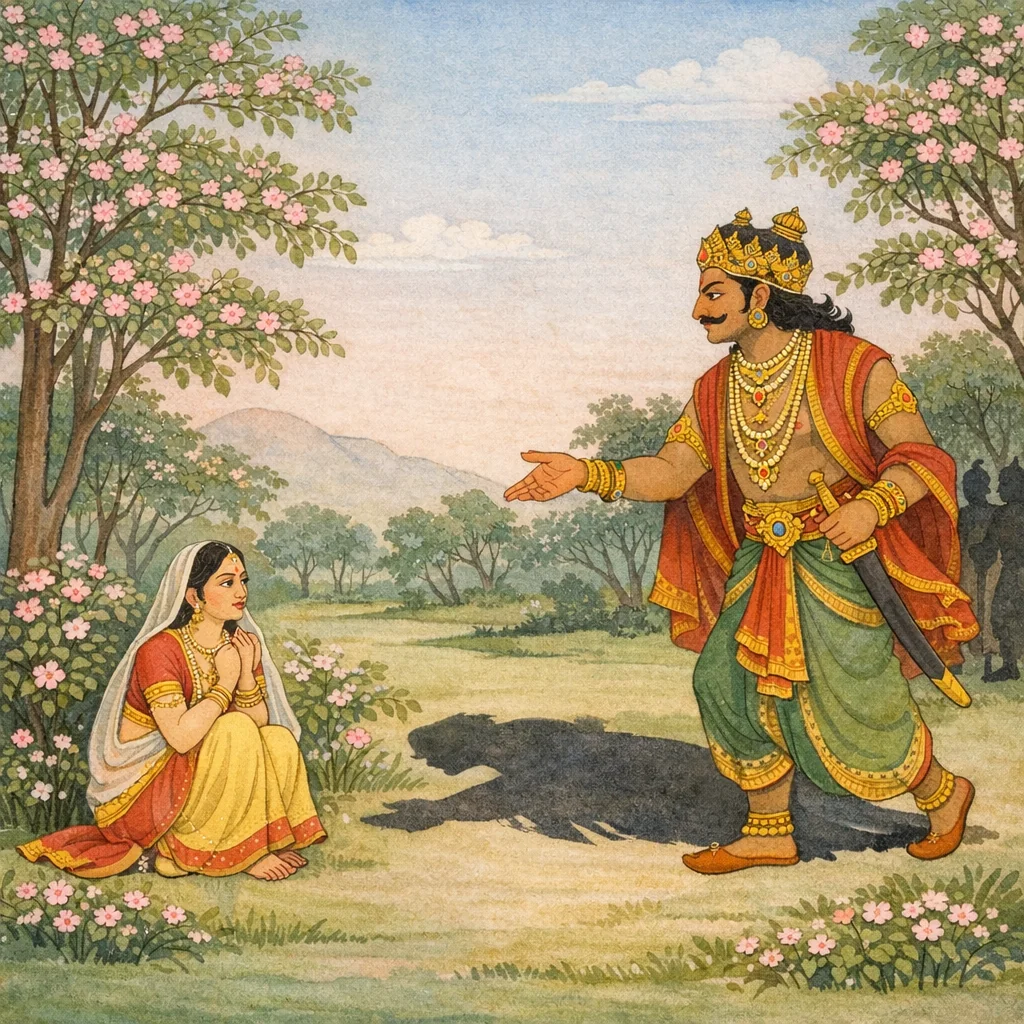
Sarga 19 presents a concentrated psychological tableau: Rāvaṇa approaches Sītā in captivity, and the text renders her immediate bodily and emotional recoil—she trembles upon seeing the rākṣasa-lord, a reaction framed through a striking simile (banana plant shaken by wind). The chapter then develops an extended chain of analogical comparisons to depict the erosion of auspiciousness and stability: Sītā is likened to dimmed fame, slighted faith, disrupted worship, frustrated hope, a blighted lotus-creeper, an army bereft of heroes, radiance smothered by darkness, a dried river, and a full moon eclipsed by Rāhu. These images serve a technical purpose: they map the moral disorder produced by abduction onto cosmic, ritual, and social symbols, while preserving Sītā’s inner dharma as intact. The description also notes her austerities—fasting, grief, brooding, fear—yet portrays her as spiritually “wealthy” through tapas. The sarga culminates with Rāvaṇa attempting to allure and threatening lethal force when she remains devoted to Rāma, reinforcing the ethical polarity between coercion and steadfast fidelity.
Shlokas
Verse 1
तस्मिन्नेव ततः काले राजपुत्री त्वनिन्दिता।रूपयौवनसम्पन्नं भूषणोत्तमभूषितम्।।।।ततो दृष्ट्वैव वैदेही रावणं राक्षसाधिपम्।प्रावेपत वरारोहा प्रवाते कदली यथा।।।।
At that very time, the blameless princess Vaidehī, seeing Rāvaṇa—the lord of the rākṣasas—endowed with youthful beauty and adorned with the finest ornaments, trembled like a banana plant shaken by a strong wind.
Verse 2
तस्मिन्नेव ततः काले राजपुत्री त्वनिन्दिता।रूपयौवनसम्पन्नं भूषणोत्तमभूषितम्।।5.19.1।।ततो दृष्ट्वैव वैदेही रावणं राक्षसाधिपम्।प्रावेपत वरारोहा प्रवाते कदली यथा।।5.19.2।।
Seeing Rāvaṇa, lord of the rākṣasas, Vaidehī—slender-waisted—trembled at once, like a banana plant shaken by a strong wind.
Verse 3
आच्छाद्योदरमूरुभ्यां बाहुभ्यां च पयोधरौ।उपविष्टा विशालाक्षी रुदन्ती वरवर्णिनी।।।।
The large-eyed, fair-complexioned Sītā sat there weeping, covering her belly and thighs, and also her breasts, with her arms.
Verse 4
दशग्रीवस्तु वैदेहीं रक्षितां राक्षसीगणैः।ददर्श सीतां दुःखार्तां नावं सन्नामिवार्णवे।।।।
Then Daśagrīva (Rāvaṇa) saw Vaidehī—Sītā—guarded by bands of rākṣasīs, grief-stricken like a boat sunk in the sea.
Verse 5
असंवृतायामासीनां धरण्यां संशितव्रताम्।छिन्नां प्रपतितां भूमौ शाखामिव वनस्पतेः।।।।
She sat upon the bare ground, her vow and resolve sharpened by suffering—like a branch cut from a tree and fallen upon the earth.
Verse 6
मलमण्डनचित्राङ्गीं मण्डनार्हाममण्डिताम्।मृणाली पङ्कदिग्धेव विभाति न विभाति च।।।।
Her limbs were mottled as though adorned only by dust; though worthy of ornaments, she wore none—like a lotus-stalk smeared with mud, shining and yet not shining.
Verse 7
समीपं राजसिंहस्य रामस्य विदितात्मनः।सङ्कल्पहयसंयुक्सैर्यान्तीमिव मनोरथैः।।।।
By the chariot of her mind—yoked to the horses of her resolve—she seemed to be traveling toward Rāma, the lion among kings, the self-knowing one.
Verse 8
शुष्यन्तीं रुदतीमेकां ध्यानशोकपरायणाम्।दुःखस्यान्तमपश्यन्तीं रामां राममनुव्रताम्।।।।
She was wasting away—alone, weeping, absorbed in thought and sorrow—seeing no end to her grief, faithful only to Rāma.
Verse 9
वेष्टमानां तथाऽविष्टां पन्नगेन्द्रवधूमिव।धूप्यमानां ग्रहेणेव रोहिणीं धूमकेतुना।।।।
Sitting thus, tightly wrapped in her sorrow, she looked like the serpent-king’s queen coiled upon herself—like Rohiṇī, as though obscured and made to “smoke,” by a baleful planet, a comet.
Verse 10
वृत्तशीलकुले जातामाचारवति धार्मिके।पुनःसंस्कारमापन्नां जातामिव च दुष्कुले।।।।
Born in a lineage of virtuous conduct, nurtured in righteous custom, she now seemed as though forced to undergo purification anew—like one born in a degraded family.
Verse 11
अभूतेनापवादेन कीर्तिं निपतितामिव।आम्नायानामयोगेन विद्यां प्रशिथिलामिव।।।।
She seemed like a reputation brought low by false slander—like sacred learning loosened and weakened when the Vedic disciplines are not properly practiced.
Verse 12
सन्नामिव महाकीर्तिं श्रद्धामिव विमानिताम्।पूजामिव परिक्षीणामाशां प्रतिहतामिव।।।।
She was like great fame grown dim; like faith that has been insulted; like worship diminished; like hope struck down and thwarted.
Verse 13
आयतीमिव विध्वस्तामाज्ञां प्रतिहतामिव।दीप्तामिव दिशं काले पूजामपहृतामिव।।।।
She was like a promising prospect ruined; like a command defied; like a direction set ablaze in a time of calamity; like worship stolen away.
Verse 14
पद्मिनीमिव विध्वस्तां हतशूरां चमूमिव।प्रभामिव तमोध्वस्तामुपक्षीणामिवापगाम्।।।।
She was like a lotus-pond laid waste; like an army whose heroes have been slain; like radiance smothered by darkness; like a stream run down and exhausted.
Verse 15
वेदीमिव परामृष्टां शान्तामग्निशिखामिव।पौर्णमासीमिव निशां राहुग्रस्तेन्दुमण्डलाम्।।।।
She was like an altar defiled; like a flame of fire gone out; like a full-moon night whose lunar orb is seized by Rāhu (an eclipse).
Verse 16
उत्कृष्टपर्णकमलां वित्रासितविहङ्गमाम्।हस्तिहस्तपरामृष्टामाकुलां पद्मिनीमिव।।।।
She appeared like a lotus-pond with splendid leaves and lotuses, its birds frightened away, churned and crushed by the trunks of elephants.
Verse 17
पतिशोकातुरां शुष्कां नदीं विस्रावितामिव।परया मृजया हीनां कृष्णपक्षनिशामिव।।।।
Tormented by grief for her husband, she looked like a river whose stream has thinned and dried—no longer fit for full ablution—like a night of the dark fortnight, stripped of its glow.
Verse 18
सुकुमारीं सुजाताङ्गीं रत्नगर्भगृहोचिताम्।तप्यमानामिवोष्णेन मृणालीमचिरोद्धृताम्।।।।
Delicate, beautifully formed, fit to dwell in a jewel-filled palace—she now seemed like a lotus-stalk freshly plucked, scorched by heat.
Verse 19
गृहीतामालितां स्तम्भे यूथपेन विनाकृताम्।निःश्वसन्तीं सुदुःखार्तां गजराजवधूमिव।।।।
She sighed deeply in intense anguish, like a royal she-elephant bound to a post, separated from her herd-lord.
Verse 20
एकया दीर्घया वेण्या शोभमानामयत्नतः।नीलया नीरदापाये वनराज्या महीमिव।।।।
Even with a single long braid, carelessly kept, she appeared beautiful—like the earth at the clearing of the rains, marked by one dark line of forest-trees.
Verse 21
उपवासेन शोकेन ध्यानेन च भयेन च।परिक्षीणां कृशां दीनामल्पाहारां तपोधनाम्।।।।
Worn down by fasting and grief, by brooding and fear, she was wasted, emaciated, and dejected—eating little, yet rich in the treasure of austerity.
Verse 22
आयाचमानां दुःखार्तां प्राञ्जलिं देवतामिव।भावेन रघुमुख्यस्य दशग्रीवपराभवम्।।।।
Tormented by grief, she seemed—like a goddess with hands folded in supplication—to be inwardly begging Rāma, the foremost of the Raghus, for the humiliation and defeat of Daśagrīva (Rāvaṇa).
Verse 23
समीक्षमाणां रुदतीमनिन्दितां सुपक्ष्मताम्रायतशुक्ललोचनाम्।अनुव्रतां राममतीव मैथिलीं प्रलोभयामास वधाय रावणः।।।।
As blameless Maithilī looked about and wept—her broad bright eyes framed by lovely lashes, slightly reddened at the corners—Rāvaṇa tried to entice her; and when she remained utterly devoted to Rāma, he resorted to threats of killing.
Frequently Asked Questions
The chapter stages coercion versus integrity: Rāvaṇa attempts to entice Sītā and escalates to threats of violence, while Sītā’s response is conveyed through steadfast refusal and embodied fear—showing dharma maintained even when safety is imperiled.
The sarga teaches that inner virtue is not identical with outer circumstance: captivity and humiliation can eclipse social auspiciousness, yet fidelity, tapas, and moral clarity remain preservable, exposing coercive power as ethically unstable.
Cultural-ritual and cosmic landmarks dominate: the vedi (altar), worship-articles, full-moon night and Rāhu’s eclipse, and Rohiṇī imagery; the scene is situated in Laṅkā’s captivity environment (commonly Aśoka-vāṭikā), emphasizing the contrast between royal splendor and enforced confinement.