Sarga 14
अशोकवनिकाविचारः (Survey of the Aśoka Grove and its Enchanted Landscape)
सुन्दरकाण्ड
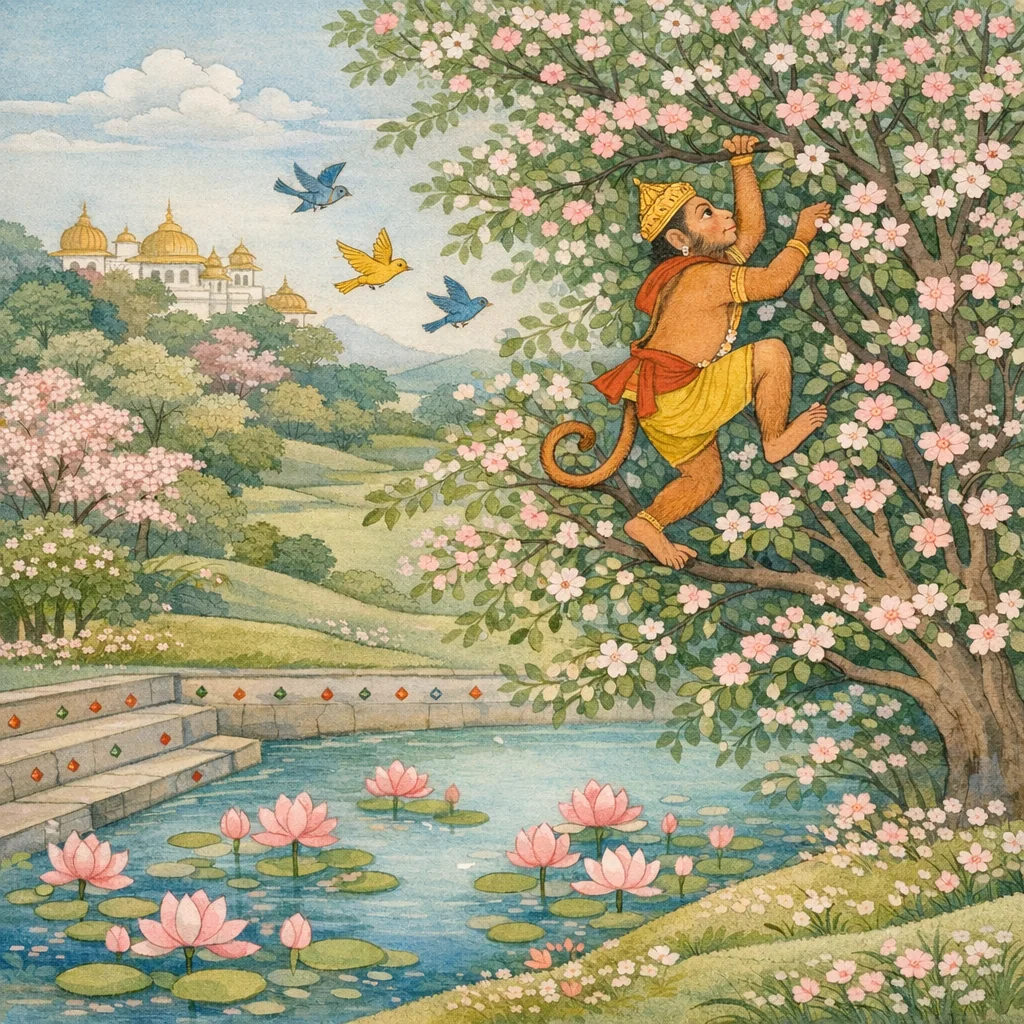
Sarga 14 narrates Hanumān’s controlled descent to the palace boundary and his entry into the Aśokavanikā as part of a covert search for Vaidehī. The chapter foregrounds sensory mapping: flowering trees shaken by his swift movement release multicolored showers; birds scatter; the grove appears like spring personified. The text employs elaborate similes—trees likened to defeated gamblers, and the grove likened to a disheveled young woman—converting physical disturbance into poetic signification. Hanumān observes engineered opulence: gem-, gold-, and silver-paved floors; ponds with jeweled steps, crystal pavements, lotus beds, and waterfowl; artificial lakes and mansions attributed to Viśvakarmā. He identifies a prominent golden śiṃśupā tree encircled by golden platforms and resounding like anklets in the wind, climbs it, and reasons that Sītā—accustomed to forest life and twilight rites—may come to the auspicious waters nearby. He then conceals himself amid dense leaves and blossoms, maintaining vigilance while awaiting the queen’s appearance.
Shlokas
Verse 1
स मुहूर्तमिव ध्यात्वा मनसा चाधिगम्य ताम्।अवप्लुतो महातेजाः प्राकारं तस्य वेश्मनः।।।।
After pondering for a moment and reaching her in his mind, the mighty and radiant one leapt down to the enclosing wall of that residence.
Verse 2
स तु संहृष्टसर्वाङ्गः प्राकारस्थो महाकपिः।पुष्पिताग्रान्वसन्तादौ ददर्श विविधान् द्रुमान्।।।।सालानशोकान् भव्यांश्च चंपकांश्च सुपुष्पितान्।उद्दालकान्नागवृक्षांश्चूतान्कपिमुखानपि।।।।
Standing upon the boundary wall, the great monkey (Hanumān), thrilled in every limb, saw many kinds of trees at the opening of spring—trees with blossoming tops: sāla and aśoka, splendid campaka in full bloom, as well as uddālaka, nāga-trees, and mango trees whose reddish fruits were compared to a monkey’s snout.
Verse 3
स तु संहृष्टसर्वाङ्गः प्राकारस्थो महाकपिः।पुष्पिताग्रान्वसन्तादौ ददर्श विविधान् द्रुमान्।।5.14.2।।सालानशोकान् भव्यांश्च चंपकांश्च सुपुष्पितान्।उद्दालकान्नागवृक्षांश्चूतान्कपिमुखानपि।।5.14.3।।
He saw many kinds of trees in full bloom—śāla, aśoka, splendid campaka, uddālaka, nāga trees, and mango trees whose reddish fruits were likened to a monkey’s snout.
Verse 4
अथाम्रवणसञ्छन्नां लताशतसमावृताम्।ज्यामुक्त इव नाराचः पुप्लुवे वृक्षवाटिकाम्।।।।
Then Hanumān sprang into the tree-garden—dense with mango groves and covered with hundreds of creepers—like an arrow released from a bowstring.
Verse 5
स प्रविश्य विचित्रां तां विहगैरभिनादिताम्।राजतैः कांचनैश्चैव पादपैः सर्वतो वृताम्।।।।विहगैर्मृगसङ्घैश्च विचित्रां चित्रकाननाम्।उदितादित्यसङ्काशां ददर्श हनुमान् कपिः।।।।वृतां नानाविधैर्वृक्षैः पुष्पोपगफलोपगैः।कोकिलैर्भृङ्गराजैश्च मत्तैर्नित्यनिषेविताम्।।।।प्रहृष्टमनुजे काले मृगपक्षिसमाकुले।मत्तबर्हिणसङ्घुष्टां नानाद्विजगणायुताम्।।।।
Entering that wondrous grove, resonant with birdsong and enclosed on every side by trees that gleamed like silver and gold, the monkey Hanumān beheld a variegated woodland—bright as the newly risen sun—alive with herds of deer and flocks of birds. It was surrounded by many kinds of trees laden with blossoms and fruits, constantly frequented by intoxicated cuckoos and bees; and at a time delightful to people, it teemed with beasts and birds, echoed with the calls of proud peacocks, and was filled with multitudes of different bird-flocks.
Verse 6
स प्रविश्य विचित्रां तां विहगैरभिनादिताम्।राजतैः कांचनैश्चैव पादपैः सर्वतो वृताम्।।5.14.5।।विहगैर्मृगसङ्घैश्च विचित्रां चित्रकाननाम्।उदितादित्यसङ्काशां ददर्श हनुमान् कपिः।।5.14.6।।वृतां नानाविधैर्वृक्षैः पुष्पोपगफलोपगैः।कोकिलैर्भृङ्गराजैश्च मत्तैर्नित्यनिषेविताम्।।5.14.7।।प्रहृष्टमनुजे काले मृगपक्षिसमाकुले।मत्तबर्हिणसङ्घुष्टां नानाद्विजगणायुताम्।।5.14.8।।
Hanumān the monkey beheld that wondrous woodland—alive with birds and herds of deer—radiant like the newly risen sun.
Verse 7
स प्रविश्य विचित्रां तां विहगैरभिनादिताम्।राजतैः कांचनैश्चैव पादपैः सर्वतो वृताम्।।5.14.5।।विहगैर्मृगसङ्घैश्च विचित्रां चित्रकाननाम्।उदितादित्यसङ्काशां ददर्श हनुमान् कपिः।।5.14.6।।वृतां नानाविधैर्वृक्षैः पुष्पोपगफलोपगैः।कोकिलैर्भृङ्गराजैश्च मत्तैर्नित्यनिषेविताम्।।5.14.7।।प्रहृष्टमनुजे काले मृगपक्षिसमाकुले।मत्तबर्हिणसङ्घुष्टां नानाद्विजगणायुताम्।।5.14.8।।
It was encircled by many kinds of trees rich with flowers and fruit, and constantly frequented by intoxicated cuckoos and bees.
Verse 8
स प्रविश्य विचित्रां तां विहगैरभिनादिताम्।राजतैः कांचनैश्चैव पादपैः सर्वतो वृताम्।।5.14.5।।विहगैर्मृगसङ्घैश्च विचित्रां चित्रकाननाम्।उदितादित्यसङ्काशां ददर्श हनुमान् कपिः।।5.14.6।।वृतां नानाविधैर्वृक्षैः पुष्पोपगफलोपगैः।कोकिलैर्भृङ्गराजैश्च मत्तैर्नित्यनिषेविताम्।।5.14.7।।प्रहृष्टमनुजे काले मृगपक्षिसमाकुले।मत्तबर्हिणसङ्घुष्टां नानाद्विजगणायुताम्।।5.14.8।।
At a time delightful to the heart, the grove teemed with animals and birds—resounding with flocks of exuberant peacocks and filled with multitudes of varied winged creatures.
Verse 9
मार्गमाणो वरारोहां राजपुत्रीमनिन्दिताम्।सुखप्रसुप्तान्विहगान् बोधयामास वानरः।।।।
While searching for the blameless princess—noble in bearing—the vanara roused the birds that had been sleeping comfortably.
Verse 10
उत्पतद्भिर्द्विजगणैः पक्षैः सालास्समाहताः।अनेकवर्णा विविधा मुमुचुः पुष्पवृष्टयः।।।।
As flocks of birds took flight, the śāla trees, struck by their wings, released many-hued and varied showers of flowers.
Verse 11
पुष्पावकीर्णश्शुशुभे हनुमान् मारुतात्मजः।अशोकवनिकामध्ये यथा पुष्पमयो गिरिः।।।।
Strewn with flowers, Hanumān—the son of the Wind—shone in the midst of the Aśoka grove like a mountain made of blossoms.
Verse 12
दिशस्सर्वाः प्रधावन्तं वृक्षषण्डगतं कपिम्।दृष्ट्वा सर्वाणि भूतानि वसन्त इति मेनिरे।।।।
Seeing the monkey racing in every direction amid clusters of trees, all the creatures there thought, “It is Spring itself.”
Verse 13
वृक्षेभ्यः पतितैः पुष्पैरवकीर्णा पृथग्विदैः।रराज वृक्षेभ्यः तत्र प्रमदेव विभूषिता।।।।
There the earth, strewn with flowers of many kinds fallen from the trees, shone—adorned like a young woman arrayed in ornaments.
Verse 14
तरस्विना ते तरवस्तरसाभिप्रकम्पिताः।कुसुमानि विचित्राणि ससृजुः कपिना तदा।।।।
Then those trees, violently shaken by the swift monkey, rained down flowers of many colors.
Verse 15
निर्धूतपत्रशिखराः शीर्णपुष्पफला द्रुमाः।निक्षिप्तवस्त्राभरणा धूर्ता इव पराजिताः।।।।
Their leafy crowns shaken off, their flowers and fruits shed, the trees looked like defeated gamblers—stripped of garments and ornaments after losing their stake.
Verse 16
हनूमता वेगवता कम्पितास्ते नगोत्तमाः।पुष्पपर्णफलान्याशु मुमुचुः पुष्पशालिनः।।।।
Shaken by swift Hanumān, even those great trees—laden with blossoms—quickly let fall flowers, leaves, and fruits.
Verse 17
विहङ्गसङ्घैर्हीनास्ते स्कन्धमात्राश्रया द्रुमाः।बभूवुरगमाः सर्वे मारुतेव निर्धुताः।।।
Deprived of flocks of birds and left with nothing but their bare trunks for support, all those trees stood stripped—shaken as if by a mighty wind.
Verse 18
निर्धूतकेशी युवतिर्यथा मृदितवर्णका।निष्पीतशुभदन्तोष्ठी नखैर्दन्तैश्च विक्षता।।।।तथा लाङ्गूलहस्तैश्च चरणाभ्यां च मर्दिता।बभूवाशोकवनिका प्रभग्नवरपादपा।।।।
Crushed and trampled by Hanumān’s tail, hands, and feet, the Aśoka grove—its finest trees broken—looked like a young woman with hair disheveled, her vermilion mark smeared away, her bright teeth and lips bruised by kisses, and her body scratched by nails and teeth.
Verse 19
निर्धूतकेशी युवतिर्यथा मृदितवर्णका।निष्पीतशुभदन्तोष्ठी नखैर्दन्तैश्च विक्षता।।5.14.18।।तथा लाङ्गूलहस्तैश्च चरणाभ्यां च मर्दिता।बभूवाशोकवनिका प्रभग्नवरपादपा।।5.14.19।।
This verse repeats the prior comparison: the Aśoka grove, crushed by Hanumān’s tail, hands, and feet and with its best trees broken, seemed like a young woman left disheveled and bruised—her vermilion mark smeared away and her lips and body wounded by rough love.
Verse 20
महालतानां दामानि व्यथमत्तरसा कपिः।यथा प्रावृषि विन्ध्यस्य मेघजालानि मारुतः।।।।
With tremendous force the monkey set swaying the great garlands of creepers, just as the wind in the rainy season drives and tosses the clustered clouds over the Vindhya range.
Verse 21
स तत्र मणिभूमीश्च राजतीश्च मनोरमाः।तथा काञ्चनभूमीश्च ददर्श विचरन्कपिः।।।।
Roaming there, the monkey saw delightful floors inlaid with gems, as well as shining silvered floors and golden pavements.
Verse 22
वापीश्च विविधाकाराः पूर्णाः परमवारिणा।महार्हैर्मणिसोपानैरुपपन्नास्ततस्ततः।।।।मुक्ताप्रवालसिकताः स्फाटिकान्तरकुट्टिमाः।काञ्चनैस्तरुभिश्चित्रैस्तीरजैरुपशोभिताः।।।।फुल्लपद्मोत्पलवनाश्चक्रवाकोपकूजिताः।नत्यूहरुतसंघुष्टा हंससारसनादिताः।।।।दीर्घाभिर्द्रुमयुक्ताभिः सरद्भिश्च समन्ततः।अमृतोपमतोयाभिश्शिवाभिरुपसंस्कृताः।।।।लताशतैरवततास्सन्तानकुसुमावृताः।नानागुल्मावृतघनाः करवीरकृतान्तराः।।।।
He saw ponds of many shapes, filled with pure water, furnished here and there with precious gem-studded steps. Their sands were of pearls and coral, their inner pavements crystal-bright; and their banks were adorned with golden, colorful trees. They held thickets of lotus and water-lily in bloom, resounding with the calls of cakravāka birds, the chattering of natyūha, and the cries of swans and sārasas. All around flowed long, tree-lined streams with nectar-like, auspicious waters, beautifully arranged; and the place was spread over with hundreds of creepers, strewn with santānaka blossoms, dense with varied shrubs, and bright with spaces marked by karavīra plants.
Verse 23
वापीश्च विविधाकाराः पूर्णाः परमवारिणा। महार्हैर्मणिसोपानैरुपपन्नास्ततस्ततः।।5.14.22।। मुक्ताप्रवालसिकताः स्फाटिकान्तरकुट्टिमाः। काञ्चनैस्तरुभिश्चित्रैस्तीरजैरुपशोभिताः।।5.14.23।। फुल्लपद्मोत्पलवनाश्चक्रवाकोपकूजिताः। नत्यूहरुतसंघुष्टा हंससारसनादिताः।।5.14.24।। दीर्घाभिर्द्रुमयुक्ताभिः सरद्भिश्च समन्ततः। अमृतोपमतोयाभिश्शिवाभिरुपसंस्कृताः।।5.14.25।। लताशतैरवततास्सन्तानकुसुमावृताः। नानागुल्मावृतघनाः करवीरकृतान्तराः।।5.14.26।।
He saw the ponds—strewn with sand like pearls and coral, their inner pavements set with crystal—made splendid by variegated golden trees growing along their banks.
Verse 24
वापीश्च विविधाकाराः पूर्णाः परमवारिणा। महार्हैर्मणिसोपानैरुपपन्नास्ततस्ततः।।5.14.22।। मुक्ताप्रवालसिकताः स्फाटिकान्तरकुट्टिमाः। काञ्चनैस्तरुभिश्चित्रैस्तीरजैरुपशोभिताः।।5.14.23।। फुल्लपद्मोत्पलवनाश्चक्रवाकोपकूजिताः। नत्यूहरुतसंघुष्टा हंससारसनादिताः।।5.14.24।। दीर्घाभिर्द्रुमयुक्ताभिः सरद्भिश्च समन्ततः। अमृतोपमतोयाभिश्शिवाभिरुपसंस्कृताः।।5.14.25।। लताशतैरवततास्सन्तानकुसुमावृताः। नानागुल्मावृतघनाः करवीरकृतान्तराः।।5.14.26।।
They held thickets of blossoming lotuses and water-lilies, resounding with the calls of cakravāka birds; stirred by the cries of natyūhas, and filled with the sounds of swans and sārasa cranes.
Verse 25
वापीश्च विविधाकाराः पूर्णाः परमवारिणा।महार्हैर्मणिसोपानैरुपपन्नास्ततस्ततः।।5.14.22।।मुक्ताप्रवालसिकताः स्फाटिकान्तरकुट्टिमाः।काञ्चनैस्तरुभिश्चित्रैस्तीरजैरुपशोभितैः।।5.14.23।।फुल्लपद्मोत्पलवनाश्चक्रवाकोपकूजिताः।नत्यूहरुतसंघुष्टा हंससारसनादिताः।।5.14.24।।दीर्घाभिर्द्रुमयुक्ताभिः सरद्भिश्च समन्ततः।अमृतोपमतोयाभिश्शिवाभिरुपसंस्कृताः।।5.14.25।।लताशतैरवततास्सन्तानकुसुमावृताः।नानागुल्मावृतघनाः करवीरकृतान्तराः।।5.14.26।।
All around were long channels and streamlets lined with trees, their waters nectar-like; auspicious and carefully adorned as part of the garden’s design.
Verse 26
वापीश्च विविधाकाराः पूर्णाः परमवारिणा।महार्हैर्मणिसोपानैरुपपन्नास्ततस्ततः।।5.14.22।।मुक्ताप्रवालसिकताः स्फाटिकान्तरकुट्टिमाः।काञ्चनैस्तरुभिश्चित्रैस्तीरजैरुपशोभितैः।।5.14.23।।फुल्लपद्मोत्पलवनाश्चक्रवाकोपकूजिताः।नत्यूहरुतसंघुष्टा हंससारसनादिताः।।5.14.24।।दीर्घाभिर्द्रुमयुक्ताभिः सरद्भिश्च समन्ततः।अमृतोपमतोयाभिश्शिवाभिरुपसंस्कृताः।।5.14.25।।लताशतैरवततास्सन्तानकुसुमावृताः।नानागुल्मावृतघनाः करवीरकृतान्तराः।।5.14.26।।
They were draped with hundreds of spreading creepers and covered with clusters of blossoms; dense with many kinds of shrubs, and patterned here and there with karavīra plants.
Verse 27
ततोऽम्बुधरसङ्काशं प्रवृद्धशिखरं गिरिम्।विचित्रकूटं कूटैश्च सर्वतः परिवारितम्।।।।शिलागृहैरवततं नानावृक्षैः समावृतम्।ददर्श हरिशार्दूलो रम्यं जगति पर्वतम्।।।।
Then the tiger among monkeys beheld a delightful mountain, stretching with stone-caves and enveloped by many kinds of trees.
Verse 28
ततोऽम्बुधरसङ्काशं प्रवृद्धशिखरं गिरिम्।विचित्रकूटं कूटैश्च सर्वतः परिवारितम्।।5.14.27।।शिलागृहैरवततं नानावृक्षैः समावृतम्।ददर्श हरिशार्दूलो रम्यं जगति पर्वतम्।।5.14.28।।
Then the tiger among monkeys beheld a delightful mountain, stretching with stone-caves and enveloped by many kinds of trees.
Verse 29
ददर्श च नगात्तस्मान्नदीं निपतितां कपिः।अङ्कादिव समुत्पत्य प्रियस्य पतितां प्रियाम्।।।।जले निपतिताग्रैश्च पादपैरुपशोभिताम्।वार्यमाणामिव क्रुद्धां प्रमदां प्रियबन्धुभिः।।।।पुनरावृत्ततोयां च ददर्श स महाकपिः।प्रसन्नामिव कान्तस्य कान्तां पुनरुपस्थिताम्।।।।
And the great monkey saw the waters turning back in eddies—as though a beloved woman, appeased, had returned again to her lover.
Verse 30
ददर्श च नगात्तस्मान्नदीं निपतितां कपिः।अङ्कादिव समुत्पत्य प्रियस्य पतितां प्रियाम्।।5.14.29।।जले निपतिताग्रैश्च पादपैरुपशोभिताम्।वार्यमाणामिव क्रुद्धां प्रमदां प्रियबन्धुभिः।।5.14.30।।पुनरावृत्ततोयां च ददर्श स महाकपिः।प्रसन्नामिव कान्तस्य कान्तां पुनरुपस्थिताम्।।5.14.31।।
He saw it adorned by trees whose tips bent down into the water—like an angry woman being held back by her dear relatives as she tries to depart.
Verse 31
ददर्श च नगात्तस्मान्नदीं निपतितां कपिः।अङ्कादिव समुत्पत्य प्रियस्य पतितां प्रियाम्।।5.14.29।।जले निपतिताग्रैश्च पादपैरुपशोभिताम्।वार्यमाणामिव क्रुद्धां प्रमदां प्रियबन्धुभिः।।5.14.30।।पुनरावृत्ततोयां च ददर्श स महाकपिः।प्रसन्नामिव कान्तस्य कान्तां पुनरुपस्थिताम्।।5.14.31।।
And the great monkey saw the waters turning back in eddies—as though a beloved woman, appeased, had returned again to her lover.
Verse 32
तस्या दूरात्सपद्मिन्यो नानाद्विजगणायुताः।ददर्श हरिशार्दूलो हनुमान् मारुतात्मजः।।।।
Not far from that place, Hanumān—the tiger among the Vānara host, son of the Wind—saw lotus-ponds filled with flocks of many kinds of water-birds.
Verse 33
कृत्रिमां दीर्घिकां चापि पूर्णां शीतेन वारिणा।मणिप्रवरसोपानां मुक्तासिकतशोभिताम्।।।।विविधैर्मृगसङ्घैश्च विचित्रां चित्रकाननाम्।प्रासादैस्सुमहद्भिश्च निर्मितैर्विश्वकर्मणा।।।।काननैः कृत्रिमैश्चापि सर्वतः समलङ्कृताम्।
He also saw an artificial, oblong lake filled with cool water, with steps adorned with fine gems and banks beautified as though strewn with pearl-sand; made vivid by herds of diverse animals, and everywhere ornamented with crafted groves and great mansions—works as if fashioned by Viśvakarman himself.
Verse 34
कृत्रिमां दीर्घिकां चापि पूर्णां शीतेन वारिणा।मणिप्रवरसोपानां मुक्तासिकतशोभिताम्।।5.14.33।।विविधैर्मृगसङ्घैश्च विचित्रां चित्रकाननाम्।प्रासादैस्सुमहद्भिश्च निर्मितैर्विश्वकर्मणा।।5.14.34।।काननैः कृत्रिमैश्चापि सर्वतः समलङ्कृताम्।
This verse repeats the same description of the crafted lake and its surroundings (as preserved in the Southern Recension): cool waters, gem-set steps, pearl-like sands, varied animal herds, colourful groves, and vast mansions as if built by Viśvakarman—adorned on every side.
Verse 35
ये केचित्पादपास्तत्र पुष्पोपगफलोपगाः।।।।सच्छत्रास्सवितर्दीकास्सर्वे सौवर्णवैदिकाः।
There, the trees bore flowers and fruits within easy reach; and the arbours and raised seats—like parasols—stood upon golden platforms.
Verse 36
लताप्रतानैर्बहुभिःपर्णैश्च बहुभिर्वृताम्।।।।काञ्चनीं शिंशुपामेकां ददर्श हरियूथपः।वृतां हेममयीभिस्तु वेदिकाभिस्समन्ततः।।।।
The leader of the monkey host saw a single golden śiṃśupā tree, covered with many vine-canopies and abundant leaves, and encircled on every side by platforms of gold.
Verse 37
लताप्रतानैर्बहुभिःपर्णैश्च बहुभिर्वृताम्।।5.14.36।।काञ्चनीं शिंशुपामेकां ददर्श हरियूथपः।वृतां हेममयीभिस्तु वेदिकाभिस्समन्ततः।।5.14.37।।
A parallel transmission repeats the same scene: the monkey leader beholds the lone golden śiṃśupā tree, thick with creepers and leaves, surrounded on all sides by golden platforms.
Verse 38
सोऽपश्यद्भूमिभागांश्च गर्तप्रस्रवणानि च।सुवर्णवृक्षानपरान् ददर्श शिखिसन्निभान्।।।।
He observed stretches of ground and streams issuing from springs, and he also saw other trees of golden hue, blazing like fire.
Verse 39
तेषां द्रुमाणां प्रभया मेरोरिव दिवाकरः।अमन्यत तदा वीरः काञ्चनोऽस्मीति वानरः।।।।
By the radiance of those trees, the heroic vānara felt as though he himself had become golden—like the sun seeming gilded by the splendour of Mount Meru.
Verse 40
तां काञ्चनैस्तरुगणैर्मारुतेन च वीजिताम्।किङ्किणीशतनिर्घोषां दृष्ट्वा विस्मयमागमत्।।।।
Seeing it fanned by the wind amid rows of golden trees—resounding like the tinkling of a hundred small bells—Hanumān was struck with wonder.
Verse 41
स पुष्पिताग्रां रुचिरां तरुणाङ्कुरपल्लवाम्।तामारुह्य महाबाहुश्शिंशुपां पर्णसंवृताम्।।।।
The strong-armed Hanumān climbed up that lovely śiṃśupā tree, whose top was in blossom and whose branches were thick with tender shoots, fresh leaves, and foliage all around—(and from there he reflected within himself).
Verse 42
इतो द्रक्ष्यामि वैदेहीं रामदर्शनलालसाम्।इतश्चेतश्च दुःखार्तां सम्पतन्तीं यदृच्छया।।।।
“From here, perhaps I shall catch sight of Vaidehī—eager for Rāma’s presence—wandering here and there, stricken with sorrow, as chance allows.”
Verse 43
अशोकवनिका चेयं दृढं रम्या दुरात्मनः।चम्पकैश्चन्दनैश्चापि वकुलैश्च विभूषिता।।।।
“This Aśoka-grove is indeed beautiful—adorned with campaka, sandalwood, and vakula trees—yet it belongs to that wicked one (Rāvaṇa).”
Verse 44
इयं च नलिनी रम्या द्विजसङ्घनिषेविता।इमां सा राममहिषी नूनमेष्यति जानकी।।।।
“And this charming lotus-pond, frequented by flocks of birds—surely Jānakī, Rāma’s queen, will come to this spot.”
Verse 45
सा रामा राममहिषी राघवस्य प्रिया सती।वनसञ्चारकुशला नूनमेष्यति जानकी।।।।
“That lovely Jānakī—Rāghava’s beloved, Rāma’s queen, a chaste woman skilled in moving about the forest—will surely come here.”
Verse 46
अथवा मृगशाबाक्षी वनस्यास्य विचक्षणा।वनमेष्यति साऽर्येह रामचिन्तानुकर्शिता।।।।
“Or else, that doe-eyed noble lady—familiar with this grove—drawn onward by thoughts of Rāma, may come here into the garden.”
Verse 47
रामशोकाभिसन्तप्ता सा देवी वामलोचना।वनवासे रता नित्यमेष्यते वनचारिणी।।।।
“That lovely-eyed queen, scorched by grief for Rāma, one who always delighted in forest life and roaming in the woods—she will come here.”
Verse 48
वनेचराणां सततं नूनं स्पृहयते पुरा।रामस्य दयिता भार्या जनकस्यसुता सती।।।।
“Surely, in earlier days, Janaka’s chaste daughter—Rāma’s dear wife—always cherished the company of those who dwell and move within the forest.”
Verse 49
सन्ध्याकालमनाः श्यामा ध्रुवमेष्यति जानकी।नदीं चेमां शुभजलां सन्ध्यार्थे वरवर्णिनी।।।।
“Intent on the twilight hour, Jānakī—dark-hued and fair of complexion—will surely come, to this river of auspicious waters, in order to perform the evening rite.”
Verse 50
तस्याश्चाप्यनुरूपेयमशोकवनिका शुभा।शुभा या पार्थिवेन्द्रस्य पत्नी रामस्य सम्मता।।।।
For that auspicious Sītā—beloved wife of Rāma, the lord among kings—this auspicious Aśoka-grove is indeed a fitting place (for her to be found).
Verse 51
यदि जीवति सा देवी ताराधिपनिभानना।आगमिष्यति साऽवश्यमिमां शिवजलां नदीम्।।।।
If that queen still lives—she whose face is like the lord of stars (the moon)—she will certainly come to this river of auspicious waters.
Verse 52
एवं तु मत्वा हनुमान्महात्मा प्रतीक्षमाणो मनुजेन्द्रपत्नीम्।अवेक्षमाणश्च ददर्श सर्वं सुपुष्पिते पर्णघने निलीनः।।।।
Having reasoned thus, the great-souled Hanumān—waiting for the wife of the lord among men—hid himself in a densely-leaved, richly-flowering tree, and watched everything carefully.
Frequently Asked Questions
The pivotal action is Hanumān’s transition from movement to concealment: after vigorously traversing the grove, he chooses disciplined stealth—climbing the śiṃśupā and hiding in dense foliage—so the mission (locating Sītā) is not compromised by display of power.
Inner deliberation governs outer strength: Hanumān’s reasoning that Sītā may come to sacred waters at twilight shows that successful action arises from attentive intelligence, empathy for another’s habits, and devotion aligned with practical judgment.
Aśokavanikā is mapped through its boundary wall, golden śiṃśupā with surrounding golden platforms, gem-and-metal floors, lotus ponds with jeweled steps and crystal pavements, artificial lakes and mansions (Viśvakarmā), and the culturally marked twilight (sandhyā) river for ritual observance.