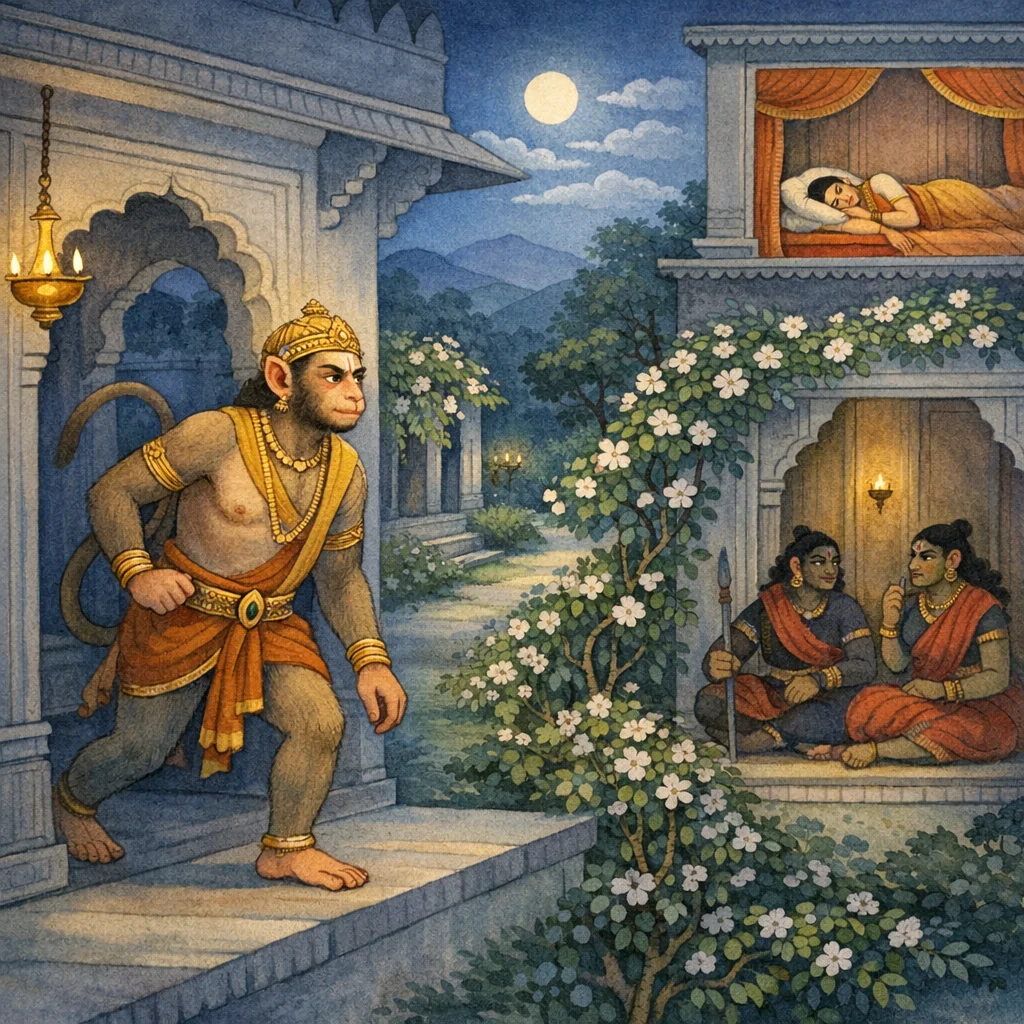
Sarga 12
द्वादशः सर्गः — हनूमतः अन्तःपुरविचयः (Hanuman’s Search Through Ravana’s Inner Apartments)
सुन्दरकाण्ड
This sarga records a renewed, systematic search within the central mansion complex of Laṅkā. Hanumān, eager for Sītā’s sight, revisits internal spaces—creeper-bowers, picture halls, night-rest chambers, banquet halls, sports rooms, garden lanes, subterranean cells, shrines/temples, and nested residences—leaving virtually no searchable gap within Rāvaṇa’s antaḥpura. The discourse is largely Hanumān’s interior reasoning: he fears mission failure, imagines Sītā’s possible death from terror or violence, and anticipates the moral and operational consequences for the vānaras waiting across the sea (including the expectations of Jāmbavān and Aṅgada). At the chapter’s ethical pivot, he rejects despair through the maxim “anirveda” (freedom from despondency) as the root of prosperity and success, and recommits to optimal effort. The sarga ends with exhaustive reconnaissance findings: many extraordinary women (including vidyādhara and nāga maidens) are seen, as well as rākṣasī attendants of varied and fearsome forms, yet Sītā—Janaka’s daughter and Rāghava’s beloved—is not found, intensifying grief while reinforcing perseverance as method.
Shlokas
Verse 1
स तस्य मध्ये भवनस्य मारुतिर्लतागृहांश्चित्रगृहान्निशागृहान्।जगाम सीतां प्रति दर्शनोत्सुकोन चैव तां पश्यति चारुदर्शनाम्।।।।
In the midst of that mansion, Māruti—eager to behold Sītā—went through the vine-bowers, the painted halls, and the night-chambers; yet he did not see her, that lady of beautiful appearance.
Verse 2
स चिन्तयामास ततो महाकपिःप्रियामपश्यन्रघुनन्दनस्य ताम्।ध्रुवं हि सीता म्रियते यथा न मेविचिन्वतो दर्शनमेति मैथिली।।।।
Then the great monkey began to brood: unable to find Rāma’s beloved, he feared, “Surely Sītā is perishing, for though I search, Maithilī does not come into my sight.”
Verse 3
सा राक्षसानां प्रवरेण जानकीस्वशीलसंरक्ष्णतत्परा सती।अनेन नूनं प्रति दुष्टकर्मणाहता भवेदार्यपथे परे स्थिता।।।।
“Janakī—steadfast on the noble path, intent on guarding her chastity—must surely have been slain by this foremost of rākṣasas, a man of perverse deeds,” (thus he feared).
Verse 4
विरूपरूपा विकृता विवर्चसोमहानना दीर्घविरूपदर्शनाः।समीक्ष्य सा राक्षसराजयोषितोभयाद्विनष्टा जनकेश्वरात्मजा।।।।
Seeing the demon-king’s women—misshapen, grotesque, dull-complexioned, huge-faced, and tall in their deformity—Janaka’s daughter (Sītā) might have collapsed in fear.
Verse 5
सीतामदृष्ट्वा ह्यनवाप्य पौरुषंविहृत्य कालं सह वानरैश्चिरम्।न मेऽस्ति सुग्रीवसमीपगा गतिःसुतीक्ष्णदण्डो बलवांश्च वानरः।।।।
If I return without seeing Sītā—having achieved no proof of valor and having spent a long time among the vānaras—there is no way for me to face Sugrīva; that powerful vānara will punish me with a harsh penalty.
Verse 6
दृष्टमन्तःपुरं सर्वं दृष्टा रावणयोषितः।न सीता दृश्यते साध्वीवृथा जातो मम श्रमः।।।।
I have seen the entire inner palace and I have seen Rāvaṇa’s women; yet the noble Sītā is not seen—my effort has come to nothing.
Verse 7
किं नु मां वानराः सर्वे गतं वक्ष्यन्ति सङ्गताः।गत्वा तत्र त्वया वीर किं कृतं तद्वदस्व नः।।।।
When I return, what will all the assembled vānaras say to me—‘O hero, having gone there, what did you accomplish? Tell us.’
Verse 8
अदृष्ट्वा किं प्रवक्ष्यामि तामहं जनकात्मजाम्।ध्रुवं प्रायमुपैष्यन्ति कालस्य व्यतिवर्तने।।।।
Without seeing Janaka’s daughter, what can I say? When the allotted time has been exceeded, they will surely resolve to fast unto death.
Verse 9
किं वा वक्ष्यति वृद्धश्च जाम्बवानाङ्गदश्च सः।गतं पारं समुद्रस्य वानराश्च समागताः।।।।
And what will the aged Jāmbavān say—what will Aṅgada say—as the gathered vānaras await me on the far shore of the ocean?
Verse 10
अनिर्वेदः श्रियो मूलमनिर्वेदः परं सुखम्।अनिर्वेदो हि सततं सर्वार्थेषु प्रवर्तकः।।।।
"Freedom from despair is the root of prosperity; freedom from despair is the highest happiness. Indeed, freedom from despair constantly impels one forward in every undertaking."
Verse 11
करोति सफलं जन्तोः कर्म यत्तत्करोति सः।तस्मादनिर्वेदकृतं यत्नं चेष्टेऽहमुत्तमम्।।।।भूयस्तावद्विचेष्यामि देशान्रावणपालितान्।
"Whatever action a living being undertakes—he makes that very action bear fruit. Therefore I shall strive with the best effort, free from despair. Once more, I will search through the regions guarded by Rāvaṇa."
Verse 12
आपानशाला विचितास्तथा पुष्पगृहाणि च।।।।चित्रशालाश्च विचिता भूयः क्रीडागृहाणि च।निष्कुटान्तररथ्याश्च विमानानि च सर्वशः।।।।
"I have searched the drinking-halls, and the flower-bowers as well; I have also searched the painted galleries, and again the play-houses. I have searched everywhere—the lanes within garden-courtyards, and even the aerial palaces/chariots."
Verse 13
आपानशाला विचितास्तथा पुष्पगृहाणि च।।5.12.12।।चित्रशालाश्च विचिता भूयः क्रीडागृहाणि च।निष्कुटान्तररथ्याश्च विमानानि च सर्वशः।।5.12.13।।
"I have searched the drinking-halls, and the flower-bowers as well; I have also searched the painted galleries, and again the play-houses. I have searched everywhere—the lanes within garden-courtyards, and even the aerial palaces/chariots."
Verse 14
इति सञ्चिन्त्य भूयोऽपि विचेतुमुपचक्रमे।भूमीगृहांश्चैत्यगृहान् गृहातिगृहकानपि।।।।
Having reflected thus, he began once more to search—through underground chambers, shrine-halls, and even houses within houses.
Verse 15
उत्पतन्निष्पतंश्चापि तिष्ठन्गच्छन् पुनः पुनः।अपावृण्वंश्च द्वाराणि कवाटान्यवघाटयन्।।।।प्रविशन्निष्पतंश्चापि प्रपतन्नुत्पतन्नपि।सर्वमप्यवकाशं स विचचार महाकपिः।।।।
Leaping up and down again and again—now standing, now moving—opening entrances and pushing aside doors, entering and emerging, dropping down and springing up, that great monkey ranged through every space where there was any scope to search.
Verse 16
उत्पतन्निष्पतंश्चापि तिष्ठन्गच्छन् पुनः पुनः।अपावृण्वंश्च द्वाराणि कवाटान्यवघाटयन्।।5.12.15।।प्रविशन्निष्पतंश्चापि प्रपतन्नुत्पतन्नपि।सर्वमप्यवकाशं स विचचार महाकपिः।।5.12.16।।
Leaping up and down again and again—now standing, now moving—opening entrances and pushing aside doors, entering and emerging, dropping down and springing up, that great monkey ranged through every space where there was any scope to search.
Verse 17
चतुरङ्गुलमात्रोऽपि नावकाशः स विद्यते।रावणान्तःपुरे तस्मिन् यं कपिर्न जगाम सः।।।।
In that inner palace of Rāvaṇa, there remained not even a space four fingers wide that the monkey had not gone to.
Verse 18
प्राकारान्तररथ्याश्च वेदिकाश्चैत्यसंश्रयाः।दीर्घिकाः पुष्करिण्यश्च सर्वं तेनावलोकितम्।।।।
He surveyed everything—lanes within the fortifications, altars, the precincts around shrines, and the wells and tanks—searching wherever his gaze could reach.
Verse 19
राक्षस्यो विविधाकारा विरूपा विकृतास्तथा।दृष्टा हनुमता तत्र न तु सा जनकात्मजा।।।।
There he saw ogresses of many kinds—hideous and misshapen—but he did not see that daughter of Janaka.
Verse 20
रूपेणाप्रतिमा लोके वरा विद्याधरस्त्रियः।दृष्टा हनुमता तत्र न तु राघवनन्दिनी।।।।
There Hanumān saw even Vidyādhara women—unsurpassed in beauty in the world—yet he did not see Rāghava’s beloved.
Verse 21
नागकन्या वरारोहाः पूर्णचन्र्दनिभाननाः।दृष्टा हनुमता तत्र न तु सीता सुमध्यमा।।।।
He saw Nāga maidens—graceful in form, with faces like the full moon—but he did not see Sītā, the slender-waisted.
Verse 22
प्रमथ्य राक्षसेन्द्रेण नागकन्या बलाद्धृताः।दृष्टा हनुमता तत्र न सा जनकनन्दिनी।।।।
There Hanumān saw Nāga maidens carried off by force by the lord of rākṣasas after overpowering them—but she was not Janaka’s beloved daughter.
Verse 23
सोऽपश्यंस्तां महाबाहुः पश्यंश्चान्या वरस्त्रियः।विषसाद मुहुर्धीमान् हनुमान् मारुतात्मजः।।।।
Seeing many noble women yet not seeing her, the wise, long-armed Hanumān—the son of the Wind—again and again sank into dejection.
Verse 24
उद्योगं वानरेन्द्राणां प्लवनं सागरस्य च।व्यर्थं वीक्ष्यानिलसुतश्चिन्तां पुनरुपागमत्।।।।
Seeing it all as futile—the mighty Vānara leaders’ effort and even the crossing of the ocean—the son of the Wind fell once more into anxious thought.
Verse 25
अवतीर्य विमानाच्च हनुमान् मारुतात्मजः।चिन्तामुपजगामाथ शोकोपहतचेतनः।।।।
Descending from the aerial car, Hanumān—the Wind-god’s son—his mind struck by grief, again entered into anxious reflection.
Frequently Asked Questions
Hanumān faces the crisis of apparent failure—after exhaustive searching he still cannot find Sītā—yet he chooses continued, systematic effort over retreat, self-blame, or abandonment of duty to the vānaras and to Rāma’s mandate.
The sarga foregrounds “anirveda” (non-despondency) as a practical ethic: freedom from despair is framed as the root of prosperity and the constant catalyst that initiates success in all aims, enabling renewed effort even when outcomes are uncertain.
The narrative maps Laṅkā’s palace ecology: Rāvaṇa’s antaḥpura, banquet halls, creeper-bowers and flower houses, picture galleries, night chambers, sports halls, garden lanes within boundary walls, shrines/altars, underground cells, water structures (wells and tanks), and the Pushpaka Vimāna as a searched locus.