Sarga 63
सम्पातेः पक्षलाभः — Sampāti Regains His Wings and Re-energizes the Search
किष्किन्धाकाण्ड
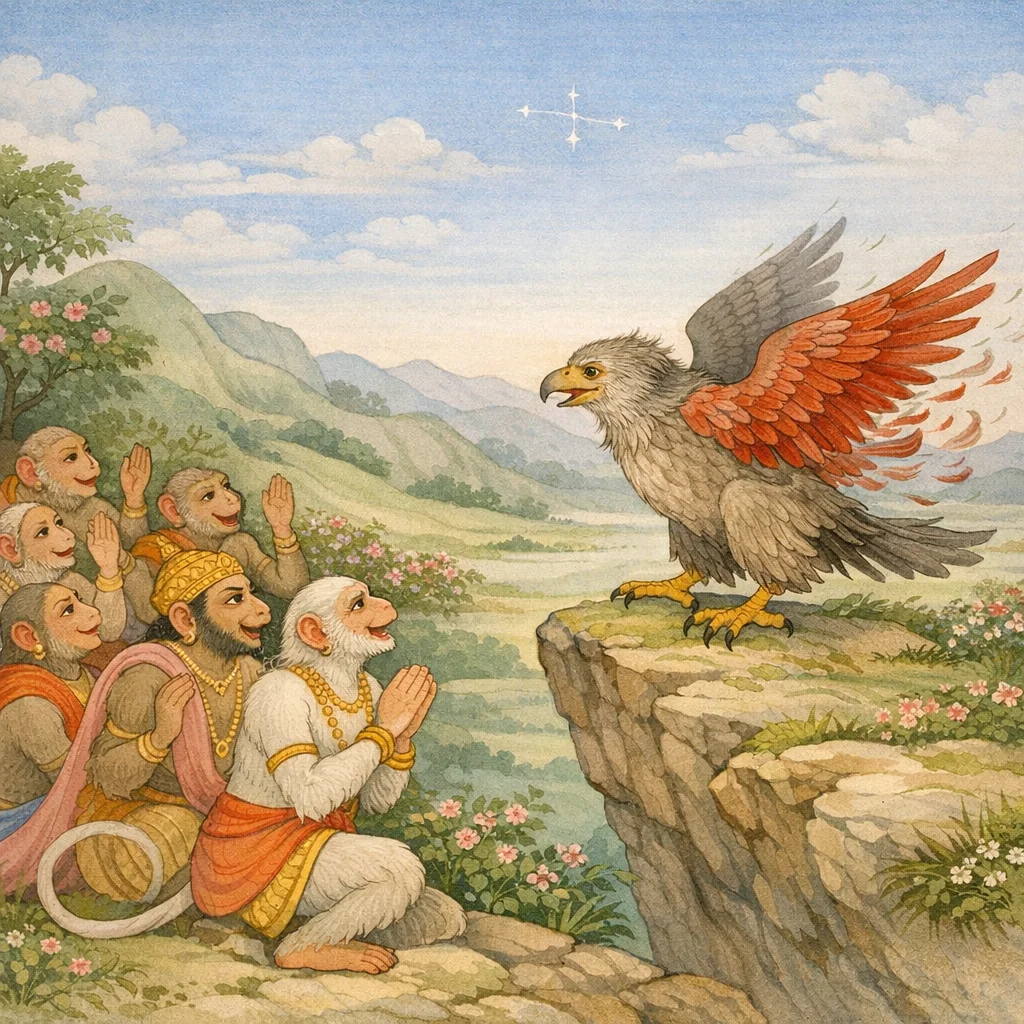
This sarga centers on Sampāti’s testimony and the restoration of confidence among the vānaras. After praising and dismissing his interlocutor (as narrated in recollection), Sampāti recounts emerging slowly from a cave, climbing Vindhya, and waiting over a hundred years for an appointed convergence of place and time, holding the sage Niśākara’s words in his heart. He describes the sage’s passing and the sorrow that followed, including thoughts of death that are repeatedly checked by the sage’s life-preserving counsel. In a reflective admission of responsibility, Sampāti recalls rebuking his son for failing to protect Maithilī despite knowing Rāvaṇa’s prowess, and he expresses displeasure in view of his friendship with Daśaratha and the suffering of Rāma and Lakṣmaṇa separated from Sītā. As he speaks before the forest-dwellers, his wings visibly reappear with reddish feathers; he experiences unparalleled joy and attributes the regrowth to the grace (prabhāva) of the revered sage. He declares that his renewed youthful strength is a proof-sign (siddhi-pratyaya) for the vānaras’ future success, urges full effort, and then leaps from the mountain peak to test the aerial route. Hearing this, the vānaras become elated and set out toward the Abhijit direction/constellation, motivated by the auspicious association of success, intent on searching for Janaka’s daughter.
Shlokas
Verse 1
एतैरन्यैश्च बहुभिर्वाक्यैर्वाक्यविशारदः।मां प्रशस्याभ्यनुज्ञाप्य प्रविष्टस्स स्वमालयम्।।।।
With these—and many other—well-chosen words, the sage, skilled in speech, praised me, granted me leave, and entered his own dwelling.
Verse 2
कन्दरात्तु विसर्पित्वा पर्वतस्य शनैश्शनैः।अहं विन्ध्यं समारुह्य भवतः प्रतिपालये।।।।
Crawling out slowly from the mountain cave, I climbed up onto the Vindhya and have been waiting there for you.
Verse 3
अद्य त्वेतस्य कालस्य साग्रं वर्षशतं गतम्।देशकालप्रतीक्षोऽस्मि हृदि कृत्वा मुनेर्वचः।।।।
Now, more than a hundred years of this time have passed. Holding the sage’s words within my heart, I have waited for the proper place and the proper time.
Verse 4
महाप्रस्थानमासाद्य स्वर्गते तु निशाकरे।मां निर्दहति सन्तापो वितर्कैर्बहुभिर्वृतम्।।।।
When Niśākara set out on his final journey and attained heaven, sorrow has been burning me ever since—my mind crowded with countless troubled thoughts.
Verse 5
उत्थितां मरणे बुद्धिं मुनिवाक्यैर्निवर्तये।बुद्धिर्या तेन मे दत्ता प्राणानां रक्षणाय तु।।।।सा मेऽपनयते दुःखं दीप्तेवाग्निशिखा तमः।
Whenever my mind rose toward death, I turned it back by recalling the sage’s words. The counsel he gave me—to protect my life—drives away my grief, as a bright flame dispels darkness.
Verse 6
बुद्ध्यता च मया वीर्यं रावणस्य दुरात्मनः।।।।पुत्रस्सन्तर्जितो वाग्भिर्न त्राता मैथिली कथम्।
Knowing the might of the evil-minded Rāvaṇa, I rebuked my son with harsh words: “How could you fail to protect the Maithilī?”
Verse 7
तस्या विलपितं श्रुत्वा तौ च सीताविनाकृतौ।।।।न मे दशरथस्नेहात्पुत्रेणोत्पादितं प्रियम्।
Even after hearing her lament, and knowing that the two (Rāma and Lakṣmaṇa) were separated from Sītā, my son’s conduct did not please me—especially in view of my affection and friendship for Daśaratha.
Verse 8
तस्य त्वेवं ब्रुवाणस्य सम्पातेर्वानरैस्सह।।।।उत्पेततुस्तदा पक्षौ समक्षं वनचारिणाम्।
As Sampāti spoke in this manner among the vānaras, at that very moment his two wings began to reappear—before the eyes of those forest-dwellers.
Verse 9
स दृष्ट्वा स्वां तनुं पक्षैरुद्गतैररुणच्छदैः।।।।प्रहर्षमतुलं लेभे वानरांश्चेदमब्रवीत्।
Seeing his own body again furnished with wings of reddish feathers, he felt boundless joy and spoke these words to the monkeys.
Verse 10
ऋषेर्निशाकरस्यैव प्रभावादमितात्मन:।।।।आदित्यरश्मिनिर्दग्धौ पक्षौ मे पुनरुपस्थितौ।
By the power and grace of the immeasurable-souled sage Niśākara, my two wings—burnt by the sun’s rays—have returned once more.
Verse 11
यौवने वर्तमानस्य ममासीद्यः पराक्रमः।।।।तमेवाद्यावगच्छामि बलं पौरुषमेव च।
The valour I possessed in my youth—I find that very same strength and manly courage within me even now.
Verse 12
सर्वथा क्रियतां यत्न स्सीतामधिगमिष्यथ।।4.63.12।।पक्षलाभो ममायं वस्सिद्धिप्रत्ययकारकः।
Therefore, let every effort be made—you will indeed find Sītā. This regaining of my wings is, for you, a confirming sign that success lies ahead.
Verse 13
इत्युक्त्वा स तान्हरीन् सर्वान्सम्पातिः पतगोत्तमः।।।।उत्पपात गिरेश्शृङ्गाज्जिज्ञासुः खगमो गतिम्।
Having spoken thus to all those monkeys, Sampāti—the best of birds—leapt up from the mountain peak, eager to ascertain the course of flight.
Verse 14
तस्य तद्वचनं श्रुत्वा प्रतिसंहृष्टमानसाः।।।।बभूवुर्हरिशार्दूला विक्रमाभ्युदयोन्मुखाः।
Hearing his words, those tiger-like monkeys became deeply gladdened, turning their minds toward victory through valour.
Verse 15
अथ पवनसमानविक्रमाःप्लवगवराः प्रतिलब्धपौरुषाः।अभिजिदभिमुखा दिशं ययुर्जनकसुतापरिमार्गणोन्मुखाः।।।।
Then the foremost monkeys—valiant like the wind and with courage restored—set out in the direction aligned with Abhijit, intent on searching for Janaka’s daughter (Sītā).
Frequently Asked Questions
Sampāti confronts despair after Niśākara’s death, including impulses toward self-destruction, but restrains himself by honoring the sage’s injunction to preserve life; he also admits a harsh rebuke to his son regarding failure to protect Sītā, framing speech as morally consequential.
The chapter teaches that sustained effort guided by wise counsel can outlast long periods of waiting, and that tangible signs of renewal (here, regrown wings) can legitimately function as pratyaya—evidence that strengthens communal resolve for dharmic action.
Vindhya and the mountain cave/peak anchor the episode geographically, while the Abhijit constellation functions as a cultural-astronomical marker associated with auspicious success and directional orientation for the search mission.