Sarga 6
आभरण-प्रत्यभिज्ञानम् (Recognition of Sītā’s Ornaments)
किष्किन्धाकाण्ड
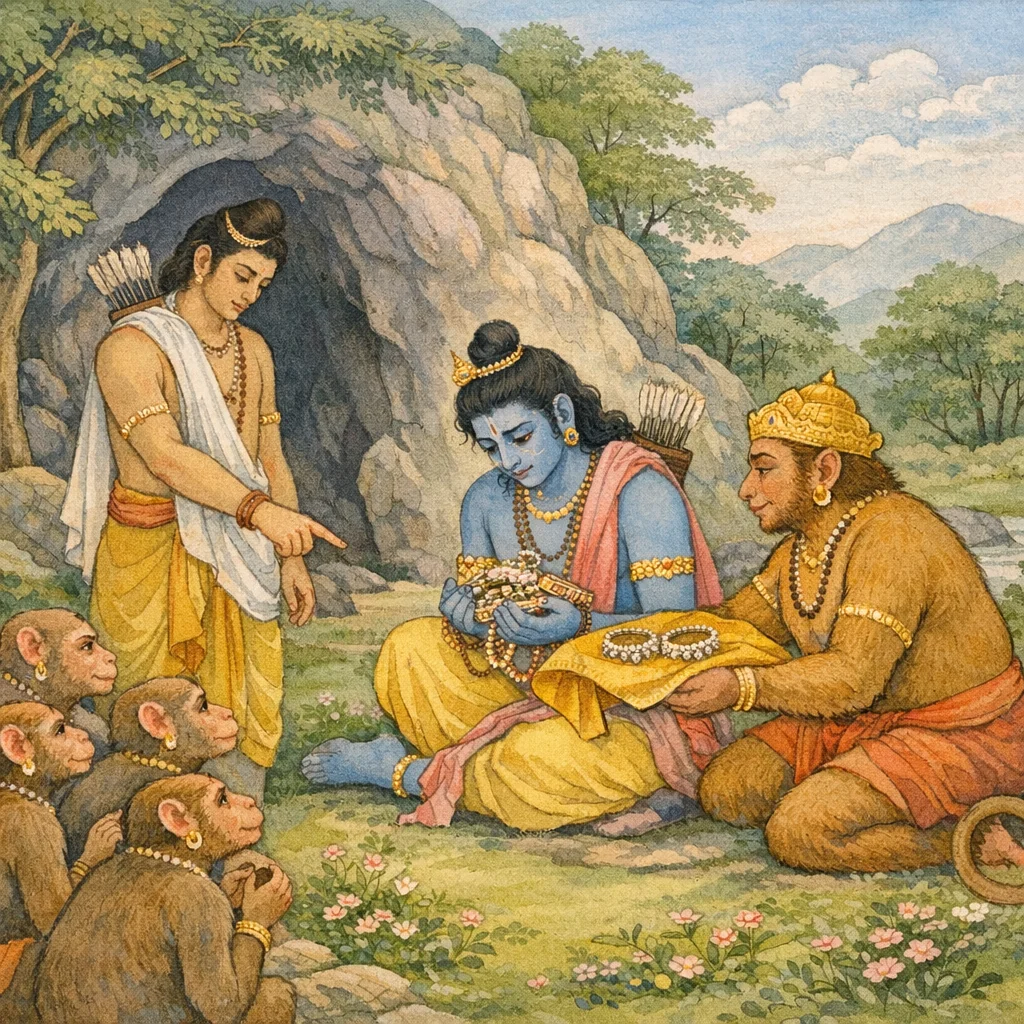
This sarga concentrates on evidentiary recognition and the psychology of grief. Sugrīva, pleased, reports that Hanumān has explained to him the cause of Rāma’s arrival in the desolate forest: Sītā’s abduction by a rākṣasa who killed Jaṭāyu while seeking opportunity. Sugrīva then recalls seeing a woman carried away, crying “Rāma, Rāma” and “Lakṣmaṇa,” writhing on Rāvaṇa’s lap like a serpent-bride. She dropped a veil (uttarīya) and auspicious ornaments, which the vānaras preserved. At Rāma’s urgent request, Sugrīva enters a mountain cave and brings the bundle out for identification. The sight of the garments and jewels overwhelms Rāma; he weeps, collapses, and presses the ornaments to his chest, his breath described with a cobra-like intensity. Rāma shows the items to Lakṣmaṇa; Lakṣmaṇa states he cannot recognize armlets or earrings but recognizes the anklets from daily reverence at Sītā’s feet—an ethical detail foregrounding modesty and service. The chapter ends with Rāma demanding directional intelligence: where the fierce rākṣasa took Sītā, where he dwells, and declaring exterminatory resolve as righteous retaliation.
Shlokas
Verse 1
पुनरेवाब्रवीत्प्रीतो राघवं रघुनन्दनम्।अयमाख्याति मे राम सचिवो मन्त्रिसत्तमः4.6.1।।हनुमान्यन्निमित्तं त्वं निर्जनं वनमागतः।लक्ष्मणेन सह भ्रात्रा वसतश्च वने तव4.6.2।।रक्षसाऽपहृता भार्या मैथिली जनकात्मजा।त्वया वियुक्ता रुदती लक्ष्मणेन च धीमता4.6.3।।अन्तरप्रेप्सुना तेन हत्वा गृध्रं जटायुषम्4.6.4।।
Pleased, Sugrīva spoke again to Rāma, delight of the Raghu line: “O Rāma, this Hanumān—my counselor, the best among ministers—has told me why you have come to this lonely forest. While you were dwelling here with your brother Lakṣmaṇa, your wife Maithilī, Janaka’s daughter, was carried off by a rākṣasa when she was left alone, crying out; and in seeking his chance, he killed the vulture Jaṭāyu.”
Verse 2
पुनरेवाब्रवीत्प्रीतो राघवं रघुनन्दनम्।अयमाख्याति मे राम सचिवो मन्त्रिसत्तमः4.6.1।।हनुमान्यन्निमित्तं त्वं निर्जनं वनमागतः।लक्ष्मणेन सह भ्रात्रा वसतश्च वने तव4.6.2।।रक्षसाऽपहृता भार्या मैथिली जनकात्मजा।त्वया वियुक्ता रुदती लक्ष्मणेन च धीमता4.6.3।।अन्तरप्रेप्सुना तेन हत्वा गृध्रं जटायुषम्4.6.4।।
Pleased, Sugrīva spoke again to Rāma, delight of the Raghu line: “O Rāma, this Hanumān—my counselor, the best among ministers—has told me why you have come to this lonely forest. While you were dwelling here with your brother Lakṣmaṇa, your wife Maithilī, Janaka’s daughter, was carried off by a rākṣasa when she was left alone, crying out; and in seeking his chance, he killed the vulture Jaṭāyu.”
Verse 3
पुनरेवाब्रवीत्प्रीतो राघवं रघुनन्दनम्।अयमाख्याति मे राम सचिवो मन्त्रिसत्तमः4.6.1।।हनुमान्यन्निमित्तं त्वं निर्जनं वनमागतः।लक्ष्मणेन सह भ्रात्रा वसतश्च वने तव4.6.2।।रक्षसाऽपहृता भार्या मैथिली जनकात्मजा।त्वया वियुक्ता रुदती लक्ष्मणेन च धीमता4.6.3।।अन्तरप्रेप्सुना तेन हत्वा गृध्रं जटायुषम्4.6.4।।
Pleased, Sugrīva spoke again to Rāma, delight of the Raghu line: “O Rāma, this Hanumān—my counselor, the best among ministers—has told me why you have come to this lonely forest. While you were dwelling here with your brother Lakṣmaṇa, your wife Maithilī, Janaka’s daughter, was carried off by a rākṣasa when she was left alone, crying out; and in seeking his chance, he killed the vulture Jaṭāyu.”
Verse 4
पुनरेवाब्रवीत्प्रीतो राघवं रघुनन्दनम्।अयमाख्याति मे राम सचिवो मन्त्रिसत्तमः4.6.1।।हनुमान्यन्निमित्तं त्वं निर्जनं वनमागतः।लक्ष्मणेन सह भ्रात्रा वसतश्च वने तव4.6.2।।रक्षसाऽपहृता भार्या मैथिली जनकात्मजा।त्वया वियुक्ता रुदती लक्ष्मणेन च धीमता4.6.3।।अन्तरप्रेप्सुना तेन हत्वा गृध्रं जटायुषम्4.6.4।।
Pleased, Sugrīva spoke again to Rāma, delight of the Raghu line: “O Rāma, this Hanumān—my counselor, the best among ministers—has told me why you have come to this lonely forest. While you were dwelling here with your brother Lakṣmaṇa, your wife Maithilī, Janaka’s daughter, was carried off by a rākṣasa when she was left alone, crying out; and in seeking his chance, he killed the vulture Jaṭāyu.”
Verse 5
भार्यावियोगजं दुःखं न चिरात्त्वं विमोक्ष्यसे।अहं तामानयिष्यामि नष्टां वेदश्रुतीमिव।।4.6.5।।
Very soon you will be freed from the grief born of separation from your wife. I will bring her back to you—like a lost Vedic revelation restored.
Verse 6
रसातले वा वर्तन्तीं वर्तन्ती वा नभस्थलेअहमानीय दास्यामि तव भार्यामरिन्दम।।।4.6.6।।
O subduer of enemies, even if she were in the underworld or moving in the sky, I will bring your wife back and restore her to you.
Verse 7
इदं तथ्यं मम वचस्त्वमवेहि च राघव।न शक्या सा जरयितुं सेन्द्रैरपि स्सुरासुरैः4.6.7।।तव भार्या महाबाहो भक्ष्यं विषकृतं यथा।त्यज शोकं महाबाहो तां कान्तामानयामि ते4.6.8।।
Know, O Rāghava, that my words are true: she cannot be ‘consumed’ or subdued with impunity even by gods and demons, even with Indra among them.
Verse 8
इदं तथ्यं मम वचस्त्वमवेहि च राघव।न शक्या सा जरयितुं सेन्द्रैरपि स्सुरासुरैः4.6.7।।तव भार्या महाबाहो भक्ष्यं विषकृतं यथा।त्यज शोकं महाबाहो तां कान्तामानयामि ते4.6.8।।
O mighty-armed one, your wife is like food laced with poison—no one can consume her without ruin. Cast off grief, O mighty-armed; I will bring that beloved one back to you.
Verse 9
अनुमानात्तु जानामि मैथिली सा न संशयः।ह्रियमाणा मया दृष्टा रक्षसा क्रूरकर्मणा4.6.9।।क्रोशन्ती राम रामेति लक्ष्मणेति च विस्वरम्।स्फुरन्ती रावणस्याङ्के पन्नगेन्द्रवधूर्यथा4.6.10।।
“By inference I know it was Maithilī—there is no doubt. I saw her being carried away by a cruel rākṣasa. Crying out ‘Rāma! Rāma!’ and ‘Lakṣmaṇa!’ in a broken voice, she writhed on Rāvaṇa’s lap like the queen of serpents.”
Verse 10
अनुमानात्तु जानामि मैथिली सा न संशयः।ह्रियमाणा मया दृष्टा रक्षसा क्रूरकर्मणा4.6.9।।क्रोशन्ती राम रामेति लक्ष्मणेति च विस्वरम्।स्फुरन्ती रावणस्याङ्के पन्नगेन्द्रवधूर्यथा4.6.10।।
“By inference I know it was Maithilī—there is no doubt. I saw her being carried away by a cruel rākṣasa. Crying out ‘Rāma! Rāma!’ and ‘Lakṣmaṇa!’ in a broken voice, she writhed on Rāvaṇa’s lap like the queen of serpents.”
Verse 11
आत्मना पञ्चमं मां हि दृष्ट्वा शैलतटे स्थितम्।उत्तरीयं तया त्यक्तं शुभान्याभरणानि च4.6.11।।
“Seeing me as a fifth onlooker, seated on the mountain-slope, she dropped her upper cloth—along with her auspicious ornaments.”
Verse 12
तान्यस्माभिगृहीतानि निहितानि च राघव।आनयिष्याम्यहं तानि प्रत्यभिज्ञातुमर्हसि4.6.12।।
“Rāghava, we gathered them up and kept them safe. I will bring them—so that you may recognize them.”
Verse 13
तमब्रवीत्ततो रामस्सुग्रीवं प्रियवादिनम्।आनयस्व सखे शीघ्रं किमर्थं प्रविलम्बसे4.6.13।।
Then Rāma said to Sugrīva, whose words were gracious: “Bring them quickly, my friend—why do you delay?”
Verse 14
एवमुक्तस्तु सुग्रीवश्शैलस्य गहनां गुहाम्।प्रविवेश ततशशीघ्रं राघवप्रियकाम्यया4.6.14।।
Thus addressed, Sugrīva quickly entered the mountain’s deep cave, wishing to please Rāghava.
Verse 15
उत्तरीयं गृहीत्वा तु शुभान्याभरणानि च।इदं पश्येति रामाय दर्शयामास वानरः4.6.15।।
Taking the upper cloth and the auspicious ornaments, the monkey showed them to Rāma, saying, “Look—here they are.”
Verse 16
ततो गृहीत्वा वासस्तु श्शुभान्याभरणानि च।अभवद्बाष्पसंरुद्धो नीहारेणेव चन्द्रमाः4.6.16।।
Then, holding the cloth and the auspicious ornaments, Rāma was choked with tears—like the moon veiled by mist.
Verse 17
सीतास्नेहप्रवृत्तेन स तु बाष्पेण दूषितः।हा प्रियेति रुदन्धैर्यमुत्सृज्य न्यपतत्क्षितौ4.6.17।।
Stained with tears born of love for Sītā, he cried, “O my beloved!” and, letting go of his composure, fell upon the earth.
Verse 18
हृदि कृत्वा तु बहुशस्तमलङ्कारमुत्तमम्।निशश्वास भृशं सर्पो बिलस्थ इव रोषितः।।4.6.18।।
Pressing those excellent ornaments again and again to his chest, Rama breathed hard—like an enraged serpent coiled within its hole.
Verse 19
अविच्छिन्नाश्रुवेगस्तु सौमित्रिं वीक्ष्य पार्श्वतः।परिदेवयितुं दीनं रामस्समुपचक्रमे4.6.19।।
With tears flowing without pause, Rama looked to Saumitri at his side and began to lament in utter misery.
Verse 20
पश्य लक्ष्मण वैदेह्या सन्त्यक्तं ह्रियमाणया।उत्तरीयमिदं भूमौ शरीराद्भूषणानि च4.6.20।।
“Look, Lakshmana—this veil and these ornaments, cast onto the ground from her body by Vaidehi as she was being carried away.”
Verse 21
शाद्वलिन्यां ध्रुवं भूमौ सीतया ह्रियमाणया।उत्सृष्टं भूषणमिदं तथारूपं हि दृश्यते4.6.21।।
“Surely, as Sita was being carried away, she dropped these ornaments onto the grassy ground; they appear just as they were.”
Verse 22
एवमुक्तस्तु रामेण लक्ष्मणो वाक्यमब्रवीत्।नाहं जानामि केयूरे नाहं जानामि कुण्डले4.6.22।।नूपुरे त्वभिजानामि नित्यं पादाभिवन्दनात्।
Thus addressed by Rama, Lakshmana replied: “I do not recognize the armlets, nor do I recognize the earrings; only the anklets I recognize—because I bowed at her feet every day.”
Verse 23
ततस्तु राघवो वाक्यं सुग्रीवमिदमब्रवीत्4.6.23।।ब्रूहि सुग्रीव कं देशं ह्रियन्ती लक्षिता त्वया।रक्षसा रौद्ररूपेण मम प्राणैः प्रिया प्रिया4.6.24।।
Then Raghava said this to Sugriva: “Tell me, Sugriva—toward which region did you see her being carried off by that fierce-looking demon—she who is dearer to me than life itself?”
Verse 24
ततस्तु राघवो वाक्यं सुग्रीवमिदमब्रवीत्4.6.23।।ब्रूहि सुग्रीव कं देशं ह्रियन्ती लक्षिता त्वया।रक्षसा रौद्ररूपेण मम प्राणैः प्रिया प्रिया4.6.24।।
“Where does that great ogre dwell—the one who has brought this immense calamity upon me? For his sake, I will destroy all the rākṣasas.”
Verse 25
क्व वा वसति तद्रक्षो महद्व्यसनदं मम।यन्निमित्तमहं सर्वान्नाशयिष्यामि राक्षसान्4.6.25।।
“Where does that great ogre dwell—the one who has brought this immense calamity upon me? For his sake, I will destroy all the rākṣasas.”
Verse 26
हरता मैथिलीं येन मां च रोषयता भृशम्।आत्मनो जीवितान्ताय मृत्युद्वारमपावृतम्4.6.26।।
“By abducting Maithili and provoking my wrath so fiercely, he has opened the door of death—bringing his own life to its end.”
Verse 27
मम दयिततरा हृता वनान्ताद्रजनिचरेण विमथ्य येन सा।कथय मम रिपुं तमद्य वैप्लवगपते यमसादनं नयामि4.6.27।।
O lord of the monkeys, tell me of that night‑ranger—my enemy—who seized my dearest from the heart of the forest and tormented her. Today I shall send him to the abode of Yama (Death).
Frequently Asked Questions
The pivotal action is evidentiary verification under grief: Rāma must confirm Sītā’s trace through objects (veil and ornaments) while maintaining purposeful agency, converting personal loss into a just, informed pursuit rather than impulsive rage.
The sarga teaches that dharma operates through both emotion and discernment: authentic sorrow is acknowledged, yet decisions proceed via pramāṇa (recognizable signs), trustworthy counsel (Hanumān’s report), and disciplined commitment to rightful action.
A mountain cave (śaila-guhā) serves as a repository of preserved evidence, while the mention of ornaments—especially Lakṣmaṇa’s recognition of nūpura through daily pādābhivandana—highlights cultural codes of reverence, modesty, and household/royal adornment practices.