Sarga 59
सम्पातिवाक्यम् (Sampati’s Intelligence Report on Sita’s Abduction)
किष्किन्धाकाण्ड
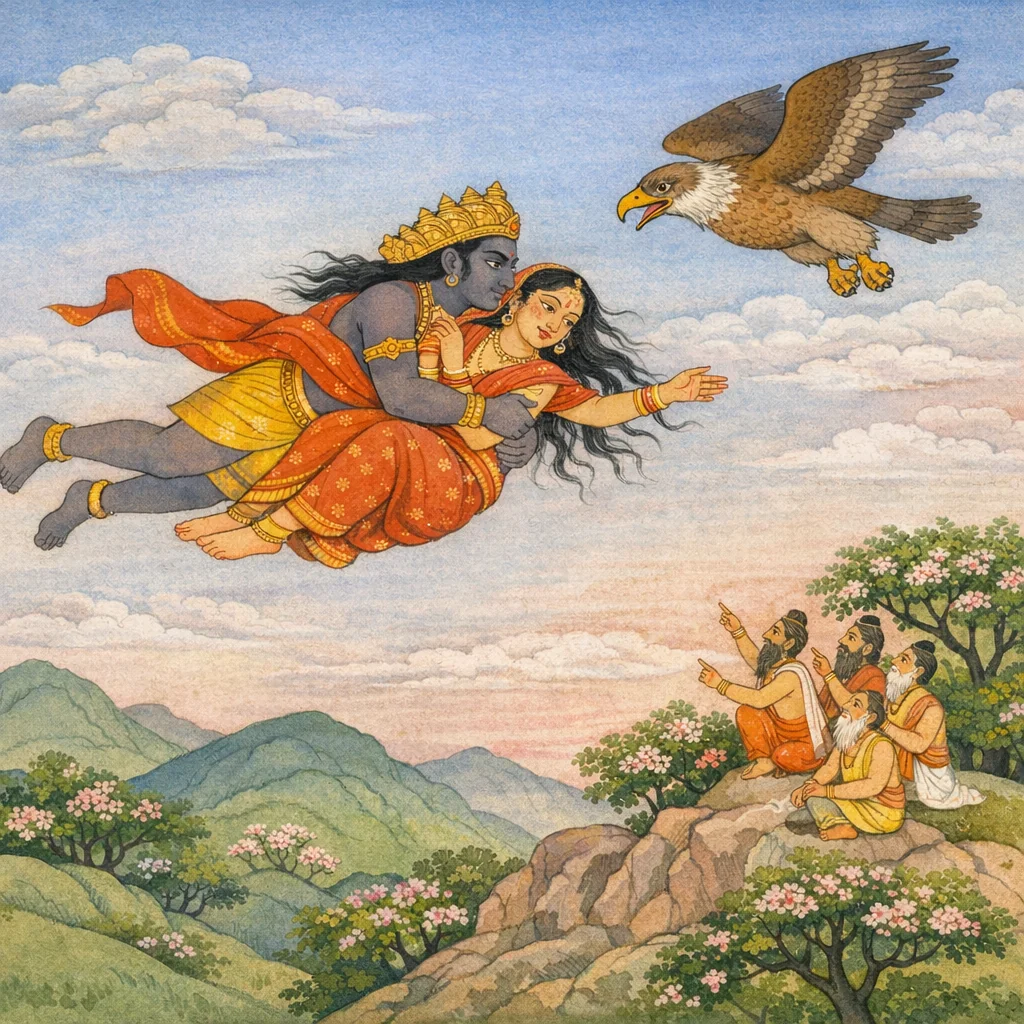
Sarga 59 pivots from despair to actionable intelligence. The vanara party—reassured and energized—addresses Sampāti, the vulture-king, requesting a full account of Sītā’s whereabouts and the identity of her abductor. Sampāti explains his debilitated state on an inaccessible mountain and introduces his son Suparśva, who sustains him with timely food. Through Suparśva’s report, Sampāti recounts an aerial encounter at the entrance of Mount Mahendra: a dark, formidable figure carrying a radiant woman. Although Suparśva initially intended to seize them for food, the traveler’s courteous request for passage restrained him, illustrating an ethical constraint against harming the polite. After the figure departs with blazing speed, siddhas and sages confirm the abductor as Rāvaṇa and identify the woman as Janaka’s daughter, Rāma’s wife, crying out “Rāma” and “Lakṣmaṇa,” dishevelled and bereft of ornaments. Sampāti admits his inability to act due to being wingless but offers strategic encouragement: the vanaras are capable, Rāma-Lakṣmaṇa’s arrows are world-subduing, and wise agents should not falter over time-pressure—urging resolute continuation of the mission.
Shlokas
Verse 1
ततस्तदमृतास्वादं गृध्रराजेन भाषितम्।निशम्य मुदिता हृष्टास्ते वचः प्लवगर्षभाः।।।।
Then, hearing those nectar-sweet words spoken by the king of vultures, the mighty monkeys became delighted and gladdened.
Verse 2
जाम्बवान् वानरश्रेष्ठस्सह सर्वैः प्लवङ्गमैः।भूतलात्सहसोत्थाय गृध्रराजानमब्रवीत्।।।।
Jāmbavān, foremost among the vānaras, rose up at once from the ground along with all the monkeys and addressed the king of vultures.
Verse 3
क्व सीता केन वा दृष्टा को वा हरति मैथिलीम्।तदाख्यातु भवात्सर्वं गतिर्भव वनौकसाम्।।।।
Where is Sītā? By whom was she seen? And who was it that carried off the Maithilī? Tell us all of it—you are our sole refuge and way forward, O forest-dwellers.
Verse 4
को दाशरथि बाणानां वज्रवेगनिपातिनाम्।स्वयं लक्ष्मणमुक्तानां न चिन्तयति विक्रमम्।।।।
Who could fail to reckon with the prowess of Daśarathi Rāma’s arrows, striking with thunderbolt speed? And who would not take seriously the might of the shafts loosed by Lakṣmaṇa himself?
Verse 5
स हरीन्प्रीतिसंयुक्तान्सीताश्रुतिसमाहितान्।पुनराश्वसयन्प्रीत: इदं वचनमब्रवीत्।।।।
Seeing the monkeys filled with joy and intent on hearing of Sītā, he—pleased—reassured them once more and spoke these words.
Verse 6
श्रूयतामिह वैदेह्या यथा मे हरणं श्रुतम्।येन चापि ममाऽख्यातं यत्र वायतलोचना।।।।
Listen now to how I came to hear of Vaidehī’s abduction—who informed me, and where that long-eyed lady is.
Verse 7
अहमस्मिन्गिरौ दुर्गे बहुयोजनमायते।चिरान्निपतितो वृद्धः क्षीणप्राणपराक्रमः।।।।
I have long lain here—old and fallen—upon this vast mountain stretching many yojanas, in an inaccessible place, my life-force and prowess spent.
Verse 8
तं मामेवं गतं पुत्रस्सुपार्श्वोनाम नामतः।आहारेण यथाकालं बिभर्ति पततां वरः।।।।
In this condition, my son—named Supārśva, the finest among birds—sustains me with food at the proper times.
Verse 9
तीक्ष्णकामास्तु गन्धर्वास्तीक्ष्णकोपा भुजङ्गमाः।मृगाणां तु भयं तीक्ष्णं ततस्तीक्ष्णक्षुधा वयम्।।।।
Gandharvas are driven by fierce desire; serpents by fierce wrath. Deer live in intense fear—and so we, the vultures, are driven by intense hunger.
Verse 10
स कदाचित्क्षुधार्तस्य ममाहाराभिकाङ्क्षिणः।गतसूर्येऽहनि प्राप्तो मम पुत्रो ह्यनामिषः।।।।
Once, when I was tormented by hunger and longing for food, my son returned to me after sunset—without any meat.
Verse 11
स मामाहारसंरोधात्पीडितं प्रीतिवर्धनः।अनुमान्य यथातत्त्वमिदं वचनमब्रवीत्।।।।
Seeing me distressed because food was cut off, my son—who ever increases my joy—understood what had happened and spoke these words truthfully, as it really was.
Verse 12
अहं तात यथाकालमामिषार्थी खमाप्लुतः।महेन्द्रस्य गिरेर्द्वारमावृत्य सुसमास्थितः।।।।
‘Father, at the proper time I went up into the sky seeking meat, and I stationed myself firmly, blocking the entrance of Mount Mahendra.’
Verse 13
तत्र सत्त्वसहस्राणां सागरान्तरचारिणाम्।पन्थानमेकोऽध्यवसं सन्निरोद्धुमवाङ्मुखः।।।।
‘There, looking downward, I stood alone, determined to obstruct the path of thousands of creatures that move within the ocean.’
Verse 14
तत्र कश्चिन्मया दृष्ट स्सूर्योदयसमप्रभाम्।स्त्रियमादाय गच्छन्वै भिन्नाञ्जनचयप्रभः।।।।
‘There I saw someone—dark and massive like a broken heap of collyrium—going while carrying a woman whose radiance was like the rising sun.’
Verse 15
सोऽहमभ्यवहारार्थी तौ दृष्ट्वा कृतनिश्चयः।तेन साम्ना विनीतेन पन्थानमभियाचितः।।।।
‘Seeking food, when I saw the two of them I made up my mind (to seize them). But he, with gentle and courteous words, requested the path (that I was blocking).’
Verse 16
न हि सामोपपन्नानां प्रहर्ता विद्यते क्वचित्।नीचेष्वपि जनः कश्चित्किमङ्ग बत मद्विधः।।।।
For those who are courteous and peaceable, there is nowhere anyone who would strike them; even among the low, hardly anyone does such a thing—how much less someone like me.
Verse 17
स यातस्तेजसा व्योम सङ्क्षिपन्निव वेगतः।अथाऽहं खेचरैर्भूतैरभिगम्य सभाजितः।।।।
He sped through the sky with such radiance that it seemed to contract before him; then the airborne beings approached me and greeted me with honor.
Verse 18
दिष्ट्या जीवसि तातेति ह्यब्रुवन्मां महर्षयः।कथञ्चित्सकळत्रोऽसौ गतस्ते स्वस्त्यसंशयम्।।।।
The great sages said to me, “Fortunate indeed that you live, dear child. Somehow he has gone from here with that woman; surely, your safety is beyond doubt.”
Verse 19
एव मुक्तस्ततोऽहं तैस्सिद्धै: परमशोभनैः।स च मे रावणो राजा रक्षसां प्रतिवेदितः।।।।हरन्दाशरथेर्भार्यां रामस्य जनकात्मजाम्।भ्रष्टाभरणकौशेयां शोकवेगपराजिताम्।।।।रामलक्ष्मणयोर्नाम क्रोशन्तीं मुक्तमूर्धजाम्।
Thus released by those splendid siddhas, I learned that he was Rāvaṇa, king of the rākṣasas. I saw him carrying off Janaka’s daughter—the wife of Rāma, son of Daśaratha—her ornaments fallen, her silken garment disordered, overwhelmed by the surge of grief, crying out the names of Rāma and Lakṣmaṇa, her hair unbound.
Verse 20
एव मुक्तस्ततोऽहं तैस्सिद्धै: परमशोभनैः।स च मे रावणो राजा रक्षसां प्रतिवेदितः।।4.59.19।।हरन्दाशरथेर्भार्यां रामस्य जनकात्मजाम्।भ्रष्टाभरणकौशेयां शोकवेगपराजिताम्।।4.59.20।।रामलक्ष्मणयोर्नाम क्रोशन्तीं मुक्तमूर्धजाम्।
Thus released by those splendid siddhas, I learned that he was Rāvaṇa, king of the rākṣasas. I saw him abducting Janaka’s daughter—the wife of Rāma, son of Daśaratha—her ornaments fallen, her silk disordered, overcome by the rush of grief, crying out the names of Rāma and Lakṣmaṇa, her hair unbound.
Verse 21
एष कालात्ययस्तावदिति कालविदां वरः।।।।एतमर्थं समग्रं मे सुपार्श्वः प्रत्यवेदयत्।
“This, then, is the reason for the delay,” said Supārśva—best among those who know the worth of time—and he reported the entire matter to me in full.
Verse 22
तच्छृत्वाऽपि हि मे बुद्धिर्नासीत्काचित्पराक्रमे।।।।अपक्षो हि कथं पक्षी कर्म किञ्चिदुपक्रमे।
Even after hearing it, no resolve to advance arose in me; for how can a bird without wings begin even the slightest action?
Verse 23
यत्तु शक्यं मया कर्तुं वाग्बुद्धिगुणवर्तिना।।।।श्रूयतां तत्प्रवक्ष्यामि भवतां पौरुषाश्रयम्।
But what I can do—endowed as I am with speech, understanding, and discernment—I shall tell you; listen to it, for it depends upon your valor to accomplish it.
Verse 24
वाङ्मतिभ्यां तु सर्वेषां करिष्यामि प्रियं हि वः।।।।यद्धि दाशरथेः कार्यं मम तन्नात्र संशयः।
With word and counsel I will do what is dear to all of you; for Rāma, son of Daśaratha—his task is mine as well, of this there is no doubt.
Verse 25
ते भवन्तो मतिश्रेष्ठा बलवन्तो मनस्विनः।।।।प्रेषिताः कपिराजेन देवैरपि दुरासदाः।
You are foremost in discernment—strong and high-spirited. Sent forth by the king of the monkeys, you are formidable, unassailable even to the gods.
Verse 26
रामलक्ष्मणबाणाश्च निशिताः कङ्कपत्रिणः।।।।त्रयाणामपि लोकानां पर्याप्तास्त्राणनिग्रहे।
The arrows of Rāma and Lakṣmaṇa—keen-edged, fletched with heron feathers—are sufficient to protect, or to subdue, even the three worlds.
Verse 27
कामं खलु दशग्रीव स्तेजोबलसमन्वितः।।।।भवतां तु समर्थानां न किञ्चिदपि दुष्करम्।
Granted, Daśagrīva is indeed endowed with might and power; yet for you who are truly capable, nothing at all is difficult.
Verse 28
तदलं कालसङ्गेन क्रियतां बुद्धिनिश्चयः।।।।न हि कर्मसु सज्जन्ते बुद्धिमन्तो भवद्विधाः।
So enough of anxiety over time—form a firm resolve in your understanding. For wise men such as you do not falter when action is to be undertaken.
Frequently Asked Questions
Suparśva faces a predatory impulse (seizing the pair for food) versus restraint prompted by the traveler’s courteous sāma (polite request). The episode frames an ethical decision: even in need, one should not harm those who approach with civility, highlighting self-governance within power.
Sampāti teaches that capability must be joined to resolve and right timing: do not collapse under deadline anxiety, but commit to clear buddhi-niścaya (determined judgment). He also affirms shared purpose—Rāma’s task is ‘dear’ to allies—grounding strategy in ethical solidarity.
Mount Mahendra’s ‘entrance’ functions as a navigational marker in the southern search corridor, while the aerial path (vyōma-panthā) underscores the trans-regional scale of the abduction. The mention of siddhas and maharṣis situates the event within a cosmological witness-tradition that authenticates the identification of Rāvaṇa and Sītā.