Sarga 56
सम्पातिदर्शनम् (Encounter with Sampāti) — Angada’s Lament and the Vulture-King’s Response
किष्किन्धाकाण्ड
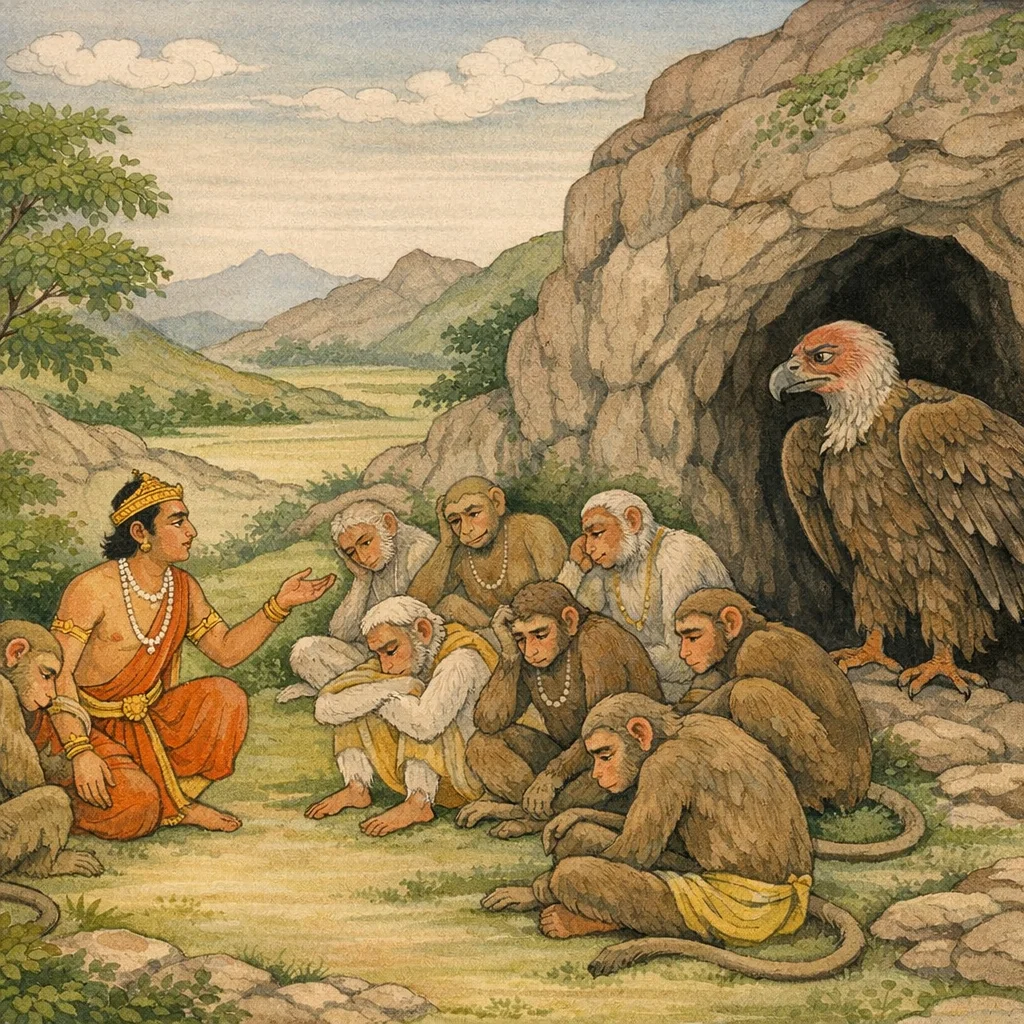
On a Vindhya mountain plateau, the vānaras sit in prāyopaveśa (fasting unto death), overwhelmed by failure to locate Maithilī and by fear of returning without fulfilling Sugrīva’s command. Sampāti, the long-lived elder brother of Jaṭāyu and a famed gṛdhrarāja, emerges from a cave and initially interprets the motionless vānaras as destined food, speaking in terms of fate and divine arrangement. Aṅgada, deeply dejected, frames the moment as an unforeseen calamity: Rāma’s task remains incomplete, and the troop’s situation has become precarious. The dialogue shifts into an ethical remembrance of Jaṭāyu’s sacrifice—undertaken out of friendship and compassion for Rāma’s welfare—positioning self-giving action as the narrative’s moral standard. Sampāti, hearing this unhappy account and seeing the vānaras fallen to the ground, becomes mentally shaken and responds with pity, setting the stage for his later role as a decisive informant in the search.
Shlokas
Verse 1
उपविष्टास्तु ते सर्वे यस्मिन्प्रायं गिरिस्थले।हरयो गृध्रराजश्च तं देशमुपचक्रमे।।।।सम्पातिर्नाम नाम्ना तु चिरञ्जीवी विहङ्गमः।भ्राता जटायुषः श्रीमान्विख्यातबलपौरुषः।।।।
When all those monkeys sat down on a mountain plateau, resolved on fasting unto death, the king of vultures came to that place—Sampāti by name, a long-lived bird, the illustrious elder brother of Jaṭāyu, famed for strength and valor.
Verse 2
उपविष्टास्तु ते सर्वे यस्मिन्प्रायं गिरिस्थले।हरयो गृध्रराजश्च तं देशमुपचक्रमे।।4.56.1।।सम्पातिर्नाम नाम्ना तु चिरञ्जीवी विहङ्गमः।भ्राता जटायुषः श्रीमान्विख्यातबलपौरुषः।।4.56.2।।
As all the monkeys sat down on a mountain-plateau resolved to die by fasting, the vulture-king came to that very place—Sampāti by name, long-lived, the illustrious elder brother of Jaṭāyu, famed for strength and prowess.
Verse 3
कन्दरादभिनिष्क्रम्य स विन्ध्यस्य महागिरेः।उपविष्टान्हरीन्दृष्ट्वा हृष्टात्मा गिरमब्रवीत्।।।।
Emerging from a cave of the great Vindhya mountain, he saw the monkeys seated there; pleased at heart, he spoke these words.
Verse 4
विधिः किल नरं लोके विधानेनानुवर्तते।यथाऽयं विहितो भक्ष्यश्चिरान्मह्यमुपागतः।।।।
“So it is said: in this world, destiny follows its own ordinance among men—else how would this long-appointed food have come to me after so long?”
Verse 5
परम्पराणां भक्षिष्ये वानराणां मृतं मृतम्।उवाचेदं वचः पक्षी तान्निरीक्ष्य प्लवङ्गमान्।।।।
Gazing at those leaping monkeys, the bird said: “I shall eat the monkeys one after another—each as it dies.”
Verse 6
तस्य तद्वचनं श्रुत्वा भक्ष्यलुब्धस्य पक्षिणः।अङ्गदः परमायस्तो हनूमन्तमथाब्रवीत्।।।।
Hearing those words of the bird, greedy for food, Angada—utterly dejected—then spoke to Hanumān.
Verse 7
पश्य सीतापदेशेन साक्षाद्वैवस्वतो यमः।इमं देशमनुप्राप्तो वानराणां विपत्तये।।।।
“Look—under the pretext of Sītā, Yama himself, the son of Vivasvān, has come to this place to bring ruin upon the monkeys.”
Verse 8
रामस्य न कृतं कार्यं राज्ञो न च वचः कृतम्।हरीणामियमज्ञाता विपत्तिस्सहसागता।।।।
“Rāma’s purpose has not been accomplished; the king’s command has not been carried out. And now, upon the monkeys, an unforeseen calamity has suddenly descended.”
Verse 9
वैदेह्याः प्रियकामेन कृतं कर्म जटायुषा।गृध्राराजेन यत्तत्र श्रुतं वस्तदशेषतः।।।।
We have heard, in full detail, of the deed accomplished there by Jatāyu—the king of vultures—performed out of love and devotion to please Vaidehī (Sītā).
Verse 10
तथा सर्वाणि भूतानि तिर्यग्योनिगतान्यपि।प्रियं कुर्वन्ति रामस्य त्यक्त्वा प्राणान्यथा वयम्।।4.56.10।।
In the same way, all creatures—even those born as animals—do what is dear to Rāma, risking their very lives, just as we have done.
Verse 11
अन्योऽन्यमुपकुर्वन्ति स्नेहकारुण्ययन्त्रिताः।तेन तस्योपकारार्थं त्यजताऽत्मानमात्मना।।।।
Bound by affection and compassion, beings help one another. Thus he (Jaṭāyu) relinquished his own life by his own resolve, for Rāma’s benefit.
Verse 12
प्रियं कृतं हि रामस्य धर्मज्ञेन जटायुषा।राघवार्थे परिश्रान्ता वयं सन्त्यक्तजीविताः।।।।कान्ताराणि प्रपन्नाः स्म न च पश्याम मैथिलीम्।
Indeed, Jaṭāyu—knower of dharma—did what was dear to Rāma. Worn out for Rāghava’s sake, we have become people who have abandoned hope of life. We have entered these wild forests, and yet we do not see Maithilī.
Verse 13
स सुखी गृध्रराजस्तु रावणेन हतो रणे।।।।मुक्तश्च सुग्रीवभयाद्गतश्च परमां गतिम्।
That king of vultures, slain by Rāvaṇa in battle, is truly fortunate: freed from fear of Sugrīva, he has attained the highest state.
Verse 14
जटायुषो विनाशेन राज्ञो दशरथस्य च।।।।हरणेन च वैदेह्या स्संशयं हरयो गताः।
By the death of Jaṭāyu, by the death of King Daśaratha, and by the abduction of Vaidehī, the monkeys have fallen into grave uncertainty about their very survival.
Verse 15
रामलक्ष्मणयोर्वासश्च अरण्ये सह सीतया।।।।राघवस्य च बाणेन वालिनश्च तथा वधः।रामकोपादशेषाणां रक्षसानां तथा वधः।।।।कैकेय्या वरदानेन इदं च विकृतं कृतम्।
“Rāma and Lakṣmaṇa’s dwelling in the forest with Sītā; Vāli’s death by Rāghava’s arrow; and likewise the destruction of the rākṣasas in the wake of Rāma’s wrath—this whole bitter turn of events has been brought about by the boon granted to Kaikeyī.”
Verse 16
रामलक्ष्मणयोर्वासश्च अरण्ये सह सीतया।।4.56.15।।राघवस्य च बाणेन वालिनश्च तथा वधः।रामकोपादशेषाणां रक्षसानां तथा वधः।।4.56.16।।कैकेय्या वरदानेन इदं च विकृतं कृतम्।
Emerging from a cave of the great Vindhya mountain, he saw the monkeys seated there; pleased at heart, he spoke these words.
Verse 17
तदसुखमनुकीर्तितं वचोभुवि पतितांश्च समीक्ष्य वानरान्।भृशचलितमतिर्महामतिःकृपणमुदाहृतवान् स गृध्रराट्।।।।
Having heard that sorrowful account and seeing the monkeys fallen upon the ground, the vulture-king—though wise—was deeply shaken in mind, and he uttered a piteous cry.
Frequently Asked Questions
The troop faces a dharma-crisis between despair-driven prāyopaveśa (abandoning life after mission failure) and continued responsibility to Rāma and Sugrīva; the narrative contrasts resignation with the prior model of Jaṭāyu’s active self-sacrifice for a righteous cause.
Compassion-bound reciprocity sustains dharma: beings help one another through sneha and kāruṇya, and true service may demand personal cost. The sarga also cautions against fatalism by showing how truthful remembrance and moral testimony can transform an adversarial encounter into aid.
The Vindhya mountain setting—its cave (kandara) and plateau (giristhala)—frames the liminal moment of prāyopaveśa, a culturally recognized vow of fasting unto death, used here to mark the extremity of despair before narrative reversal.