Sarga 46
पृथिवीमण्डलपरिज्ञानम् — Sugriva on Surveying the Earth’s Regions
किष्किन्धाकाण्ड
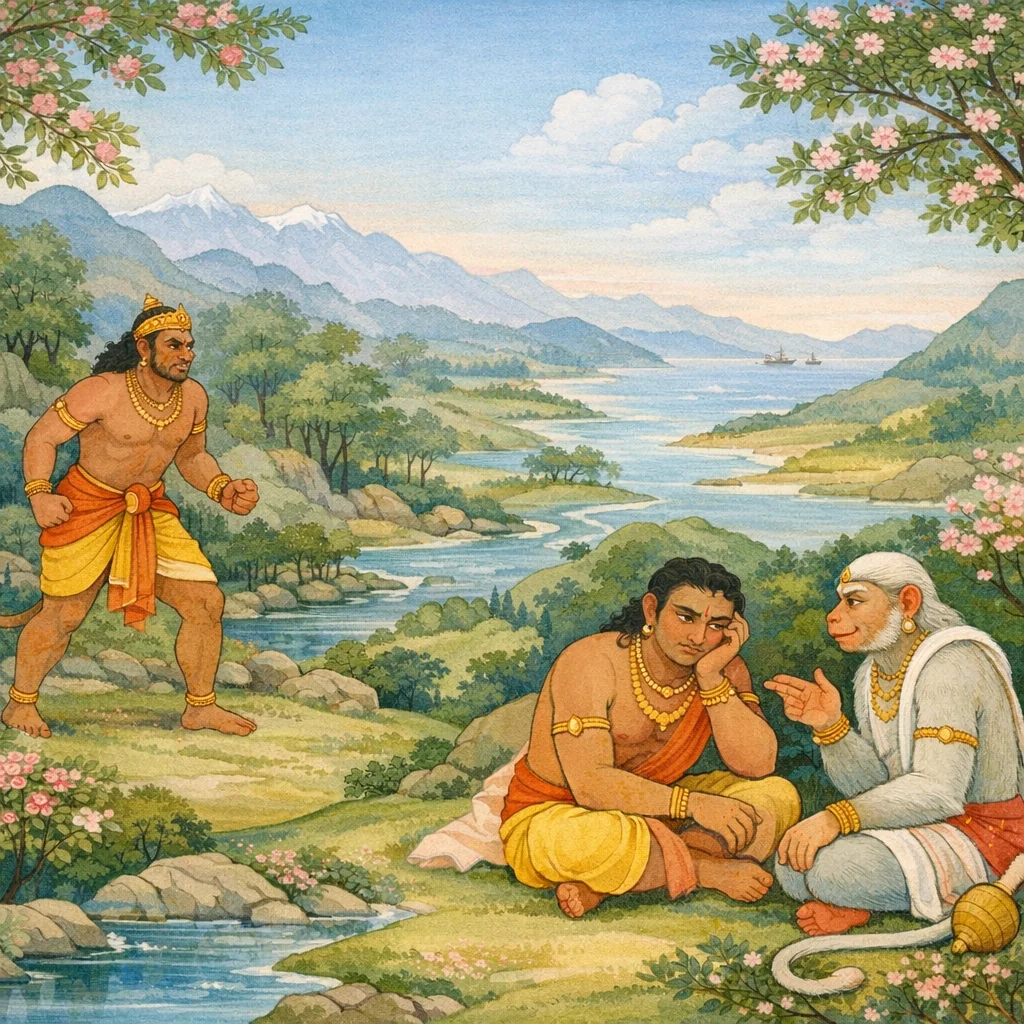
After the Vānara chieftains depart, Rāma asks Sugrīva how he knows the full “maṇḍala” (circular expanse) of the earth (4.46.1). Sugrīva replies with a detailed personal account: during Vāli’s pursuit, originating from the Dundubhi episode at Mount Malaya’s cave, Sugrīva waited at the cave-mouth, inferred Vāli’s death from blood surging out, and sealed the entrance with a massive rock (4.46.3–7). Believing Vāli lost, he returned to Kiṣkindhā and assumed kingship with Tārā and Rumā, but Vāli later returned after killing the demon and reclaimed the kingdom; Sugrīva fled as Vāli, enraged and uncontrolled, chased him with ministers (4.46.8–12). This flight becomes an inadvertent geographic survey: Sugrīva runs east, then south (through Vindhya and sandal forests), then west to the setting-mountain region, then north past Himavān, Meru, and the northern sea, observing rivers, forests, towns, lakes, and notable mountains such as Udaya and the sunset-mountain (4.46.14–20). Finally, Hanūmān recalls Matanga’s curse: Vāli cannot enter Matanga’s āśrama-maṇḍala without his head splitting into a hundred pieces; thus Sugrīva reaches Ṛṣyamūka where Vāli will not enter, securing refuge and concluding that he has directly surveyed the earth’s circle through forced traversal (4.46.21–24). The Southern Recension material here includes duplicative verse numbering/attestation for the Matanga-curse passage (4.46.21–22), reflecting recensional transmission features important for digital collation.
Shlokas
Verse 1
गतेषु वानरेन्द्रेषु रामस्सुग्रीवमब्रवीत्।कथं भवान्विजानीते सर्वं वै मण्डलं भुवः।।।।
When the monkey-lords had departed, Rāma said to Sugrīva: “How do you know the entire circuit of the earth—this whole terrestrial sphere?”
Verse 2
सुग्रीवस्तु ततो राममुवाच प्रणतात्मवान्।श्रूयतां सर्वमाख्यास्ये विस्तरेण नरर्षभ।।।।
Then Sugrīva, with a reverent and humble mind, spoke to Rāma: “Let everything be heard; I shall recount it in full detail, O best among men.”
Verse 3
यदा तु दुन्दुभिं नाम दानवं महिषाकृतिम्।परिकालयते वाली मलयं प्रति पर्वतम्।।।।तदा विवेश महिषो मलयस्य गुहां प्रति।विवेश वाली तत्रापि मलयं तज्जिघांसया।।।।
Now when Vālī pursued the demon named Dundubhi—who had taken the form of a buffalo—toward Mount Malaya, intent on killing him,
Verse 4
यदा तु दुन्दुभिं नाम दानवं महिषाकृतिम्।परिकालयते वाली मलयं प्रति पर्वतम्।।4.46.3।।तदा विवेश महिषो मलयस्य गुहां प्रति।विवेश वाली तत्रापि मलयं तज्जिघांसया।।4.46.4।।
then the buffalo entered the cave of Malaya, and Vālī too entered there, driven by the intent to kill him.
Verse 5
ततोऽहं तत्र निक्षिप्तो गुहाद्वारि विनीतवत्।न च निष्क्रामते वाली तदा संवत्सरे गते।।
Then I was stationed there at the cave’s entrance, obediently; but even when a year had passed, Vālī did not come out.
Verse 6
ततः क्षतजवेगेन आपुपूरे तदा बिलम्।तदहं विस्मितो दृष्ट्वा भ्रातृशोकविषार्दितः।।।।
Then the cave filled up with a rush of blood; seeing that, I was stunned and tormented by grief for my brother.
Verse 7
अथाऽहं कृतबुद्धिस्तु सुव्यक्तं निहतो गुरुः।शिला पर्वतसङ्काशा बिलद्वारि मया कृता।।।।अशक्नुव न्निष्क्रमितुं महिषो विनशेदिति।
Then, concluding that my elder brother had surely been slain, I set a rock like a mountain at the cave-mouth, thinking: ‘Let the buffalo be destroyed, unable to come out.’
Verse 8
ततोऽहमागां किष्किन्धां निराशस्तस्य जीविते।।।।राज्यं च सुमहत्प्राप्य तारया रुमया सह।मित्रैश्च सहितस्तत्र वसामि विगतज्वरः।।।।
Then, despairing of his survival, I returned to Kiṣkindhā; and having obtained the great kingdom—together with Tārā and Rumā—and supported by friends, I lived there free from fear and turmoil.
Verse 9
ततोऽहमागां किष्किन्धां निराशस्तस्य जीविते।।4.46.8।।राज्यं च सुमहत्प्राप्य तारया रुमया सह।मित्रैश्च सहितस्तत्र वसामि विगतज्वरः।।4.46.9।।
Then, losing hope that he was alive, I came back to Kiṣkindhā; and after gaining the great kingdom—along with Tārā and Rumā—supported by friends, I lived there untroubled.
Verse 10
आजगाम ततो वाली हत्वा तं दानवर्षभम्।ततोऽहमददां राज्यं गौरवाद्भययन्त्रितः।।4.46.10।।
Then Vālī returned after killing that bull among demons; and then I yielded back the kingdom—compelled by fear and constrained by respect for him.
Verse 11
स मां जिघांसुर्दुष्टात्मा वाली प्रव्यथितेन्द्रियः।परिकालयते क्रोधाद्धावन्तं सचिवैस्सह।।।।
That Vālī—evil-intentioned and unsteady in his senses—sought to kill me; in wrath he pursued me as I fled, together with his ministers.
Verse 12
ततोऽहं वालिना तेन साऽनुबद्धः प्रधावितः।नदीश्च विविधाः पश्यन्वनानि नगराणि च।।4.46.12।।
Then I ran on, pursued by that Vālī, seeing many rivers, forests, and towns along the way.
Verse 13
आदर्शतलसङ्काशा ततो वै पृथिवी मया।अलातचक्रप्रतिमा दृष्टा गोष्पदवत्तदा।।4.46.13।।
Then the earth appeared to me like a mirror’s surface—like a whirling firebrand—and at that time it seemed as small as a cow’s hoofprint.
Verse 14
पूर्वां दिशं ततो गत्वा पश्यामि विविधान् द्रुमान्।पर्वतन्श्च नदी रम्यास्सरांसि विविधानि च।।।।
Then, going toward the eastern quarter, I saw many kinds of trees—mountains too—pleasant rivers, and varied lakes.
Verse 15
उदयं तत्र पश्यामि पर्वतं धातुमण्डितम्।क्षीरोदं सागरं चैव नित्यमप्सरसालयम्।।।।
There I saw the Udaya mountain, adorned with many minerals, and also the Milk-Ocean—ever a dwelling-place frequented by the apsarases.
Verse 16
परिकालयमानस्तु वालिनाऽभिद्रुत स्तदा।पुनरावृत्य सहसा प्रस्थितोऽहं तदा विभो।।।।
But when Vālī drove me off and pursued me, O king, I would suddenly turn back again and then rush off once more.
Verse 17
पुनरावर्तमानस्तु वालिनाऽभिद्रुतोद्रुतम्।दिशस्तस्यास्ततो भूयः प्रस्थितो दक्षिणां दिशम्।विन्ध्यपादपसङ्कीर्णां चन्दनद्रुमशोभिताम्।।।।
Again changing course while Vālī pursued me swiftly, I turned away from that direction and ran toward the southern quarter—crowded with the Vindhya ranges and beautified by sandalwood trees.
Verse 18
द्रुमशैलांस्ततः पश्यन्भूयो दक्षिणतोऽपराम्।पश्चिमां च दिशं प्राप्ता वालिना समभिद्रुतः।।।।
While looking upon forests and mountains, I again left the southern side and reached the western quarter—still pursued by Vālī.
Verse 19
सम्पश्यन्विविधान्देशानस्तं च गिरिसत्तमम्।प्राप्य चास्तं गिरिश्रेष्ठमुत्तरां सम्प्रधावितः।।।।
Seeing many lands, I reached the excellent mountain called Asta (the mountain of sunset); and upon reaching that foremost peak, I ran on toward the northern quarter.
Verse 20
हिमवन्तं च मेरुं च समुद्रं च तथोत्तरम्।यदा न विन्दं शरणं वालिना समभिद्रुतः।।।।तदा मां बुद्धिसम्पन्नो हनूमान्वाक्यमब्रवीत्।
I saw Himavān, Meru, and even the northern sea; yet, as Vālī kept pursuing me, I found no refuge. Then the wise Hanumān spoke these words to me.
Verse 21
इदानीं मे स्मृतं राजन्यथा वाली हरीश्वरः।।।।मतङ्गेन तदा शप्तो ह्यस्मिन्नाश्रममण्डले।प्रविशेद्यदि वै वाली मूर्धाऽस्य शतधा भवेत्।।।।तत्र वासस्सुखोऽस्माकं निरुद्विग्नो भविष्यति।
“Now I remember, O king, how Vālī—the lord of the monkeys—was once cursed by Matanga: ‘If Vālī enters this hermitage-ground, his head shall shatter into a hundred pieces.’ There, our dwelling will be pleasant and free from fear.”
Verse 22
इदानीं मे स्मृतं राजन्यथा वाली हरीश्वरः।।4.46.21।।मतङ्गेन तदा शप्तो ह्यस्मिन्नाश्रममण्डले।प्रविशेद्यदि वै वाली मूर्धाऽस्य शतधा भवेत्।।4.46.22।।तत्र वासस्सुखोऽस्माकं निरुद्विग्नो भविष्यति।
“Now I remember, O king, that Vālī, lord of the monkeys, was cursed by Matanga: if he enters this hermitage precinct, his head will split into a hundred pieces. Therefore, our residence there will be comfortable and untroubled.”
Verse 23
ततः पर्वतमासाद्य ऋष्यमूकं नृपात्मज।।।।न विवेश तदा वाली मतङ्गस्य भयात्तदा।
Then, O prince (son of a king), when I reached Mount Ṛṣyamūka, Vālī did not enter it at that time, out of fear of Matanga (and his curse).
Verse 24
एवं मया तदा राजन्प्रत्यक्षमुपलक्षितम्।।।।पृथिवीमण्डलं कृत्स्नं गुहामस्यागतस्ततः।
O king, in this way I directly surveyed the whole expanse of the earth; then I came back here to this very cave.
Frequently Asked Questions
Sugrīva’s pivotal action is sealing Malaya’s cave with a mountain-sized rock after inferring Vāli’s death from blood flowing out—an act framed as protective prudence against Dundubhi, yet it triggers political consequences when Vāli later returns and accuses Sugrīva, leading to exile and pursuit.
The chapter models how knowledge can arise from adversity: forced wandering becomes empirical “survey,” and wise counsel (Hanūmān’s remembered curse narrative) converts panic into lawful refuge, showing that memory, tradition, and strategy stabilize life under unjust threat.
Key landmarks include Mount Malaya and its cave, Vindhya with sandal forests, the sunrise-mountain (Udaya), the sunset-mountain region (Asta), Himavān, Meru, the northern sea, the Milky Ocean, and Matanga’s āśrama-maṇḍala near Mount Ṛṣyamūka, a culturally protected refuge-zone.