Sarga 45
वानरसेनानिर्गमनम् — Dispatch of the Vanara Search Parties
किष्किन्धाकाण्ड
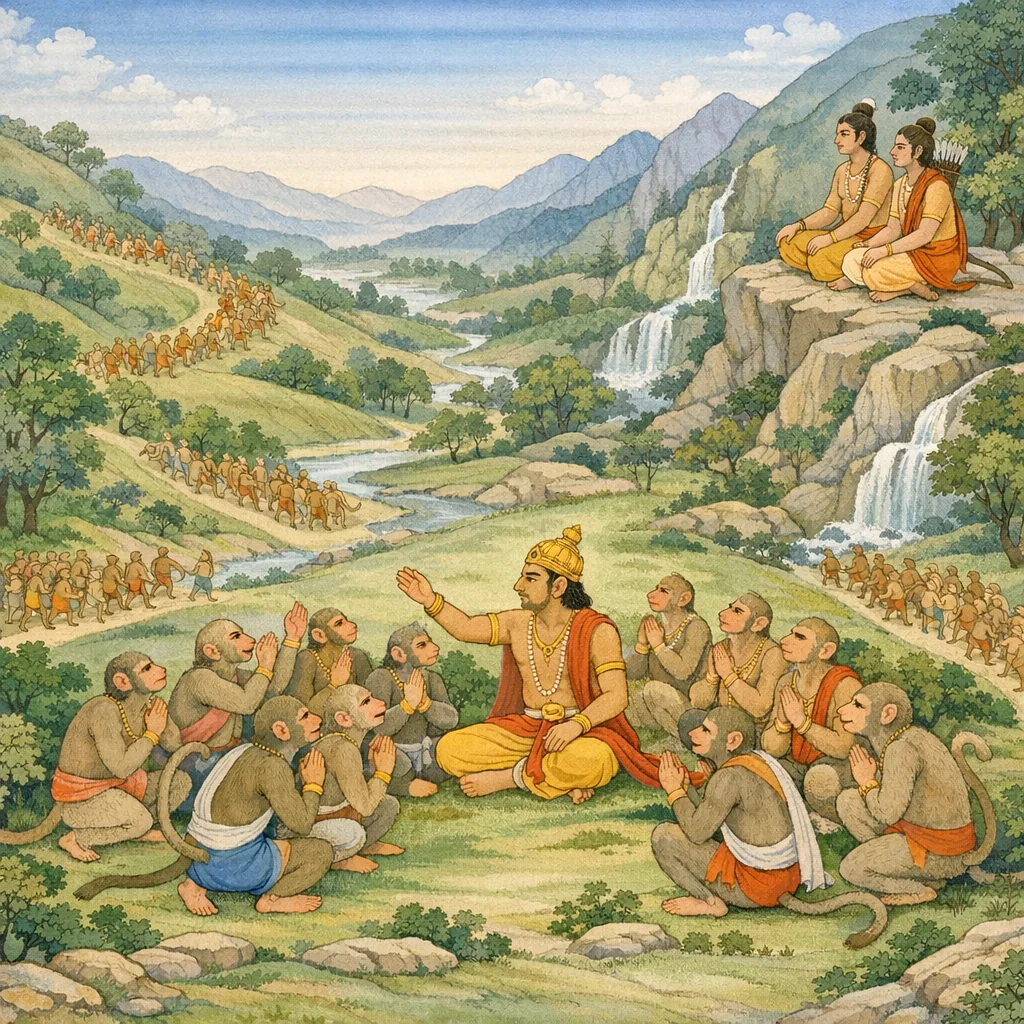
Sarga 45 depicts Sugrīva’s command-and-control moment after consolidating the vānaras’ resolve. He summons the entire vanara host and reiterates the operational directive: search exactly as instructed for Sītā to accomplish Rāma’s purpose (4.45.1). The troops respond with martial confidence and competitive vows—some proclaiming single-handed victory over Rāvaṇa and rapid recovery of Janakī, others boasting of cosmic-scale strength (splitting mountains, churning seas) and long-distance leaping measured in yojanas (4.45.10–15). The narrative then shifts from rhetoric to execution: having understood the king’s strict order, the monkey forces spread over the earth like locusts (4.45.2). Rāma and Lakṣmaṇa remain stationed at Prasravaṇa, awaiting the month fixed for the search (4.45.3). Finally, the expedition is geographically partitioned: Śatavalī goes north (4.45.4), Vinata goes east (4.45.5), Hanumān (son of the Wind-god) with Aṅgada and others proceeds south associated with Agastya’s region (4.45.5–6), and Suṣeṇa goes west under Varuṇa’s quarter (4.45.7). Sugrīva rejoices after dispatching the principal commanders, while the leaders depart swiftly to their assigned directions (4.45.8–9).
Shlokas
Verse 1
सर्वांश्चाहूय सुग्रीवः प्लवगान् प्लवगर्षभः।समस्तानब्रवीद्भूयो रामकार्यर्थसिद्धये।।4.45.1।।एवमेतद्विचेतव्यं यन्मया परिकीर्तितम्।
Sugriva, the foremost among the vanaras, summoned all the monkeys and again addressed them for the fulfillment of Rama’s purpose: “Search exactly in the manner I have described.”
Verse 2
तदुग्रशासनं भर्तुर्विज्ञाय हरिपुङ्गवाः।।4.45.2।।शलभा इव सञ्छाद्य मेदिनीं सम्प्रतस्थिरे।
Understanding their lord’s stern command, the foremost of the monkeys set out, covering the earth like a swarm of locusts.
Verse 3
रामः प्रस्रवणे तस्मिन्यवसत्सहलक्ष्मणः।।4.45.3।।प्रतीक्षमाणस्तं मासं यस्सीताधिगमे कृतः।
Rāma, with Lakṣmaṇa, stayed on that Prasravaṇa mountain, waiting for the month that had been fixed for gaining news of Sītā.
Verse 4
उत्तरां तु दिशं रम्यां गिरिराजसमावृताम्।।4.45.4।।प्रतस्थे सहसा वीरो हरिश्शतवलिस्तदा।
Then the heroic monkey Śatavalī set out at once toward the lovely northern quarter, encircled by lordly mountains.
Verse 5
पूर्वां दिशं प्रतिययौ विनतो हरियूथपः।।4.45.5।।ताराङ्गदादिसहितः प्लवङ्गो मारुतात्मजः।अगत्याचरितामाशां दक्षिणां हरियूथपः।।4.45.6।।
Vinata, a leader of monkey troops, departed toward the eastern quarter. And the troop-leader, the son of the Wind-god, set out for the southern region—associated with Agastya—together with Tārā and Aṅgada and others.
Verse 6
पूर्वां दिशं प्रतिययौ विनतो हरियूथपः।।4.45.5।।ताराङ्गदादिसहितः प्लवङ्गो मारुतात्मजः।अगत्याचरितामाशां दक्षिणां हरियूथपः।।4.45.6।।
Hanumān, the son of the Wind-god and a leader among the monkey-hosts, set out toward the southern quarter—land sanctified by the presence and wanderings of Agastya—accompanied by Tārā, Aṅgada, and others.
Verse 7
पश्चिमां तु भृशं घोरां सुषेणः प्लवगेश्वरः।प्रतस्थे हरिशार्दूलो दिशं वरुणपालिताम्।।4.45.7।।
Sūṣeṇa, lord among monkeys—a tiger among the vānaras—set out swiftly for the dread western quarter, the direction guarded by Varuṇa.
Verse 8
ततस्सर्वा दिशो राजा चोदयित्वा यथातथम्।कपिसेनापतीन्मुख्यान्मुमोद सुखितस्सुखम्।।4.45.8।।
Then the king, having duly directed the foremost commanders of the monkey-army to all quarters as required, felt relieved and rejoiced.
Verse 9
एवं सम्बोधितास्सर्वे राज्ञा वानरयूथपाः।स्वां स्वां दिशमभिप्रत्त्य त्वरिता सम्प्रतस्थिरे।।4.45.9।।
Thus addressed by the king, all the leaders of monkey-troops hastened away, each bound for his own appointed direction.
Verse 10
नदन्तश्चोन्नदन्तश्च गर्जन्तश्च प्लवङ्गमाः।क्ष्वेलन्तो धावमानाश्च विनदन्तो महाबलाः।।4.45.10।।
The mighty monkeys surged forth—noisy and loudly calling, roaring, leaping, running, and crying out as they went.
Verse 11
एवं सम्बोदितास्सर्वे राज्ञा वानरयूथपाः।आनयिष्यामहे सीतां हनिष्यामश्च रावणम्।।4.45.11।।
Thus addressed by their king, all the vanara leaders declared: “We will bring back Sita, and we will slay Ravana.”
Verse 12
अहमेको हनिष्यामि रावणं प्राप्तमाहवे।ततश्चोन्मथ्य सहसा हरिष्ये जनकात्मजाम्।।4.45.12।।
“I alone will slay Rāvaṇa when he meets me in battle; then, swiftly crushing and scattering (his forces), I will bring back Janaka’s daughter.”
Verse 13
वेपमानां श्रमेणाद्य भवद्भिः स्थीयतामिति।एक एवाहरिष्यामि पातालादपि जानकीम्।।4.45.13।।
“You may wait now (without strain); I alone will bring back Jānakī—even if she were in Pātāla—trembling and worn with exhaustion.”
Verse 14
वधिष्याम्यहं वृक्षान् दारयिष्याम्यहं गिरीन्।धरणीं दारयिष्यामि क्षोभयिष्यामि सागरान्।।4.45.14।।
“I will smash trees, split mountains, cleave the earth, and churn the seas.”
Verse 15
अहं योजनसङ्ख्यायाः प्लविता नात्र संशयः।शतं योजनसङ्ख्यायाश्शतं समधिकं ह्यहम्।।4.45.15।।
“I can leap a distance measured in a hundred yojanas—there is no doubt of it.” Another declared, “I can leap a hundred yojanas more than that.”
Verse 16
“I am capable of going about unobstructed—across the earth, in the sea, on mountain-peaks, through forests, and even down to the netherworld’s depths.”
Verse 17
सर्वांश्चाहूय सुग्रीवः प्लवगान् प्लवगर्षभः।समस्तानब्रवीद्भूयो रामकार्यर्थसिद्धये।।4.45.1।।एवमेतद्विचेतव्यं यन्मया परिकीर्तितम्।
Then Sugrīva—the foremost among the vanaras—summoned them all again and addressed the assembled troops for the fulfillment of Rāma’s purpose: “Search exactly in the manner I have laid down.”
Frequently Asked Questions
The pivotal action is the conversion of personal vows of prowess into accountable service: Sugrīva’s strict command channels heroic self-assertion into a disciplined, mission-bound search for Sītā, aligning strength with duty rather than mere bravado.
Effective dharma-aligned leadership requires clear instruction, delegation, and time-bound responsibility; equally, devotion to a righteous cause is shown through coordinated effort, not only through individual boasts of power.
Prasravaṇa is marked as Rāma’s waiting-station; the search is mapped to the four quarters (north/east/south/west), with cultural-ritual geography signposted by Agastya’s southern association and Varuṇa’s guardianship of the western direction.