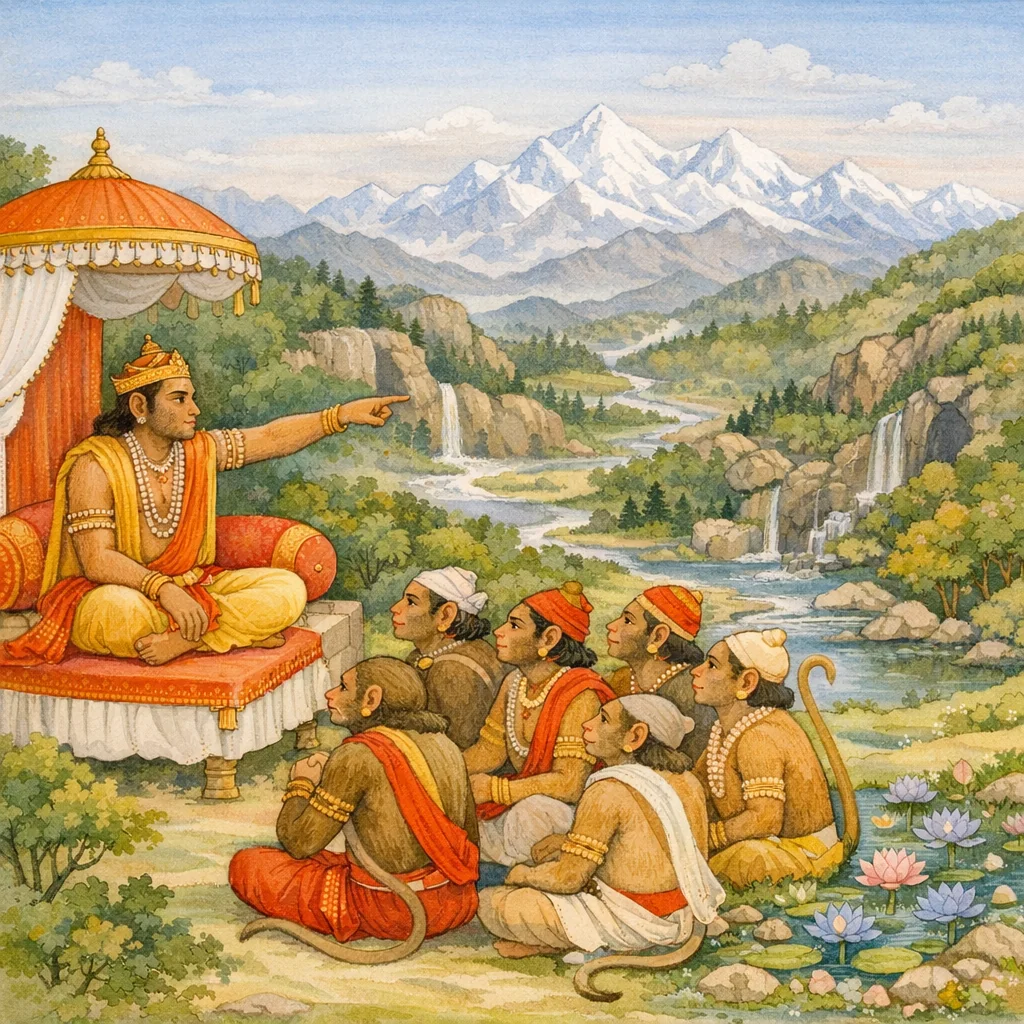
Sarga 43
सुग्रीवस्य शतवलि-प्रेषणम् (Sugriva’s Commission to Satavali for the Northern Search)
किष्किन्धाकाण्ड
अस्मिन् सर्गे सुग्रीवः (धर्मज्ञः राजा) शतवलिं नाम वानर-वीरं दिशानियोजनस्य भागरूपेण नियुक्त्वा ‘परिमार्ग’ (systematic search) इति कार्य-नीतिं प्रतिपादयति। आरम्भे शतवलिः पश्चिम-दिशा-प्रेषणस्य प्रसङ्गे निर्दिश्यते, ततः मुख्य-उपदेशः उत्तर-दिशायां (हिमवद्-पर्यन्ते) विस्तीर्ण-भूगोल-सूची-रूपेण प्रवहति—वनदुर्ग, नद्यः, शैलान्तराणि, जनपदानां नामावली (म्लेच्छ, पुलिन्द, शूरसेन, कुरु, काम्बोज, यवन, शक, बाह्लीक, चीन, परमचीन, दरद, इत्यादयः) तथा पर्वत-श्रृङ्खलाः (कैलास, क्रौञ्च, मैनाक, सुदर्शन, देवसख, सोमगिरि) इत्यादि। सुग्रीवः अन्वेषण-प्रोटोकॉलं निर्दिशति—गुहासु, निर्दरेषु, कानन-षण्डेषु, निर्घरेषु ‘रावणः सह वैदेह्या’ इति द्वय-लक्ष्य-निर्देशेन मार्गणीयम्। उत्तरकुरु-देशस्य अद्भुत-समृद्धि-वर्णनं (रत्न, मणि, मुक्ताः, नीलोत्पलवन, दिव्य-भोग्य-वस्तूनि) ‘मिथिक-भूगोल’ इत्यस्य काव्य-मानचित्रं निर्माति, किन्तु स्पष्ट-सीमा-नियमः अपि दत्तः—कुरूणाम् उत्तरेण न गन्तव्यम्; सोमगिरि-पर्यन्तं एव वानरैः शक्यम्। समापनं कृतज्ञता-नीतौ केन्द्रितम्—रामस्य उपकारस्य प्रतिकारः जीवन-साफल्यं, तथा सीता-दर्शन-फलितं रामस्य/सुग्रीवस्य प्रीतिवर्धनम्।
Shlokas
Verse 1
ततस्सन्दिश्य सुग्रीवश्श्वशुरं पश्चिमां दिशम्।वीरं शतवलिं नाम वानरं वानरर्षभः।।।।
Then Sugrīva—the foremost among monkeys—having dispatched his father-in-law toward the western direction, addressed the heroic monkey named Śatavali.
Verse 2
उवाच राजा धर्मज्ञस्सर्ववानरसत्तमम्।वाक्यमात्म हितं चैव रामस्य च हितं तथा।।।।
King Sugrīva, a knower of dharma, addressed the foremost of the vānaras with words intended for his own welfare and equally for Rāma’s good.
Verse 3
वृतश्शतसहस्रेण त्वद्विधानां वनौकसाम्।वैवस्वतसुतैस्सार्धं प्रतिष्ठस्व स्वमन्त्रिभिः।।।।
Take with you a hundred thousand forest-dwellers like yourself, along with the sons of Vaivasvata, and set out together with your own ministers.
Verse 4
दिशं ह्युदीचीं विक्रान्तां हिमशैलावतंसकाम्।सर्वतः परिमार्गध्वं रामपत्नीमनिन्दिताम्।।।।
Search everywhere in the mighty northern quarter—adorned, as it were, with the Himālaya like an ear-ornament—for Sītā, the blameless wife of Rāma.
Verse 5
अस्मिन्कार्येविनिर्वृत्ते कृते दाशरथेः प्रिये।ऋणान्मुक्ता भविष्यामः कृतार्थार्थविदां वराः।।।।
When this undertaking is brought to completion—when the task dear to Rāma, the son of Daśaratha, is accomplished—then we shall be freed from our debt (of gratitude) and counted among those who truly succeed and understand what is worth pursuing.
Verse 6
कृतं हि प्रियमस्माकं राघवेण महात्मना।तस्य चेत्प्रतिकारोऽस्ति सफलं जीवितं भवेत्।।।।
The great-souled Rāghava has already rendered us a dear service; if there is any way for us to repay him, then our very lives will become meaningful.
Verse 7
अर्थिनः कार्यनिर्वृत्तिमकर्तुरपि यश्चरेत्।तस्य स्यात्सफलं जन्म किं पुनः पूर्वकारिणः।।।।
Even if one accomplishes the task of a supplicant who has never helped before, that person’s birth becomes fruitful—how much more so when one repays a benefactor who helped first.
Verse 8
एतां बुद्धिमवस्थाय दृश्यते जानकी यथा।तथा भवद्भिः कर्तव्यमस्मत्प्रियहितैषिभिः।।।।
Holding firmly to this resolve, you—who seek what is dear and beneficial to us—must act in such a way that Jānakī may be found.
Verse 9
अयं हि सर्वभूतानां मान्यस्तु नरसत्तमः।अस्मासु चागत: प्रीती रामः परपुरञ्जयः।।।।
This Rāma—best among men, conqueror of enemy strongholds—is worthy of honor from all beings; and toward us too he has shown affection.
Verse 10
इमानि वनदुर्गाणि नद्यश्शैलान्तराणि च।भवन्तः परिमार्गन्तु बुद्धिविक्रमसम्पदा।।।।
Endowed with wisdom and valor, you should thoroughly search these forest-fastnesses, the rivers, and the mountain ranges.
Verse 11
तत्र म्लेच्छान्पुलिन्दांश्च शूरसेनांस्तथैव च।प्रस्थलान्भरतांश्चैव कुरूंश्च सह मद्रकैः।।।।काम्बोजान्यवनां श्चैव शकानारट्टकानपि।बाह्लीकानृषिकां श्चैव पौरवानथ टङ्कणान्।।।।चीनान्परमचीनांश्च नीहारांश्च पुनः पुनः।अन्विष्यदरदांश्चैव हिमवन्तं तथैव च।।।।
There, search among the Mlecchas and Pulindas, and also the Śūrasenas; the Prasthalas, the Bharatas, and the Kurus along with the Madrakas; the Kāmbojas and Yavanas, the Śakas and Āraṭṭakas; the Bāhlīkas, Ṛṣikas, Pauravas, and Ṭaṅkaṇas; and again and again search among the Cīnas, Parama-Cīnas, Nīhāras, and Daradas, and likewise in the Himavat range.
Verse 12
तत्र म्लेच्छान्पुलिन्दांश्च शूरसेनांस्तथैव च।प्रस्थलान्भरतांश्चैव कुरूंश्च सह मद्रकैः।।4.43.11।।काम्बोजान्यवनां श्चैव शकानारट्टकानपि।बाह्लीकानृषिकां श्चैव पौरवानथ टङ्कणान्।।4.43.12।।चीनान्परमचीनांश्च नीहारांश्च पुनः पुनः।अन्विष्यदरदांश्चैव हिमवन्तं तथैव च।।4.43.13।।
There too, search among the Kāmbojas and the Yavanas, and also among the Śakas and the Āraṭṭakas; likewise among the Bāhlīkas and the Ṛṣikas, and then among the Pauravas and the Ṭaṅkaṇas.
Verse 13
तत्र म्लेच्छान्पुलिन्दांश्च शूरसेनांस्तथैव च।प्रस्थलान्भरतांश्चैव कुरूंश्च सह मद्रकैः।।4.43.11।।काम्बोजान्यवनां श्चैव शकानारट्टकानपि।बाह्लीकानृषिकां श्चैव पौरवानथ टङ्कणान्।।4.43.12।।चीनान्परमचीनांश्च नीहारांश्च पुनः पुनः।अन्विष्यदरदांश्चैव हिमवन्तं तथैव च।।4.43.13।।
King Sugrīva, a knower of dharma, addressed the foremost of the vānaras with words intended for his own welfare and equally for Rāma’s good.
Verse 14
लोध्रपद्मकषण्डेषु देवदारुवनेषु च।रावणस्सह वैदेह्या मार्गितव्यस्ततस्ततः।।।।
Search everywhere—among thickets of lodhra and lotus-groves, and within forests of deodāra—for Rāvaṇa together with Vaidehī (Sītā).
Verse 15
ततस्सोमाश्रमं गत्वा देवगन्धर्वसेवितम्।कालं नाम महासानुं पर्वतं तु गमिष्यथ।।।।
Then, having gone to Soma’s hermitage—frequented by gods and gandharvas—you should proceed to the mountain named Kāla, with its vast slopes.
Verse 16
महत्सु तस्य शैलस्य निर्दरेषु गुहासु च।विचिनुध्वं महाभागां रामपत्नींततस्ततः।।।।
Search everywhere for that noble lady, Rāma’s wife—within the great mountain’s ravines and in its caves.
Verse 17
तमतिक्रम्य शैलेन्द्रं हेमगर्भं महागिरिम्।ततस्सुदर्शनं नाम गन्तुमर्हथ पर्वतम्।।।।
Having crossed that great mountain-lord, rich as though with gold within, you should then go to the mountain called Sudarśana.
Verse 18
ततो देवसखो नाम पर्वतः पतगालयः।नानापक्षिगणाकीर्णो विविधद्रुमभूषितः।।।।
From there lies the mountain named Devasakha, a dwelling-place of birds, crowded with many flocks and adorned with diverse trees.
Verse 19
तस्य काननषण्डेषु निर्घरेषु गुहासु च।रावणस्सह वैदेह्या मार्गितव्यस्ततस्ततः।।।।
There, in its forest-thickets, by its waterfalls, and within its caves, search everywhere for Rāvaṇa together with Vaidehī.
Verse 20
तमतिक्रम्य चाकाशं सर्वतश्शतयोजनम्।अपर्वतनदीवृक्षं सर्वसत्त्वविवर्जितम्।।।।
Beyond that, you must cross a vast empty expanse for a hundred yojanas—devoid of mountains, rivers, and trees, and bereft of living beings.
Verse 21
तं तु शीघ्रमतिक्रम्य कान्तारं रोमहर्षणम्।कैलासं पाण्डुरं शैलं प्राप्य हृष्टा भविष्यथ।।।।
But once you swiftly cross that wilderness that makes the hair stand on end, you will rejoice on reaching the pale-white mountain Kailāsa.
Verse 22
तत्र पाण्डुरमेघाभं जाम्बूनदपरिष्कृतम्।कुबेरभवनं रम्यं निर्मितं विश्वकर्मणा।।।।
There stands Kubera’s exquisite mansion, built by Viśvakarman—adorned with Jāmbūnada gold and gleaming like a pale-white cloud.
Verse 23
विशाला नलिनी यत्र प्रभूतकमलोत्पला।हंसकारण्डवाकीर्णाप्सरोगणसेविता।।।।
There is a vast lotus-lake, rich with lotuses and blue lilies, thronged with swans and kāraṇḍava ducks, and frequented by hosts of Apsarases.
Verse 24
तत्र वैश्रवणो राजा सर्वभूतनमस्कृतः।धनदो रमते श्रीमान्गुह्यकैस्सह यक्षराट्।।।।
There the Yakṣa-king Vaiśravaṇa—Dhanada, honored by all beings—dwells in prosperity, delighting in the company of the Guhyakas.
Verse 25
तस्य चन्द्रनिकाशेषु पर्वतेषु गुहासु च।रावणः सह वैदेह्या मार्गितव्यस्ततस्ततः।।।।
Across those moon-white mountains and their caves, you must search everywhere for Rāvaṇa together with Vaidehī.
Verse 26
क्रौञ्चं तु गिरिमासाद्य बिलं तस्य सुदुर्गमम्।अप्रमत्तै: प्रवेष्टव्यं दुष्प्रवेशं हि तत्स्मृतम्।।।।
Having reached Mount Krauñca, enter its exceedingly hard-to-reach cavern only with full vigilance, for it is said to be perilously difficult to enter.
Verse 27
वसन्ति हि महात्मानस्तत्र सूर्यसमप्रभाः।देवैरप्यर्चिता स्सम्यग्देवरूपा महर्षयः।।।।
For there dwell great-souled sages, radiant like the sun—properly revered even by the gods—mahārṣis with a godlike splendor.
Verse 28
क्रौञ्चस्य तु गुहाश्चान्या स्सानूनिशिखराणि च।निर्दराश्च नितम्बाश्च विचेतव्या स्ततस्ततः।।।।कौञ्चस्य शिखरं चापि निरीक्ष्य च ततस्ततः।
You must search everywhere on Krauñca—its other caves, its slopes and peaks, its clefts and ridges—examining even its summit again and again throughout.
Verse 29
अवृक्षं कामशैलं च मानसं विहगालयम्।न गतिस्तत्र भूतानां देवदानव रक्षसाम्।।।।
There lies the treeless Kāma-śaila and Mānasā, a sanctuary of birds; no beings can pass there—not even gods, Dānavas, or Rākṣasas.
Verse 30
स च सर्वैर्विचेतव्यस्ससानुप्रस्थभूधरः।क्रौञ्चं गिरिमतिक्रम्य मैनाको नाम पर्वतः।।।।
That mountain, with its slopes, plateaus, and ridgelands, must be searched by all of you; after passing Mount Krauñca comes the mountain called Maināka.
Verse 31
मयस्य भवनं यत्र दानवस्य स्वयं कृतम्।।।।मैनाकस्तु विचेतव्य स्ससानुप्रस्थकन्दरः।स्त्रीणामश्वमुखीनां तु निकेतास्तत्र तत्र तु।।।।
There is the mansion of the Dānava Māyā—built by his own hand.
Verse 32
मयस्य भवनं यत्र दानवस्य स्वयं कृतम्।।4.43.31।।मैनाकस्तु विचेतव्य स्ससानुप्रस्थकन्दरः।स्त्रीणामश्वमुखीनां तु निकेतास्तत्र तत्र तु।।4.43.32।।
You should carefully search Mount Maināka, with its plateaus, slopes, and deep caves; and there, in various places, are the dwellings of the horse-faced women—those too must be examined.
Verse 33
तं देशं समतिक्रम्य आश्रमं सिद्धसेवितम्।सिद्धा वैखानसास्तत्र वालखिल्याश्च तापसाः।।।।
After passing that region, you will reach a hermitage frequented by Siddhas; there dwell Siddhas, Vaikhānasas, and ascetics known as the Vālakhilyas.
Verse 34
वन्द्यास्ते तु तपस्सिद्धास्तपसा वीतकल्मषाः।प्रष्टव्या चापि सीतायाः प्रवृत्तिर्विनयान्वितैः।।।।
They are worthy of reverence—perfected through austerity and cleansed of sin by penance. With humility and proper conduct, you should also ask them for information concerning Sītā.
Verse 35
हेमपुष्करसञ्छन्नं तस्मिन् वैखानसं सरः।तरुणादित्यसङ्काशैर्हंसैर्विचरितं शुभैः।।4.43.35।।
There lies the Vaikhānasa lake, covered with golden lotuses, where auspicious swans—radiant like the rising sun—move about.
Verse 36
औपवाह्यः कुबेरस्य सार्वभौम इति स्मृतः।गजः पर्येति तं देशं सदा सह करेणुभिः।।4.43.36।।
Kubera’s royal mount—an elephant famed as Sārvabhauma—ever roams that region together with female elephants.
Verse 37
तत्सरस्समतिक्रम्य नष्टचन्द्रदिवाकरम्।अनक्षत्रगणं व्योम निष्पयोदमनादितम्।।।।
After crossing that lake, you will reach a sky where the moon and sun are unseen—starless, cloudless, and without any sound.
Verse 38
गभस्तिभिरिवार्कस्य स तु देशः प्रकाशते।विश्राम्यद्भिस्तपस्सिद्धैर्देवकल्पैः स्वयंप्रभैः।।।।
Yet that land shines as though lit by the sun’s rays, because self-effulgent ascetics—godlike and perfected through austerity—rest there.
Verse 39
तं तु देशमतिक्रम्य शैलोदा नाम निम्नगा।उभयोस्तीरयोस्तस्याः कीचका नाम वेणवः।।।।ते नयन्ति परं तीरं सिद्धान्प्रत्यानयन्ति च।
Passing beyond that region, you will come to a mountain stream called Śailodā. On both its banks are bamboo groves known as Kīcakas; they convey the Siddhas to the far shore and bring them back again.
Verse 40
उत्तराः कुरवस्तत्र कृतपुण्यप्रतिश्रयाः।।।।ततः काञ्चनपद्माभिः पद्भिनीभिः कृतोदकाः।नीलवैडूर्यपत्राभिर्नद्यस्तत्र सहस्रशः।।।।रक्तोत्पलवनैश्चात्र मण्डिताश्च हिरण्मयैः।
There lies the land of Uttara-Kuru, a realm that serves as a refuge and abode for those who have performed meritorious deeds.
Verse 41
उत्तराः कुरवस्तत्र कृतपुण्यप्रतिश्रयाः।।4.43.40।।ततः काञ्चनपद्माभिः पद्भिनीभिः कृतोदकाः।नीलवैडूर्यपत्राभिर्नद्यस्तत्र सहस्रशः।।4.43.41।।रक्तोत्पलवनैश्चात्र मण्डिताश्च हिरण्मयैः।
Beyond that, there are waters filled to the brim among lotus-groves—golden lotuses with blue-green leaves—while in that region rivers run by the thousand.
Verse 42
तरुणादित्यसङ्काशैर्भान्ति तत्र जलाशयाः।।।।महार्हमणिरत्नैश्च काञ्चनप्रभकेसरैः।निलोत्पलवनैश्चित्रै स्स देश स्सर्वतो वृतः।।।।निस्तुलाभिश्च मुक्ताभिर्मणिभिश्च महाधनैः।
There the lakes and reservoirs shine with lotuses radiant like the newly risen sun.
Verse 43
तरुणादित्यसङ्काशैर्भान्ति तत्र जलाशयाः।।4.43.42।।महार्हमणिरत्नैश्च काञ्चनप्रभकेसरैः।निलोत्पलवनैश्चित्रै स्स देश स्सर्वतो वृतः।।4.43.43।।निस्तुलाभिश्च मुक्ताभिर्मणिभिश्च महाधनैः।
That whole region is encircled on every side by wondrous blue-lotus groves, by precious gems, by filaments gleaming like gold, and by incomparable pearls and richly valuable jewels.
Verse 44
उद्भूतपुलिनास्तत्र जातरूपैश्च निम्नगाः।सर्वरत्नमयैश्चित्रैरवगाढा नगोत्तमैः।।।।जातरूपमयैश्चापि हुताशनसमप्रभैः।
There the rivers have banks that rise up in gold; and the best of mountains, variegated with every kind of gem, plunge down into those waters—golden too, and blazing with a fire-like brilliance.
Verse 45
नित्यपुष्पफलास्तत्र नगाः पत्त्ररथाकुलाः।।।।दिव्यगन्धरसस्पर्शाः सर्वान्कामान् स्रवन्ति च।नानाकाराणि वासांसि फलन्त्यन्ये नगोत्तमाः।।।।
There the trees are ever in flower and fruit, alive with flocks of birds. Their divine fragrance, taste, and touch seem to pour forth every delight; and other excellent trees even yield garments of many kinds.
Verse 46
नित्यपुष्पफलास्तत्र नगाः पत्त्ररथाकुलाः।।4.43.45।।दिव्यगन्धरसस्पर्शाः सर्वान्कामान् स्रवन्ति च।नानाकाराणि वासांसि फलन्त्यन्ये नगोत्तमाः।।4.43.46।।
There the trees are ever in flower and fruit, alive with flocks of birds. Their divine fragrance, taste, and touch seem to pour forth every delight; and other excellent trees even yield garments of many kinds.
Verse 47
मुक्ता वैढूर्यचित्राणि भूषणानि तथैव च।स्त्रीणां चाप्यनुरूपाणि पुरुषाणां तथैव च।।।।सर्वर्तुसुख सेव्यानि फलन्त्यन्ये नगोत्तमाः।महार्हाणि विचित्राणि हैमान्यन्ये नगोत्तमाः।।।।
Other splendid trees produce ornaments—studded with pearls and vaidūrya—suitable alike for women and for men, pleasing in every season; and still other excellent trees yield wondrous, costly ornaments of gold.
Verse 48
मुक्ता वैढूर्यचित्राणि भूषणानि तथैव च।स्त्रीणां चाप्यनुरूपाणि पुरुषाणां तथैव च।।4.43.47।।सर्वर्तुसुख सेव्यानि फलन्त्यन्ये नगोत्तमाः।महार्हाणि विचित्राणि हैमान्यन्ये नगोत्तमाः।।4.43.48।।
Other splendid trees produce ornaments—studded with pearls and vaidūrya—suitable alike for women and for men, pleasing in every season; and still other excellent trees yield wondrous, costly ornaments of gold.
Verse 49
शयनानि प्रसूयन्ते चित्रास्तरणवन्ति च।मनःकान्तानि माल्यानि फलन्त्यत्रापरे द्रुमाः।।।।
Some trees there even bring forth beds with colorful coverings; and other trees yield garlands that are delightful to the heart.
Verse 50
पानानि च महार्हाणि भक्ष्याणि विविधानि च।स्त्रियश्च गुणसम्पन्ना रूपयौवनलक्षिताः।।।।
There are choice drinks and many kinds of foods; and women as well—endowed with virtues, and distinguished by beauty and youth.
Verse 51
गन्धर्वाः किन्नरास्सिद्धा नागा विद्याधरास्तथा।रमन्ते सततं स्तत्र नारीभिर्भास्करप्रभाः।।।।
There Gandharvas, Kinnaras, Siddhas, Nāgas, and Vidyādharas—radiant like the sun—sport continually with their women companions.
Verse 52
सर्वे सुकृतकर्माण स्सर्वे रतिपरायणाः।सर्वे कामार्थसहिता वसन्ति सहयोषितः।।।।
All there are doers of meritorious deeds; all are devoted to delight; all live with the enjoyments of desire and prosperity, together with their women companions.
Verse 53
गीतवादित्रनिर्घोष स्सोत्कृष्टहसितस्वनः।श्रूयते सततं तत्र सर्वभूतमनोहरः।।।।
There, constantly, one hears the resonant sounds of song and instruments, and the fine peals of laughter—delighting the minds of all beings.
Verse 54
तत्र नामुदितः कश्चिन्नास्ति कश्चिदसत्प्रियः।अहन्यहनि वर्धन्ते गुणास्तत्र मनोरमाः।।।।
There no one is unhappy, and no one is fond of what is wrong; day after day, delightful virtues continue to increase among the people there.
Verse 55
समतिक्रम्य तं देशमुत्तरः पयसां निधिः।तत्र सोमगिरिर्नाम मध्ये हेममयो महान्।।।।
Having crossed that region, you will reach the northern ocean; and there, in its midst, stands the great golden mountain named Somagiri.
Verse 56
इन्द्रलोकगता ये च ब्रह्मलोकगताश्च ये।देवास्तं समवेक्षन्ते गिरिराजं दिवं गताः।।।।
Only those deities who have attained the worlds of Indra and of Brahmā—having gone to heaven—are able to behold that king of mountains.
Verse 57
स तु देशो विसूर्योऽपि तस्य भासा प्रकाशते।सूर्यलक्ष्म्याऽभिविज्ञेयस्तपतेव विवस्वता।।।।
That region, though without the sun, shines by its own radiance—recognizable as if endowed with the sun’s splendor, as though heated by the Sun himself.
Verse 58
भगवानपि विश्वात्मा शम्भुरेकादशात्मकः।ब्रह्मा वसति देवेशो ब्रह्मर्षिपरिवारितः।।।।
There dwell divine beings as well: Śambhu in his elevenfold form, and Brahmā, lord of the gods, surrounded by Brahmarṣis; and the all-pervading cosmic Self is also spoken of in that sacred sphere.
Verse 59
न कथञ्चन गन्तव्यं कुरूणामुत्तरेण वः।अन्येषामपि भूतानां नातिक्रामति वै गतिः।।।।
You must not go in any manner beyond the northern region of the Kurus; indeed, even the movement of other beings does not transgress that limit.
Verse 60
स हि सोमगिरिर्नाम देवानामपि दुर्गमः।तमालोक्य ततः क्षिप्रमुपावर्तितुमर्हथ।।।।
For that mountain is called Somagiri, and it is difficult to reach even for the gods; having seen it, you should promptly turn back from there.
Verse 61
एतावद्वानरैश्शक्यं गन्तुं वानरपुङ्गवाः।अभास्करममर्यादं न जानीमस्ततः परम्।।।।
O foremost of monkeys, only this far is it possible for monkeys to go; beyond that lies a sunless, boundaryless region—what is further than that, we do not know.
Verse 62
सर्वमेतद्विचेतव्यं यन्मया परिकीर्तितम्।यदन्यदपि नोक्तं च तत्रापि क्रियतां मतिः।।।।
All that I have described should be thoroughly investigated; and even regarding other matters I have not mentioned, you should apply your judgment there as well.
Verse 63
ततः कृतं दाशरथेर्महत्प्रियंमहत्तरं चापि ततो मम प्रियम्।कृतं भविष्यत्यनिलानलोपमाविदेहजादर्शनजेन कर्मणा।।।।
Then a great joy will have been done for Dāśarathi (Rāma), and an even greater joy for me, O heroes like wind and fire, by the deed of bringing about the sight (discovery) of the daughter of Videha (Sītā).
Verse 64
ततः कृतार्थाः सहितास्सबान्धवाःमयाऽर्चितास्सर्वगुणैर्मनोरमैः।चरिष्यथोर्वीं प्रति शान्तशत्रवस्सहप्रिया भूतधराः प्लवङ्गमाः।।।।
Then, having achieved your purpose, together with your kinsmen, honored by me with delightful virtues and rewards, you will roam the earth—your enemies pacified—along with your loved ones, O vānara supporters of beings.
Frequently Asked Questions
The pivotal action is Sugriva’s dharma-based delegation: he converts Rama’s personal loss into a disciplined, multi-region search mission, framed as a moral repayment of Rama’s prior help (kṛtajñatā) and as a king’s duty to coordinate resources responsibly.
Service to a benefactor is treated as life’s fruition: assisting Rama is not mere strategy but ethical necessity. The discourse also models prudent action—courage must be paired with buddhi (wisdom), and zeal must respect maryada (explicit operational limits).
A dense ‘digital-map’ style itinerary is provided: Kailasa and Kubera’s realm; Krauncha’s difficult cave; Mainaka with Maya’s mansion; Sailoda with Kichaka bamboos; the mythic Uttara-Kuru with gem-filled rivers; and the terminal boundary at the inaccessible Somagiri beyond which travel is prohibited.