Sarga 40
पूर्वदिशि सीतामार्गण-नियोगः (Deployment to the Eastern Quarter for the Search of Sita)
किष्किन्धाकाण्ड
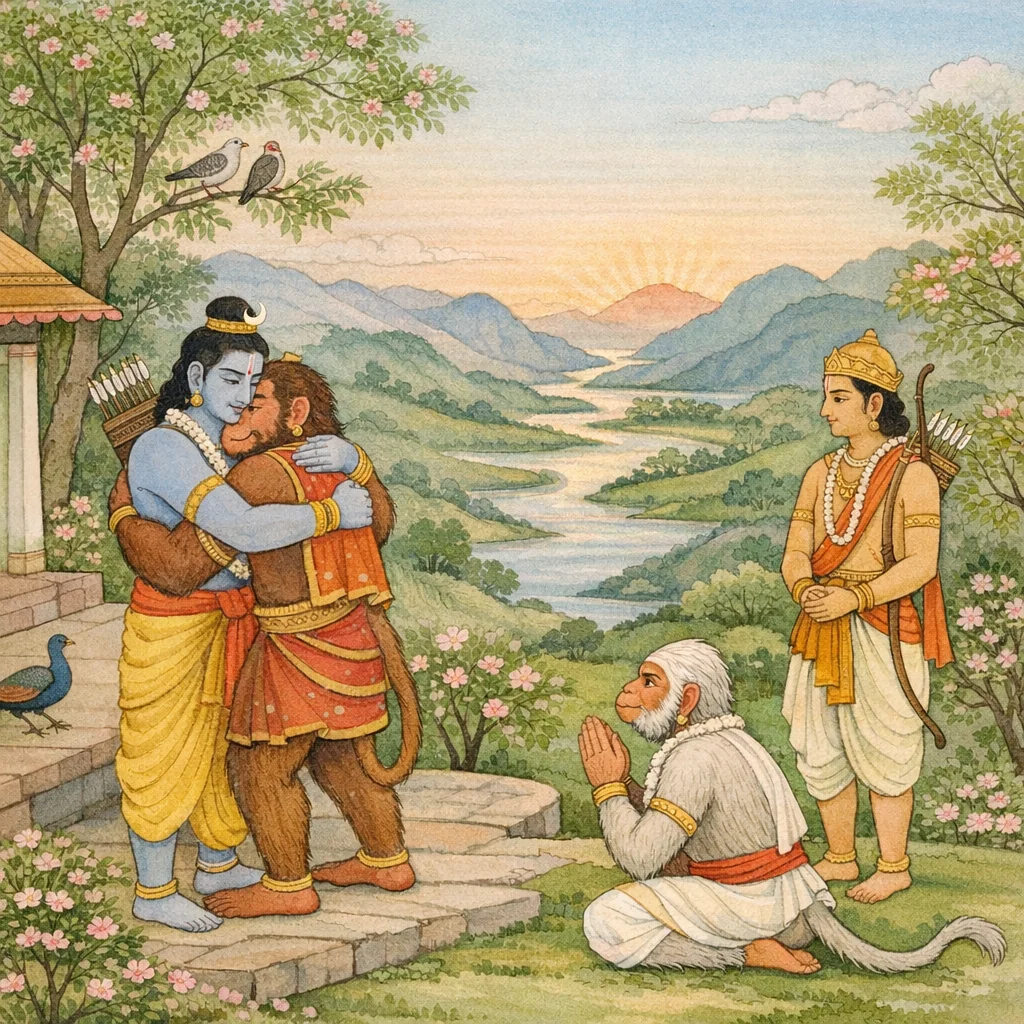
अस्मिन् सर्गे सुग्रीवः रामं वानरसेनासमृद्धिं निवेदयति, तथा रामस्य आज्ञां प्रार्थयते (4.40.1–9)। रामः सुग्रीवं आलिङ्ग्य मुख्यलक्ष्यं निर्दिशति—वैदेह्याः जीवित-अजीवित-निश्चयः तथा रावणनिवास-प्रदेशस्य अधिगमः (4.40.10–12)। ततः रामः नेतृत्वधर्मं सुग्रीवे समर्पयति—वानरसेनायाः आज्ञापनं सुग्रीवस्य एव अधिकारः, न राम-लक्ष्मणयोः (4.40.13–15)। सुग्रीवः विनतं नाम यूथपं समाहूय पूर्वदिशि अन्वेषणार्थं नियोजयति; ‘देश-काल-नय’युक्तं निर्णयकौशलं प्रशंसन् एकलक्ष-वानरैः सह प्रस्थानं आदेशयति (4.40.16–19)। अन्वेषण-मानचित्रे नद्यः, जनपदाः, पर्वताः, द्वीपाः, समुद्राः, तथा अद्भुत-लोकवर्णनं (यवद्वीपः, शिशिरपर्वतः, लोहित-सागरः, क्षीरोदः, जलोदः, जातरूपशिलो, अनन्तः, उदयपर्वतः इत्यादि) विस्तरेण निर्दिष्टम् (4.40.20–67)। अन्ते सुग्रीवः कार्यकाल-सीमा (मासः) तथा उत्तरदायित्वदण्डं (अनागमनं चेत् वध्यत्वम्) स्थिरीकरोति, एवं अन्वेषणं ‘शास्त्रीय-रणनीति’रूपेण नियन्त्रितं भवति (4.40.68–70)।
Shlokas
Verse 1
अथ राजा समृद्धार्थस्सुग्रीवः प्लवगेश्वरः।उवाच नरशार्दूलं रामं परबलार्दनम्।।4.40.1।।
Then King Sugrīva, lord of the monkeys, now fully equipped in purpose and resources, spoke to Rāma—the tiger among men, the crusher of hostile forces.
Verse 2
आगता विनिविष्टाश्च बलिनः कामरूपिणः।वानरा वारणेन्द्रभा: ये मद्विषयवासिनः।।4.40.2।।
The Vānara warriors who dwell within my realm have arrived and taken their positions—mighty in strength, able to assume forms at will, and huge like lordly elephants.
Verse 3
त इमे बहुविक्रान्तैर्हरिभिर्भीमविक्रमैः।आगता वानरा घोरा दैत्यदानवसन्निभाः।।4.40.3।।
Those dreadful Vānara warriors—monkeys of great might and fearsome valor, resembling Daityas and Dānavas in their formidable appearance—have arrived.
Verse 4
ख्यातकर्मापदानाश्च बलवन्तो जितक्लमाः।पराक्रमेषु विख्याता व्यवसायेषु चोत्तमाः।।4.40.4।।पृथिव्यम्बुचरा राम नानानगनिवासिनः।कोट्यग्रश इमे प्राप्ता वानरास्तव किङ्कराः।।4.40.5।।
O Rāma, mighty vānaras—renowned for past deeds, tireless, famed for valor, and foremost in determined effort—dwelling on many mountains and able to move on land and in water, have arrived here in countless crores, ready as your attendants.
Verse 5
ख्यातकर्मापदानाश्च बलवन्तो जितक्लमाः।पराक्रमेषु विख्याता व्यवसायेषु चोत्तमाः।।4.40.4।।पृथिव्यम्बुचरा राम नानानगनिवासिनः।कोट्यग्रश इमे प्राप्ता वानरास्तव किङ्कराः।।4.40.5।।
O Rāma, mighty vānaras—renowned for past deeds, tireless, famed for valor, and foremost in determined effort—dwelling on many mountains and able to move on land and in water, have arrived here in countless crores, ready as your attendants.
Verse 6
निदेशवर्तिनस्सर्वे सर्वे गुरुहिते रताः।अभिप्रेतमनुष्ठातुं तव शक्ष्यन्त्यरिन्दम।।4.40.6।।
O subduer of foes, all of them are obedient to command; all are devoted to the welfare of their elders, and they are capable of carrying out what you intend.
Verse 7
त इमे बहुसाहस्रैरनीकै भीमविक्रमैः।आगता वानरा घोरा दैत्यदानवसन्निभा:।।4.40.7।।
Here have come those dreadful vanaras, with forces numbering many thousands—fighters of terrifying prowess, resembling Daityas and Dānavas in might.
Verse 8
यन्मन्यसे नरव्याघ्र प्राप्तकालं तदुच्यताम्।तत्सैन्यं त्वद्वशे युक्तमाज्ञापयितुमर्हसि।।4.40.8।।
O tiger among men, declare what you judge to be the proper time for action. This army stands ready under your command—you should issue the orders.
Verse 9
काममेषामिदं कार्यं विदितं मम तत्त्वतः।तथापि तु यथातत्त्वमाज्ञापयितुमर्हसि।।4.40.9।।
Even if the purpose of this mission is already known to me in its essence, you should still issue the orders correctly and in due detail, as is fitting.
Verse 10
इति ब्रुवाणं सुग्रीवं रामो दशरथात्मजः।बाहुभ्यां सम्परिष्वज्य इदं वचनमब्रवीत्।।4.40.10।।
As Sugrīva spoke thus, Rāma—Daśaratha’s son—embraced him with both arms and then replied with these words.
Verse 11
ज्ञायतां मम वैदेही यदि जीवति वा न वा।स च देशो महाप्राज्ञ यस्मिन्वसति रावणः।।4.40.11।।
O greatly wise one, let it be ascertained whether my Vaidehī is alive or not—and also the very region where Rāvaṇa resides.
Verse 12
अधिगम्य तु वैदेहीं निलयं रावणस्य च।प्राप्तकालं विधास्यामि तस्मिन्काले सह त्वया।।4.40.12।।
Once Vaidehī is found and Rāvaṇa’s abode is known, at the proper time I will act—together with you—when that moment arrives.
Verse 13
नाहमस्मिन् प्रभुः कार्ये वानरेश न लक्ष्मणः।त्वमस्य हेतुः कार्यस्य प्रभुश्च प्लवगेश्वर।।4.40.13।।
O king of the Vānaras, neither I nor Lakṣmaṇa should command in this undertaking; you are both the cause and the rightful lord of this task, O ruler of the monkeys.
Verse 14
त्वमेवाऽज्ञापय विभो मम कार्यविनिश्चयम्।त्वं हि जानासि यत्कार्यं मम वीर न संशयः।।4.40.14।।
You alone, O mighty one, should issue the orders that settle my course of action; for you know what must be done for me, O hero—there is no doubt.
Verse 15
सुहृद्वितीयो विक्रान्तः प्राज्ञः कालविशेषवित्।भवानस्मध्दिते युक्त स्सुकृतार्थोऽर्थवित्तमः।।4.40.15।।
You are my second friend—valiant, wise, and a knower of the nuances of proper timing. You are devoted to our welfare, capable in execution, and foremost in understanding the purpose at hand.
Verse 16
एवमुक्तस्तु सुग्रीवो विनतं नाम यूथपम्।अब्रवीद्रामसान्निध्ये लक्ष्मणस्य च धीमतः।।4.40.16।।शैलाभं मेघनिर्घोषमूर्जितं प्लवगेश्वरः।
Thus addressed, Sugrīva—the lord of the monkeys—spoke in the presence of Rāma and the wise Lakṣmaṇa, calling the troop-leader named Vinata, who was mountain-like in stature, thunder-voiced like a cloud, and powerfully built.
Verse 17
सोमसूर्यात्मजै स्सार्धं वानरैर्वानरोत्तम।।4.40.17।।देशकालनयैर्युक्तः कार्या कार्यविनिश्चये।वृतश्शतसहश्रेण वानराणां तरस्विनाम्।।4.40.18।।अधिगच्छ दिशं पूर्वां सशैलवनकाननाम्।
O best of Vānaras, set forth eastward—into the region with mountains, forests, and groves—together with the sons of the Moon and Sun, and accompanied by a hundred thousand swift monkeys. Endowed with sound policy suited to place and time, you are fit to determine what should be done.
Verse 18
सोमसूर्यात्मजै स्सार्धं वानरैर्वानरोत्तम।।4.40.17।।देशकालनयैर्युक्तः कार्या कार्यविनिश्चये।वृतश्शतसहश्रेण वानराणां तरस्विनाम्।।4.40.18।।अधिगच्छ दिशं पूर्वां सशैलवनकाननाम्।
O best of Vānaras, set forth eastward—into the region with mountains, forests, and groves—together with the sons of the Moon and Sun, and accompanied by a hundred thousand swift monkeys. Endowed with sound policy suited to place and time, you are fit to determine what should be done.
Verse 19
तत्र सीतां च वैदेहीं निलयं रावणस्य च।।4.40.19।।मार्गध्वं गिरिशृङ्गेषु वनेषु च नदीषु च।
There, search for Sītā—Vaidehī—and also for Rāvaṇa’s dwelling: look upon mountain peaks, in forests, and along rivers.
Verse 20
नदीं भागीरथीं रम्यां सरयूं कौशिकीं तथा।।4.40.20।।कालिन्दीं यमुनां रम्यां यामुनं च महागिरिम्।सरस्वतीं च सिन्धुं च शोणं मणिनिभोदकम्।।4.40.21।।महीं कालमहीं चैव शैलकाननशोभिताम्।ब्रह्ममालान्विदेहांश्च मालवान्कालिकोसलान्।।4.40.22।।मागधांश्च महाग्रामान्पुण्ड्रांन्वङ्गां स्तथैव च।पत्तनं कोशकाराणां भूमिं च रजताकराम्।।4.40.23।।
Search for Sītā along the lovely river Bhāgīrathī, and likewise on the Sarayū and the Kauśikī.
Verse 21
नदीं भागीरथीं रम्यां सरयूं कौशिकीं तथा।।4.40.20।।कालिन्दीं यमुनां रम्यां यामुनं च महागिरिम्।सरस्वतीं च सिन्धुं च शोणं मणिनिभोदकम्।।4.40.21।।महीं कालमहीं चैव शैलकाननशोभिताम्।ब्रह्ममालान्विदेहांश्च मालवान्कालिकोसलान्।।4.40.22।।मागधांश्च महाग्रामान्पुण्ड्रांन्वङ्गां स्तथैव च।पत्तनं कोशकाराणां भूमिं च रजताकराम्।।4.40.23।।
Search along the charming Kāлиндī (Yamunā), and the great mountain called Yāmuna; also along the Sarasvatī and the Sindhu, and the Śoṇa whose waters are clear like gems.
Verse 22
नदीं भागीरथीं रम्यां सरयूं कौशिकीं तथा।।4.40.20।।कालिन्दीं यमुनां रम्यां यामुनं च महागिरिम्।सरस्वतीं च सिन्धुं च शोणं मणिनिभोदकम्।।4.40.21।।महीं कालमहीं चैव शैलकाननशोभिताम्।ब्रह्ममालान्विदेहांश्च मालवान्कालिकोसलान्।।4.40.22।।मागधांश्च महाग्रामान्पुण्ड्रांन्वङ्गां स्तथैव च।पत्तनं कोशकाराणां भूमिं च रजताकराम्।।4.40.23।।
Search also in Mahī and in Kālamahī, lands made splendid by mountains and forests; and proceed to Brahmamāla, Videha, Mālava, Kāśī, and Kosala.
Verse 23
नदीं भागीरथीं रम्यां सरयूं कौशिकीं तथा।।4.40.20।।कालिन्दीं यमुनां रम्यां यामुनं च महागिरिम्।सरस्वतीं च सिन्धुं च शोणं मणिनिभोदकम्।।4.40.21।।महीं कालमहीं चैव शैलकाननशोभिताम्।ब्रह्ममालान्विदेहांश्च मालवान्कालिकोसलान्।।4.40.22।।मागधांश्च महाग्रामान्पुण्ड्रांन्वङ्गां स्तथैव च।पत्तनं कोशकाराणां भूमिं च रजताकराम्।।4.40.23।।
Search among the Magadhas and their great settlements; likewise in Puṇḍra and Vaṅga; and in the port-town of the silk-workers, and in the land famed for its silver-mines.
Verse 24
सर्वमेतद्विचेतव्यं मृगयद्भिस्ततस्ततः।रामस्य दयितां भार्यां सीतां दशरथस्नुषाम्।।4.40.24।।
Searching again and again, you must investigate all these places—for Sītā, Rāma’s beloved wife, the daughter-in-law of Daśaratha.
Verse 25
समुद्रमवगाढांश्च पर्वतान्पत्तनानि च।मन्दरस्य च ये कोटिं संश्रिताः केचिदायताम्।।4.40.25।।कर्णप्रावरणाश्चैव तथा चाप्योष्ठकर्णकाः।घोरलोहमुखाश्चैव जवनाश्चैकपादकाः।।4.40.26।।अक्षया बलवन्तश्च पुरुषाः पुरुषादकाः।किराताः कर्ण चूडाश्च हेमाङ्गा: प्रियदर्शनाः।।4.40.27।।आममीनाशनास्तत्र किराता द्वीपवासिनः।अन्तर्जलचरा घोरा नरव्याघ्रा इति शृताः।।4.40.28।।एतेषामाश्रयास्सर्वे विचेयाः कावनौकसः।गिरिभिर्ये च गम्यन्ते प्लवनेन प्लवेन च।।4.40.29।।
Search even those places that lie deep within the sea, as well as mountains and towns; and those who dwell taking shelter on the broad heights of Mandara.
Verse 26
समुद्रमवगाढांश्च पर्वतान्पत्तनानि च।मन्दरस्य च ये कोटिं संश्रिताः केचिदायताम्।।4.40.25।।कर्णप्रावरणाश्चैव तथा चाप्योष्ठकर्णकाः।घोरलोहमुखाश्चैव जवनाश्चैकपादकाः।।4.40.26।।अक्षया बलवन्तश्च पुरुषाः पुरुषादकाः।किराताः कर्ण चूडाश्च हेमाङ्गा: प्रियदर्शनाः।।4.40.27।।आममीनाशनास्तत्र किराता द्वीपवासिनः।अन्तर्जलचरा घोरा नरव्याघ्रा इति शृताः।।4.40.28।।एतेषामाश्रयास्सर्वे विचेयाः कावनौकसः।गिरिभिर्ये च गम्यन्ते प्लवनेन प्लवेन च।।4.40.29।।
There are also beings who cover their ears, and others whose ears reach the lips; some have dreadful iron-like faces, and others are swift-moving and one-footed.
Verse 27
समुद्रमवगाढांश्च पर्वतान्पत्तनानि च।मन्दरस्य च ये कोटिं संश्रिताः केचिदायताम्।।4.40.25।।कर्णप्रावरणाश्चैव तथा चाप्योष्ठकर्णकाः।घोरलोहमुखाश्चैव जवनाश्चैकपादकाः।।4.40.26।।अक्षया बलवन्तश्च पुरुषाः पुरुषादकाः।किराताः कर्ण चूडाश्च हेमाङ्गा: प्रियदर्शनाः।।4.40.27।।आममीनाशनास्तत्र किराता द्वीपवासिनः।अन्तर्जलचरा घोरा नरव्याघ्रा इति शृताः।।4.40.28।।एतेषामाश्रयास्सर्वे विचेयाः कावनौकसः।गिरिभिर्ये च गम्यन्ते प्लवनेन प्लवेन च।।4.40.29।।
There are indestructible and powerful man-eaters; and Kirātas too, with side-locks reaching the ears—golden-limbed and pleasing to behold.
Verse 28
समुद्रमवगाढांश्च पर्वतान्पत्तनानि च।मन्दरस्य च ये कोटिं संश्रिताः केचिदायताम्।।4.40.25।।कर्णप्रावरणाश्चैव तथा चाप्योष्ठकर्णकाः।घोरलोहमुखाश्चैव जवनाश्चैकपादकाः।।4.40.26।।अक्षया बलवन्तश्च पुरुषाः पुरुषादकाः।किराताः कर्ण चूडाश्च हेमाङ्गा: प्रियदर्शनाः।।4.40.27।।आममीनाशनास्तत्र किराता द्वीपवासिनः।अन्तर्जलचरा घोरा नरव्याघ्रा इति शृताः।।4.40.28।।एतेषामाश्रयास्सर्वे विचेयाः कावनौकसः।गिरिभिर्ये च गम्यन्ते प्लवनेन प्लवेन च।।4.40.29।।
There, island-dwelling Kirātas are said to eat raw fish; they move beneath the waters, fierce—heard of as ‘tiger-men’.
Verse 29
समुद्रमवगाढांश्च पर्वतान्पत्तनानि च।मन्दरस्य च ये कोटिं संश्रिताः केचिदायताम्।।4.40.25।।कर्णप्रावरणाश्चैव तथा चाप्योष्ठकर्णकाः।घोरलोहमुखाश्चैव जवनाश्चैकपादकाः।।4.40.26।।अक्षया बलवन्तश्च पुरुषाः पुरुषादकाः।किराताः कर्ण चूडाश्च हेमाङ्गा: प्रियदर्शनाः।।4.40.27।।आममीनाशनास्तत्र किराता द्वीपवासिनः।अन्तर्जलचरा घोरा नरव्याघ्रा इति शृताः।।4.40.28।।एतेषामाश्रयास्सर्वे विचेयाः कावनौकसः।गिरिभिर्ये च गम्यन्ते प्लवनेन प्लवेन च।।4.40.29।।
All the haunts of these forest-dwellers must be searched; and those places that are reached by mountains, by leaping, and by swimming as well.
Verse 30
रत्नवन्तं यवद्वीपं सप्तराज्योपशोभितम्।सुवर्णरूप्यकं चैव सुवर्णाकरमण्डितम्।।4.40.30।।यवद्वीपमतिक्रम्य शिशिरो नाम पर्वतः।दिवं स्पृशति शृङ्गेण देवदानवसेवितः।।4.40.31।।एतेषां गिरिदुर्गेषु प्रपातेषु वनेषु च।मार्गध्वं सहितास्सर्वे रामपत्नीं यशस्विनीम्।।4.40.32।।
Proceed to Yavadvīpa, rich in gems, splendid with seven kingdoms, abundant in gold and silver, and adorned with mines of gold.
Verse 31
रत्नवन्तं यवद्वीपं सप्तराज्योपशोभितम्।सुवर्णरूप्यकं चैव सुवर्णाकरमण्डितम्।।4.40.30।।यवद्वीपमतिक्रम्य शिशिरो नाम पर्वतः।दिवं स्पृशति शृङ्गेण देवदानवसेवितः।।4.40.31।।एतेषां गिरिदुर्गेषु प्रपातेषु वनेषु च।मार्गध्वं सहितास्सर्वे रामपत्नीं यशस्विनीम्।।4.40.32।।
Passing beyond Yavadvīpa, you will come to a mountain named Śiśira; with its peak it seems to touch the sky, and it is frequented by both gods and Dānavas.
Verse 32
रत्नवन्तं यवद्वीपं सप्तराज्योपशोभितम्।सुवर्णरूप्यकं चैव सुवर्णाकरमण्डितम्।।4.40.30।।यवद्वीपमतिक्रम्य शिशिरो नाम पर्वतः।दिवं स्पृशति शृङ्गेण देवदानवसेवितः।।4.40.31।।एतेषां गिरिदुर्गेषु प्रपातेषु वनेषु च।मार्गध्वं सहितास्सर्वे रामपत्नीं यशस्विनीम्।।4.40.32।।
All of you, united together, must search for the illustrious wife of Rāma among those inaccessible mountain-fastnesses, waterfalls, and forests.
Verse 33
ततो रक्तजलं शोणमगाधं शीघ्रगामिनम्।गत्वा पारं समुद्रस्य सिद्धचारणसेवितम्।।4.40.33।।तस्य तीर्थेषु रम्येषु विचित्रेषु वनेषु च।रावण स्सह वैदेह्या मार्गितव्यस्ततस्ततः।।4.40.34।।
From there, reach the deep, swift-flowing Śoṇa with its red waters; then go to the farther shore of the ocean, frequented by Siddhas and Cāraṇas.
Verse 34
ततो रक्तजलं शोणमगाधं शीघ्रगामिनम्।गत्वा पारं समुद्रस्य सिद्धचारणसेवितम्।।4.40.33।।तस्य तीर्थेषु रम्येषु विचित्रेषु वनेषु च।रावण स्सह वैदेह्या मार्गितव्यस्ततस्ततः।।4.40.34।।
In its delightful landing-places and in its wondrous forests, search everywhere for Rāvaṇa together with Vaidehī.
Verse 35
तत स्समुद्रद्वीपांश्च सुभीमान्द्रष्टुमर्हथ।ऊर्मिमन्तं समुद्रं च क्रोशन्तमनिलोद्धतम्।।4.40.35।।
Thereafter you should also survey the fearsome islands of the ocean, and the sea itself—wave-tossed, wind-driven, and roaring.
Verse 36
तत्रासुरा महाकायाश्छायां गृह्णन्ति नित्यशः।ब्रह्मणा समनुज्ञाता दीर्घकालं बुभुक्षिताः।।4.40.36।।
There, huge-bodied Asuras continually seize the shadows (of passers-by); long famished, they have been granted permission by Brahmā.
Verse 37
तं कालमेघप्रतिमं महोरगनिषेवितम्।अभिगम्य महानादं तीर्थेनैव महोदधिम्।।4.40.37।।ततो रक्तजलं भीमं लोहितं नाम सागरम्।गत्वा प्रेक्ष्यथ तां चैव बृहतीं कूटशाल्मलीम्।।4.40.38।।
Approach that great ocean—roaring, like a dark cloud at the time of dissolution, and inhabited by mighty serpents—reaching it by the shore-route.
Verse 38
तं कालमेघप्रतिमं महोरगनिषेवितम्।अभिगम्य महानादं तीर्थेनैव महोदधिम्।।4.40.37।।ततो रक्तजलं भीमं लोहितं नाम सागरम्।गत्वा प्रेक्ष्यथ तां चैव बृहतीं कूटशाल्मलीम्।।4.40.38।।
Then, going to the dreadful red-water sea called Lohita, you will also behold there the vast Kūṭaśālmalī tree.
Verse 39
गृहं च वैनतेयस्य नानारत्नविभूषितम्।तत्र कैलाससङ्काशं विहितं विश्वकर्मणा।।4.40.39।।
There, you will see Garuḍa’s house, fashioned by Viśvakarman—shining like Mount Kailāsa and adorned with many kinds of jewels.
Verse 40
तत्र शैलनिभा भीमा मन्देहा नाम राक्षसाः।शैलशृङ्गेषु लम्बन्ते नानारूपा भयावहाः।।4.40.40।।
There dwell fearsome rākṣasas called the Mandehas—mountain-like in size, taking many forms—hanging down from the crags of the peaks, terrifying to behold.
Verse 41
ते पतन्ति जले नित्यं सूर्यस्योदयनं प्रति।निहता ब्रह्मतेजोभिरहन्यहनि राक्षसाः।।4.40.41।।अभितप्ताश्च सूर्येण लम्बन्ते स्म पुनः पुनः।
At sunrise every day they fall into the water—those rākṣasas, slain day after day by the brahmanical radiance of sacred mantra-power; scorched by the sun’s heat, they again and again hang down once more.
Verse 42
ततः पाण्डुरमेघाभं क्षीरोदं नाम सागरम्।।4.40.42।।गत्वा द्रक्ष्यथ दुर्धर्षा मुक्ताहारमिवोर्मिभिः।
Then, O unassailable ones, after going onward you will behold the ocean called Kṣīroda, white as pale clouds—its waves ranged like a necklace of pearls.
Verse 43
तस्य मध्ये महान् श्वेतो ऋषभो नाम पर्वतः।।4.40.43।।दिव्यगन्धैः कुसुमितै राजितैश्च नगैर्वृतः।सरश्च राजतैः पद्मैर्ज्वलितैर्हेमकेसरैः।।4.40.44।।नाम्ना सुदर्शनं नाम राजहंसैस्समाकुलम्।
In the midst of that ocean stands a great white mountain called Ṛṣabha, ringed by radiant, flowering groves fragrant with heavenly scents. There too is a lake named Sudarśana, blazing with silver lotuses whose filaments gleam like gold, and filled with royal swans.
Verse 44
तस्य मध्ये महान् श्वेतो ऋषभो नाम पर्वतः।।4.40.43।।दिव्यगन्धैः कुसुमितै राजितैश्च नगैर्वृतः।सरश्च राजतैः पद्मैर्ज्वलितैर्हेमकेसरैः।।4.40.44।।नाम्ना सुदर्शनं नाम राजहंसैस्समाकुलम्।
In the midst of that ocean stands a great white mountain called Ṛṣabha, ringed by radiant, flowering groves fragrant with heavenly scents. There too is a lake named Sudarśana, blazing with silver lotuses whose filaments gleam like gold, and filled with royal swans.
Verse 45
विबुधाश्चारणा यक्षाः किन्नराश्चाप्सरोगणाः।।4.40.45।।हृष्टास्समभिगच्छन्ति नलिनीं तां रिरंसवः।
Devas, Cāraṇas, Yakṣas, Kinnaras, and hosts of Apsarases—delighting in it—repeatedly come to that lotus-lake, wishing to wander and enjoy its beauty.
Verse 46
क्षीरोदं समतिक्रम्य तदा द्रक्ष्यथ वानराः।।4.40.46।।जलोदं सागरं शीघ्रं सर्वभूतभयावहम्।
O vānaras, once you pass beyond the Milky Ocean, you will then swiftly come to behold the ocean called Jaloda—terrifying to all beings.
Verse 47
तत्र तत्कोपजं तेजः कृतं हयमुखं महत्।।4.40.47।।अस्याहुस्तन्महावेगमोदनं सचराचरम्।
There, a great, blazing power—born of its wrath—has taken form as the mighty Hayamukha; they say that for him, all beings, moving and unmoving alike, become food, driven by his tremendous force.
Verse 48
तत्र विक्रोशतां नादो भूतानां सागरौकसाम्।।4.40.48।।श्रूयते च समर्थानां दृष्ट्वा तद्बडबामुखम्।
There, the cries of sea-dwelling creatures are heard, as even the strong, on beholding that fearsome Vadavā-fire, are driven to alarm.
Verse 49
स्वादूदस्योत्तरे देशे योजनानि त्रयोदश।।4.40.49।।जातरूपशिलो नाम महान्कनकपर्वतः।
To the north of that ocean of sweet waters, at a distance of thirteen yojanas, stands a great golden mountain named Jātarūpaśila.
Verse 50
तत्र चन्द्रप्रतीकाशं पन्नगं धरणीधरम्।।4.40.50।।पद्मपत्रविशालाक्षं ततो द्रक्ष्यथ वानराः।आसीनं पर्वतस्याग्रे सर्वभूतनमस्कृतम्।।4.40.51।।सहस्रशिरसं देवमनन्तं नीलवाससम्।
There, O vanaras, you will then behold Ananta—the divine serpent, thousand-hooded, moon-bright, blue-robed, lotus-petal–eyed—seated upon the mountain’s summit, bearing the earth’s burden and revered by all beings.
Verse 51
तत्र चन्द्रप्रतीकाशं पन्नगं धरणीधरम्।।4.40.50।।पद्मपत्रविशालाक्षं ततो द्रक्ष्यथ वानराः।आसीनं पर्वतस्याग्रे सर्वभूतनमस्कृतम्।।4.40.51।।सहस्रशिरसं देवमनन्तं नीलवाससम्।
There, O vanaras, you will then behold Ananta—the divine serpent, thousand-hooded, moon-bright, blue-robed, lotus-petal–eyed—seated upon the mountain’s summit, bearing the earth’s burden and revered by all beings.
Verse 52
त्रिशिराः काञ्चनः केतुस्तालस्तस्य महात्मनः।।4.40.52।।स्थापितः पर्वतस्याग्रे विराजति सवेदिकः।
Upon that mountain’s summit shines, set upon an altar, the great-souled one’s banner: a golden palm-tree standard with three crests.
Verse 53
पूर्वस्यां दिशि निर्माणं कृतं तत् त्रिदशेश्वरैः।।4.40.53।।ततः परं हेममय श्श्रीमानुदयपर्वतः।तस्य कोटिर्दिवं स्पृष्ट्वा शतयोजनमायता।।4.40.54।।जातरूपमयी दिव्या विराजति सवेदिका।
In the eastern quarter, that arrangement was established by the lords of the gods. Beyond it stands the splendid golden Udaya Mountain; its summit, stretching a hundred yojanas, touches the sky, and upon it a divine golden altar gleams.
Verse 54
पूर्वस्यां दिशि निर्माणं कृतं तत् त्रिदशेश्वरैः।।4.40.53।।ततः परं हेममय श्श्रीमानुदयपर्वतः।तस्य कोटिर्दिवं स्पृष्ट्वा शतयोजनमायता।।4.40.54।।जातरूपमयी दिव्या विराजति सवेदिका।
In the eastern quarter, that arrangement was established by the lords of the gods. Beyond it stands the splendid golden Udaya Mountain; its summit, stretching a hundred yojanas, touches the sky, and upon it a divine golden altar gleams.
Verse 55
सालैस्तालैस्तमालैश्च कर्णिकारैश्च पुष्पितैः।।4.40.55।।जातरूपमयैर्दिव्यै श्शोभते सूर्यसन्निभैः।
It is adorned with flowering sāla, tāla, tamāla, and karṇikāra trees—divine blossoms of golden hue, radiant like the sun.
Verse 56
तत्र योजनविस्तारमुच्छ्रितं दशयोजनम्।।4.40.56।।शृङ्गं सौमनसं नाम जातरूपमयं ध्रुवम्।
There stands a firm golden peak named Saumanasa—one yojana in breadth and rising ten yojanas high.
Verse 57
तत्रपूर्वं पदं कृत्वा पुरा विष्णुस्त्रिविक्रमे।।4.40.57।।द्वितीयं शिखरे मेरोश्चकार पुरुषोत्तमः।
In ancient times, when Viṣṇu—supreme among persons—performed the three strides (as Trivikrama), he set his first step there, and placed the second upon the summit of Mount Meru.
Verse 58
त्तरेण परिक्रम्य जम्बूद्वीपं दिवाकरः।।4.40.58।।दृश्यो भवति भूयिष्ठं शिखरं तन्महोच्छ्रयम्।
Circling Jambūdvīpa to the north, the Sun becomes most clearly visible when he reaches that exceedingly lofty mountain-peak.
Verse 59
तत्र वैखानसा नाम वालखिल्या महर्षयः।।4.40.59।।प्रकाशमाना दृश्यन्ते सूर्यवर्णास्तपस्विनः।
There, the great sages called the Vaikhānasas and the Vālakhilyas are seen—ascetics radiant, with a brilliance like the Sun.
Verse 60
अयं सुदर्शनो द्वीपः पुरो यस्य प्रकाशते।।4.40.60।।यस्मिं स्तेजश्च चक्षुश्च सर्वप्राणभृतामपि।
This is the island called Sudarśana, shining before it—where the Sun’s radiance, and with it the power of sight for all living beings, is manifest.
Verse 61
शैलस्य तस्य शृङ्गेषु कन्दरेषु वनेषु च।।4.40.61।।रावणस्सह वैदेह्या मार्गितव्यस्ततस्ततः।
Upon that mountain’s peaks, in its caves, and in its forests—here and there—Rāvaṇa together with Vaidehī must be searched for.
Verse 62
काञ्चनस्य च शैलस्य सूर्यस्य च महात्मनः।।4.40.62।।आविष्टा तेजसा सन्ध्या पूर्वा रक्ता प्रकाशते।
Suffused with the brilliance of the golden mountain and of the great Sun, the eastern twilight shines—red in hue.
Verse 63
पूर्वमेतत्कृतं द्वारं पृथिव्या भुवनस्य च।।4.40.63।।सूर्यस्योदयनं चैव पर्वा ह्येषा दिगुच्यते।
This is the eastern ‘gate’ made for the earth and for the world; and since the Sun rises here, this quarter is indeed called the East.
Verse 64
तस्य शैलस्य पृष्ठेषु निर्झरेषु गुहासु च।।4.40.64।।रावण स्सह वैदेह्या मार्गितव्यस्ततस्ततः।
On that mountain’s slopes and back-ridges, by its streams, and in its caves as well—everywhere—Rāvaṇa along with Vaidehī must be searched for.
Verse 65
ततः परमगम्या स्याद्दिक्पूर्वा त्रिदशावृता।।4.40.65।।रहिता चन्द्रसूर्याभ्यामदृश्या तिमिरावृता।
Beyond that, the eastern quarter becomes impassable—guarded by the gods; bereft of Moon and Sun, it is unseen, enveloped in darkness.
Verse 66
शैलेषु तेषु सर्वेषु कन्दरेषु वनेषु च।।4.40.66।।ये च नोक्ता मया देशा विचेया तेषु जानकी।
Search for Jānakī everywhere in those mountains—through their caves and forests as well—and also in any regions I have not specifically named.
Verse 67
एतावद्वानरैश्शक्यं गन्तुं वानरपुङ्गवाः।।4.40.67।।अभास्करममर्यादं न जानीमस्ततः परम्।
O foremost of monkeys, up to this point it is possible for vanaras to go; beyond it—where there is no sunlight and no clear boundary—we do not know what lies further.
Verse 68
अधिगम्य तु वैदेहीं निलयं रावणस्य च।।4.40.68।।मासे पूर्णे निवर्तध्वमुदयं प्राप्य पर्वतम्।
Having reached the Udaya mountain, seek Vaidehī and also the dwelling of Rāvaṇa; then return when the month’s term is completed.
Verse 69
ऊर्ध्वं मासान्न वस्तव्यं वसन्वध्यो भवेन्मम।।4.40.69।।सिद्धार्थास्सन्निवर्तध्वमधिगम्य तु मैथिलीम्।
Do not remain away beyond a month; if you stay longer, you will be liable to punishment by me. Having reached Maithilī and achieved the purpose, return in full success.
Verse 70
महेन्द्रकान्तां वनषण्डमण्डितांदिशं चरित्वा निपुणेन वानराः।अवाप्य सीतां रघुवंशजप्रियांततो निवृत्तास्सुखिनो भविष्यथ।।4.40.70।।
O monkeys, traverse with skill the eastern quarter beloved of Mahendra, adorned with groves and forests. When you find Sītā, dear to the scion of Raghu’s line (Rāma), return—then you will live in safety and happiness.
Frequently Asked Questions
The pivotal action is Rama’s deliberate delegation of command: he refuses to ‘command’ the vanaras directly and assigns operational authority to Sugriva (4.40.13–14). This frames leadership as role-appropriate dharma—Rama as ally and objective-holder, Sugriva as sovereign commander responsible for discipline, deployment, and outcomes.
The chapter teaches that righteous action requires (i) clarity of aim (Sita’s status and Ravana’s locus), (ii) proper governance structure (authority aligned with office), and (iii) time-bound execution (one-month limit). ‘देश-काल-नय’ becomes a moralized strategy: prudence and timing are treated as ethical competencies, not merely tactical skills.
A dense itinerary of the eastern quarter is provided: major rivers (Bhagirathi, Sarayu, Kausiki, Kalindi/Yamuna, Saraswati, Sindhu, Sona), regions and janapadas (Videha, Magadha, Vanga, Anga, etc.), and mytho-geographic sites (Yavadvipa, Sisira mountain, Lohita sea, Kshiroda ocean with Rishabha mountain and Sudarsana lake, Jatarupasila, Ananta’s seat, Udaya mountain). These serve as a narrative ‘search-map’ for the reconnaissance mission.