Sarga 34
कृतघ्ननिन्दा तथा सुग्रीवप्रबोधनम् (Condemnation of Ingratitude and Admonition of Sugriva)
किष्किन्धाकाण्ड
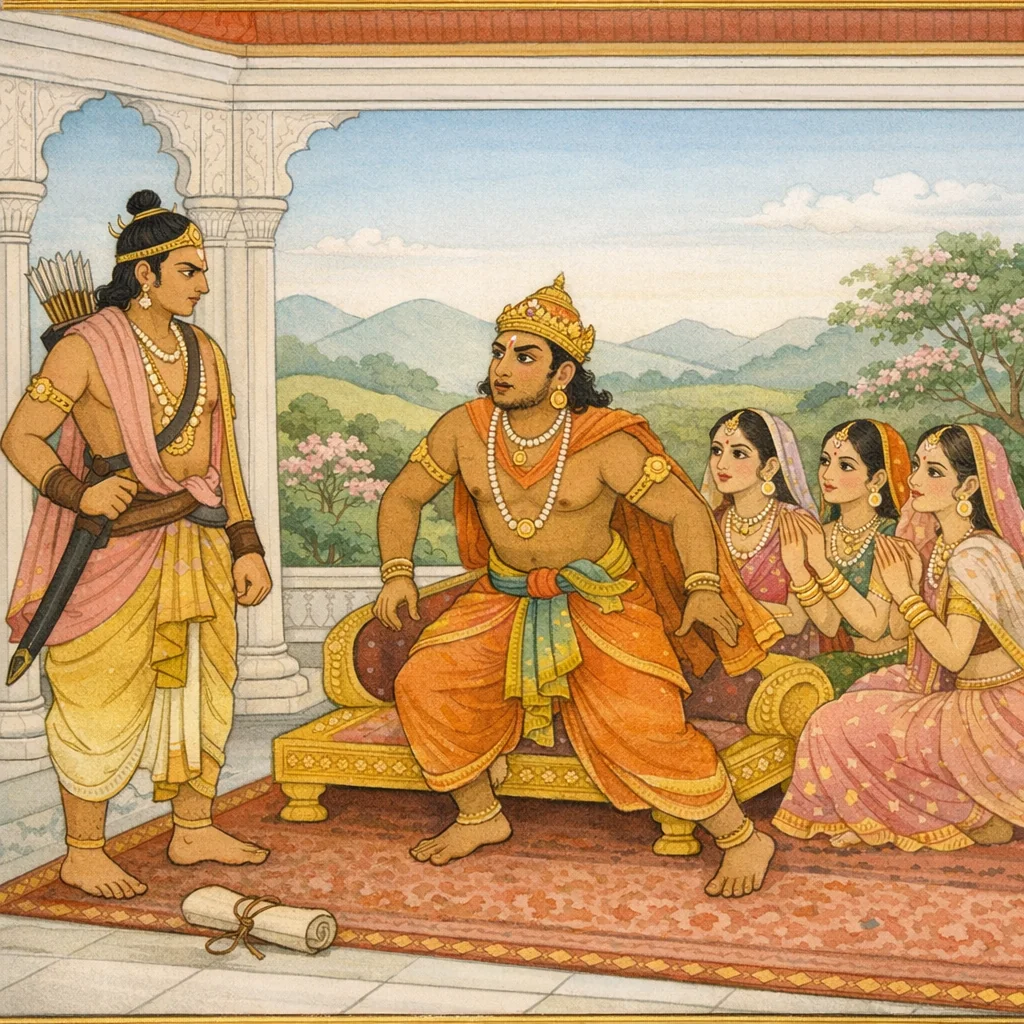
Sarga 34 depicts Lakṣmaṇa’s forceful entry into Sugrīva’s royal space and frames the episode as a rājadharma audit. Sugrīva, described as unsettled upon seeing the “unobstructable” and angry Lakṣmaṇa, rises from a golden throne; Rumā and other women stand, forming a courtly tableau likened to stars around the full moon. Lakṣmaṇa addresses Sugrīva while he stands amid women, using a sequence of normative statements: the ideal king is noble-born, compassionate, self-controlled, grateful, and truthful; the king who turns unrighteous toward benefactors and makes false promises is especially culpable. A graded teaching on the moral weight of untruth culminates in a broader indictment: one who benefits first from a friend and fails to reciprocate is kṛtaghna (ungrateful) and worthy of punishment. Lakṣmaṇa cites a widely revered verse attributed to a brāhmaṇa, asserting that expiation exists for grave transgressions (brahmin-killing, drunkenness, theft, vow-breaking) but not for ingratitude. The admonition becomes immediate political pressure: Sugrīva must honor the agreement and undertake earnest efforts to search for Sītā; otherwise Lakṣmaṇa threatens coercive consequences, invoking the precedent of Vāli’s death and the continuing availability of the same path. The sarga thus integrates court scene, ethical instruction, and enforcement of alliance obligations.
Shlokas
Verse 1
तमप्रतिहतं क्रुद्धं प्रविष्टं पुरुषर्षभम्।सुग्रीवो लक्ष्मणं दृष्ट्वा बभूव व्यथितेन्द्रियः।।।।
Seeing Lakṣmaṇa enter—angry, unstoppable, a bull among men—Sugrīva became inwardly shaken, his senses disturbed.
Verse 2
क्रुद्धं निश्श्वसमानं तं प्रदीप्तमिव तेजसा।भ्रातुर्व्यसनसन्तप्तं दृष्ट्वा दशरथात्मजम्।।।।उत्पपात हरिश्रेष्ठो हित्वा सौवर्णमासनम्।महान्महेन्द्रस्य यथा स्वलङ्कृत इव ध्वजः।।।।
Seeing the son of Daśaratha—Lakṣmaṇa—enraged, breathing hard, blazing with splendor as if aflame, and burning with sorrow over his brother’s calamity, Sugrīva, best of the vānaras, sprang up, abandoning his golden seat—like the great, ornamented banner of Mahendra (Indra) suddenly raised aloft.
Verse 3
क्रुद्धं निश्श्वसमानं तं प्रदीप्तमिव तेजसा।भ्रातुर्व्यसनसन्तप्तं दृष्ट्वा दशरथात्मजम्।।4.34.2।।उत्पपात हरिश्रेष्ठो हित्वा सौवर्णमासनम्।महान्महेन्द्रस्य यथा स्वलङ्कृत इव ध्वजः।।4.34.3।।
Seeing Lakṣmaṇa, Daśaratha’s son—wrathful, breathing hard, and blazing with splendor, scorched by grief over his brother’s distress—Sugrīva, foremost among the vānaras, sprang up from his golden seat, like Indra’s great, ornamented banner lifted high.
Verse 4
उत्पतन्तमनूत्पेतू रुमाप्रभृतयः स्त्रियः।सुग्रीवं गगने पूर्णचन्द्रं तारागणा इव।।।।
As Sugrīva sprang up, Rumā and the other women rose as well—like clusters of stars rising around the full moon in the sky.
Verse 5
संरक्तनयनः श्रीमान्विचचाल कृताञ्जलिः।बभूवावस्थितस्तत्र कल्पवृक्षो महानिव।।।।
Sugrīva—his eyes reddened (from intoxication)—trembled, then stood there with palms joined in salutation, like a great wish-fulfilling tree shaken in place.
Verse 6
रुमाद्वितीयं सुग्रीवं नारीमध्यगतं स्थितम्।अब्रवील्लक्ष्मणः क्रुद्धस्सतारं शशिनं यथा।।।।
Seeing Sugrīva standing amid women, with Rumā beside him—like the moon encircled by stars—Lakṣmaṇa, angered, spoke out.
Verse 7
सत्त्वाभिजनसम्पन्नस्सानुक्रोशो जितेन्द्रियः।कृतज्ञस्सत्यवादी च राजा लोके महीयते।।।।
A king who is endowed with noble character and lineage, compassionate, self-restrained, grateful, and truthful is honored and prospers in the world.
Verse 8
यस्तु राजा स्थितोऽधर्मे मित्राणामुपकारिणाम्।मिथ्या प्रतिज्ञां कुरुते को नृशंसतरस्ततः।।।।
But what king could be more cruel than one who stands in unrighteousness and makes false promises to friends who have helped him?
Verse 9
शतमश्वानृते हन्ति सहस्रं तु गवानृते।आत्मानं स्वजनं हन्ति पुरुषः पुरुषानृते।।।।
By lying about a horse, a man incurs the guilt of killing a hundred; by lying about a cow, of killing a thousand; but by lying about a person, he destroys himself and his own people.
Verse 10
पूर्वं कृतार्थो मित्राणां न तत्प्रतिकरोति यः।कृतघ्नस्सर्वभूतानां स वध्यः प्लवगेश्वर।।।।
“O lord of the monkeys! Whoever first fulfills his own purpose through friends, yet does not repay them in return—such a man is ungrateful toward all beings and deserves death.”
Verse 11
गीतोऽयं ब्रह्मणा श्लोक स्सर्वलोकनमस्कृतः।दृष्ट्वा कृतघ्नं क्रुद्धेन तन्निबोध प्लवङ्गम।।।।
“O monkey-lord, listen: this revered verse, honored by all the worlds, was sung by an enraged brāhmaṇa upon seeing an ungrateful man.”
Verse 12
ब्रह्मघ्ने च सुरापे च चोरे भग्नव्रते तथा।निष्कृतिर्विहिता सद्भि: कृतघ्ने नास्ति निष्कृतिः।।।।
“For the killer of a brāhmaṇa, for the drunkard, for the thief, and likewise for one who breaks sacred vows—good people prescribe expiation; but for the ungrateful, there is no expiation at all.”
Verse 13
अनार्यस्त्वं कृतघ्नश्च मिथ्यावादी च वानर।पूर्वं कृतार्थो रामस्य न तत्प्रतिकरोषि यत्।।।।
O Vānara! You have already gained your own end through Rāma, yet you do not return that help to him. You are ignoble, ungrateful, and a speaker of falsehood.
Verse 14
ननु नाम कृतार्थेन त्वया रामस्य वानर।सीताया मार्गणे यत्नः कर्तव्यः कृतमिच्छता।।।।
Indeed, O Vānara, since you have achieved your end with Rāma’s help, you—seeking to do what is right—must now exert yourself in the search for Sītā.
Verse 15
स त्वं ग्राम्येषु भोगेषु सक्तो मिथ्याप्रतिश्रवः।न त्वां रामो विजानीते सर्पं मण्डूकराविणम्।।।।
But you, absorbed in coarse pleasures and bound by false promises—Rāma did not recognize you for what you are: a serpent that only claims attention by croaking like a frog.
Verse 16
महाभागेन रामेण पापः करुणवेदिना।हरीणां प्रापितो राज्यं त्वं दुरात्मा महात्मना।।।।
By the illustrious and compassionate Rāma—great-souled—kingship over the vānaras was secured for you, though you are sinful and wicked-minded.
Verse 17
कृतं चेन्नाभिजानीषे रामस्याक्लिष्टकर्मणः।सद्यस्त्वं निशितैर्भावार्हतो द्रक्ष्यसि वालिनम्।।।।
If you refuse to acknowledge what Rāma—whose deeds meet no obstacle—has done for you, then at once, slain by sharp arrows, you will behold Vāli (in the next world).
Verse 18
न च सङ्कुचितः पन्था येन वाली हतो गतः।समये तिष्ठ सुग्रीव मा वालिपथमन्वगाः।।।।
The path by which Vāli went—slain—is not barred or narrow. Stand by the agreement, O Sugrīva; do not follow Vāli’s path.
Verse 19
न नूनमिक्ष्वाकुवरस्य कार्मुकच्युतान् शरान्पश्यसि वज्र सन्निभान्।तत स्सुखं नाम निषेवसे सुखी।न रामकार्यं मनसाऽप्यवेक्षसे।।।।
Surely you have not truly seen the thunderbolt-like arrows released from the bow of that best of the Ikṣvāku line. Therefore you sit at ease, indulging in comfort without fear, and you do not even turn your mind toward Rāma’s work.
Frequently Asked Questions
The pivotal dilemma is alliance accountability: Sugrīva has gained his kingdom through Rāma’s aid yet delays reciprocation by initiating Sītā’s search. Lakṣmaṇa treats this as a breach of promise and a failure of rājadharma, demanding immediate fulfillment of the agreed duty.
The upadeśa elevates gratitude and truth as non-negotiable civic virtues: a ruler is honored for self-restraint, compassion, and kṛtajñatā, while ingratitude is portrayed as uniquely corrosive—so severe that traditional expiation is declared unavailable for the kṛtaghna.
The sarga foregrounds Kiṣkindhā’s courtly environment (golden throne, royal household with Rumā and women attendants) and uses cultural-ethical touchstones—brāhmaṇa-uttered revered śloka, lists of expiable sins, and iconic similes (Indra’s banner, kalpavṛkṣa, moon-and-stars)—to frame political conduct within a recognizable dharmic culture.