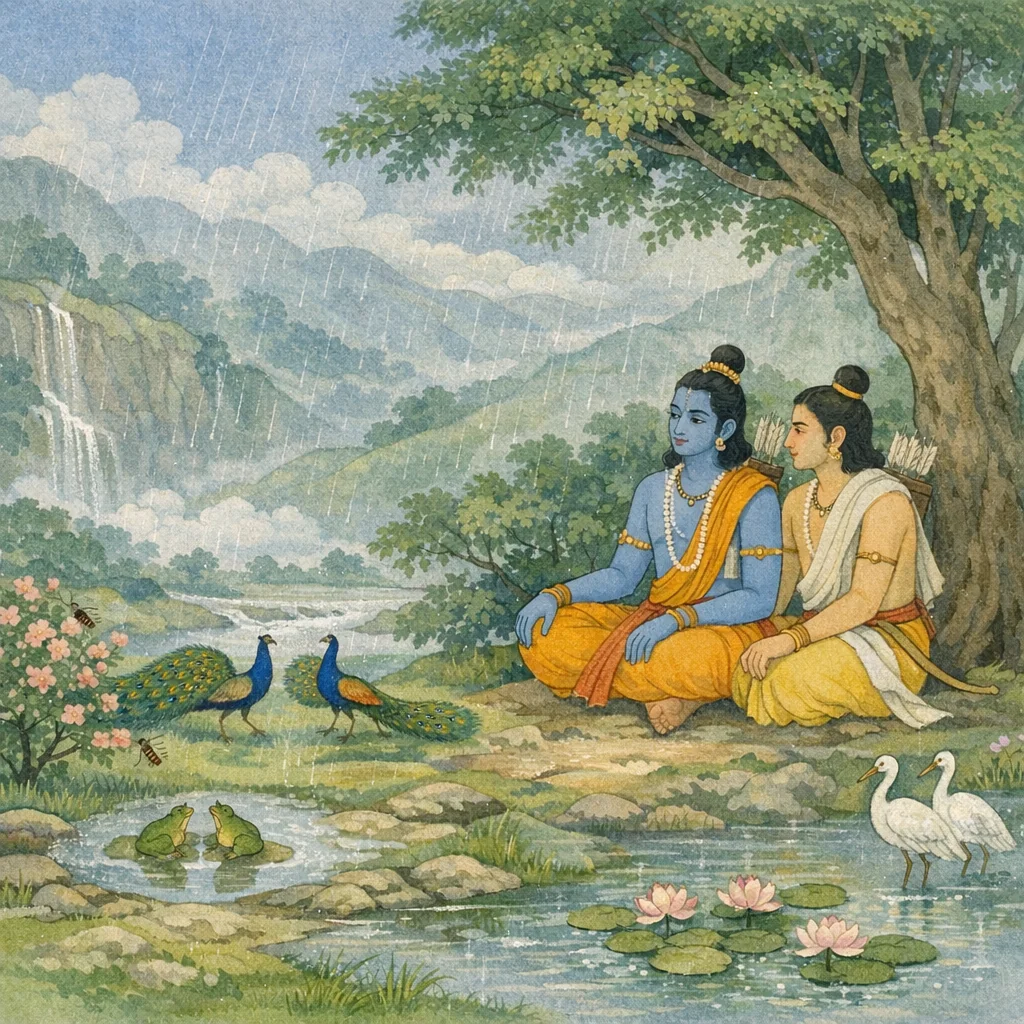
Sarga 28
वर्षावर्णनम् — The Monsoon Description and Rama’s Counsel on Timing
किष्किन्धाकाण्ड
After Vālī’s death and Sugrīva’s consecration, Rāma resides on Mount Mālyavān and addresses Lakṣmaṇa while the rainy season begins. The sarga develops an extended ṛtu-varṇana: clouds as mountain-peaks, lightning as golden whips, thunder as Vedic recitation, waterfalls as pearl-strings, and forests animated by peacocks, frogs, bees, cranes, and swollen rivers. Amid this sensory cartography, Rāma’s inner state surfaces—separation from Sītā, the difficulty of travel in rains, and the looming magnitude of Rāvaṇa. Rāma explains why he does not press Sugrīva immediately: the ally has suffered, has only recently regained domestic stability, and the mission must be pursued with kāla-jñāna (timely judgment). The discourse culminates in a principle of reciprocal obligation: help should be repaid, and ingratitude wounds the virtuous. Lakṣmaṇa respectfully concurs, advising endurance until autumn, when Sugrīva can effectively act.
Shlokas
Verse 1
स तदा वालिनं हत्वा सुग्रीवमभिषिच्य च।वसन्माल्यवतः पृष्ठे रामो लक्ष्मणमब्रवीत्।।
Then, after slaying Vālin and installing Sugrīva as king, Rāma took up residence on the slopes of Mālyavat and spoke to Lakṣmaṇa.
Verse 2
अयं स कालस्सम्प्राप्तस्समयोऽद्य जलागमः।सम्पश्य त्वं नभो मेघैस्संवृतं गिरिसन्निभैः।।
This very time has now arrived—the season of rains. Look: the sky is covered with clouds that resemble mountains.
Verse 3
नवमासधृतं गर्भं भास्करस्य गभस्तिभिः।पीत्वा रसं समुद्राणां द्यौः प्रसूते रसायनम्।।
Having drunk up the oceans’ essence through the Sun’s rays and held it as a womb for nine months, the sky now gives birth to water—the source from which all sap and nourishment arise.
Verse 4
शक्यमम्बरमारुह्य मेघसोपानपङ्क्तिभिः।कुटजार्जुनमालाभिरलङ्कर्तुं दिवाकरम्।।
One could climb into the sky by stair-rows of clouds, and garland the Sun himself with wreaths of kuṭaja and arjuna blossoms.
Verse 5
सन्ध्यारागोत्थितैस्ताम्रैरन्तेष्वधिक पाण्डरैः।स्निग्धैरभ्रपटच्छेदैर्बद्धव्रणमिवाम्बरम्।।
The sky appears like a wound that has been bandaged—wrapped in glossy strips of cloud-cloth, pale-white yet edged with copper-red, tinted by the twilight’s glow.
Verse 6
मन्दमारुत निश्वासं सन्ध्याचन्दनरञ्जितम्।आपाण्डुजलदं भाति कामातुरमिवाम्बरम्।।
The sky—breathing as it were with gentle winds, tinted by twilight like sandal paste, and bearing pale-grey clouds—shines like a love-stricken person.
Verse 7
एषा घर्मपरिक्लिष्टा नववारिपरिप्लुता।सीतेव शोकसन्तप्ता मही बाष्पं विमुञ्चति।।
This earth—first scorched by heat and now flooded with fresh rain—seems, like Sita tormented by grief, to be shedding tears.
Verse 8
मेघोदरविनिर्मुक्ताः कह्लारसुखशीतलाः।शक्यमञ्जलिभिः पातुं वाताः केतकिगन्धिनः।।
Winds released from the womb of the clouds—cool and soothing like white lotuses, fragrant with ketakī—feel as if they could be drunk in cupped palms.
Verse 9
एष फुल्लार्जुनश्शैलः केतकैरधिवासितः।सुग्रीव इव शान्तारिर्धाराभिरभिषिच्यते।।
This mountain, fragrant with ketakī and blooming arjuna blossoms, is bathed by streaming rains—as if it were Sugriva, his enmity stilled, being consecrated by flowing waters.
Verse 10
मेघकृष्णाजिनधरा: धारायज्ञोपवीतिनः।मारुतापूरितगुहाः प्राधीता इव पर्वताः।।
The mountains, clothed in cloud-dark hides, with rain-streams hanging like sacred threads, and with caves filled by the wind, appear like Vedic reciters engaged in study.
Verse 11
कशाभिरिव हैमीभिर्विद्युद्भिरिवताडितम्।अन्तस्त्सतनिर्घोषं सवेदनमिवाम्बरम्।।
The sky, struck as though by golden whips—by flashes of lightning—and rumbling with thunder within, seems as if it is crying out in pain.
Verse 12
नीलमेघाश्रिता विद्युत्स्फुरन्ती प्रतिभाति मा।स्फुरन्ती रावणस्याङ्के वैदेहीव तपस्विनी।।
To me, the lightning trembling within dark clouds appears like the austere Vaidehī, struggling helplessly in the lap of Rāvaṇa.
Verse 13
इमास्ता मन्मथवतां हिताः प्रतिहता दिशः।अनुलिप्ता इव घनैर्नष्टग्रहनिशाकराः।।
These directions, blocked as though smeared over by dense clouds—so that planets and even the moon vanish—are said to be favorable to those in love.
Verse 14
चिद्बाष्पाभिसंरुद्धान् वर्षागमसमुत्सुकान्।कुटजान्पश्य सौमित्रे पुष्पितान्गिरिसानुषु।।मम शोकाभिभूतस्य कामसन्दीपनान् स्थितान्।
O Saumitri, look at these kuṭaja trees in bloom upon the mountain slopes—parched by hot vapors yet eager for the coming of the rains; though I am overwhelmed with sorrow, they stand here kindling desire within me.
Verse 15
रजः प्रशान्तं सहिमोऽद्य वायुर्निदाघदोषप्रसराः प्रशान्ताः।स्थिता हि यात्रा वसुधाधिपानांप्रवासिनो यान्ति नरास्स्वदेशान्।।
O Saumitri, look at these kuṭaja trees in bloom upon the mountain slopes—parched by hot vapors yet eager for the coming of the rains; though I am overwhelmed with sorrow, they stand here kindling desire within me.
Verse 16
सम्प्रस्थिता मानसवासलुब्धाःप्रियान्विताः सम्प्रति चक्रवाकाः।अभीक्ष्णवर्षोदकविक्षतेषुयानानि मार्गेषु न सम्पतन्ति।।
The swans, eager to dwell at Lake Mānasā, have set out, and the cakravāka birds are now reunited with their mates; yet carts do not move along the roads, torn up by incessant rain-water.
Verse 17
क्वचित्प्रकाशं क्वचिदप्रकाशंनभः प्रकीर्णाम्बुधरं विभाति।क्वचित्क्वचित्पर्वतसन्निरुद्धंरूपं यथा शान्तमहार्णवस्य।।
Here the sky shines bright, and there it is dim, as clouds lie scattered across it; in places it looks as though hemmed in by mountains—like the calm ocean’s surface broken by rising landforms.
Verse 18
व्यामिश्रितं सार्जकदम्बपुष्पैर्नवं जलं पर्वतधातुताम्रम्।मयूरकेकाभिरनुप्रयातंशैलापगाश्शीघ्रतरं वहन्ति।।
Mountain-streams swiftly carry fresh rain-water—mingled with sārja and kadamba blossoms and reddened by the mountain’s mineral deposits—while the calls of peacocks seem to accompany their flow.
Verse 19
रसाकुलं षट्पदसन्निकाशंप्रभुज्यते जम्बुफलं प्रकामम्।अनेकवर्णं पवनावधूतंभूमौ पतत्याम्रफलं विपक्वम्।।
Juicy jambu fruits, dark like bees, are eaten to one’s fill; and fully ripened mangoes, taking on many hues, are shaken down by the wind and fall upon the ground.
Verse 20
विद्युत्पताकास्सबलाकमालाःशैलेन्द्रकूटाकृतिसन्निकाशाः।गर्जन्ति मेघाः समुदीर्णनादाःमत्ता गजेन्द्रा इव संयुगस्थाः।।
Clouds, shaped like lofty mountain-peaks, bearing lightning as their banners and rows of herons as their garlands, roar with swelling thunder—like rutting lordly elephants drawn up for battle.
Verse 21
वर्षोदकाप्यायितशाद्वलानिप्रवृत्तनृत्तोत्सवबर्हिणानि।वनानि निर्वृष्टवलाहकानिपश्यापराह्णेष्वधिकं विभान्ति।।
See how the forests shine all the more in the afternoon—when the clouds have poured out their rain—grasslands plumped by rain-water and peacocks begun in their festival of dance.
Verse 22
समुद्वहन्त स्सलिलातिभारंबलाकिनो वारिधरा नदन्तः।महत्सु शृङ्गेषु महीधराणांविश्रम्य विश्रम्य पुनः प्रयान्ति।।
Bearing an excessive burden of water and thundering, the cloud-masses—attended by cranes—rest again and again upon the great peaks of the mountains, and then move on once more.
Verse 23
मेघाभिकामा परिसम्पतन्तीसम्मोदिता भाति बलाकपङ्क्तिः।वातावधूता वरपौण्डरीकीलम्बेव माला रचिताम्बरस्य।।
Rejoicing and flying along in longing for the clouds, the line of cranes gleams—wind-tossed—like a long garland of fine white lotuses strung across the sky.
Verse 24
बालेन्द्रगोपान्तरचित्रितेनविभाति भूमिर्नवशाद्वलेन।गात्रानुपृक्तेन शुकप्रभेणनारीव लाक्षोक्षितकम्बलेन।।
The earth gleams with fresh young grass, speckled with little indragopa insects; it looks like a woman clothed in a parrot-green wrap, sprinkled with red lac.
Verse 25
निद्रा शनैः केशवमभ्युपैतिद्रुतं नदी सागरमभ्युपैति।हृष्टा बलाका घनमभ्युपैतिकान्ता सकामा प्रियमभ्युपैति।।
As sleep gently steals upon Keśava, so the river swiftly hastens to the sea; the delighted balākā-bird approaches the cloud, and a longing beloved approaches her dear one.
Verse 26
जाता वनान्ताश्शिखिसम्प्रनृत्ताजाताः कदम्बाः सकदम्बशाखाः।जाता वृषा गोषु समानकामाजाता मही सस्यवनाभिरामा।।
In the forest tracts, peacocks have begun to dance; kadamba trees and their branches have burst into bloom; bulls among the cows grow alike in desire; and the earth becomes lovely with crops and green woods.
Verse 27
वहन्ति वर्षन्ति नदन्ति भान्तिध्यायन्ति नृत्यन्ति समाश्वसन्ति।नद्यो घना मत्तगजा वनान्ताःप्रियाविहीनाश्शिखिनः प्लवङ्गमाः।।
Rivers flow, clouds pour, rutting elephants trumpet, and the forest tracts gleam; those parted from their beloved brood, while the monkeys fall quiet and the peacocks dance.
Verse 28
प्रहर्षिताः केतकपुष्पगन्धमाघ्राय हृष्टा वननिर्झरेषु।प्रपातशब्दाकुलिता गजेन्द्रास्सार्धं मयूरै स्समदा नदन्ति।।
Rejoicing in the forest waterfalls, the lordly elephants, delighted by the scent of ketakī blossoms and stirred by the roar of cascades, trumpet in intoxication together with the peacocks.
Verse 29
धारानिपातैरभिहन्यमानाःकदम्बशाखासु विलम्बमानाः।क्षणार्जितं पुष्परसावगाढंशनैर्मदं षट्चरणास्त्यजन्ति।।
Beaten by falling sheets of rain and clinging to kadamba branches, the bees—having quickly drunk deep of floral nectar—slowly let their intoxication ebb away.
Verse 30
अङ्गारचूर्णोत्करसन्निकाशैःफलैस्सुपर्याप्तरसैस्समृद्धैः।जम्बूद्रुमाणां प्रविभान्ति शाखाःनिलीयमाना इव षट्पदौघैः।।
The branches of jambū trees shine, laden with rich, juicy fruits dark as heaps of powdered charcoal, as though covered over by swarms of bees settling upon them.
Verse 31
तटित्पताकाभिरलङ्कृतानामुदीर्णगम्भीरमहारवाणाम्।विभान्ति रूपाणि बलाहकानांरणोद्यतानामिव वानरणानाम्।।
The forms of the rain-clouds—adorned with lightning as banners and sounding deep, mighty roars—shine like vānara warriors standing ready for battle.
Verse 32
मार्गानुगश्शैलवनानुसारीसम्प्रस्थितो मेघरवं निशम्य।युद्धाभिकामः प्रतिनादशङ्कीमत्तो गजेन्द्रः प्रतिसन्निवृत्तः।।
An intoxicated lordly elephant, moving along the path by the mountain-forest, hears the thunder of clouds; eager for combat and suspecting a rival’s challenge-call, he turns back again.
Verse 33
क्वचित्प्रगीता इव षट्पदौघैःक्वचित्प्रनृत्ता इव नीलकण्ठैः।क्वचित्प्रमत्ता इव वारणेन्द्रैर्विभान्त्यनेकाश्रयिणो वनान्ताः।।
The forest tracts, sheltering many kinds of life, appear in manifold ways—here as if sung by swarms of bees, there as if danced by peacocks, and elsewhere as if made riotous by lordly elephants.
Verse 34
कदम्बसर्जार्जुनकन्दलाढ्यावनान्तभूमिर्नववारिपूर्णा।मयूरमत्ताभिरुतप्रनृत्तैरापानभूमिप्रतिमा विभाति।।
The forest-tract—rich with tender shoots of kadamba, sarja, and arjuna, and brimming with fresh rainwater—shines like a tavern, as intoxicated peahens cry out and dance about.
Verse 35
मुक्तासकाशं सलिलं पतद्वैसुनिर्मलं पत्रपुटेषु लग्नम्।हृष्टा विवर्णच्छदना विहङ्गास्सुरेन्द्रदत्तं तृषिताः पिबन्ति।।
Water, falling and crystal-pure, gleams like pearls as it gathers in leaf-cups; thirsty birds—delighted, their wing-colours paling with wetness—drink it as a gift bestowed by Indra.
Verse 36
षट्पादतन्त्रीमधुराभिधानंप्लवङ्गमोदीरितकण्ठतालम्।आविष्कृतं मेघमृदङ्गनादैर्वनेषु सङ्गीतमिव प्रवृत्तम्।।
In the forests it is as though a concert has begun: bees hum sweetly like stringed instruments, frogs keep time with throat-born rhythms, and the clouds resound like drums.
Verse 37
क्वचित्प्रनृत्तै: क्वचिदुन्नदद्भिःक्वचिच्च वृक्षाग्रनिषण्णकायैः।व्यालम्बबर्हाभरणैर्मयूरैर्वनेषु सङ्गीतमिव प्रवृत्तम्।।
Somewhere peacocks dance, elsewhere they cry out; in other places they sit upon treetops, adorned with trailing plumes—so that the forest seems to have set a musical performance in motion.
Verse 38
स्वनैर्घनानां प्लवगाः प्रबुद्धाःविहाय निद्रां चिरसन्निरुद्धाम्।अनेकरूपाकृतिवर्णनादाःनवाम्बुधाराभिहता नदन्ति।।
Awakened by the thunder of clouds, frogs abandon the long sleep that had held them; struck by fresh rain-streams, they croak in many kinds—of form, colour, and sound.
Verse 39
नद्यस्समुद्वाहितचक्रवाकास्तटानि शीर्णान्यपवाहयित्वा।दृप्ता नवप्राभृतपूर्णभोगाःद्रुतं स्वभर्तारमुपोपयान्ति।।
Rivers, bearing along cakravāka birds, sweep away their crumbled banks and—swollen and proud, rich with new offerings—hurry swiftly to meet their lord, the sea.
Verse 40
नीलेषु नीला: प्रविभान्ति सक्ताःमेघेषु मेघा नववारिपूर्णाः।दवाग्निदग्धेषु दवाग्निदग्धाश्शैलेषु शैला इव बद्धमूलाः।।
Dark clouds, laden with fresh rainwater, cling to dark mountain-sides and gleam—like rock-masses scorched by forest-fire, yet still rooted firm upon the hills.
Verse 41
प्रहृष्टसन्नादितबर्हिणानिसशक्रगोपाकुलशाद्वलानि।चरन्ति नीपार्जुनवासितानिगजास्सुरम्याणि वनान्तराणि।।
Elephants roam delightful forest-glades—where peacocks cry out in joy, where young grass is crowded with indragopa insects, and where kadamba (nīpa) and arjuna blossoms perfume the air.
Verse 42
नवाम्बुधाराहतकेसराणिद्रुतं परित्यज्य सरोरुहाणि।कदम्बपुष्पाणि सकेसराणिनवानि हृष्टा भ्रमराः पतन्तिः।।
Delighted bees quickly abandon lotuses whose filaments have been battered by fresh rain, and alight upon new kadamba blossoms still rich with intact filaments.
Verse 43
मत्ता गजेन्द्रा मुदिता गवेन्द्रावनेषु विश्रान्ततरा मृगेन्द्रा।रम्या नगेन्द्रा निभृता नरेन्द्राःप्रक्रीडितो वारिधरैस्सुरेन्द्रः।।
In the forests, lordly elephants are in rut, and mighty bulls are glad; the kings of beasts rest at ease. The great mountains appear lovely, and kings remain quiet at repose—while Indra, lord of the gods, seems to sport amid the rain-bearing clouds.
Verse 44
मेघास्समुद्धूतसमुद्रनादाःमहाजलौघैर्गगनावलम्बाः।नदीस्तटाकानि सरांसि वापीर्महीं च कृत्स्नामपवाहयन्ति।।
Clouds, hanging in the sky with mighty torrents, drown out even the ocean’s roar; they make rivers, tanks, lakes, and wells overflow, flooding the whole earth.
Verse 45
वर्षप्रवेगा विपुलाः पतन्तिप्रवान्ति वातास्समुदीर्णघोषाः।प्रणष्टकूलाः प्रवहन्ति शीघ्रंनद्योजलैर्विप्रतिपन्नमार्गाः।।
Heavy rain-torrents fall with force; winds blow with a rising roar. Rivers, their banks broken, rush swiftly—water driving them into altered courses.
Verse 46
नरैर्नरेन्द्रा इव पर्वतेन्द्रास्सुरेन्द्रदत्तै: पवनोपनीतैः।घनाम्बुकुम्भैरभिषिच्यमानारूपं श्रियं स्वामिव दर्शयन्ति।।
The great mountains, as though they were kings, are anointed with the cloud-water ‘pitchers’—sent by Indra and carried by the winds; thus they display their own form and splendor, like sovereigns consecrated by their people.
Verse 47
घनोपगूढं गगनं सतारंन भास्करो दर्शनमभ्युपैति।नवैर्जलौघैर्धरणी विसृप्तातमो विलिप्ता न दिशः प्रकाशाः।।
With the sky wrapped in clouds, neither sun nor stars come into view. The earth seems to glide under fresh sheets of water, and the directions are not bright—smeared over with darkness.
Verse 48
महान्ति कूटानि महीधराणांधाराभिधौतान्यधिकं विभान्ति।महाप्रमाणैर्विपुलैः प्रपातैर्मुक्ताकलापैरिव लम्बमानैः।।
The lofty peaks of the mountains, washed clean by streaming rain, shine all the more—hung about with broad, long waterfalls like suspended strings of pearls.
Verse 49
शैलोपलप्रस्खलमानवेगाश्शैलोत्तमानां विपुलाः प्रपाताः।गुहासु सन्नादितबर्हिणासुहारा विकीर्यन्त इवावभान्ति।।
Great waterfalls on the finest mountains, their force stumbling over rocky slabs, stream through caves loud with peacocks’ calls—appearing like pearl-necklaces snapped and scattered.
Verse 50
शीघ्रप्रवेगा विपुलाः प्रपाताःनिर्धौतशृङ्गोपतला गिरीणाम्।मुक्ताकलापप्रतिमाः पतन्तोमहागुहोत्सङ्गतलैर्ध्रियन्ते।।
Vast waterfalls, swift in their rush, wash clean the slopes around mountain peaks; falling like strings of pearls, they gather and are held in the lap-like floors of great caves.
Verse 51
सुरतामर्दविच्छिन्नास्स्वर्गस्त्रीहारमौक्तिकाः।पतन्ति चातुला दिक्षु तोयधारास्समन्तत:।।
Everywhere, in all directions, incomparable streams of water fall—like pearls from the necklaces of heavenly women, snapped by the rubbing of amorous play.
Verse 52
निलीयमानैर्विहगैर्निमीलद्भिश्च पङ्कजैः।विकसन्त्या च मालत्या गतोऽस्तं ज्ञायते रविः।।
The sun’s setting is inferred from the birds returning to their resting places, from lotuses closing, and from the mālatī jasmine blooming.
Verse 53
वृत्ता यात्रा नरेन्द्राणां सेना प्रतिनिवर्तते।वैराणि चैव मार्गाश्च सलिलेन समीकृताः।।
Kings’ campaigns come to a halt; armies turn back. Waters flood the routes, and even hostilities are, as it were, brought to a pause.
Verse 54
मासि प्रोष्ठपदे ब्रह्म ब्राह्मणानां विवक्षताम्।अयमध्यायसमयस्सामगानामुपस्थितः।।
In the month of Proṣṭhapada, the season has arrived for brahmins who wish to recite the Veda—and for the Sāma-chanters, the proper time of study is now present.
Verse 55
निवृत्तकर्मायतनो नूनं सञ्चितसञ्चयः।आषाढीमभ्युपगतो भरतः कोसलाधिपः।।
Surely Bharata, lord of Kosala, has completed his necessary tasks and gathered what is needed, having reached the month of Āṣāḍha.
Verse 56
नूनमापूर्यमाणायास्सर्वव्या वर्धते रयः।मां समीक्ष्य समायान्तमयोध्याया इव स्वनः।।
Surely the Sarayū, filling with rainwater, runs swifter—like Ayodhyā’s rising cheers when it sees me returning.
Verse 57
इमास्फीतगुणा वर्षास्सुग्रीवस्सुखमश्नुते।विजितारिः सदारश्च राज्ये महति च स्थितः।।
During these merit-rich rains, Sugrīva enjoys ease—having conquered his foe, established in a great kingdom, and living together with his wife.
Verse 58
अहं तु हृतदारश्च राज्याच्य महतश्च्युतः।नदीकूलमिव क्लिन्नमवसीदामि लक्ष्मण।।।।
But I—robbed of my wife and fallen from a mighty kingdom—sink down, like a riverbank made sodden and collapsing.
Verse 59
शोकश्च मम विस्तीर्णो वर्षाश्च भृशदुर्गमाः।रावणश्च महान् शत्रुरपारं प्रतिभाति मे।।
My sorrow spreads wide; the rains are exceedingly hard to traverse; and Rāvaṇa, that great enemy—everything seems to me like an impassable expanse.
Verse 60
अयात्रां चैव दृष्ट्वेमां मार्गांश्च भृशदुर्गमान्।प्रणते चैव सुग्रीवे न मया किञ्चिदीरितम्4.28.60।।
Seeing that travel is suspended and the roads are extremely difficult—and seeing Sugrīva still devoted—I said nothing at all.
Verse 61
अपि चातिपरिक्लिष्टं चिराद्दारैस्समागतम्।आत्मकार्यगरीयस्त्वाद्वक्तुं नेच्छामि वानरम्।।
Moreover, since that monkey-king has endured great hardship and, after a long time, has been reunited with his wives—and since our own mission is weighty—I do not wish to speak to him just now.
Verse 62
स्वयमेव हि विश्रम्य ज्ञात्वा कालमुपागतम्।उपकारं च सुग्रीवो वेत्स्यते नात्र संशयः4.28.62।।
For after resting on his own, and realizing that the proper time has arrived, Sugriva will himself understand the help he owes—of this there is no doubt.
Verse 63
तस्मात्कालप्रतीक्षोऽहं स्थितोऽस्मि शुभलक्षण।सुग्रीवस्य नदीनां च प्रसादममनुपालयन्।।
Therefore, O auspicious Lakshmana, I shall remain waiting for the right moment, seeking the favor of Sugriva—and of the rivers as well.
Verse 64
उपकारेण वीरस्तु प्रतीकारेण युज्यते।अकृतज्ञोऽप्रतिकृतो हन्ति सत्त्ववतां मनः।।
A true hero responds to a kindness with a fitting return. But the ungrateful—one who does not repay—wounds the hearts of the virtuous.
Verse 65
अथैवमुक्तः प्रणिधाय लक्ष्मणःकृताञ्जलिस्तत्प्रतिपूज्य भाषितम्।उवाच रामं स्वभिरामदर्शनंप्रदर्शयन्दर्शनमात्मनश्शुभम्।।
Thus addressed, Lakshmana reflected; then, with palms joined, honoring Rama’s words, he spoke to Rama—pleasing to behold—expressing his own auspicious and respectful view.
Verse 66
यथोक्तमेतत्तव सर्वमीप्सितंनरेन्द्र कर्ता नचिराद्धरीश्वरः।शरत्प्रतीक्षः क्षमतामिमं भवान्जलप्रपातं रिपुनिग्रहे धृतः।।
Just as you have said, O king, the lord of the monkeys will soon accomplish all that you desire. Awaiting the autumn, endure this season of torrents, and remain steadfast in your resolve to subdue the enemy.
Frequently Asked Questions
Rāma faces the governance dilemma of whether to immediately compel Sugrīva to act on the alliance promise or to wait for a suitable season and for Sugrīva’s recovery. He chooses restraint, prioritizing kāla (timing) and the ally’s circumstances while keeping the larger mission intact.
The sarga teaches that dharma operates through reciprocity and discernment: assistance should be repaid (upakāra → pratīkāra), and ingratitude harms the moral order. It also frames endurance as strategic virtue—bearing the monsoon’s obstacles while remaining steadfast toward the higher objective.
Geographically, Mount Mālyavān anchors the scene, with forests, waterfalls, caves, rivers, and the sea forming a monsoon landscape-map. Culturally, the text references seasonal practice and learning cycles—Bhadrapada as a study/recitation time for Veda and Sāmagāna, and the Cāturmāsya motif of Viṣṇu’s sleep—integrating ecology with ritual calendar.