Sarga 27
प्रस्रवणगिरिवासवर्णनम् (Residence on Mount Prasravana; Counsel during the Rains)
किष्किन्धाकाण्ड
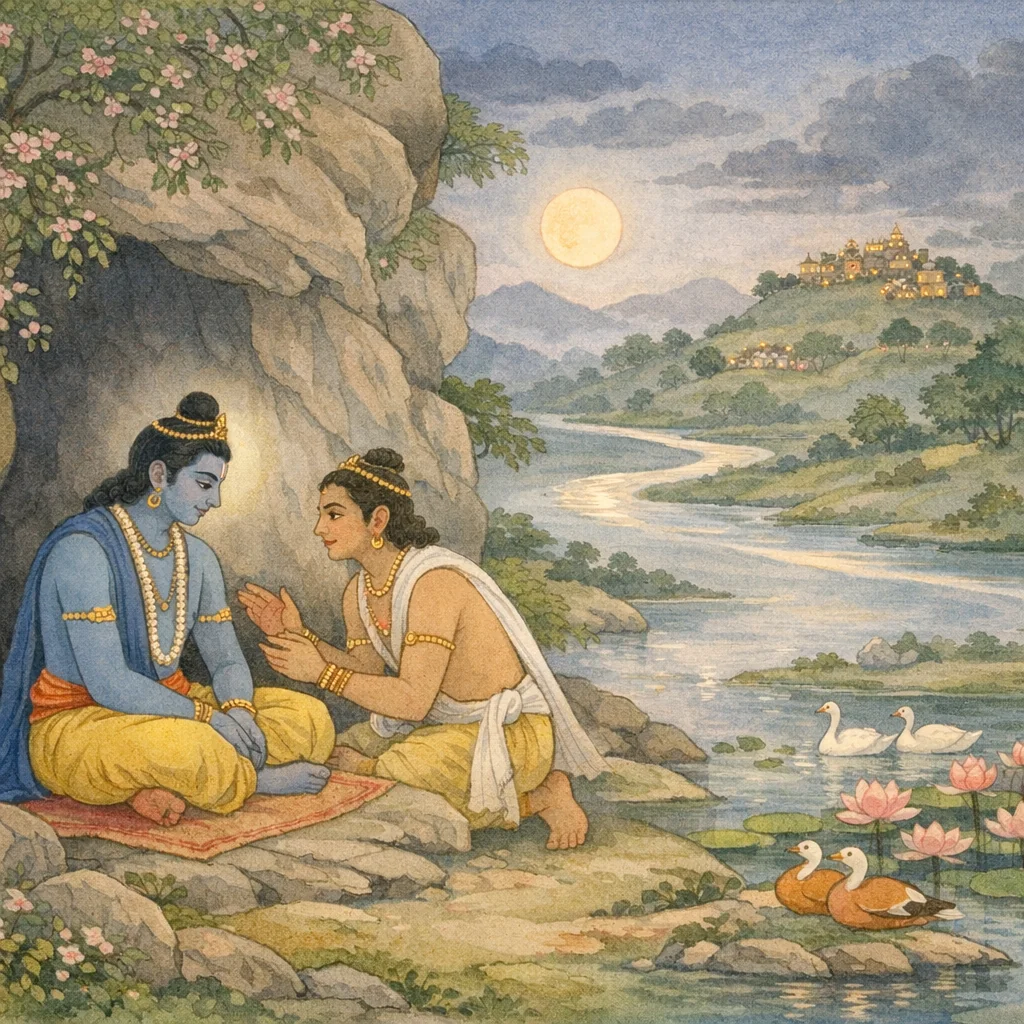
After Sugrīva’s consecration and return to the cave-city of Kiṣkindhā, Rāma and Lakṣmaṇa proceed to Mount Prasravaṇa and select a spacious, well-ventilated cave for residence during the rainy season. The sarga foregrounds topographical and ecological mapping: multicolored mineral-strewn peaks, caves and waterfalls, lotus-filled ponds, directional features around the cave (northeast descent, western elevation, wind-sheltered site), and a pure east-flowing river likened to the Jahnavī on Trikūṭa. The riverbanks are catalogued with specific trees and flowering plants, and the soundscape includes birds, peacocks, swans, sārasas, and cakravākas moving in pairs. From a distance, music and drums from Kiṣkindhā are heard, implying Sugrīva’s restored prosperity. Yet the narrative pivots to interiority: despite comfort, Rāma’s joy is minimal as the rising moon intensifies remembrance of Sītā; sleep eludes him. Lakṣmaṇa offers structured consolation—reject despair, cultivate enterprise, wait for autumn after the rains, and then destroy the enemy with firm resolve. Rāma accepts the counsel, commits to seasonal patience, and articulates the ethics of reciprocating assistance (gratitude as a heroic duty).
Shlokas
Verse 1
अभिषिक्ते तु सुग्रीवे प्रविष्टे वानरे गुहाम्।आजगाम सह भ्रात्रा रामः प्रस्रवणं गिरिम्4.27.1।।
When Sugrīva had been consecrated and had entered the cave-city, Rāma, accompanied by his brother, came to Mount Prasravaṇa.
Verse 2
शार्दूलमृगसङ्घुष्टं सिंहैर्भीमरवैर्वृतम्।नानागुल्मलतागूढं बहुपादपसङ्कुलम्4.27.2।।ऋक्षवानरगोपुच्छैर्मार्जारैश्च निषेवितम्।मेघराशिनिभं शैलं नित्यं शुचिजलाशयम्।।4.27.3।।
“This mountain resounds with the cries of tigers and deer, and it is ringed about by lions with dreadful roars. It lies hidden under many kinds of shrubs and creepers and is crowded with numerous trees. It is frequented by bears, monkeys, langūrs, and wildcats; it looks like a mass of piled-up clouds, and it always holds pools of pure water.”
Verse 3
शार्दूलमृगसङ्घुष्टं सिंहैर्भीमरवैर्वृतम्।नानागुल्मलतागूढं बहुपादपसङ्कुलम्4.27.2।।ऋक्षवानरगोपुच्छैर्मार्जारैश्च निषेवितम्।मेघराशिनिभं शैलं नित्यं शुचिजलाशयम्।।4.27.3।।
“This mountain resounds with the cries of tigers and deer, and it is ringed about by lions with dreadful roars. It lies hidden under many kinds of shrubs and creepers and is crowded with numerous trees. It is frequented by bears, monkeys, langūrs, and wildcats; it looks like a mass of piled-up clouds, and it always holds pools of pure water.”
Verse 4
तस्य शैलस्य शिखरे महतीमायतां गुहाम्।प्रत्यगृह्णत वासार्थं रामस्सौमित्रिणा सह4.27.4।।
On the summit of that mountain, Rāma—together with Saumitri (Lakṣmaṇa)—chose for their dwelling a great, spacious cave.
Verse 5
कृत्वा च समयं रामस्सुग्रीवेण सहानघः।कालयुक्तं महद्वाक्यमुवाच रघुनन्दनः4.27.5।।विनीतं भ्रातरं भ्राता लक्ष्मणं लक्ष्मिवर्धनम्।
Having made an agreement with Sugrīva, sinless Rāma—the delight of the Raghu line—spoke weighty words, timely and apt, to his obedient brother Lakṣmaṇa, the enhancer of his glory.
Verse 6
इयं गिरिगुहा रम्या विशाला युक्तमारुता।अस्यां वत्स्याम सौमित्रे वर्षरात्रमरिन्दम4.27.6।।
“O Saumitri, subduer of foes—this mountain cave is lovely, spacious, and well-aired. Here we shall dwell through the nights of the rainy season.”
Verse 7
गिरिशृङ्गमिदं रम्यमुन्नतं पार्थिवात्मज4.27.7।।श्वेताभिः कृष्णताम्राभिश्शिलाभिरुपशोभितम्।नानाधातुसमाकीर्णं दरीनिर्झरशोभितम्4.27.8।।विविधैर्वृक्षषण्डैश्च चारुचित्रलतायुतम्।नानाविहगसङ्घुष्टं मयूररवनादितम्4.27.9।।मालतीकुन्दगुल्मैश्च सिन्धुवारैश्शिरीषकैः।कदम्बार्जुनसर्जैश्च पुष्पितैरुपशोभितम्4.27.10।।
O prince, this mountain peak is charming and lofty.
Verse 8
गिरिशृङ्गमिदं रम्यमुन्नतं पार्थिवात्मज4.27.7।।श्वेताभिः कृष्णताम्राभिश्शिलाभिरुपशोभितम्।नानाधातुसमाकीर्णं दरीनिर्झरशोभितम्4.27.8।।विविधैर्वृक्षषण्डैश्च चारुचित्रलतायुतम्।नानाविहगसङ्घुष्टं मयूररवनादितम्4.27.9।।मालतीकुन्दगुल्मैश्च सिन्धुवारैश्शिरीषकैः।कदम्बार्जुनसर्जैश्च पुष्पितैरुपशोभितम्4.27.10।।
It is adorned with white, black, and copper-red stones; it is strewn with many kinds of minerals, and beautified by caves and cascading streams.
Verse 9
गिरिशृङ्गमिदं रम्यमुन्नतं पार्थिवात्मज4.27.7।।श्वेताभिः कृष्णताम्राभिश्शिलाभिरुपशोभितम्।नानाधातुसमाकीर्णं दरीनिर्झरशोभितम्4.27.8।।विविधैर्वृक्षषण्डैश्च चारुचित्रलतायुतम्।नानाविहगसङ्घुष्टं मयूररवनादितम्4.27.9।।मालतीकुन्दगुल्मैश्च सिन्धुवारैश्शिरीषकैः।कदम्बार्जुनसर्जैश्च पुष्पितैरुपशोभितम्4.27.10।।
It is filled with varied groves of trees and lovely, colorful creepers; it resounds with flocks of many birds, and is enlivened by the calls of peacocks.
Verse 10
गिरिशृङ्गमिदं रम्यमुन्नतं पार्थिवात्मज4.27.7।।श्वेताभिः कृष्णताम्राभिश्शिलाभिरुपशोभितम्।नानाधातुसमाकीर्णं दरीनिर्झरशोभितम्4.27.8।।विविधैर्वृक्षषण्डैश्च चारुचित्रलतायुतम्।नानाविहगसङ्घुष्टं मयूररवनादितम्4.27.9।।मालतीकुन्दगुल्मैश्च सिन्धुवारैश्शिरीषकैः।कदम्बार्जुनसर्जैश्च पुष्पितैरुपशोभितम्4.27.10।।
O prince, this delightful mountain-peak is lofty, adorned with white, black, and copper-red rocks. It is strewn with many kinds of minerals and beautified by caves and waterfalls. It is graced with diverse groves of trees and charming, variegated creepers; it resounds with many kinds of birds and with the calls of peacocks. It is further embellished by flowering mālatī and kunda shrubs, sindhuvāra plants, śirīṣa trees, and by kadamba, arjuna, and sarja trees in bloom.
Verse 11
इयं च नलिनी रम्या फ़ुल्लपङ्कजमण्डिता।नातिदूरे गुहायानौ भविष्यति नृपात्मज4.27.11।।
O prince, this lovely lotus-pond, adorned with fully blossomed lotuses, lies not far from the cave and will be convenient for us.
Verse 12
प्रागुदक्प्रवणे देशे गुहा साधु भविष्यति।पश्चाच्चैवोन्नता सौम्य निवातेयं भविष्यति4.27.12।।
O gentle one, the cave will be well-situated on ground that slopes to the east and north; and on the western side it is elevated—this place will be sheltered from strong winds.
Verse 13
गुहाद्वारे च सौमित्रे शिला समतला शुभा।श्लक्ष्णा चैवायता चैव भिन्नाञ्जनचयोपमा4.27.13।।
O Saumitri, at the cave’s entrance there is an auspicious rock—level, smooth, and broad—resembling a heap of gleaming collyrium.
Verse 14
गिरिशृङ्गमिदं तात पश्य चोत्तरतः शुभम्।भिन्नाञ्जनचयाकारमम्भोधरमिवोत्थितम्4.27.14।।
“Dear one, look at this auspicious mountain-peak to the north—risen up like a rain-cloud, and shaped as though it were a split heap of collyrium.”
Verse 15
दक्षिणस्यामपि दिशि स्थितं श्वेतमिवापरम्।कैलासशिखरप्रख्यं नानाधातुविभूषितम्4.27.15।।
“And in the southern quarter stands another, as it were white—like the summit of Kailāsa—adorned with many kinds of minerals.”
Verse 16
प्राचीनवाहिनीं चैव नदीं भृशमकर्दमाम्।गुहायाः पूर्वतः पश्य त्रिकूटे जाह्नवीमिव4.27.16।।चन्दनैस्तिलकैस्तालैस्तमालैरतिमुक्तकैः।पद्मकैः सरलैश्चैव अशोकैश्चैव शोभिताम्4.27.17।।
“See also this river flowing eastward, wonderfully clear and free of mire—lying to the east of the cave, like the Jāhnavī upon Trikūṭa. It is made lovely by sandalwood, tilaka trees, palms, tamālas, atimuktaka creepers, padmaka, sarala, and aśoka trees.”
Verse 17
प्राचीनवाहिनीं चैव नदीं भृशमकर्दमाम्।गुहायाः पूर्वतः पश्य त्रिकूटे जाह्नवीमिव4.27.16।।चन्दनैस्तिलकैस्तालैस्तमालैरतिमुक्तकैः।पद्मकैः सरलैश्चैव अशोकैश्चैव शोभिताम्4.27.17।।
“See also this river flowing eastward, wonderfully clear and free of mire—lying to the east of the cave, like the Jāhnavī upon Trikūṭa. It is made lovely by sandalwood, tilaka trees, palms, tamālas, atimuktaka creepers, padmaka, sarala, and aśoka trees.”
Verse 18
वानीरैस्तिमिशैश्चैव वकुलैः केतकैर्धवैः।हिन्तालैस्तिनिशैर्नीपैर्वेत्रकैः कृतमालकैः4.27.18।।तीरजैश्शोभिता भाति नानारूपै स्ततस्ततः।वसनाभरणोपेता प्रमदेवाभ्यलङ्कृता4.27.19।।
“Adorned along its banks by many forms of riverside growth—vānīra reeds, timiśa, vakula, ketaka, dhava, hintāla, tiniśa, nīpa, vetraka, and kṛtamālaka—this river shines here and there, like a lovely woman dressed and ornamented.”
Verse 19
वानीरैस्तिमिशैश्चैव वकुलैः केतकैर्धवैः।हिन्तालैस्तिनिशैर्नीपैर्वेत्रकैः कृतमालकैः4.27.18।।तीरजैश्शोभिता भाति नानारूपै स्ततस्ततः।वसनाभरणोपेता प्रमदेवाभ्यलङ्कृता4.27.19।।
“Adorned along its banks by many forms of riverside growth—vānīra reeds, timiśa, vakula, ketaka, dhava, hintāla, tiniśa, nīpa, vetraka, and kṛtamālaka—this river shines here and there, like a lovely woman dressed and ornamented.”
Verse 20
शतशः पक्षिसङ्घैश्च नानानादैर्विनादिता।एकैकमनुरक्तैश्च चक्रवाकैरलङ्कृता।।4.27.20।।पुलिनैरतिरम्यैश्च हंससारससेवितैः।प्रहसन्तीवभात्येषा नारी सर्वविभूषिता।।4.27.21।।
“Resounding with many melodies from hundreds of flocks of birds, and beautified by cakravāka pairs devoted to one another; with exceedingly lovely sandbanks frequented by swans and sārasa cranes—this river gleams as though it were a fully adorned woman laughing.”
Verse 21
शतशः पक्षिसङ्घैश्च नानानादैर्विनादिता।एकैकमनुरक्तैश्च चक्रवाकैरलङ्कृता।।4.27.20।।पुलिनैरतिरम्यैश्च हंससारससेवितैः।प्रहसन्तीवभात्येषा नारी सर्वविभूषिता।।4.27.21।।
“Resounding with many melodies from hundreds of flocks of birds, and beautified by cakravāka pairs devoted to one another; with exceedingly lovely sandbanks frequented by swans and sārasa cranes—this river gleams as though it were a fully adorned woman laughing.”
Verse 22
क्वचिन्नीलोत्पलैश्छन्ना भाति रक्तोत्पलैः क्वचित्।क्वचिदाभाति शुक्लैश्च दिव्यैः कुमुदकुट्मलैः4.27.22।।
“In some places it is covered with blue lotuses; in other places it shines with red lotuses; and elsewhere it gleams with divine white kumuda buds.”
Verse 23
पारिप्लवशतैर्जुष्टा बर्हिक्रौञ्चविनादिता।रमणीया नदी सौम्य मुनिसङ्घैर्निषेविता4.27.23।।
O gentle one, this lovely river is a favored haunt of hundreds of waterbirds, resonant with peacocks and krauñca-cranes, and frequented by groups of sages.
Verse 24
पश्य चन्दनवृक्षाणां पङ्क्तीस्सुरचिता इव।ककुभानां च दृश्यन्ते मनसेवोदितास्समम्4.27.24।।
Look—rows of sandalwood trees appear as though artfully arranged; even the quarters seem evenly set out, as if shaped by the mind itself.
Verse 25
अहो सुरमणीयोऽयं देशश्शत्रुनिषूदन।दृढं रंस्याव सौमित्रे साध्वत्र निवसावहै4.27.25।।
Ah, this land is exceedingly delightful, O destroyer of foes! Surely, O Saumitri, we shall enjoy ourselves here—let us stay in this place.
Verse 26
इतश्च नातिदूरे सा किष्किन्धा चित्रकानना।सुग्रीवस्य पुरी रम्या भविष्यति नृपात्मज4.27.26।।
And not far from here lies Kiṣkindhā, set amid a wondrous forest—the delightful city of Sugrīva, O prince.
Verse 27
गीतवादित्रनिर्घोषश्श्रूयते जयतां वर।नर्दतां वानराणां च मृदङ्गाडम्बरै स्सह4.27.27।।
O best among the victorious, the clamour of song and instruments is heard—along with the cries of monkeys and the booming flourish of drums.
Verse 28
लब्ध्वा भार्यां कपिवरः प्राप्य राज्यं सुहृद्वृतः।ध्रुवं नन्दति सुग्रीवस्सम्प्राप्य महतीं श्रियम्4.27.28।।
Having regained his wife and attained his kingdom, surrounded by friends, Sugrīva—the chief among monkeys—surely rejoices, having come into great prosperity.
Verse 29
इत्युक्त्वा न्यवसत्तत्र राघवस्सहलक्ष्मणः।बहुदृश्यदरीकुञ्जे तस्मिन्प्रस्रवणे गिरौ4.27.29।।
Having spoken thus, Rāghava stayed there with Lakṣmaṇa—on that Prasravaṇa mountain, in a lovely spot of many visible caves and thickets.
Verse 30
सुसुखेऽपि बहुद्रव्ये तस्मिन्हि धरणीधरे।वसतस्तस्य रामस्य रतिरल्पापिना भवेत्4.27.30।।
Though that mountain was comfortable and rich in many enjoyments, as Rama lived there he found not even a little delight.
Verse 31
हृतां हि भार्यां स्मरतः प्राणेभ्योऽपि गरीयसीम्।उदयाभ्युदितं दृष्ट्वा शशाङ्कं च विशेषतः4.27.31।।
For as he remembered his wife who had been abducted—dearer to him than life itself—especially upon seeing the moon rising in the east, his longing intensified.
Verse 32
आविवेश न तं निद्रा निशासु शयनं गतम्।तत्समुत्थेन शोकेन बाष्पोपहतचेतसम्4.27.32।।
When he lay down at night, sleep did not take hold of him—his mind, clouded by tears, was seized again by grief as it surged up within him.
Verse 33
तं शोचमानं काकुत्स्थं नित्यं शोकपरायणम्।तुल्यदुःखोऽब्रवीद्भ्राता लक्ष्मणोऽनुनयन्वचः4.27.33।।
Seeing Kakutstha (Rāma) grieving continually and wholly given over to sorrow, his brother Lakṣmaṇa—himself equally pained—spoke words meant to console and steady him.
Verse 34
अलं वीर व्यथां गत्वा न त्वं शोचितुमर्हसि।शोचतो व्यवसीदन्ति सर्वार्था विदितं हि ते4.27.34।।
Enough, O hero—set aside this anguish; it does not befit you to brood. For when one grieves, all aims sink down and fail—and you know this well.
Verse 35
भवान्क्रियापरो लोके भवान् देवपरायणः।आस्तिको धर्मशीलश्च व्यवसायी च राघव4.27.35।।न ह्यव्यवसितश्शत्रुं राक्षसं तं विशेषतः।समर्थस्त्वं रणे हन्तुं विक्रमैर्जिह्मकारिणम्4.27.36।।
O Rāghava, you are known in the world as one devoted to action; you are devoted to the gods—faithful, righteous in conduct, and steadfast in enterprise.
Verse 36
भवान्क्रियापरो लोके भवान् देवपरायणः।आस्तिको धर्मशीलश्च व्यवसायी च राघव4.27.35।।न ह्यव्यवसितश्शत्रुं राक्षसं तं विशेषतः।समर्थस्त्वं रणे हन्तुं विक्रमैर्जिह्मकारिणम्4.27.36।।
For without firm resolve, you will not be able to slay that enemy in battle—especially that rākṣasa—who acts with crooked stratagems, even with all your valor.
Verse 37
समुन्मूलय शोकं त्वं व्यवसायं स्थिरं कुरु।ततस्सपरिवारं तं निर्मूलं कुरु राक्षसम्।।4.27.37।।
Uproot your sorrow; make your resolve firm. Then you can annihilate that rākṣasa, together with his whole following.
Verse 38
पृथिवीमपि काकुत्स्थ ससागरवनाचलाम्।परिवर्तयितुं शक्तः किमङ्गपुन रावणम्4.27.38।।
O Kakutstha, you are able even to overturn the earth with its oceans, forests, and mountains—what then of Rāvaṇa?
Verse 39
शरत्कालं प्रतीक्षस्व प्रावृट्कालोऽयमागतः।ततस्सराष्ट्रं सगणं रावणं त्वं वधिष्यसि4.27.39।।
This is the rainy season that has arrived; wait for the autumn. Then you will slay Rāvaṇa—together with his realm and his forces.
Verse 40
अहं तु खलु ते वीर्यं प्रसुप्तं प्रतिबोधये।दीप्सैराहुतिभिः काले भस्मच्छन्नमिवानलम्4.27.40।।
I, for my part, am rousing your dormant valor—like a fire covered by ashes that is kindled in due time by offerings placed upon it.
Verse 41
लक्ष्मणस्य तु तद्वाक्यं प्रतिपूज्य हितं शुभम्।राघवस्सुहृदं स्निग्धमिदं वचनमब्रवीत्।।4.27.41।।
Honouring Lakṣmaṇa’s auspicious and beneficial counsel, Rāghava (Rāma) spoke these affectionate words, warm with friendship.
Verse 42
वाच्यं यदनुरक्तेन स्निग्धेन च हितेन च।सत्यविक्रमयुक्तेन तदुक्तं लक्ष्मण त्वया4.27.42।।
“Lakṣmaṇa, what you have said is exactly what should be said—spoken by one who is devoted, affectionate, and a true well-wisher, and who is endowed with valour that is steadfast in truth.”
Verse 43
एष शोकः परित्यक्तस्सर्वकार्यावसादकः।विक्रमेष्वप्रतिहतं तेजः प्रोत्साहयाम्यहम्।।4.27.43।।
“This grief—so ruinous that it weakens every undertaking—I now cast aside. In deeds of valour I will rouse within myself an energy that cannot be checked.”
Verse 44
शरत्कालं प्रतीक्षिष्ये स्थितोऽस्मि वचने तव।सुग्रीवस्य नदीनां च प्रसादमनुपालयन्4.27.44।।
“I shall wait for the season of autumn, steadfast in your counsel—while awaiting Sugrīva’s readiness and the rivers’ calm (when their waters subside).”
Verse 45
उपकारेण वीरस्तु प्रतीकारेण युज्यते।अकृतज्ञोऽप्रतिकृतो हन्ति सत्त्ववतां मनः4.27.45।।
“A hero repays a kindness with a fitting return. But an ungrateful man, who does not requite what was done for him, breaks the hearts of the noble-spirited.”
Verse 46
अथैव मुक्तःप्रणिधाय लक्ष्मणःकृताञ्जलिस्तत्प्रतिपूज्य भाषितम्।उवाच रामं स्वभिरामदर्शनंप्रदर्शयन्दर्शनमात्मनश्शुभम्4.27.46।।
Thereupon Lakṣmaṇa, having reflected, and honouring what was spoken, with folded hands addressed Rāma—whose appearance is ever pleasing—setting forth his own auspicious view.
Verse 47
यथोक्तमेतत्तव सर्वमीप्सितंनरेन्द्र कर्ता न चिराद्धरीश्वरः।शरत्प्रतीक्षः क्षमतामिमं भवान्जलप्रपातं रिपुनिग्रहे धृतः4.27.47।।
“Just as you have said, O king: before long the lord of the Vānaras will accomplish all that you desire. Be steadfast for the subduing of the enemy, and—waiting for autumn—bear with this season of cascading waters.”
Verse 48
नियम्य कोपं प्रतिपाल्यतां शरत्क्षमस्व मासां श्चतुरो मया सह।वसाचलेऽस्मिन्मृगराजसेवितेसंवर्धयन् शत्रुवधे समुद्यमम्4.27.48।।
“Restrain your anger and let autumn be awaited. Pardon these four months with me; dwell on this mountain frequented by lions, nurturing your resolve for the slaying of the enemy.”
Frequently Asked Questions
The dilemma is whether sorrow should govern conduct when the mission is urgent. The action prescribed is śoka-nigraha (uprooting grief) and vyavasāya (firm enterprise), coupled with a strategic pause mandated by the rainy season, so that action resumes effectively in autumn.
Lakṣmaṇa frames dharma as purposeful agency: grief obstructs objectives, while steadfast resolve enables righteous victory. Rāma further adds a social ethic—reciprocation of assistance is integral to noble character, and ingratitude harms the moral heart of the virtuous.
Mount Prasravaṇa and its cave-dwelling site; the directional terrain around the cave (northeast descent, western elevation, wind-shelter); a lotus pond; an east-flowing pure river compared to the Jahnavī at Trikūṭa; and audible cultural life from Kiṣkindhā (song, instruments, drums).