Sarga 25
वालिनः और्ध्वदैहिकम् — Vali’s Funeral Rites and the Consolation of the Bereaved
किष्किन्धाकाण्ड
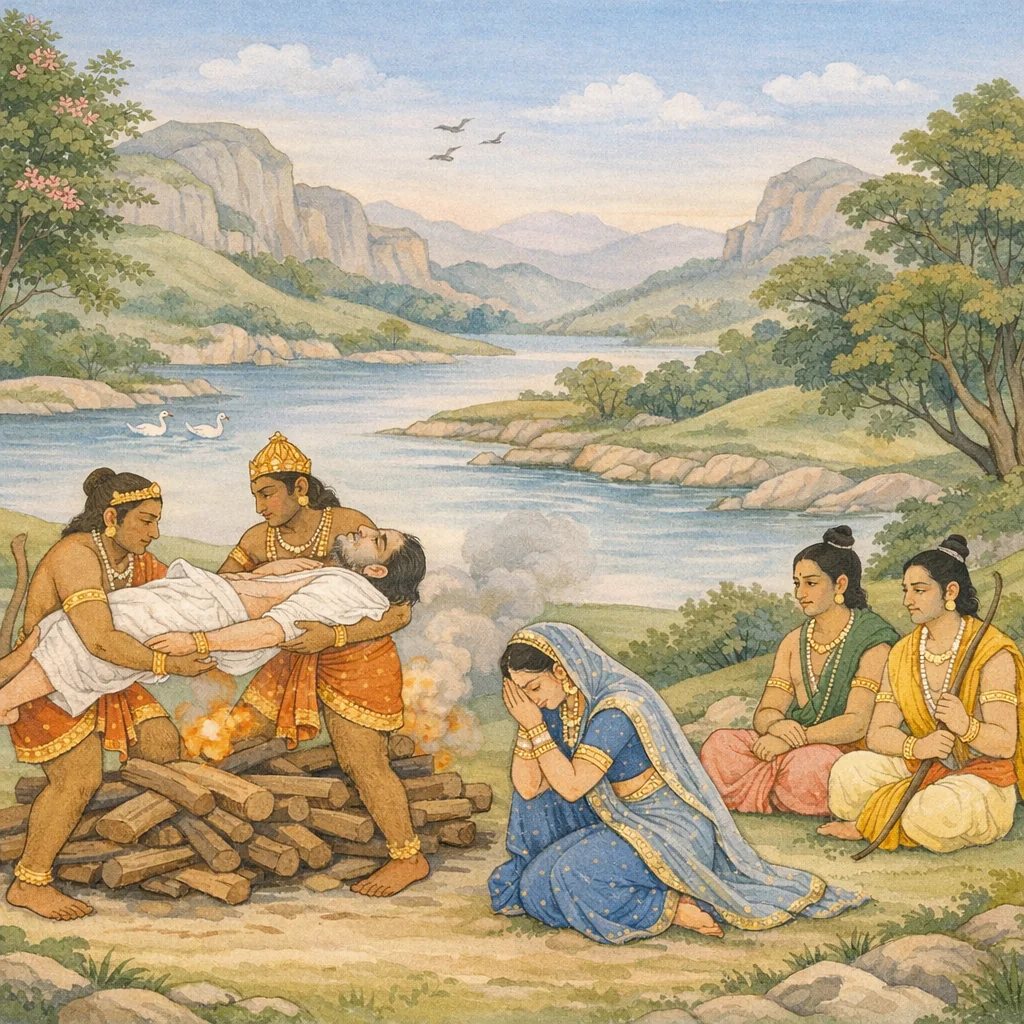
अस्मिन् सर्गे रामः सुग्रीवं, तारां, अङ्गदं च समशोकः सान्त्वयति। शोकपरितापस्य निष्फलत्वं प्रतिपाद्य, नियति-काल-स्वभाव-प्रधानं दार्शनिकं उपदेशं दत्ते—मृतस्य कल्याणं क्रियाकालेन, कर्तव्यपालनेन च साध्यते, न तु विलापेन। ततः लक्ष्मणः विनयेन सुग्रीवं और्ध्वदैहिककर्मणि प्रवर्तयति: काष्ठ-चन्दनादि-संग्रहः, शिबिकायाः सिद्धिः, वहनयोग्य-वानराणां सज्जीकरणम्, अङ्गदस्य समाश्वासनम् इत्यादि। तारा शीघ्रं गुहां प्रविश्य विश्वकर्मनिर्मित-समलङ्कृतां दिव्यां शिबिकां आनयति; रामः ‘क्षिप्रं विनीयतां वाली’ इति आदेशं ददाति। सुग्रीवः अङ्गदेन सह रुदन् वालिनं शिबिकायामारोपयति; राजकीय-समुचितं अन्त्येष्टि-विधानं आज्ञापयति—रत्नवृष्ट्या अग्रगमनं, भर्तृसत्क्रिया च। वानरीगणाः करुणस्वरैः अनुगच्छन्ति; तारा शिबिकातलशायिनं पतिं दृष्ट्वा विलपति, रामरूपेण कालस्य आगमनं निर्दिश्य विधवात्व-दुःखं व्यक्तयति। अन्ते चिता नदीपुलिने सज्जीकृता; अङ्गदः सुग्रीवेण सह पितरं चितामारोपयति, विधिवदग्निदानं कृत्वा अपसव्य-परिक्रमां करोति। दाहसंस्कारानन्तरं वानराः शुभजलायां नदीं गत्वा उदकदानं कुर्वन्ति; रामः समानशोकः प्रेतकार्याणि नियोजयति, तथा सर्गसमाप्तौ शोकात् कर्तव्य-प्रवृत्तेः संक्रमणं सुस्पष्टं भवति।
Shlokas
Verse 1
सुग्रीवं चैव तारां च साङ्गदं सहलक्ष्मणः।समानशोकः काकुत्स्थ स्सान्त्वयन्निदमब्रवीत्।।4.25.1।।
Rāma, the Kakutstha prince, accompanied by Lakṣmaṇa and sharing the same grief, consoled Sugrīva, Tārā, and Aṅgada, and spoke these words.
Verse 2
न शोकपरितापेन श्रेयसा युज्यते मृतः।यदत्रानन्तरं कार्यं तत्समाधातुमर्हथ4.25.2।।
The dead do not attain well-being through grief and burning sorrow. Therefore, you should now set in order and undertake whatever duty must be done next.
Verse 3
लोकवृत्तमनुष्ठेयं कृतं वो बाष्पमोक्षणम्।न कालादुत्तरं किञ्चित्कर्म शक्यमुपासितुम्4.25.3।।
“Follow what is proper in the world’s established way; you have shed tears enough. Once the right time passes, no act—however small—can truly be carried out as it should.”
Verse 4
नियतिः कारणं लोके नियतिः कर्मसाधनम्।नियतिस्सर्वभूतानां नियोगेष्विह कारणम्4.25.4।।
“In the world, destiny is a cause; destiny is what brings actions to completion. For all beings, here, destiny is the cause behind the allotment of their appointed conditions.”
Verse 5
न कर्ता कस्यचित्कश्चिन्नियोगे चापिनेश्वरः।स्वभावे वर्तते लोकस्तस्य कालः परायणम्4.25.5।।
No one is truly the maker of another’s actions—nor even the Lord, in the sense of assigning control; the world moves according to its own nature, and for that, Time is the final resort (the ultimate determinant).
Verse 6
न कालः कालमत्येति न कालः परिहीयते।स्वभावं च समासाद्य न कश्चिदतिवर्तते4.25.6।।
Time does not overstep Time, nor does Time diminish; and having come under one’s own nature, no one can transgress it.
Verse 7
न कालस्यास्ति बन्धुत्वं न हेतुर्न पराक्रमः।न मित्रज्ञातिसम्बन्धः कारणं नात्मनो वशः4.25.7।।
Time shows no partiality for kinship; neither reasoning nor personal valor can restrain it. Bonds of friends and relatives are not its cause—Time itself operates beyond one’s control.
Verse 8
किं तु कालपरीणामो द्रष्टव्यस्साधु पश्यता।धर्मश्चार्थश्च कामश्च कालक्रमसमाहिताः4.25.8।।
Yet one who sees rightly should contemplate the transformations brought by Time. Dharma, artha, and kāma unfold according to the sequence ordained by Time.
Verse 9
इतस्स्वां प्रकृतिं वाली गतःप्राप्तः क्रियाफलम्।धर्मार्थकाम संयोगैः पवित्रं प्लवगेश्वरः4.25.9।।
Vālī has departed from here, returning to his own state; the lord of monkeys has obtained the fruit of his deeds—an outcome shaped by the conjunction of dharma, artha, and kāma.
Verse 10
स्वधर्मस्य च संयोगाज्जितस्तेन महात्मना।स्वर्गः परिगृहीतश्च प्राणानपरिरक्षता4.25.10।।
By steadfast adherence to his own duty, that great soul won heaven; not clinging to life, he has attained the heavenly state.
Verse 11
एषा वै नियतिश्शेष्ठा यां गतो हरियूथपः।तदलं परितापेन प्राप्तकालमुपास्यताम्4.25.11।।
This is indeed the noblest course of destiny that the chief of the Vānaras has reached; therefore, grieve no more—attend now to what the time requires.
Verse 12
वचनान्ते तु रामस्य लक्ष्मणः परवीरहा।अवदत्प्रश्रितं वाक्यं सुग्रीवं गतचेतसम्4.25.12।।
When Rāma had finished speaking, Lakṣmaṇa—slayer of enemy heroes—humbly addressed Sugrīva, who was beside himself with grief.
Verse 13
कुरु त्वमस्य सुग्रीव प्रेतकार्यमनन्तरम्।ताराङ्गदाभ्यां सहितो वालिनो दहनं प्रति।।4.25.13।।
O Sugrīva, together with Tārā and Aṅgada, perform at once the funerary duties for him—especially the rites leading to Vāli’s cremation.
Verse 14
समाज्ञापय काष्ठानि शुष्कानि च बहूनि च।चन्दनादीनि दिव्यानि वालिसंस्कारकारणात्4.25.14।।
Issue orders for many dry logs, and for fine sandalwood and the like, for the sake of Vāli’s funeral preparations.
Verse 15
समाश्वासय चैनं त्वमङ्गदं दीनचेतसम्।मा भूर्बालिशबुद्धिस्त्वं त्वदधीनमिदं पुरम्4.25.15।।
And you should reassure this despondent Aṅgada; do not let him fall into childish thinking—this city is now under your authority.
Verse 16
अङ्गदस्त्वानयेन्माल्यं वस्त्राणि विविधानि च।घृतं तैलमथो गन्धान्यच्चात्र समनन्तरम्4.25.16।।
Let Aṅgada bring garlands and various garments, along with ghee, oil, fragrances, and whatever else is needed here without delay.
Verse 17
त्वं तार शिबिकां शीघ्रमादायागच्छ सम्भ्रमात्।त्वरा गुणवती युक्ता ह्यस्मिन्काले विशेषतः4.25.17।।
Tārā, quickly bring a litter at once; haste—well-directed and properly arranged—is especially fitting at this time.
Verse 18
सज्जीभवन्तु प्लवगाश्शिबिकावाहनोचिताः।समर्था बलिनश्चैव निर्हरिष्यन्ति वालिनम्।।4.25.18।।
Let the Vānaras who are fit to carry the litter—capable and strong—make themselves ready; they will bear Vāli away.
Verse 19
एवमुक्त्वा तु सुग्रीवं सुमित्रानन्दवर्धनः।तसौ भ्रातृसमीपस्थो लक्ष्मणः परवीरहा4.25.19।।
Having spoken thus to Sugrīva, Lakṣmaṇa—Sumitrā’s delight and the slayer of enemy heroes—stood close beside his brother (Rāma).
Verse 20
लक्ष्मणस्य वचश्श्रुत्वा तारस्सम्भ्रान्तमानसः।प्रविवेश गुहां शीघ्रं शिबिकासक्तमानसः4.25.20।।
Hearing Lakṣmaṇa’s words, Tārā—his mind stirred with urgency—quickly entered the cave, intent on arranging the palanquin.
Verse 21
आदाय शिबिकां तारस्स तु पर्यापतत्पुनः।वानरैरुह्यमानां तां शूरैरुद्वहनोचितैः4.25.21।।
Having obtained the palanquin, Tārā hurried back again to it, as it was being borne by heroic vānaras fit to carry such a load.
Verse 22
दिव्यां भद्रासनयुतां शिबिकां स्यन्दनोपमाम्।पक्षिकर्मभिराचित्रां द्रुमकर्मविभूषिताम्4.25.22।।आचितां चित्रपत्तीभि स्सुनिविष्टां समन्ततः।विमानमिव सिद्धानां जालवातायनान्विताम्4.25.23।।सुनियुक्तां विशालां च सुकृतां विश्वकर्मणा।दारुपर्वतकोपेतां चारुकर्मपरिष्कृताम्4.25.24।।वराभरणहारैश्च चित्रमाल्योपशोभिताम्।गुहागहनसञ्छन्नां रक्तचन्दनभूषिताम्4.25.25।।पुष्पौघैस्समभिच्छन्नां पद्ममालाभिरेव च।तरुणादित्यवर्णाभिर्भ्राजमानाभिरावृताम्4.25.26।।
A wondrous palanquin was brought—furnished with an auspicious seat and comparable to a chariot—carved with bird motifs and adorned with designs of trees. Covered all around with colorful panels, it resembled the aerial car of perfected beings, fitted with latticed windows. Broad and well-joined, it was expertly crafted (as by Viśvakarmā), embellished with carvings like wooden mountains and refined ornamentation. It shone with choice jewelry and garlands, with grotto-like decorative recesses, and was anointed with red sandalwood.
Verse 23
दिव्यां भद्रासनयुतां शिबिकां स्यन्दनोपमाम्।पक्षिकर्मभिराचित्रां द्रुमकर्मविभूषिताम्4.25.22।।आचितां चित्रपत्तीभि स्सुनिविष्टां समन्ततः।विमानमिव सिद्धानां जालवातायनान्विताम्4.25.23।।सुनियुक्तां विशालां च सुकृतां विश्वकर्मणा।दारुपर्वतकोपेतां चारुकर्मपरिष्कृताम्4.25.24।।वराभरणहारैश्च चित्रमाल्योपशोभिताम्।गुहागहनसञ्छन्नां रक्तचन्दनभूषिताम्4.25.25।।पुष्पौघैस्समभिच्छन्नां पद्ममालाभिरेव च।तरुणादित्यवर्णाभिर्भ्राजमानाभिरावृताम्4.25.26।।
A wondrous palanquin was brought—furnished with an auspicious seat and comparable to a chariot—carved with bird motifs and adorned with designs of trees. Covered all around with colorful panels, it resembled the aerial car of perfected beings, fitted with latticed windows. Broad and well-joined, it was expertly crafted (as by Viśvakarmā), embellished with carvings like wooden mountains and refined ornamentation. It shone with choice jewelry and garlands, with grotto-like decorative recesses, and was anointed with red sandalwood.
Verse 24
दिव्यां भद्रासनयुतां शिबिकां स्यन्दनोपमाम्।पक्षिकर्मभिराचित्रां द्रुमकर्मविभूषिताम्4.25.22।।आचितां चित्रपत्तीभि स्सुनिविष्टां समन्ततः।विमानमिव सिद्धानां जालवातायनान्विताम्4.25.23।।सुनियुक्तां विशालां च सुकृतां विश्वकर्मणा।दारुपर्वतकोपेतां चारुकर्मपरिष्कृताम्4.25.24।।वराभरणहारैश्च चित्रमाल्योपशोभिताम्।गुहागहनसञ्छन्नां रक्तचन्दनभूषिताम्4.25.25।।पुष्पौघैस्समभिच्छन्नां पद्ममालाभिरेव च।तरुणादित्यवर्णाभिर्भ्राजमानाभिरावृताम्4.25.26।।
A wondrous palanquin was brought—furnished with an auspicious seat and comparable to a chariot—carved with bird motifs and adorned with designs of trees. Covered all around with colorful panels, it resembled the aerial car of perfected beings, fitted with latticed windows. Broad and well-joined, it was expertly crafted (as by Viśvakarmā), embellished with carvings like wooden mountains and refined ornamentation. It shone with choice jewelry and garlands, with grotto-like decorative recesses, and was anointed with red sandalwood.
Verse 25
दिव्यां भद्रासनयुतां शिबिकां स्यन्दनोपमाम्।पक्षिकर्मभिराचित्रां द्रुमकर्मविभूषिताम्4.25.22।।आचितां चित्रपत्तीभि स्सुनिविष्टां समन्ततः।विमानमिव सिद्धानां जालवातायनान्विताम्4.25.23।।सुनियुक्तां विशालां च सुकृतां विश्वकर्मणा।दारुपर्वतकोपेतां चारुकर्मपरिष्कृताम्4.25.24।।वराभरणहारैश्च चित्रमाल्योपशोभिताम्।गुहागहनसञ्छन्नां रक्तचन्दनभूषिताम्4.25.25।।पुष्पौघैस्समभिच्छन्नां पद्ममालाभिरेव च।तरुणादित्यवर्णाभिर्भ्राजमानाभिरावृताम्4.25.26।।
A wondrous palanquin was brought—furnished with an auspicious seat and comparable to a chariot—carved with bird motifs and adorned with designs of trees. Covered all around with colorful panels, it resembled the aerial car of perfected beings, fitted with latticed windows. Broad and well-joined, it was expertly crafted (as by Viśvakarmā), embellished with carvings like wooden mountains and refined ornamentation. It shone with choice jewelry and garlands, with grotto-like decorative recesses, and was anointed with red sandalwood.
Verse 26
ईदृशीं शिबिकां दृष्ट्वा रामो लक्ष्मणमब्रवीत्।क्षिप्रं विनीयतां वाली प्रेतकार्यं विधीयताम्4.25.26।।
A wondrous palanquin was brought—furnished with an auspicious seat and comparable to a chariot—carved with bird motifs and adorned with designs of trees. Covered all around with colorful panels, it resembled the aerial car of perfected beings, fitted with latticed windows. Broad and well-joined, it was expertly crafted (as by Viśvakarmā), embellished with carvings like wooden mountains and refined ornamentation. It shone with choice jewelry and garlands, with grotto-like decorative recesses, and was anointed with red sandalwood.
Verse 27
ततो वालिनमुद्यम्य सुग्रीवश्शिबिकां तदा।आरोपयत विक्रोशन्नङ्गदेन सहैव तु4.25.27।।
Then Sugrīva, weeping aloud, lifted Vāli and placed him upon the palanquin, together with Aṅgada.
Verse 28
आरोप्य शिबिकां चैव वालिनं गतजीवितम्।अलङ्कारैश्च विविधैर्माल्यैर्वस्त्रैश्च भूषितम्4.25.28।।
Vali, now lifeless, was placed upon a palanquin and adorned with varied ornaments, garlands, and garments.
Verse 29
आज्ञापयत्तदा राजा सुग्रीव प्लवगेश्वरः।और्ध्वदैहिकमार्यस्य क्रियतामनुरूपतः।।4.25.29।।
Then King Sugriva, lord of the monkeys, commanded: “Let the proper funeral rites for the noble one be performed in a manner befitting him.”
Verse 30
विश्राणयन्तो रत्नानि विविधानि बहून्यपि।अग्रतः प्लवगा यान्तु शिबिका समनन्तरम्4.25.30।।
“Let the monkeys go in front, scattering many kinds of gems in abundance, and let the palanquin follow close behind.”
Verse 31
राज्ञामृद्दिविशेषा हि दृश्यन्ते भुवि यादृशाः।तादृशैरिह कुर्वन्तु वानरा भर्तृसत्क्रियाम्4.25.31।।
“As special royal honors are seen on earth for kings, so too—by such means—let the monkeys here perform the due honors for their lord.”
Verse 32
तादृशं वालिनः क्षिप्रं प्राकुर्वन्नौर्ध्वदैहिकम्।अङ्गदं परिगृह्याऽशु तारप्रभृतयस्तदा4.25.32।।क्रोशन्तः प्रययुस्सर्वे वानरा हतबान्धवाः।
Thus, Vāli’s funeral rites were promptly set in motion in that befitting manner. Then Tārā and the others, quickly taking Aṅgada with them, all the monkeys—bereft of their kinsman—went onward, crying aloud.
Verse 33
ततः प्रणिहिताः सर्वा वानर्योस्य वशानुगाः4.25.33।।चुक्रुशु र्वीर वीरेति भूयः क्रोशन्ति ताः स्त्रीयः।
Then all the female monkeys who had lived under his protection cried out; again and again those women wailed, “O hero, O hero!”
Verse 34
ताराप्रभृतयस्सर्वा वानर्यो हरियूथपाः।अनुजग्मुर्हि भर्तारं क्रोशन्त्यः करुणस्वनाः4.25.34।।
Tārā and all the other female monkeys, wives of the monkey-chiefs, followed their lord, wailing with voices heavy with sorrow.
Verse 35
तासां रुदितशब्देन वानरीणां वनान्तरे।वनानि गिरयश्चैव विक्रोशन्तीव सर्वतः4.25.35।।
By the sound of the female monkeys’ weeping in the forest depths, the woods and even the mountains on all sides seemed as though they too were crying out.
Verse 36
पुलिने गिरिनद्यास्तु विविक्ते जलसंवृते4.25.36।।चितां चक्रुस्सुबहवो वानराश्शोककर्शिता:।
Grief-worn, many monkeys prepared a funeral pyre on the sandbank of a mountain stream, in a secluded spot encircled by flowing waters.
Verse 37
अवरोप्य ततस्स्कन्धाच्छिबिकां वाहनोचिताः।तस्थुरेकान्तमाश्रित्य सर्वे शोकसमन्विता:4.25.37।।
Then the bearers, fit for carrying the palanquin, set it down from their shoulders; withdrawing to a secluded spot, they all stood there, overcome with grief.
Verse 38
ततस्तारा पतिं दृष्ट्वा शिबिकातलशायिनम्4.25.38।।आरोप्याङ्के शिरस्तस्य विललाप सुदुःखिता।
Then Tārā, seeing her husband lying upon the palanquin, placed his head upon her lap and, overwhelmed with sorrow, began to lament.
Verse 39
हा वानर महाराज हा नाथ मम वत्सल4.25.39।।हा महार्ह महाबाहो हा मम प्रिय पश्य माम्।जनं न पश्यसीमं त्वं कस्माच्छोकाभिपीडितम्।4.25.40।।
“Alas, O monkey-king! Alas, my lord—my beloved! Alas, noble one, mighty-armed, my dear—look at me! Why do you not see me here, crushed by grief?”
Verse 40
हा वानर महाराज हा नाथ मम वत्सल4.25.39।।हा महार्ह महाबाहो हा मम प्रिय पश्य माम्।जनं न पश्यसीमं त्वं कस्माच्छोकाभिपीडितम्।4.25.40।।
“O revered one, though life has left you, your face appears as if cheerful; it bears the hue of the setting sun, just as it did when you were alive.”
Verse 41
प्रहृष्टमिव ते वक्त्रं गतासोरपि मानदआस्तार्कसमवर्णं च लक्ष्यते जीवतो यथा4.25.41।।
“O revered one, though life has left you, your face appears as if cheerful; it bears the hue of the setting sun, just as it did when you were alive.”
Verse 42
एष त्वां रामरूपेण कालः कर्षति वानर।येन स्म विधवास्सर्वाः कृता एकेषुणा वने4.25.42।।
“O monkey, it is Death (Kāla) in the form of Rāma that has dragged you away—he who, with a single arrow in the forest, has made us all widows.”
Verse 43
इमास्तास्तव राजेन्द्र वानर्योवल्लभास्सदा।पादैर्विकृष्ट मध्वानमागताः किं न बुध्यसे4.25.43।।
“O king of kings, these she-monkeys—ever dear to you—have come on foot across a long road; why do you not understand (and look upon them)?”
Verse 44
तवेष्टा ननु नामैता भार्याश्चन्द्रनिभाननाः।इदानीं नेक्षसे कस्तात्सुग्रीवं प्लवगेश्वरम्4.25.44।।
“Indeed, these moon-faced wives were once your favorites; why do you not look at them now? Why do you not look upon Sugrīva, lord among monkeys?”
Verse 45
एते हि सचिवा राजं स्तारप्रभृतयस्तव।पुरवासी जनश्चायं परिवार्यासतेऽनघ4.25.45।।
“O king, these are your ministers—Tārā and the others—and these citizens of the city sit here surrounding you, O blameless one.”
Verse 46
विसर्जयैतान् प्लवगान्यथोचितमरिन्दम।ततः क्रीडामहे सर्वा वनेषु मदनोत्कटाः4.25.46।।
O subduer of enemies, dismiss these monkeys after granting them what is proper according to their rank; then, inflamed by desire, we shall all sport in the forests.
Verse 47
एवं विलपतीं तारां पतिशोकपरिप्लुताम्।उत्थापयन्ति स्म तदा वानर्यश्शोककर्शिताः4.25.47।।
Thus, while Tārā lamented—overwhelmed by sorrow for her husband—the grief-worn female monkeys then helped her to rise.
Verse 48
सुग्रीवेण ततस्सार्धंमङ्गदः पितरं रुदन्।चितामारोपयामास शोकेनाभिहतेन्द्रियः4.25.48।।
Then Aṅgada, weeping, together with Sugrīva, placed his father upon the funeral pyre, his senses numbed by grief.
Verse 49
ततोऽग्निं विधिवद्दत्त्वा सोऽपसव्यं चकार ह।पितरं दीर्घमध्वानं प्रस्थितं व्याकुलेन्द्रियः4.25.49।।
Then, having offered the fire in the prescribed manner, he circumambulated (the pyre) keeping it to his left, his senses distressed, as to a father who had departed on a long journey.
Verse 50
संस्कृत्य वालिनं ते तु विधिपूर्वं प्लवङ्गमाः।आजग्मुरुदकं कर्तुं नदीं शुभजलां शिवाम्4.25.50।।
After duly completing the rites for Vāli, the monkeys went to an auspicious river of pure waters to make the water-offering.
Verse 51
ततस्ते सहितास्तत्र ह्यङ्गदं स्थाप्य चाग्रतः।सुग्रीवतारासहितास्सिषिचुर्वालिने जलम्4.25.51।।
Then, gathered there, placing Aṅgada at the forefront, the monkeys—together with Sugrīva and Tārā—poured out water for Vāli.
Verse 52
सुग्रीवेणेव दीनेन दीनो भूत्वा महाबलः।समानशोकः काकुत्स्थ: प्रेतकार्याण्यकारयत्4.25.52।।
Mighty Rāma, the Kakutstha, becoming as downcast as the sorrowful Sugrīva and sharing the same grief, had the funeral rites carried out.
Verse 53
After cremating Vāli of mighty prowess—his tawny face radiant like fire—who had been openly slain by the great arrow of Rāma of the Ikṣvāku line, Sugrīva approached Rāma and Lakṣmaṇa. Thus ends the twenty-fifth sarga of the Kiṣkindhākāṇḍa.
Frequently Asked Questions
The dilemma is how to respond to death within dharma: Rama and Lakshmana redirect Sugriva’s grief into immediate, appropriate action—performing Vali’s cremation and aurdhvadaihika rites without delaying the prescribed time, while also stabilizing Angada’s succession-minded emotions.
The upadesha frames human events under niyati/kāla and svabhāva: lamentation cannot restore the dead; wise conduct is to recognize time’s order and fulfill duty—ritual, governance, and communal obligations—thereby transforming private sorrow into dharmic completion.
Culturally, the text foregrounds royal-style funeral protocol (palanquin procession, pyre construction, agni-offering, apasavya circumambulation, and udaka offerings). Geographically, it notes Kishkindha’s cave-city (guhā) and a solitary sandbank on a mountain stream/river where the pyre is built and water oblations are performed.