Sarga 20
ताराविलापः — Tara’s Lament over Vāli
किष्किन्धाकाण्ड
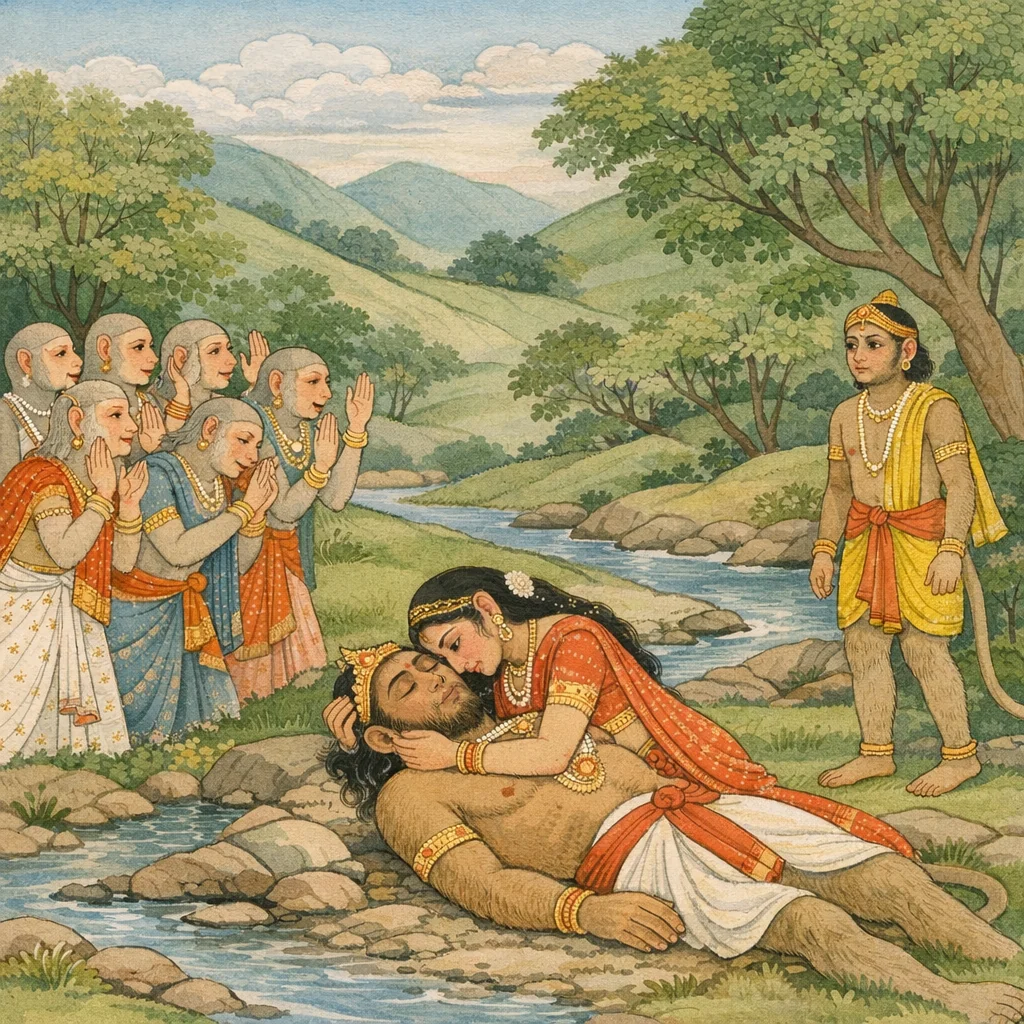
This sarga presents the immediate aftermath of Vāli’s death by Rāma’s arrow. Tārā, described as moon-faced and dignified, approaches the fallen Vāli and embraces him, initiating an extended vilāpa (lament) marked by sharp imagery (earth as the beloved embraced in death; Vāli compared to an uprooted tree, elephant-like in strength). Her speech blends grief with moral accounting: she notes her own shock that her heart does not shatter; she indicts Vāli’s prior actions against Sugrīva (banishment and seizure of Rūmā) as the causal ‘fruit’ now ripened; and she recalls that her well-meant counsel was earlier despised. She turns to Angada, urging him to look upon his dharma-loving father and to receive final affection and instruction, while also fearing Angada’s future under an anger-deluded uncle. She acknowledges Rāma’s act as fulfillment of his promise to Sugrīva, then addresses Sugrīva directly, conceding that his desire is achieved and the kingdom is his. The chapter closes with collective mourning by Vāli’s other wives, and Tārā’s resolve to undertake prāya (fasting unto death) beside Vāli.
Shlokas
Verse 1
रामचापविसृष्टेन शरेणान्तकरेण तम्।दृष्ट्वा विनिहतं भूमौ तारा ताराधिपानना4.20.1।।सा समासाद्य भर्तारं पर्यष्वजत भामिनी।
Seeing her husband lying slain on the ground by the death-dealing arrow released from Rāma’s bow, Tārā—moon-faced and radiant—went to him and embraced him.
Verse 2
इषुणाऽभिहतं दृष्ट्वा वालिनं कुञ्जरोपमम्4.20.2।।वानरेन्द्र महेन्द्राभं शोकसन्तप्तमानसा।तारा तरुमिवोन्मूलं पर्यदेवयदातुरा4.20.3।।
Seeing Vāli—the lord of monkeys—struck down by an arrow, elephant-like in might and mountain-like in splendour, lying fallen like an uprooted tree, Tārā, her mind scorched by grief, grew frantic and lamented aloud.
Verse 3
इषुणाऽभिहतं दृष्ट्वा वालिनं कुञ्जरोपमम्4.20.2।।वानरेन्द्र महेन्द्राभं शोकसन्तप्तमानसा।तारा तरुमिवोन्मूलं पर्यदेवयदातुरा4.20.3।।
Seeing Vāli, lord of the monkeys, radiant like a great mountain, felled like an uprooted tree, Tārā—her mind scorched by grief—became distraught and wailed aloud.
Verse 4
रणे दारुण विक्रान्त प्रवीर प्लवतां वर।किं दीनामपुरोभागामद्य त्वं नाभिभाषसे।।4.20.4।।
“O valiant one—terrible in battle, foremost among the monkeys—why do you not speak today to me, wretched and helpless before you?”
Verse 5
उत्तिष्ठ हरिशार्दूल भजस्व शयनोत्तमम्।नैवंविधाश्शेरते हि भूमौ नृपतिसत्तमाः4.20.5।।
“Rise, O tiger among monkeys; take to the finest couch. Great kings like you do not lie upon the bare earth.”
Verse 6
अतीव खलु ते कान्ता वसुधा वसुधाधिप।गतासुरपि यां गात्रैर्मां विहाय निषेवसे4.20.6।।
“O lord of the earth, the earth herself must have been dearer to you than I—for even now, bereft of life, you abandon me and cling to her with your limbs.”
Verse 7
व्यक्तमन्या त्वया वीर धर्मत: सम्प्रवर्तिता।किष्किन्धेव पुरी रम्या स्वर्गमार्गे विनिर्मिता4.20.7।।
“Clearly, O hero, you have set out righteously on another path—having built for yourself a delightful city like Kiṣkindhā upon the road to heaven.”
Verse 8
यान्यस्माभिस्त्वया सार्धं वनेषु मधुगन्धिषु।विहृतानि त्वया काले तेषामुपरमः कृतः4.20.8।।
“Those wanderings of delight that we shared with you in sweet-fragrant forests—today you have brought them to an end.”
Verse 9
निरानन्दा निराशाऽहं निमग्ना शोकसागरे।त्वयि पञ्चत्वमापन्ने महायूथपयूथपे4.20.9।।
“O leader of leaders, now that you have met your end, I am joyless and without hope, sunk in an ocean of sorrow.”
Verse 10
हृदयं सुस्थिरं मह्यं दृष्ट्वा विनिहतं पतिम्।यन्न शोकाभिसन्तप्तं स्फुटतेऽद्य सहस्रधा4.20.10।।
My heart must be made of iron—since, though scorched by grief, it has not shattered into a thousand pieces even on seeing my husband slain.
Verse 11
सुग्रीवस्य त्वया भार्या हृता स च विवासितः।यत्तु त्तस्य त्वया व्युष्टिः प्राप्तेयं प्लवगाधिप4.20.11।।
O lord of monkeys, you seized Sugrīva’s wife and drove him into exile; this calamity that has now come upon you is the consequence of that deed.
Verse 12
निश्श्रेयसपरा मोहात्त्वया चाहं विगर्हिता।यैषाऽब्रुवं हितं वाक्यं वानरेन्द्र हितैषिणी4.20.12।।
Seeking your true good, I spoke beneficial counsel, O lord of monkeys; yet, deluded, you scorned me for it.
Verse 13
रूपयौवनदृप्तानां दक्षिणानां च मानद।नूनमप्सरसामार्य चित्तानि प्रमथिष्यसि4.20.13।।
O noble one, bestower of honor—surely you will now stir and unsettle the hearts of the gentle apsarases, proud of their beauty and youth.
Verse 14
कालो निस्संशयो नूनं जीवितान्तकरस्तव।बलाद्येनावपन्नोऽसि सुग्रीवस्यावशो वशम्4.20.14।।
Surely, without doubt, Time—the ender of life—had come for you; for you, once uncontrollable, have now been forced under Sugrīva’s power.
Verse 15
वैधव्यं शोकसन्तापं कृपणं कृपणा सती।अदुःखोपचिता पूर्वं वर्तयिष्याम्यनाथवत्।।4.20.15।।
I, who once knew no sorrow, must now live in wretched widowhood, burning with grief—like one without refuge.
Verse 16
लालितश्चाङ्गदो वीरस्सुकुमारस्सुखोचितः।वर्त्स्यते कामवस्थां मे पितृव्ये क्रोधमूर्छिते।।4.20.16।।
And what fate will befall my Angada—heroic yet tender, raised with affection and worthy of comfort—when his paternal uncle, clouded by anger, holds power?
Verse 17
कुरुष्व पितरं पुत्र सुदृष्टं धर्मवत्सलम्।दुर्लभं दर्शनं वत्स तव तस्य भविष्यति।।4.20.17।।
O son, look well upon your father—one who is devoted to dharma. Dear child, for you his sight will soon become hard to obtain.
Verse 18
समाश्वासय पुत्रं त्वं सन्देशं सन्दिशस्व मे।मूर्ध्नि चैनं समाघ्राय प्रवासं प्रस्थितो ह्यसि4.20.18।।
Console your son, and give him my message. Smell him upon the head in farewell—for you are indeed setting out on a journey away (from which you will not return).
Verse 19
रामेण हि महत्कर्म कृतं त्वामभिनिघ्नता।आनृण्यं च गतं तस्य सुग्रीवस्य प्रतिश्रवे4.20.19।।
Indeed, by striking you down Rāma has accomplished a great deed; in fulfilling his pledge to Sugrīva, he has also freed himself from the debt of that promise.
Verse 20
सकामो भव सुग्रीव रुमां त्वं प्रतिपत्स्यसे।भुङ्क्षव राज्यमनुद्विग्नश्शस्तो भ्राता रिपुस्तव4.20.20।।
Be satisfied, Sugrīva—your desire is fulfilled. You will regain Rumā; enjoy the kingdom without anxiety, for your enemy—your brother—has been slain.
Verse 21
किं मामेवं विलपतीं प्रेम्णा त्वं नाभिभाषसे।इमाः पश्य वरा बह्वीर्भार्यास्ते वानरेश्वर4.20.21।।
Why do you not speak to me with love, even as I wail like this? Look—here are your many excellent wives, O lord of monkeys.
Verse 22
तस्या विलपितं श्रुत्वा वानर्यस्सर्वतश्च ताः।परिगृह्याङ्गदं दीनं दुःखार्ता परिचुक्रुशुः4.20.22।।
Hearing her lament, the monkey-women gathered from all sides; taking up the pitiable Aṅgada in their arms, afflicted with sorrow, they cried out in grief.
Verse 23
किमङ्गदं साङ्गदवीरबाहो विहाय यास्यद्य चिरप्रवासम्।न युक्तमेवं गुणसन्निकृष्टंविहाय पुत्रं प्रियपुत्र गन्तुम्4.20.23।।
O hero with armlets, mighty-armed—why do you leave Aṅgada today and depart on a long journey? It is not fitting to go away like this, abandoning your dear son, so close to you in virtues.
Verse 24
किमप्रियं ते प्रिय चारुवेषमया कृतं नाथ सुतेन वा ते।सहाङ्गदां मां प्रविहाय वीरयत्प्रस्थितो दीर्घ मितः प्रवासम्4.20.24।।
O beloved, fair-robed; O lord—what displeasing thing has been done to you by me, or by your son, that you, O hero, leave me together with Aṅgada and set out from here on so distant a journey?
Verse 25
यद्यप्रियं किञ्चिदसम्प्रधार्यकृतं मया स्यात्तव दीर्घबाहो।क्षमस्व मे तद्धरिवंशनाथव्रजामि मूर्ध्ना तव वीर पादौ।।4.20.25।।
If, O long-armed one, I have done anything displeasing to you—unthinkingly—then forgive me, O lord of the monkey line. O hero, I bow to your feet with my head.
Verse 26
Then Tārā—of flawless beauty—crying in deep compassion, sat down on the ground near her husband Vāli, together with the other she-monkeys, resolved to undertake prāya (fasting unto death), giving up food and drink.
Frequently Asked Questions
The sarga frames Vāli’s death as an ethically consequential act within a political dispute: Tārā links the outcome to Vāli’s earlier wrongdoing toward Sugrīva (banishment and taking Rūmā), while also recognizing that Rāma’s killing of Vāli functions as promise-fulfillment to Sugrīva—placing personal grief alongside a public-ethical reckoning.
The dialogue emphasizes karma-phala and the cost of ignoring well-intentioned counsel: power and pride (rūpa-yauvana-darpa, dominance) do not negate moral causality, and grief becomes a lens through which dharma, responsibility to kin, and the fragility of sovereignty are understood.
Kiṣkindhā is the cultural-political center implicitly invoked as the contested capital and then restored kingdom; culturally, the chapter foregrounds vilāpa as a formal lament mode and prāya (fasting unto death) as an ascetic-mourning practice undertaken beside the deceased.