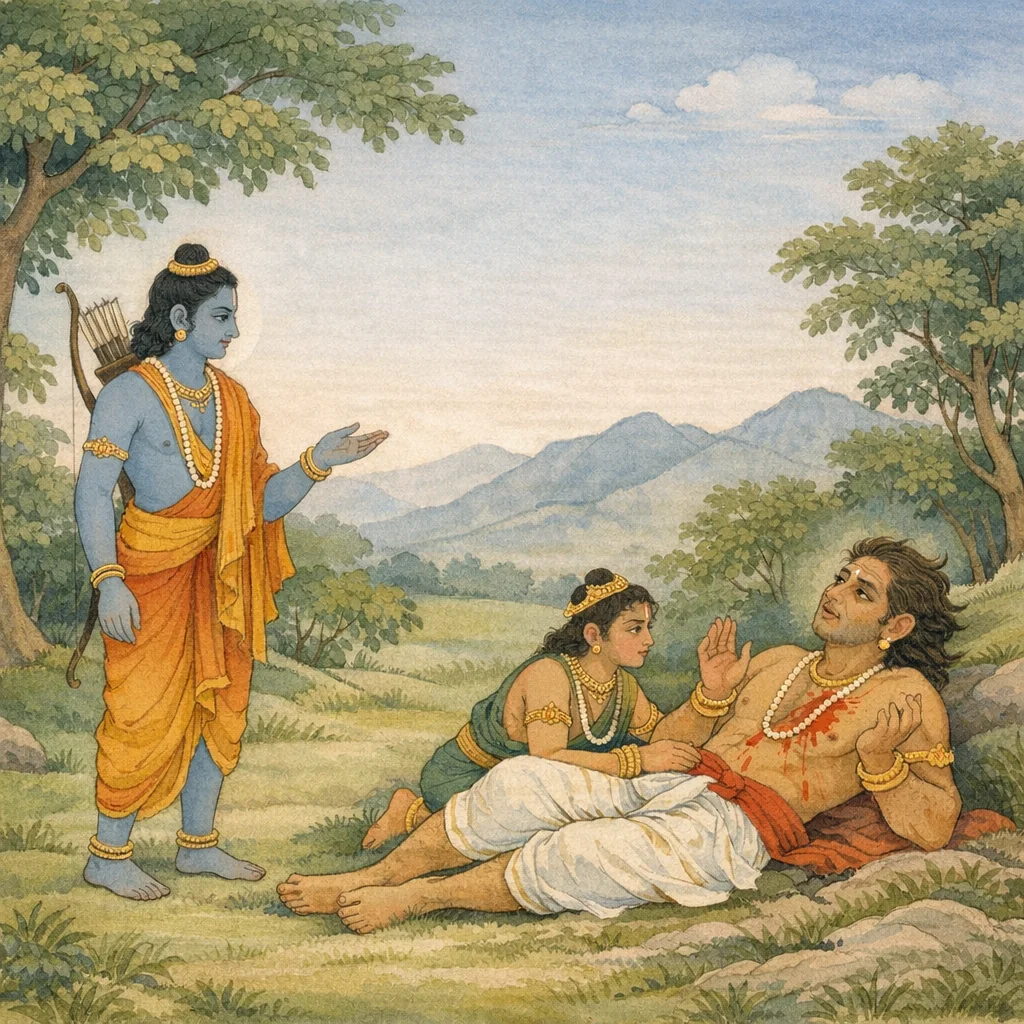
Sarga 18
वाली–रामसंवादः (Rama’s Justification to Vali on Rājadharma)
किष्किन्धाकाण्ड
Sarga 18 is a tightly argued juridical-ethical dialogue following Vālī’s mortal wounding. Vālī initially reproaches Rāma for an apparently harsh act; Rāma responds by reframing the event as enforcement of rājadharma under Bharata’s de facto regency, asserting that kings (Ikṣvāku authority) possess nigraha and anugraha (punishment and reward) over beings within their domain. Rāma identifies Vālī’s central transgression as bhrātṛbhāryāvamarśa—sexual appropriation of a brother’s wife—treating it as a grave breach warranting daṇḍa, even vadhā according to smṛti. He further argues from precedent and dharmaśāstra logic: punishment purifies the sinner; failure to punish transfers demerit to the king; and even hunting analogies illustrate the permissibility of striking a ‘śākhāmṛga’ (monkey) irrespective of face-to-face combat conventions. Vālī’s confusion clears; he concedes Rāma’s reasoning, asks forgiveness, and turns to succession ethics—requesting protection for Aṅgada and fair treatment of Tārā under Sugrīva. Rāma consoles Vālī, articulating karmic causality and the inevitability of fate, and assures continuity of care for Aṅgada—closing the chapter with reconciliation grounded in dharma.
Shlokas
Verse 1
इत्युक्तः प्रश्रितं वाक्यं धर्मार्थसहितं हितम्।परुषं वालिना रामो निहतेन विचेतसा।।
Thus addressed, Rāma responded to Vālin’s harsh words—words that were outwardly courteous and well-intended, and that invoked dharma and expediency—spoken by one mortally wounded and confused in mind.
Verse 2
तं निष्प्रभमिवादित्यं मुक्ततोयमिवाम्बुदम्।उक्तवाक्यं हरिश्रेष्ठमुपशान्तमिवानलम्।।धर्मार्थगुणसम्पन्नं हरीश्वरमनुत्तमम्।अधिक्षिप्तस्तदा रामः पश्चाद्वालिनमब्रवीत्।।
Then Rama, having been reproached, spoke afterward to Vali—the foremost of monkeys, the peerless lord of the monkeys, rich in dharma, purpose, and virtue—who, after speaking, appeared like the sun dimmed of radiance, like a cloud emptied of rain, or like a fire gone quiet.
Verse 3
तं निष्प्रभमिवादित्यं मुक्ततोयमिवाम्बुदम्।उक्तवाक्यं हरिश्रेष्ठमुपशान्तमिवानलम्4.18.2।।धर्मार्थगुणसम्पन्नं हरीश्वरमनुत्तमम्।अधिक्षिप्तस्तदा रामः पश्चाद्वालिनमब्रवीत्4.18.3।।
Vali—the best of monkeys, the peerless lord of the vānaras, endowed with qualities of dharma and artha—fell silent after speaking, like the sun dimmed of splendor, like a cloud drained of rain, like a fire that has died down. Then Rama, having been reproached, spoke in reply to Vali.
Verse 4
धर्ममर्थं च कामं च समयं चापि लौकिकम्।अविज्ञाय कथं बाल्यान्मामिहाद्य विगर्हसे।।
Without understanding dharma, artha, kāma, and even the ordinary conventions of the world, how can you—out of childish ignorance—reproach me here today?
Verse 5
अपृष्ट्वा बुद्धिसम्पन्नान्वृद्धानाचार्यसम्मतान्।सौम्य वानरचापल्यात्किं मावक्तुमिहेच्छसि।।
Without first consulting the wise—elders approved by the teachers—why, O gentle one, do you wish to speak to me here with the fickle rashness of a monkey?
Verse 6
इक्ष्वाकूणामियं भूमिस्सशैलवनकानना।मृगपक्षिमनुष्याणां निग्रहप्रग्रहावपि।।
This earth—together with its mountains, groves, and forests—belongs to the Ikṣvāku kings; and over beasts, birds, and humans alike, the authority to restrain and to favor also rests with them.
Verse 7
तां पालयति धर्मात्मा भरतस्सत्यवागृजुः।धर्मकामार्थतत्त्वज्ञो निग्रहानुग्रहे रतः।।
That earth is ruled by Bharata—righteous in nature, truthful in speech, upright—one who knows the principles of dharma, kāma, and artha, and who is devoted to both punishment and favor (as justice requires).
Verse 8
नयश्च विनयश्चोभौ यस्मिन्सत्यं च सुस्थितम्।विक्रमश्च यथा दृष्टस्स राजा देशकालवित्।।
He is a king in whom both sound policy (naya) and discipline (vinaya) are present, in whom truth stands firmly established, and in whom valor is seen—one who knows the proper place and time for action.
Verse 9
तस्य धर्मकृतादेशा वयमन्ये च पार्थिवाः।चरामो वसुधां कृत्स्नां धर्मसन्तानमिच्छवः।।
Receiving his commands framed by dharma, we and other kings move throughout the whole earth, desiring the continuance and flourishing of dharma.
Verse 10
तस्मिन्नृपतिशार्दूले भरते धर्मवत्सले।पालयत्यखिलां भूमिं कश्चरेद्धर्मनिग्रहम्।।
When Bharata—tiger among kings and devoted to dharma—protects the entire earth, who would dare to transgress and stray from the restraint of righteousness?
Verse 11
ते वयं धर्मविभ्रष्टं स्वधर्मे परमे स्थिताः।भरताज्ञां पुरस्कृत्य निगृह्णीमो यथाविधि।।
We, firmly established in our highest duty, uphold Bharata’s command and duly restrain and punish the one who has deviated from dharma.
Verse 12
त्वं तु संक्लिष्टधर्मा च कर्मणा च विगर्हितः।कामतन्त्रप्रधानश्च न स्थितो राजवर्त्मनि।।
But you have corrupted dharma and are censured for your deeds. Ruled chiefly by desire, you have not remained on the kingly path of righteous conduct.
Verse 13
ज्येष्ठो भ्राता पिता चैव यश्च विद्यां प्रयच्छति।त्रयस्ते पितरो ज्ञेया धर्म्ये च पथि वर्तिनः4.18.13।।
An elder brother, a father, and one who bestows learning—these three are to be regarded as fathers, and one should conduct oneself toward them on the righteous path.
Verse 14
यवीयानात्मनः पुत्रशशिष्यश्चापि गुणोदितः।पुत्रवत्ते त्रयश्चिन्त्या धर्मश्चेदत्रकारणम्4.18.14।।
A younger brother, one’s own son, and a virtuous disciple—these three should be regarded as one’s sons, if dharma is the standard being considered here.
Verse 15
सूक्ष्मः परमदुरजेयस्सतां धर्मः प्लवङ्गम।हृदिस्थस्सर्वभूतानामात्मा वेद शुभाशुभम्।।
O monkey, the dharma of the good is subtle and exceedingly hard to grasp. The Self, dwelling in the hearts of all beings, knows what is auspicious and inauspicious.
Verse 16
चपलश्चपलैस्सार्धं वानरैरकृतात्मभिः।जात्यन्ध इव जात्यन्धैर्मन्त्रयन् प्रेक्षसे नु किम्।।
Fickle yourself, and taking counsel with fickle, undisciplined monkeys, you are like one blind from birth guided by others blind from birth—what understanding can you expect to gain?
Verse 17
अहं तु व्यक्ततामस्य वचनस्य ब्रवीमि ते।न हि मां केवलं रोषात्त्वं विगर्हितुमर्हसि।।
I shall state this matter to you with clarity. You should not condemn me merely out of anger.
Verse 18
तदेतत्कारणं पश्य यदर्थं त्वं मया हतः।भ्रातुर्वर्तसि भार्यायां त्यक्त्वा धर्मं सनातनम्।।
See, then, the reason for which you were struck down by me: forsaking eternal dharma, you have lived with your brother’s wife.
Verse 19
अस्य त्वं धरमाणस्य सुग्रीवस्य महात्मनः।रुमायां वर्तसे कामात्स्नुषायां पापकर्मकृत्।।
While the great-souled Sugriva yet lives, you—doer of sinful deeds—out of lust have consorted with Ruma, who stands to you as a daughter-in-law.
Verse 20
तद्व्यतीतस्य ते धर्मात्कामवृत्तस्य वानर।भ्रातृभार्यावमर्शेऽस्मिन्दण्डोऽयं प्रतिपादितः।।
Therefore, O monkey—since you have transgressed dharma and acted from lust in violating your brother’s wife—this punishment has been duly applied.
Verse 21
न हि धर्मविरुद्धस्य लोकवृत्तादपेयुषः।दण्डादन्यत्र पश्यामि निग्रहं हरियूथप।
O lord of the monkey-troops, for one who acts against dharma and deviates from the world’s accepted code of conduct, I see no restraint other than punishment.
Verse 22
न हि ते मर्षये पापं क्षत्रियोऽहं कुलोद्भवः।औरसीं भगिनीं वापि भार्यां वाप्यनुजस्य यः।।प्रचरेत नरः कामात्तस्य दण्डो वधः स्मृतः।
I will not pardon your sin; I am a kṣatriya of noble lineage. A man who, driven by lust, violates his own daughter, or even his sister, or his younger brother’s wife—his prescribed punishment, according to smṛti, is death.
Verse 23
भरतस्तु महीपालो वयं त्वादेशवर्तिनः।।त्वं तु धर्मादतिक्रान्तः कथं शक्यं उपेक्षितुम्।
Bharata is the king, and we act in obedience to his command. But you have overstepped dharma—how could that be ignored?
Verse 24
गुरूर्धर्मव्यतिक्रान्तं प्राज्ञो धर्मेण पालयन्।।भरतः कामवृत्तानां निग्रहे पर्यवस्थितः।
Bharata—wise and worthy of reverence—rules in accordance with dharma, and he stands resolved to restrain and punish those who act from lustful impulse and violate dharma.
Verse 25
वयं तु भरतादेश विधिं कृत्वा हरीश्वर।त्वद्विधान्भिन्नमर्यादान्नियन्तुपर्यवस्थिताः।।
O lord of the monkeys, having accepted Bharata’s command as our guiding rule, we stand determined to restrain and punish those like you who have broken the bounds of proper conduct (maryādā).
Verse 26
सुग्रीवेण च मे सख्यं लक्ष्मणेन यथा तथा।दारराज्यनिमित्तं च निःश्रेयसि रत स्स मे।।प्रतिज्ञा च मया दत्ता तदा वानरसन्निधौ।प्रतिज्ञा च कथं शक्या मद्विधेनानवेक्षितुम्।।
My friendship with Sugriva is as firm as with Lakshmana; it is for the sake of restoring his wife and his kingdom, and it serves a rightful end. I gave my pledge then, in the presence of the monkeys—how could a person like me possibly disregard a promise?
Verse 27
सुग्रीवेण च मे सख्यं लक्ष्मणेन यथा तथा।दारराज्यनिमित्तं च निःश्रेयसि रत स्स मे4.18.26।।प्रतिज्ञा च मया दत्ता तदा वानरसन्निधौ।प्रतिज्ञा च कथं शक्या मद्विधेनानवेक्षितुम्4.18.27।।
This verse repeats the same statement: Rama affirms his firm friendship with Sugriva, the righteous aim of restoring wife and kingdom, and the inviolability of the pledge he made publicly before the vānaras.
Verse 28
तदेभिः कारणैस्सर्वैर्महद्भिर्धर्मसंहितैः।।शासनं तप यद्युक्तं तद्भवाननुमन्यताम्।
Therefore, for all these weighty reasons consistent with dharma, the punishment that has befallen you is proper; you should accept it.
Verse 29
सर्वथा धर्म इत्येव द्रष्टव्यस्तव निग्रहः।।वयस्यस्योपकर्तव्यं धर्ममेवानुपश्यतः।
In every way, your restraint and punishment should be regarded as dharma itself. For one who keeps dharma in view, helping even a friend is to be done in accordance with dharma.
Verse 30
शक्यं त्वयाऽपि तत्कार्यं धर्ममेवानुपश्यता।।श्रूयते मनुना गीतौ श्लोकौ चारित्रवत्सलौ।गृहीतौ धर्मकुशलैस्तत्तथा चरितं हरे।।
You too could have acted thus, keeping dharma alone in view. Now hear the two verses sung by Manu—verses that cherish proper conduct and are accepted by those skilled in dharma. O monkey, what I have done follows that very principle.
Verse 31
शक्यं त्वयाऽपि तत्कार्यं धर्ममेवानुपश्यता4.18.30।।श्रूयते मनुना गीतौ श्लोकौ चारित्रवत्सलौ।गृहीतौ धर्मकुशलैस्तत्तथा चरितं हरे4.18.31।।
You too were capable of acting so, with dharma alone in mind. Hear the two verses spoken by Manu—dear to right conduct and accepted by the learned in dharma. O monkey, my action conforms to that very standard.
Verse 32
राजभिर्धृतदण्डास्तु कृत्वा पापानि मानवाः।निर्मलास्स्वर्गमायान्ति सन्तस्सुकृतिनो यथा।।
When human beings commit sins and are duly punished by kings, they become cleansed and reach heaven—like the virtuous who have performed good deeds.
Verse 33
शासनाद्वाऽपिमोक्षाद्वा स्तेनः स्तेयाद्विमुच्यते।राजात्वशासन्पापस्य तदवाप्नोति किल्बिषम्4.18.33।।
Whether through punishment or through release (after due process), a thief is freed from the sin of theft; but a king who does not punish a sinner takes that guilt upon himself.
Verse 34
आर्येण मम मान्धात्रा व्यसनं घोरमीप्सितम्।श्रमणेन कृते पापे यथा पापं कृतं त्वया।।
In my noble lineage, King Māndhātṛ once imposed a dreadful punishment when a śramaṇa committed a sin—just as you have committed a sin.
Verse 35
अन्यैरपि कृतं पापं प्रमत्तैर्वसुधाधिपैः।प्रायश्चित्तं च कुर्वन्ति तेन तच्छाम्यते रजः।।
Even other kings, when negligent, have committed wrong; they then perform atonement, and by that the stain is calmed and removed.
Verse 36
तदलं परितापेन धर्मतः परिकल्पितः।वधो वानरशार्दूल न वयं स्ववशे स्थिता:।।।।
Therefore, enough of grief: your death has been ordained in accordance with dharma, O tiger among monkeys. We are not acting by mere personal whim; we are bound by the rule of righteousness.
Verse 37
शृणु चाप्यपरं भूयः कारणं हरिपुङ्गव।यच्छ्रुत्वा हेतुमद्वीर न मन्युं कर्तुमर्हसि।।
Hear yet another reason, O foremost of monkeys. Having heard this reasoned account, O hero, you ought not to give way to anger.
Verse 38
न मे तत्र मनस्तापो न मन्युर्हरिपुङ्गव।वागुराभिश्च पाशैश्च कूटैश्च विविधैर्नराः।।प्रतिच्छन्नाश्च दृश्याश्च गृह्णन्ति सुबहून्मृगान्।
In this matter I feel neither anguish nor remorse, O foremost of monkeys. People catch many beasts—by nets, by nooses, and by various stratagems—whether concealed or openly visible.
Verse 39
प्रधावितान्वा वित्रस्तान्विस्रब्धांश्चापि निष्ठितान्।।प्रमत्तानप्रमत्तान्वा नरा मांसार्थिनो भृशम्।विध्यन्ति विमुखांश्चापि न च दोषोऽत्र विद्यते।।
Men who seek flesh strike down animals—whether they are running, frightened, trusting, or standing still; whether heedless or wary, even when turned away. In such a case, no fault is recognized here.
Verse 40
प्रधावितान्वा वित्रस्तान्विस्रब्धांश्चापि निष्ठितान्4.18.39।।प्रमत्तानप्रमत्तान्वा नरा मांसार्थिनो भृशम्।विध्यन्ति विमुखांश्चापि न च दोषोऽत्र विद्यते4.18.40।।
Men seeking flesh for food strike animals whether they are running or frightened, at ease or standing still—whether alert or unalert, even when turned away; and in this there is held to be no fault.
Verse 41
यान्ति राजर्षयश्चात्र मृगयां धर्मकोविदाः।तस्मात्त्वं निहतो युद्धे मया बाणेन वानर।।अयुध्यन्प्रतियुध्यन्वा यस्माच्छाखामृगो ह्यसि।
Here even royal sages, well-versed in dharma, go hunting. Therefore, O monkey, I struck you in this encounter with my arrow—whether you were fighting back or not—since you are indeed a tree-dwelling beast.
Verse 42
दुर्लभस्य च धर्मस्य जीवितस्य शुभस्य च।।राजानो वानरश्रेष्ठ प्रदातारो न संशयः।
O best of monkeys, kings are indeed the givers of what is hard to obtain—dharma, life, and auspicious well-being; of this there is no doubt.
Verse 43
तान्न हिंस्यान्न चाक्रोशेन्नाक्षिपेन्नाप्रियं वदेत्।।देवा मानुषरूपेण चरन्त्येते महीतले।
One should not harm them, nor shout at them, nor disparage them, nor speak harshly to them; for these (kings) move upon the earth as gods in human form.
Verse 44
त्वं तु धर्ममविज्ञाय केवलं रोषमास्थितः।।प्रदूषयसि मां धर्मे पितृपैतामहे स्थितम्।
But you, not understanding dharma and taking refuge only in anger, seek to defame me—one who stands established in the dharma handed down by fathers and forefathers.
Verse 45
एवमुक्तस्तु रामेण वाली प्रव्यथितो भृशम्।।न दोषं राघवे दध्यौ धर्मेऽधिगतनिश्चयः।
Thus addressed by Rāma, Vālī was deeply pained; yet, having reached clarity about dharma, he no longer perceived any fault in Rāghava.
Verse 46
प्रत्युवाच ततो रामं प्राञ्जलिर्वानरेश्वरः।।।।यत्त्वमात्थ नरश्रेष्ठ तदेवं नात्र संशयः।
Then the lord of monkeys, with palms joined, replied to Rāma: “O best of men, what you have said is indeed so—there is no doubt here.”
Verse 47
प्रतिवक्तुं प्रकृष्टे हि नापकृष्टस्तु शक्नुयात्4.18.47।।यदयुक्तं मया पूर्वं प्रमादाद्वाक्यमप्रियम्।तत्रापि खलु मे दोषं कर्तुं नार्हसि राघव।
Indeed, an inferior person cannot properly argue back against one who is superior. If earlier, through heedlessness, I spoke improper and unpleasant words—then even for that you should not hold it against me, O Rāghava.
Verse 48
तदयुक्तं मया पूर्वं प्रमादादुक्तमप्रियम् ।तत्रापि खलु मे दोषं कर्तुं नार्हसि राघव ।। ।।
Those unpleasant words, improperly spoken by me earlier out of heedlessness—even for that you should not impute fault to me, O Rāghava.
Verse 49
त्वं हि दृष्टार्थतत्त्वज्ञ: प्रजानां च हिते रतः।कार्यकारणसिद्धौ च प्रसन्ना बुद्धिरव्यया।।
For you are one who understands realities as they are and knows the truth of things; you are devoted to the welfare of the people. And because you discern clearly what is to be done and what causes lead to what results, your judgment is steady and your disposition gracious.
Verse 50
मामप्यगतधर्माणं व्यतिक्रान्तपुरस्कृतम्।धर्मसंहितया वाचा धर्मज्ञ परिपालय।।
Even me—one who has not walked in dharma and has overstepped its bounds—do you, O knower of dharma, protect with words aligned to righteousness.
Verse 51
न त्वात्मानमहं शोचे न तारां न च बान्धवान्।यथा पुत्रं गुणज्येष्ठमङ्गदं कनकाङ्गदम् ।।
I do not grieve for myself, nor for Tara, nor even for my kinsmen—so much as I grieve for my son Angada, foremost in virtues, adorned with golden armlets.
Verse 52
स ममादर्शनाद्दीनो बाल्यात्प्रभृति लालितः।तटाक इव पीताम्बुरुपशोषं गमिष्यति।।
Loved and indulged by me from his very childhood, he will grow desolate when he no longer sees me—like a pond whose waters have been drunk away, he will wither into dryness.
Verse 53
बालश्चाकृतबुद्धिश्च एकपुत्रश्च मे प्रियः।तारेयो राम भवता रक्षणीयो महाबलः।।
He is but a child, still unformed in judgment—my only son and dear to me. O Rama, Tara’s son, though mighty, must be protected by you.
Verse 54
सुग्रीवे चाङ्गदे चैव विधत्स्व मतिमुत्तमाम्।त्वं हि शास्ता च गोप्ता च कार्याकार्यविधौ स्थितः।।
Set a noble and steady disposition in Sugriva and in Angada alike. For you are both guide and guardian—one who stands firm in discerning what ought to be done and what ought not.
Verse 55
या ते नरपते वृत्तिर्भरते लक्ष्मणे च या।सुग्रीवे चाङ्गदे राजंस्तां त्वमाधातुमिहासि।।
O lord of men, the same faithful regard you show to Bharata and Lakshmana—O king—extend that very regard here to Sugriva and to Angada as well.
Verse 56
मद्दोषकृतदोषां तां यथा तारां तपस्विनीम्।सुग्रीवो नावमन्येत तथाऽवस्थातुमर्हसि।।
As for Tara—who has suffered harm because of my own fault—see to it that Sugriva does not slight or humiliate that afflicted woman; you should ensure she is treated rightly.
Verse 57
त्वया ह्यनुगृहीतेन राज्यं शक्यमुपासितुम्।।त्वद्वशे वर्तमानेन तव चित्तानुवर्तिना।शक्यं दिवं चार्जयितुं वसुधां चापि शासितुम्।।
By one who has gained your favor, it is possible to hold and administer a kingdom. Indeed, for one who remains under your guidance and follows your intention, it becomes possible both to attain heaven and to govern the earth.
Verse 58
त्वया ह्यनुगृहीतेन राज्यं शक्यमुपासितुम्4.18.57।।त्वद्वशे वर्तमानेन तव चित्तानुवर्तिना।शक्यं दिवं चार्जयितुं वसुधां चापि शासितुम्4.18.58।।
One who remains under your authority and follows your intention can both win heaven and also govern the earth.
Verse 59
त्वत्तोऽहं वधमाकाङ्क्षन्वार्यमाणोऽपि तारया।सुग्रीवेण सह भ्रात्रा द्वन्द्वयुद्धमुपागतः।।इत्युक्त्वा सन्नतो रामं विरराम हरीश्वरः।
“Seeking death at your hands, I came to a duel with my brother Sugrīva, even though Tārā tried to restrain me.” Having spoken thus, the lord of the monkeys bowed to Rāma and fell silent.
Verse 60
स तमाश्वासयद्रामो वालिनं व्यक्तदर्शनम्।।सामसम्पन्नया वाचा धर्मतत्त्वार्थयुक्तया।
Then Rāma comforted Vāli—now clear in understanding—with words imbued with calm persuasion and grounded in the truth of dharma and its meaning.
Verse 61
न सन्तापस्त्वया कार्य एतदर्थं प्लवङ्गम।।न वयं भवता चिन्त्या नाप्यात्मा हरिसत्तम।वयं भवद्विशेषेण धर्मतः कृतनिश्चयाः।।
“O monkey, do not grieve on this account. Do not worry about us, nor even about yourself, O best of monkeys. We have reached our decision in accordance with dharma, considering your particular offense.”
Verse 62
न सन्तापस्त्वया कार्य एतदर्थं प्लवङ्गम4.18.61।।न वयं भवता चिन्त्या नाप्यात्मा हरिसत्तम।वयं भवद्विशेषेण धर्मतः कृतनिश्चयाः4.18.62।।
“O monkey, do not grieve on this account. Do not worry about us, nor even about yourself, O best of monkeys. We have reached our decision in accordance with dharma, considering your particular offense.”
Verse 63
दण्ड्ये यः पातयेद्दण्डं दण्ड्यो यश्चापि दण्ड्यते।कार्यकारणसिद्धार्था वुभौ तौ नावसीदतः।।
He who inflicts punishment upon one who deserves punishment, and he who is punished as one deserving punishment—both stand within a proven order of cause and effect; therefore, neither should sink into despondency.
Verse 64
तद्भवान्दण्डसंयोगादस्माद्विगतकल्मषः।गतस्स्वां प्रकृतिं धर्म्यं धर्मदृष्टेन वर्त्मना।।
Therefore, by undergoing this punishment, you are freed from defilement; by a path seen as righteous, you have returned to your own rightful nature.
Verse 65
त्यज शोकं च मोहं च भयं च हृदये स्थितम्।त्वया विधानं हर्यग्र्य न शक्यमतिवर्तितुम्।।
Cast away the sorrow, delusion, and fear lodged in your heart, O foremost of monkeys; for it is not possible for you to overstep what has been ordained.
Verse 66
यथा त्वय्यङ्गदो नित्यं वर्तते वानरेश्वर।तथा वर्तेत सुग्रीवे मयि चापि न संशयः।।
O lord of monkeys, just as Aṅgada has always lived in devotion to you, so will he live with Sugrīva—and with me as well; of this there is no doubt.
Verse 67
स तस्य वाक्यं मधुरं महात्मनस्समाहितं धर्मपथानुवर्तिनः।निशम्य रामस्य रणावमर्दिनोवचस्सुयुक्तं निजगाद वानरः।।
Hearing the sweet and well-composed words of great-souled Rāma—who follows the path of dharma and crushes foes in battle—the monkey (Vāli) replied with words that were fitting and appropriate.
Verse 68
शराभितप्तेन विचेतसा मयाप्रदूषितस्त्वं यदजानता प्रभो।इदं महेन्द्रोपम भीमविक्रमप्रसादितस्त्वं क्षम मे नरेश्वर।।
O Lord—like Mahendra (Indra), of dreadful valor, ruler among men—since I, not understanding, spoke words that accused you, my mind being clouded by the torment of your arrow, be gracious; forgive me.
Frequently Asked Questions
The chapter centers on the legitimacy of Rāma’s act of striking Vālī and whether it violates fair combat; Rāma argues it is lawful enforcement of rājadharma because Vālī’s conduct—especially living with Sugrīva’s wife—constitutes a punishable breach of maryādā.
Daṇḍa is presented as both social necessity and moral purification: punishment regulates those who deviate from dharma, prevents broader disorder, and—per dharmaśāstra logic—cleanses the offender while obligating rulers to act or incur fault through negligence.
Rather than naming many sites, the Sarga foregrounds cultural-legal ‘landmarks’: Ikṣvāku sovereignty over the inhabited world, the institution of Bharata’s rule as dharma-centered governance, and the accepted practice of mṛgayā (hunting) invoked to explain permissible modes of striking a ‘śākhāmṛga’ (monkey).