Sarga 17
वालिवधः — Vālī’s Fall and Dharma-Accusation (Kiṣkindhā Sarga 17)
किष्किन्धाकाण्ड
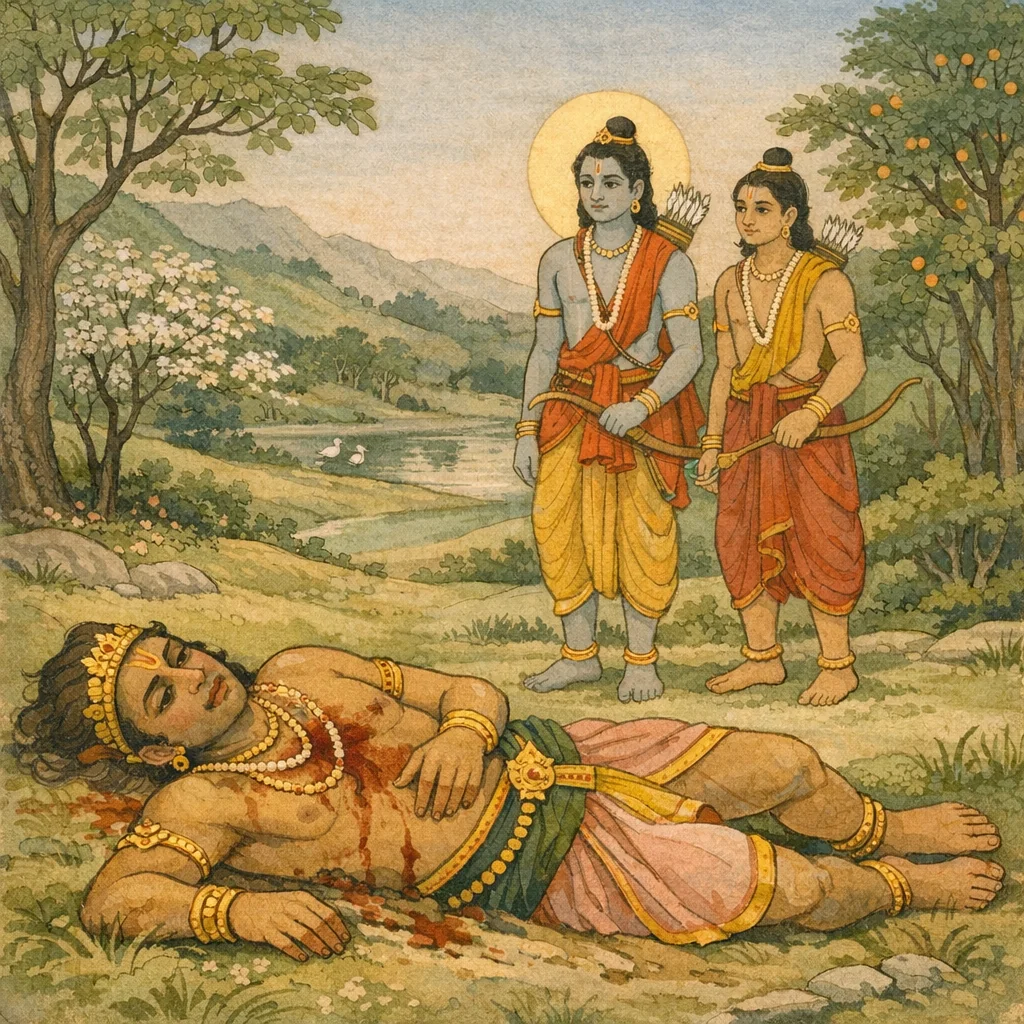
This sarga documents the immediate aftermath of Vālī being struck by Rāma’s arrow: Vālī collapses abruptly “like a felled tree,” and his body is described with sustained heroic imagery—golden ornaments, Indra’s banner simile, and cosmic comparisons (fire without flame, Yayāti fallen from heaven, the Sun cast down at aeon’s end). Rāma, accompanied by Lakṣmaṇa, approaches and observes Vālī’s formidable presence even in defeat. Vālī then delivers an extended, rhetorically sharp dharma-critique: he acknowledges Rāma’s royal lineage and reputed virtues, yet challenges the ethics of being killed while engaged with another (parāṅmukha/indirect killing), framing the act as improper for a kṣatriya and dangerous for royal legitimacy. He contrasts forest-dwelling vānarā life with human kingship, questions motive (land/wealth vs. forest fruits), and invokes norms of punishment, restraint, and truthful governance. Vālī recalls Tārā’s warning (ignored through delusion), asserts he could have recovered Sītā swiftly, and concludes by urging Rāma to reflect and answer. Exhausted and in pain, Vālī falls silent while gazing at Rāma, who is described as radiant like the Sun.
Shlokas
Verse 1
ततश्शरेणाभिहतो रामेण रणकर्कशः।पपात सहसा वाली निकृत्त इव पादपः।।
Then Vālī—fierce and ruthless in battle—was struck by Rāma’s arrow and suddenly fell, like a tree cut down.
Verse 2
स भूमौ न्यस्तसर्वाङ्गस्तप्तकाञ्चनभूषणः।अपतद्देवराजस्य मुक्तरश्मिरिव ध्वजः।।
“It was not proper for you to attack me while I was absorbed in fighting another. Such was the thought that arose in me when I did not see you.”
Verse 3
तस्मिन्निपतिते भूमौ वानराणां गणेश्वरे।नष्टचन्द्रमिव व्योम न व्यराजत भूतलम्।।
When the lord of the monkey hosts fell upon the ground, the earth no longer shone—like the sky when the moon has vanished.
Verse 4
भूमौ निपतितस्यापि तस्य देहं महात्मनः।न श्रीर्जहाति न प्राणा न तेजो न पराक्रमः।।
Even though the great-souled Vāli’s body had fallen to the ground, its splendor did not leave it—nor its life-breath, nor its radiance, nor its valor.
Verse 5
शक्रदत्ता वरा माला काञ्चनी वज्रभूषिता।दधार हरिमुख्यस्य प्राणांस्तेज्शियं च सा।।
That exquisite golden garland—given by Śakra (Indra) and adorned with vajra-like jewels—sustained the life, radiance, and splendor of Vāli, chief of the monkeys.
Verse 6
स तया मालया वीरो हेमया हरियूथपः।सन्ध्यानुगतपर्यन्तः पयोधर इवाभवत्।।
That heroic leader of the monkey-host, adorned with that golden garland, appeared like a rain-cloud edged with the glow of twilight.
Verse 7
तस्य माला च देहश्च मर्मघाती च यश्शरः।त्रिधेव रचिता लक्ष्मीः पतितस्यापि शोभते।।
Even as he lay fallen, a threefold splendor still shone upon him—his garland, his body, and the arrow that had struck his vital parts.
Verse 8
तदस्त्रं तस्य वीरस्य स्वर्गमार्गप्रभावनम्।रामबाणासनक्षिप्तमावहत्परमां गतिम्।।
That weapon—Rāma’s arrow released from the bow—became for that hero a force that opened the path to heaven, bringing him to the highest destiny.
Verse 9
तं तदा पतितं सङ्ख्ये गतार्चिषमिवानलम्।बहुमान्य च तं वीर वीक्षमाणं शनैरिव।।।ययातिमिव पुण्यान्ते देवलोकादिहच्युतम्।आदित्यमिव कालेन युगान्ते भुवि पातितम्।।।महेन्द्रमिव दुर्धर्षंमुपेन्द्रमिव दुस्सहम्।महेन्द्रपुत्रं पतितं वालिनं हेममालिनम्।।।।सिंहोरस्कं महाबाहुं दीप्तास्यं हरिलोचनम्।लक्ष्मणानुगतो रामो ददर्शोपससर्प च।।।।
Then Rāma, followed by Lakṣmaṇa, slowly approached and beheld the fallen Vālin upon the battlefield—like a fire whose flame has gone out; like King Yayāti dropped to earth from the world of gods when his merit was spent; like the sun cast down at the end of an age by the power of time. He was the son of Mahendra (Indra), garlanded with gold—unassailable like Indra, hard to endure like Upendra—lion-chested, mighty-armed, bright-faced, and tawny-eyed.
Verse 10
तं तदा पतितं सङ्ख्ये गतार्चिषमिवानलम्।बहुमान्य च तं वीर वीक्षमाणं शनैरिव।4.17.9।।ययातिमिव पुण्यान्ते देवलोकादिहच्युतम्। आदित्यमिव कालेन युगान्ते भुवि पातितम्।4.17.10।।महेन्द्रमिव दुर्धर्षंमुपेन्द्रमिव दुस्सहम्।महेन्द्रपुत्रं पतितं वालिनं हेममालिनम्।।4.17.11।।सिंहोरस्कं महाबाहुं दीप्तास्यं हरिलोचनम्।लक्ष्मणानुगतो रामो ददर्शोपससर्प च।।4.17.12।।
He lay fallen like Yayāti cast down from the world of the gods when his merit was spent—like the Sun itself hurled to earth by Time at the end of an age.
Verse 11
तं तदा पतितं सङ्ख्ये गतार्चिषमिवानलम्।बहुमान्य च तं वीर वीक्षमाणं शनैरिव।4.17.9।।ययातिमिव पुण्यान्ते देवलोकादिहच्युतम्। आदित्यमिव कालेन युगान्ते भुवि पातितम्।4.17.10।।महेन्द्रमिव दुर्धर्षंमुपेन्द्रमिव दुस्सहम्।महेन्द्रपुत्रं पतितं वालिनं हेममालिनम्।।4.17.11।।सिंहोरस्कं महाबाहुं दीप्तास्यं हरिलोचनम्।लक्ष्मणानुगतो रामो ददर्शोपससर्प च।।4.17.12।।
Vālī—the son of Mahendra, adorned with a golden garland—lay fallen: once unassailable like Indra, and formidable like Upendra.
Verse 12
तं तदा पतितं सङ्ख्ये गतार्चिषमिवानलम्।बहुमान्य च तं वीर वीक्षमाणं शनैरिव।4.17.9।।ययातिमिव पुण्यान्ते देवलोकादिहच्युतम्। आदित्यमिव कालेन युगान्ते भुवि पातितम्।4.17.10।।महेन्द्रमिव दुर्धर्षंमुपेन्द्रमिव दुस्सहम्।महेन्द्रपुत्रं पतितं वालिनं हेममालिनम्।।4.17.11।।सिंहोरस्कं महाबाहुं दीप्तास्यं हरिलोचनम्।लक्ष्मणानुगतो रामो ददर्शोपससर्प च।।4.17.12।।
Rāma, followed by Lakṣmaṇa, saw Vālī—lion-chested, long-armed, radiant-faced, tawny-eyed—and approached him.
Verse 13
तं दृष्ट्वा राघवं वाली लक्ष्मणं च महाबलम्।अब्रवीत्प्रश्रितं वाक्यं परुषं धर्मसंहितम्।।त्वं नराधिपतेः पुत्रः प्रथितः प्रियदर्शनःकुलीनस्सत्त्वसम्पन्न स्तेजस्वी चरितव्रतः।।।।पराङ्मुखवधं कृत्वा कोऽत्र प्राप्तस्त्वया गुणः।यदहं युद्धसंरब्धश्शरेणोरसि ताडित:।।
Seeing Rāghava and the mighty Lakṣmaṇa, Vālī addressed him with words that were both harsh and framed in dharma: “You are the son of a king—renowned, pleasing to behold, noble-born, virtuous, brilliant, and faithful to right conduct. What merit have you gained here by killing one who was not facing you, when I, engaged in battle, was struck in the chest by an arrow?”
Verse 14
तं दृष्ट्वा राघवं वाली लक्ष्मणं च महाबलम्।अब्रवीत्प्रश्रितं वाक्यं परुषं धर्मसंहितम्4.17.13।।त्वं नराधिपतेः पुत्रः प्रथितः प्रियदर्शनःकुलीनस्सत्त्वसम्पन्न स्तेजस्वी चरितव्रतः।।4.17.14।।पराङ्मुखवधं कृत्वा कोऽत्र प्राप्तस्त्वया गुणः।यदहं युद्धसंरब्धश्शरेणोरसि ताडित:4.17.15।।
You are the son of a king—renowned and pleasing to behold; noble-born, rich in virtue, radiant in power, and steadfast in righteous conduct.
Verse 15
तं दृष्ट्वा राघवं वाली लक्ष्मणं च महाबलम्।अब्रवीत्प्रश्रितं वाक्यं परुषं धर्मसंहितम्4.17.13।।त्वं नराधिपतेः पुत्रः प्रथितः प्रियदर्शनःकुलीनस्सत्त्वसम्पन्न स्तेजस्वी चरितव्रतः।।4.17.14।।पराङ्मुखवधं कृत्वा कोऽत्र प्राप्तस्त्वया गुणः।यदहं युद्धसंरब्धश्शरेणोरसि ताडित:4.17.15।।
“Having killed one who was turned away, what merit have you gained by it? For I, while fully engaged in battle, was struck in the chest by your arrow.”
Verse 16
रामः करुणवेदी च प्रजानां च हिते रतः।सानुक्रोशो जितोत्साहस्समयज्ञो दृढव्रतः।।4.17.16।।इति ते सर्वभूतानि कथयन्ति यशो भुवि।।4.17.17।।
“Rāma is known as one who understands compassion, who is devoted to the welfare of the people—tender-hearted, steadfast in effort, discerning of proper occasion, and firm in his vows.”
Verse 17
रामः करुणवेदी च प्रजानां च हिते रतः।सानुक्रोशो जितोत्साहस्समयज्ञो दृढव्रतः।।4.17.16।।इति ते सर्वभूतानि कथयन्ति यशो भुवि।।4.17.17।।
“Thus do all beings in the world speak of your fame.”
Verse 18
दमश्शमः क्षमा धर्मो धृतिस्सत्यं पराक्रमः।पार्थिवानां गुणा राजन्दण्डश्चाप्यपराधिषु।।
“O king, self-restraint, inner composure, forbearance, righteousness, steadfastness, truthfulness, and valor—these are the virtues of rulers; and punishment too, toward offenders.”
Verse 19
तान्गुणान्सम्प्रधार्याहमग्र्यं चाभिजनं तव।तारया प्रतिषिद्धोऽपि सुग्रीवेण समागतः।।
“Considering those virtues—and your foremost noble lineage—I came to face Sugrīva, even though Tārā warned me against it.”
Verse 20
न मामन्येन सम्रब्धं प्रमत्तं योद्धु मर्हसि।इति मे बुद्धिरुत्पन्ना बभूवादर्शने तव4.17.20।।
“It was not proper for you to attack me while I was absorbed in fighting another. Such was the thought that arose in me when I did not see you.”
Verse 21
न त्वां विनिहतात्मानं धर्मध्वजमधार्मिकम्।जाने पापसमाचारं तृणैः कूपमिवावृतम्।।
“I did not know you to be one who has slain his own conscience—unrighteous though bearing the banner of dharma—sinful in conduct, like a well whose mouth is hidden by grass.”
Verse 22
सतां वेषधरं पापं प्रच्छन्नमिव पावकम्।नाहं त्वामभिजानामि धर्मच्छद्माभिसंवृतम्।।
“I did not recognise you as a sinner wearing the guise of the good—like fire concealed—covered over by dharma as a mere pretext.”
Verse 23
विषये वा पुरे वा ते यदा पापं करोम्यहम्।न च त्वामवजाने च कस्मात्त्वं हंस्यकिल्बिषम्।।फलमूलाशनं नित्यं वानरं वनगोचरम्।मामिहाप्रतियुध्यन्तमन्येन च समागतम्।।
“When have I ever committed any wrong in your realm or in your city? Nor have I slighted you. Why then do you kill me—one without offense—an ape who lives always on fruits and roots and ranges in the forest? Here I was not fighting you at all, but engaged with another.”
Verse 24
विषये वा पुरे वा ते यदा पापं करोम्यहम्।न च त्वामवजाने च कस्मात्त्वं हंस्यकिल्बिषम्4.17.23।।फलमूलाशनं नित्यं वानरं वनगोचरम्।मामिहाप्रतियुध्यन्तमन्येन च समागतम्4.17.24।।
I am a forest-roaming monkey, always living on fruits and roots. Here I was not even fighting you; I was engaged with another—why did you come against me?
Verse 25
त्वं नराधिपतेः पुत्रः प्रतीतः प्रियदर्शनः।लिङ्गमप्यस्ति ते राजनन्दृश्यते धर्मसंहितम्।।
You are the son of a king—well known and fair to behold. Indeed, O prince, the marks of one aligned with dharma are seen in you.
Verse 26
कः क्षत्रियकुले जात्शृतवान्नष्टसंशयः।धर्मलिङ्गप्रतिच्छन्न क्रूरं कर्म समाचरेत्।।
Who, born in a kṣatriya lineage, learned in sacred teaching and free from doubt, would commit a cruel deed while hiding behind the outward signs of righteousness?
Verse 27
राम राजकुले जातो धर्मवानिति विश्रुतः।।।।अभव्यो भव्यरूपेण किमर्थं परिधावसि।
Rāma, you are born in a royal house and famed as righteous. Why do you move about in the guise of the noble while acting in a way unworthy of it?
Verse 28
साम दानं क्षमा धर्मस्सत्यं धृतिपराक्रमौ।पार्थिवानां गुणा राजन् दण्डश्चाप्यपराधिषु।।
Conciliation, generosity, forbearance, righteousness, truth, steadfast courage—and also punishment toward offenders: these are the recognized qualities of kings, O prince.
Verse 29
वयं वनचरा राम मृगा मूलफलाशना:।एषा प्रकृतिरस्माकं पुरुषस्त्वं नरेश्वरः।।
We are forest-dwellers, Rāma—mere beasts living on roots and fruits; such is our nature. But you are a man, a lord among men.
Verse 30
भूमिर्हिरण्यं रूप्यं च विग्रहे कारणानि च।अत्र कस्ते वने लोभो मदीयेषु फलेषु वा।।
Land, gold, and silver—these are common causes of conflict. But here in the forest, what greed could you have—was it for my possessions, or for these fruits?
Verse 31
नयश्च विनयश्चोभौ निग्रहानुग्रहावपि।।राजवृत्तिरसङ्कीर्णा न नृपाः कामवृत्तयः।
Policy and humility—along with restraint and favor—each has its proper place. The king’s conduct must not be confused or disorderly; kings must not act by mere impulse and desire.
Verse 32
त्वं तु कामप्रधानश्च कोपनश्चानवस्थितः।।राजवृत्तेश्च सङ्कीणश्शरासनपरायणः।
Policy and humility—along with restraint and favor—each has its proper place. The king’s conduct must not be confused or disorderly; kings must not act by mere impulse and desire.
Verse 33
न तेऽस्त्यपचितिर्धर्मे नार्थे बुद्धिरवस्थिता।।इन्द्रियैः कामवृत्तस्सन्कृष्यसे मनुजेश्वर।
O lord of men, you show no reverence for dharma, nor is your judgment steady even regarding worldly aims; driven by sense-desires, you are being dragged along by your own senses.
Verse 34
हत्वा बाणेन काकुत्स्थ मामिहानपराधिनम्।।किं वक्ष्यसि सतां मध्ये कर्म कृत्वा जुगुप्सितम्।
O scion of Kakutstha, having killed me here with an arrow though I had done you no wrong, and having committed a deed that is shameful—what will you say in your defense among the righteous?
Verse 35
राजहा ब्रह्महा गोघ्नश्चोरः प्राणिवधे रतः।।नास्तिकः परिवेत्ता च सर्वे निरयगामिनः।
A killer of a king, a slayer of a brāhmaṇa, a killer of cows, a thief, one who delights in taking life, an atheist, and one who violates the proper order of marriage—such people all go to hell.
Verse 36
सूचकश्च कदर्यश्च मित्रघ्नो गुरुतल्पगः4.17.36।।लोकं पापात्मनामेते गच्छन्ते नात्र संशयः।
A slanderer, a miser, a killer of a friend, and one who violates the guru’s bed—such people go to the realm of sinners; of this there is no doubt.
Verse 37
अधार्यं चर्म मे सद्भी रोमाण्यस्थि च वर्जितम्।अभक्ष्याणि च मांसानि त्वद्विधैर्धर्मचारिभिः।।
My hide is not to be worn by the virtuous; my hair and even my bones are forbidden for use. My flesh too is not fit to be eaten by righteous men such as you.
Verse 38
पञ्च पञ्च नखा भक्ष्या ब्रह्मक्षत्रेण राघव।।शल्यक श्श्वाविधो गोधा शशः कूर्मश्च पञ्चमः।
O Rāghava, for brāhmaṇas and kṣatriyas only five ‘five-nailed’ creatures are permitted as food: the porcupine, the hedgehog, the godhā, the hare, and the tortoise as the fifth.
Verse 39
चर्म चास्थि च मे राजन् नस्पृशन्ति मनीषिणः।।अभक्ष्याणि च मांसानि सोऽहं पञ्चनखो हतः।
O king, the wise do not even touch my hide or bones, and my flesh is not fit to be eaten—yet I, a five-nailed creature, have been killed.
Verse 40
तारया वाक्यमुक्तोऽहं सत्यं सर्वज्ञया हितम्।।तदतिक्रम्य मोहेन कालस्य वशमागतः।
Tārā—who knew the truth—spoke to me words that were true and meant for my welfare; but, overruling them in delusion, I have come under the power of Time (Death).
Verse 41
त्वया नाथेन काकुत्स्थ न सनाथा वसुन्धरा।प्रमदा शीलसम्पन्ना धूर्तेन पतिना यथा।।
O Kakutstha, with you as her lord, the earth is not truly protected—just as a virtuous woman cannot be safeguarded by a deceitful husband.
Verse 42
शठो नैकृतिकः क्षुद्रो मिथ्याप्रश्रितमानसः।कथं दशरथेन त्वं जातः पापो महात्मना।।
You are treacherous, dishonest, and base—your mind masked with false humility. How could a sinner like you have been born of the high-souled Daśaratha?
Verse 43
छिन्नचारित्रकक्ष्येण सतां धर्मातिवर्तिना।त्यक्तधर्माङ्कुशेनाहं निहतो रामहस्तिना।।
By one who has snapped the restraints of good conduct and transgressed the dharma upheld by the righteous—casting aside the goad of self-restraint—I have been slain by the elephant-like Rāma.
Verse 44
अशुभं चाप्ययुक्तं च सतां चैव विगर्हितम्।वक्ष्यसे चेदृशं कृत्वा सद्भिस्सह समागतः।।
This deed is inauspicious, improper, and condemned by the virtuous. After doing such a thing, what will you say when you stand among noble people and are questioned?
Verse 45
उदासीनेषु योऽस्मासु विक्रमऽस्ते प्रकाशितः।अपकारिषु ते राजन्नहि पश्यामि विक्रमम्।।
O king, the valor you displayed against us—who were not your enemies—this I see. But against those who truly wrong you, I do not see such valor.
Verse 46
दृश्यमानस्तु युद्ध्येथा मया यदि नृपात्मज।अद्य वैवस्वतं देवं पश्येस्त्वं निहतो मया।।
O prince, if you had fought me openly, face to face, then today—slain by me—you would have seen Vaivasvata, the lord of death.
Verse 47
त्वयाऽदृश्येन तु रणे निहतोऽहं दुरासदः।प्रसुप्तः पन्नगेनेव नरः पानवशं गतः।।
But I—an unassailable warrior—have been killed in battle by you while you were unseen, like a man overcome by drink and fast asleep, struck down by a serpent.
Verse 48
मामेव यदि पूर्वं त्वमेतदर्थमचोदयः।।मैथिलीमहमेकाह्ना तव चानीतवान्भवेत्।सुग्रीवप्रियकामेन यदहं निहतस्त्वया।कण्ठे बद्ध्वा प्रदद्यां ते निहतं रावणं रणे।।
If earlier you had approached me for this purpose, I could have brought Maithilī back to you within a single day. Since you have killed me to please Sugrīva, know that I would even have slain Rāvaṇa in battle and handed him over to you, bound by the neck.
Verse 49
मामेव यदि पूर्वं त्वमेतदर्थमचोदयः4.17.48।।मैथिलीमहमेकाह्ना तव चानीतवान्भवेत्।सुग्रीवप्रियकामेन यदहं निहतस्त्वया।कण्ठे बद्ध्वा प्रदद्यां ते निहतं रावणं रणे4.17.49।।
Even if Maithilī were concealed in the waters of the ocean or even in the underworld, I could bring her back at your command—just as Śvetā was brought back for Aśvatarī.
Verse 50
न्यस्तां सागरतोये वा पाताले वापि मैथिलीम्।आनयेयं तवादेशाच्छ्वेतामश्वतरीमिव।।
Even if Maithilī were concealed in the waters of the ocean or even in the underworld, I could bring her back at your command—just as Śvetā was brought back for Aśvatarī.
Verse 51
युक्तं यत्प्राप्नुयाद्राज्यं सुग्रीवस्स्वर्गते मयि।अयुक्तं यदधर्मेण त्वयाऽहं निहतो रणे।।
It is proper that Sugrīva should obtain the kingdom after I have gone to heaven. But it is not proper that you have slain me in battle by unrighteous means.
Verse 52
काममेवं विधो लोकः कालेन विनियुज्यते।क्षमं चेद्भवता प्राप्तमुत्तरं साधु चिन्त्यताम्।।
Indeed, the world meets death when its appointed time arrives. You have obtained my death by hiding yourself—if you think that is proper, then reflect well and give your answer.
Verse 53
इत्येवमुक्त्वा परिशुष्कवक्त्रःशराभिघाताद्व्यथितो महात्मा।समीक्ष्य रामं रविसन्निकाशंतूष्णीं बभूवामरराजसूनुः।।
Having spoken thus, the great Vālin—his mouth parched and his body wracked with pain from the arrow’s blow—gazed intently at Rāma, radiant like the sun, and then fell silent, he who was the son of the lord of the gods (Indra).
Frequently Asked Questions
The core dilemma is the legitimacy of Rāma killing Vālī indirectly while Vālī is engaged with another combatant; Vālī frames this as parāṅmukha/indirect killing and challenges whether such an act aligns with kṣatriya conduct and rāja-dharma.
The sarga models dharma-inquiry as public accountability: power must justify its violence through articulated norms (restraint, punishment of offenders, truthfulness), and ignoring wise counsel (as Vālī admits regarding Tārā) precipitates irreversible karmic and political outcomes.
Culturally, the text references Devaloka, ocean waters, and Pātāla as cosmographic spaces to stress capability and loss; it also records a dharma-rule on permissible “five-nailed” animals (pañcanakhāḥ), reflecting normative cultural-legal discourse embedded in the narrative.