Sarga 16
वालिवधः — The Slaying of Vali
किष्किन्धाकाण्ड
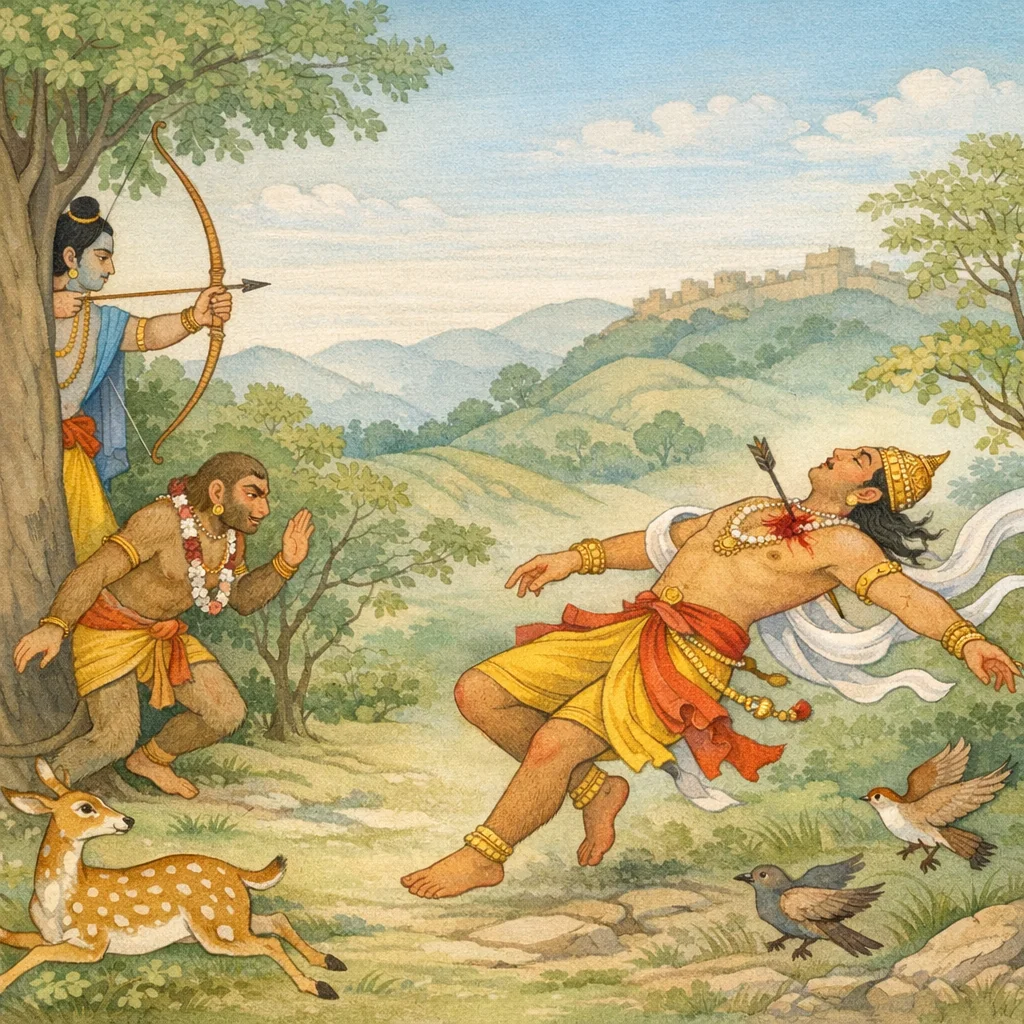
अस्मिन् सर्गे तारा वालिं निवर्तयितुं प्रयत्नं करोति, किन्तु वाली स्वमान-क्षत्रधर्मसदृश-युद्धधर्मं प्रतिपादयन् सुग्रीवस्य गर्जितं ‘अपमान’ इव मन्यते तथा प्रतिज्ञां करोति—सुग्रीवं जित्वा एव निवर्तिष्य इति। तारा प्रियवाक्या सन् परिष्वज्य प्रदक्षिणं कृत्वा स्वस्त्ययन-मन्त्रैः विजयाशंसा च कृत्वा अन्तःपुरं प्रविशति। ततः वाली क्रुद्धः नगरान्निर्गत्य शत्रुदर्शनकाङ्क्षया दिशो विलोकयन् सुग्रीवं ददर्श; उभौ मुष्टिमुद्यम्य, वृक्ष-प्रहारैः नख-मुष्टि-पद-जानु-बाहु-प्रयोगैश्च घोरं युद्धं कुर्वन्तौ वर्ण्येते—वृत्र-वासवयोरिव, चन्द्र-सूर्ययोरिव च उपमानैः। युद्धे वालिना बलवृद्धिः, सुग्रीवस्य हीयमानता च दृश्यते; रामः सुग्रीवस्य संकटं निरीक्ष्य धनुषि आशीविषोपमं शरं सन्धाय, ज्यातलघोषेण वन्यजीवान् त्रासयन्, महाबाणं मुक्त्वा वालिवक्षसि पातयति। तेन वाली रक्तसिक्तः भूमौ पतति—इन्द्रध्वजोपमा, अशोकवृक्षोपमा च पतनवर्णने प्रयुज्यते। सर्गः मित्रधर्म-रणनीति-धर्मसङ्कट-प्रसङ्गस्य निर्णायकबिन्दुं स्थापयति, यतः सुग्रीवराज्यस्थापनाय मार्गः प्रशस्तः भवति।
Shlokas
Verse 1
तामेवं ब्रुवतीं तारां ताराधिपनिभाननाम्।वाली निर्भर्त्सयामास वचनं चेदमब्रवीत्4.16.1।।
As Tara—moon-faced like the lord of stars—spoke in this manner, Vāli rebuked her and replied with these words.
Verse 2
गर्जतोऽस्य च सुसम्भ्रश्च भ्रातुः शत्रोर्विशेषतः।मर्षयिष्याम्यहं केन कारणेन वरानने4.16.2।।
"O fair-faced one, for what reason should I endure this enemy—who is in truth my own brother—especially as he roars in heated excitement?"
Verse 3
अधर्षितानां शूराणां समरेष्वनिवर्तिनाम्।धर्षणामर्षणं भीरु मरणादतिरिच्यते4.16.3।।
O timid one, for heroes who are unconquered and who do not turn back in battle, enduring humiliation is worse than death.
Verse 4
सोढुं न च समर्थोऽहं युद्धकामस्य संयुगे।सुग्रीवस्य च सम्रम्भं हीनग्रीवस्य गर्जतः4.16.4।।
“I am not able to endure, on the battlefield, the agitation and challenge of Sugrīva—this weak-necked one—when he roars, eager for combat.”
Verse 5
न च कार्यो विषादस्ते राघवं प्रति मत्कृते।धर्मज्ञश्च कृतज्ञश्च कथं पापं करिष्यति4.16.5।।
“Do not grieve on my account with regard to Rāghava. How could he—one who knows dharma and is grateful—commit a sinful act?”
Verse 6
निवर्तस्व सह स्त्रीभिः कथं भूयोऽनुगच्छसि।सौहृदं दर्शितं तारे मयि भक्ति: कृता त्वया4.16.6।।
Return now, together with the women. Why do you follow me again? O Tārā, your goodwill is already shown, and your devotion toward me is firmly established.
Verse 7
प्रतियोत्स्याम्यहं गत्वा सुग्रीवं जहि सम्भ्रमम्।दर्पमात्रं विनेष्यामि न च प्राणैर्विमोक्ष्यते4.16.7।।
I will go and meet Sugrīva’s challenge in combat—give up your fear. I shall crush only his arrogance; he will not be deprived of his life.
Verse 8
अहं ह्याजौस्थितस्यास्य करिष्यामि यथेप्सितम्।वृक्षैर्मुष्टिप्रहारैश्च पीडितः प्रतियास्यति4.16.8।।
When he stands before me on the battlefield, I will do as I wish: battered by trees and by blows of my fists, he will retreat.
Verse 9
न मे गर्वितमायस्तं सहिष्यति दुरात्मवान्।कृतं तारे सहांयत्वं सौहृदं दर्शितं मयि4.16.9।।
That ill-intentioned one will not endure my proud, relentless blows. O Tārā, you have rendered help and have shown your affection toward me.
Verse 10
शापिताऽपि मम प्राणैर्निवर्तस्व जयेन च।अहं जित्वा निवर्तिष्ये तमहं भ्रातरं रणे4.16.10।।
“Even if I must stake my very life, and my victory as well—return. I will come back only after I have defeated that brother of mine in battle.”
Verse 11
तं तु तारा परिष्वज्य वालिनं प्रियवादिनी।चकार रुदती मन्दं दक्षिणा सा प्रदक्षिणम्4.16.11।।
Then Tara—gentle of speech—embraced Vāli; weeping softly, she obediently circumambulated him in farewell.
Verse 12
ततः स्वस्त्ययनं कृत्वा मन्त्रविद्विजयैषिणी।अन्तःपुरं सह स्त्रीभिः प्रविष्टा शोकमोहिता4.16.12।।
After uttering auspicious blessings—she, skilled in sacred formulas and wishing him victory—Tara, overcome by grief, entered the inner chambers with the other women.
Verse 13
प्रविष्टायां तु तारायां सह स्त्रीभिस्स्वमालयम्।नगरान्निर्ययौ क्रुद्धो महासर्प इव श्वसन्4.16.13।।
When Tara had gone back to her dwelling with the women, Vāli—still enraged—went out from the city, breathing hard like a great serpent.
Verse 14
स निश्श्वस्य महातेजा वाली परमरोषणः।सर्वतश्चारयन् दृष्टिं शत्रुदर्शनकाङ्क्षया4.16.14।।
Breathing heavily, the radiant Vāli—seized with intense anger—cast his gaze in every direction, eager to catch sight of his enemy.
Verse 15
स ददर्श ततश्श्रीमान् सुग्रीवं हेमपिङ्गलम्।सुसंवीतमवष्टब्धं दीप्यमानमिवानलम्4.16.15।।
Then the splendid Vāli saw Sugrīva—golden-reddish in hue—well-prepared and steady for battle, blazing like fire.
Verse 16
स तं दृष्ट्वा महावीर्यं सुग्रीवं पर्यवस्थितम्।गाढं परिदधे वासो वाली परमरोषण:4.16.16।।
Seeing mighty Sugrīva standing firm, Vāli—burning with rage—tightened and secured his garment, preparing himself for combat.
Verse 17
स वाली गाढसंवीतो मुष्टिमुद्यम्य वीर्यवान्।सुग्रीवमेवाभिमुखो ययौ योद्धुं कृतक्षणः4.16.17।।
With his garment tightly fastened, the valiant Vāli raised his fist and strode straight toward Sugrīva, impatient for the moment to fight.
Verse 18
श्लिष्टं मुष्टिं समुद्यम्य संरब्धतरमागतः।सुग्रीवोऽपि समुद्दिश्य वालिनं हेममालिनम्4.16.18।।
Sugrīva too, with his fist clenched tight, advanced with even greater agitation, aiming himself at Vāli adorned with a golden garland.
Verse 19
तं वाली क्रोधताम्राक्षस्सुग्रीवं रणपण्डितम्।आपतन्तं महावेगमिदं वचनमब्रवीत्4.16.19।।
As Sugrīva—the skilled warrior—rushed forward at great speed, Vāli, his eyes reddened with anger, spoke these words to him.
Verse 20
एष मुष्टिर्मयाबद्धो गाढस्सन्निहिताङ्गुलिः।मया वेगविमुक्तस्ते प्राणानादाय यास्यति4.16.20।।
"This fist of mine is clenched tight, the fingers pressed close; once I hurl it with force, it will depart only after taking away your life."
Verse 21
एवमुक्तस्तु सुग्रीवः क्रुद्धो वालिनमब्रवीत्।तवैव चा हरन्प्राणान्मुष्टिः पततु मूर्धनि4.16.21।।
Thus addressed, Sugrīva—angered—answered Vāli: "Let my fist fall upon your head and take away your very life."
Verse 22
ताडितस्तेन सङ्कृद्धस्समभिक्रम्य वेगितः।अभवच्छोणितोद्गारी सोत्पीड इव पर्वतः4.16.22।।
Struck by him, Sugrīva—enraged—rushed back into the encounter with speed; streaming with blood, he looked like a mountain with red torrents bursting forth.
Verse 23
सुग्रीवेण तु निस्सङ्गं सालमुत्पाट्य तेजसा।गात्रेष्वभिहतो वाली वज्रेणेव महागिरिः4.16.23।।
With forceful vigor, Sugrīva uprooted a sāla tree and struck Vālin on his limbs—like a thunderbolt striking a great mountain.
Verse 24
स तु वाली प्रचलितस्सालताडनविह्वलः।गुरुभारसमाक्रान्तो नौ सार्थ इव सागरे4.16.24।।
Struck and shaken by the blows of the sāla tree, Vālin reeled—like a merchant ship, heavy with cargo, tossed about in the ocean.
Verse 25
तौ भीमबलविक्रान्तौ सुपर्णसमवेगिनौ।प्रवृद्धौ घोरवपुषौ चन्द्रसूर्याविवाम्बरे।परस्परममित्रघ्नौ च्छिद्रान्वेषणतत्परौ4.16.25।।
Both, possessed of dreadful strength and prowess, swift as Garuḍa, grew ever more formidable—like the sun and moon in the sky—each intent on striking down the other and searching for an opening.
Verse 26
ततोऽवर्धत वाली तु बलवीर्यसमन्वितः।सूर्यपुत्रो महावीर्यस्सुग्रीवः परिहीयते4.16.26।।
Then Vālin, endowed with strength and valor, began to dominate; while mighty Sugrīva, son of the Sun, started to lose ground.
Verse 27
वालिना भग्नदर्पस्तु सुग्रीवो मन्दविक्रमः।वालिनं प्रति सामर्षो दर्शयामास लाघवम्4.16.27।।
With his pride broken by Vālin and his prowess diminished, Sugrīva—burning with anger—displayed quickness and tactical nimbleness against him.
Verse 28
वृक्षैः स्सशाखै स्सशिखैर्वज्रकोटिनिभैर्नखैः4.16.28।।मुष्टिभिर्जानुभिः पद्भिर्बाहुभिश्च पुनः पुनः।तयोर्युद्धमभूद्घोरं वृत्रवासवयोरिव4.16.29।।
Again and again they struck one another—using trees with branches and tops, with nails hard like thunderbolt-points, and with fists, knees, feet, and arms. Their combat became terrifying, like that of Vṛtra and Vāsava (Indra).
Verse 29
वृक्षैः स्सशाखै स्सशिखैर्वज्रकोटिनिभैर्नखैः4.16.28।।मुष्टिभिर्जानुभिः पद्भिर्बाहुभिश्च पुनः पुनः।तयोर्युद्धमभूद्घोरं वृत्रवासवयोरिव4.16.29।।
Again and again they struck one another—using trees with branches and tops, with nails hard like thunderbolt-points, and with fists, knees, feet, and arms. Their combat became terrifying, like that of Vṛtra and Vāsava (Indra).
Verse 30
तौ शोणिताक्तौ युध्येतां वानरौ वनचारिणौ।मेघाविव महाशब्दै स्तर्जमानौ परस्परम्4.16.30।।
Those two forest-roaming monkeys, smeared with blood, continued to clash—thundering at each other with loud roars like two clouds.
Verse 31
हीयमानमथोऽपश्यत्सुग्रीवं वानरेश्वरम्।वीक्षमाणं दिशश्चैव राघवस्स मुहुर्मुहुः4.16.31।।
Then Rāghava noticed Sugrīva, lord of the monkeys, weakening—and again and again glancing toward the directions, as if seeking help.
Verse 32
ततो रामो महातेजा आर्तं दृष्ट्वा हरीश्वरम्।शरं च वीक्षते वीरो वालिनो वधकारणात् 4.16.32।।
Then the heroic Rāma, brilliant in energy, seeing the lord of monkeys in distress, looked toward his arrow—intent on Vāli’s death as the cause for ending that suffering.
Verse 33
ततो धनुषि सन्धाय शरमाशीविषोपमम्।पुरयामास तच्चापं कालचक्रमिवान्तकः4.16.33।।
Then, fixing upon his bow an arrow like a venomous serpent, he drew that bow fully—like Death himself setting in motion the wheel of time.
Verse 34
तस्य ज्यातलघोषेण त्रस्ताः पत्ररथेश्वराः।प्रदुद्रुवुर्मृगाश्चैव युगान्त इव मोहिताः4.16.34।।
At the sharp twang of his bowstring, birds and beasts fled in terror in every direction, as though bewildered at the world’s end.
Verse 35
मुक्तस्तु वज्रनिर्घोष: प्रदीप्ताशनिसन्निभः।राघवेण महाबाणो वालिवक्षसि पातितः4.16.35।।
Released by Rāghava, the great arrow—thundering like a vajra and blazing like lightning—struck into Vāli’s chest.
Verse 36
ततस्तेन महातेजा वीयौटत्सिक्तः कपीश्वरः।वेगेनाभिहतो वाली निपपात महीतले4.16.36।।
Then Vāli, the radiant lord of monkeys, proud of his strength, was struck with that arrow’s speed and fell upon the earth.
Verse 37
इन्द्रध्वज इवोद्धूतः पौर्णमास्यां महीतले।आश्वयुक्समये मासि गतश्रीको विचेतनः4.16.37।।
Lustreless and unconscious, he lay on the ground—like Indra’s festival banner cast down on the full-moon day in the month of Āśvayuja.
Verse 38
नरोत्तमः कालयुगान्तकोपमंशरोत्तमं काञ्चनरूप्यभुषितम्।ससर्ज दीप्तं तममित्रमर्दनंसधूममग्निं मुखतो यथा हरः4.16.38।।
That best of men released a peerless arrow, like the wrath of time at the age’s end—adorned with gold and silver, blazing and enemy-crushing—like smoky fire issuing from Hara’s mouth.
Verse 39
Then Vāsava’s son, drenched by streams of blood, fell unconscious in the battle—like a fully blossomed aśoka tree shaken by the wind, like Indra’s banner toppled down upon the earth.
Frequently Asked Questions
The pivotal action is Rama’s concealed intervention: he releases an arrow that strikes Vali during Vali’s duel with Sugriva. The episode is framed as a strategic act to uphold an alliance and restore order, while simultaneously generating a dharma-sankat concerning fairness in combat and royal responsibility.
Vali articulates a warrior’s ethic where enduring insult is worse than death for the battle-resolute, while Tara embodies prudent counsel and ritual propriety (embrace, pradakshina, svastyayana). The chapter juxtaposes personal valor with the limits of rage, showing how political outcomes often turn on disciplined decision-making rather than mere strength.
Kishkindha’s urban space and the antahpura (inner apartments) mark the courtly setting; the forest battlefield is implied through the use of uprooted trees (notably the sala). Cultural markers include svastyayana mantras, pradakshina, and the Indra-dhvaja and Aswayuja full-moon imagery used to contextualize Vali’s fall.