Sarga 14
किष्किन्धायां सुग्रीवस्य नादः — Sugriva’s War-Cry at Kishkindha
किष्किन्धाकाण्ड
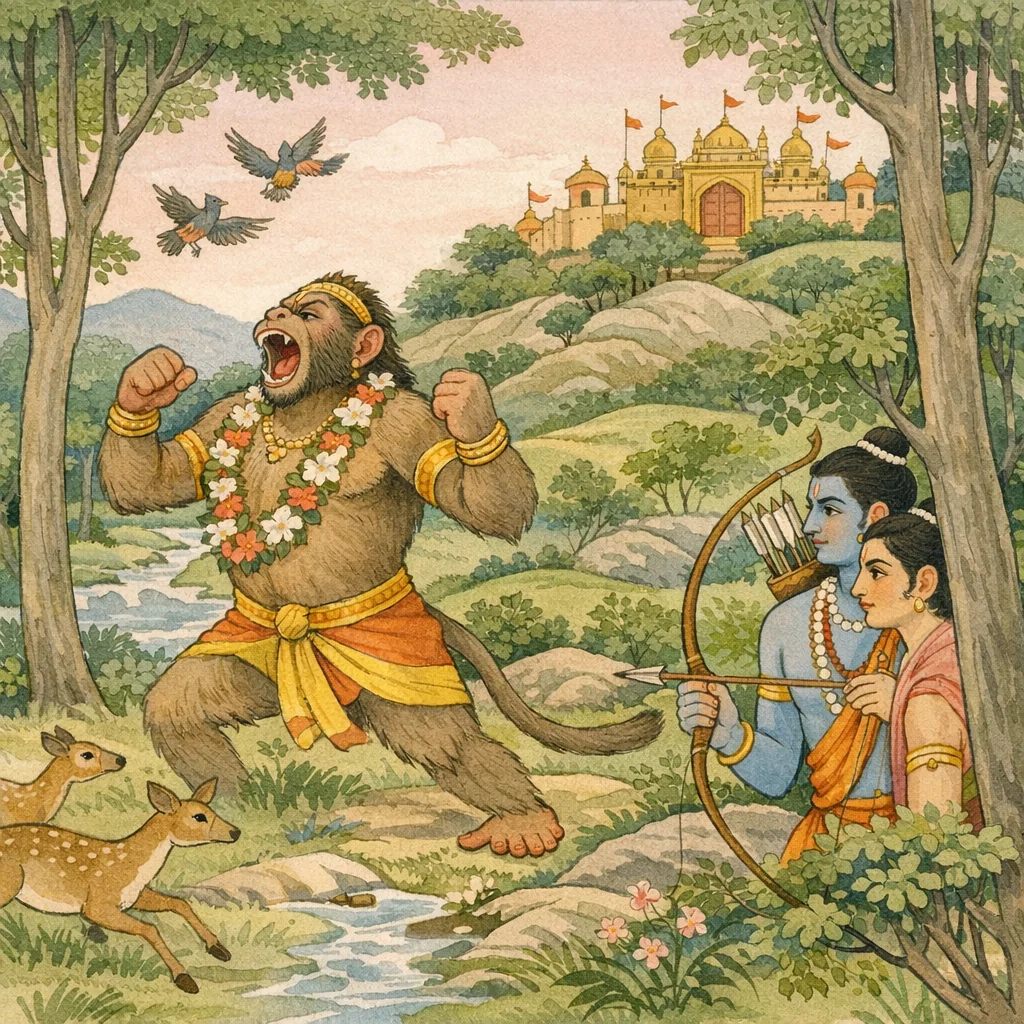
Sarga 14 stages the tactical approach to Kiṣkindhā and formalizes the identification-and-engagement protocol before the duel with Vāli. The party reaches Kiṣkindhā ruled by Vāli and waits concealed in a dense forest behind trees (4.14.1). Sugrīva scans the surroundings and becomes intensely enraged (4.14.2), then issues a terrifying challenge-roar, surrounded by companions, likened to a great cloud driven by wind, as if splitting the sky (4.14.3). Sugrīva reports arrival at Vāli’s fortified capital—marked by golden archways and flags—and urges Rāma to fulfill the earlier vow to kill Vāli when the time is ripe (4.14.5–6). Rāma replies with operational assurances: Lakṣmaṇa has placed a gaja-creeper garland on Sugrīva’s neck as an identification mark in combat (4.14.8–9). Rāma promises to dispel Sugrīva’s fear and enmity with a single arrow (4.14.10), asks Sugrīva to show the ‘enemy in a brother’s form’ (4.14.11), and asserts he will not let Vāli escape alive once in sight—so blame will not attach to Rāma (4.14.12). He cites the prior demonstration of piercing seven sāla trees with one arrow as proof of capability (4.14.13), affirms truthfulness bound to dharma (4.14.14), and vows to make his promise fruitful like Indra’s timely rain (4.14.15). Rāma then instructs Sugrīva to raise the specific summoning cry that will draw out Vāli adorned with a golden garland (4.14.16–17). The text generalizes warrior psychology—heroes do not tolerate a challenge, especially before women (4.14.18). Sugrīva roars accordingly (4.14.19), producing ecological and social imagery: cows scatter like unprotected noblewomen; deer falter like wounded horses; birds drop like merit-exhausted planets (4.14.20–21). The sarga closes with an intensified poetic simile: Sugrīva’s roar resembles thundercloud clusters and wind-whipped ocean waves (4.14.22), preparing the narrative for Vāli’s emergence and the decisive confrontation.
Shlokas
Verse 1
सर्वे ते त्वरितं गत्वा किष्किन्धां वालि पालिताम्।वृक्षैरात्मानमावृत्य व्यतिष्ठन् गहने वने4.14.1।।
All of them hurried to Kiṣkindhā, ruled by Vāli, and in the dense forest they concealed themselves behind trees and waited.
Verse 2
विचार्य सर्वतो दृष्टिं कानने काननप्रियः।सुग्रीवो विपुलग्रीवः क्रोधमाहारयद्भृशम्4.14.2।।
After scanning the forest all around, Sugriva—broad-necked and fond of the woodland—was seized by intense anger.
Verse 3
ततस्स निनदं घोरं कृत्वा युद्धाय चाह्वयत्।परिवारैः परिवृतो नादैर्भिन्दन्निवाम्बरम्4.14.3।।गर्जन्निव महामेघो वायुवेगपुरस्सरः।
Then, surrounded by his companions, he let out a terrifying roar and challenged (Vali) to combat—his cries seeming to split the sky, like a great cloud thundering as it drives forward with the speed of the wind.
Verse 4
अथ बालार्कसदृशो दृप्तसिंहगतिस्तदा4.14.4।।दृष्ट्वा रामं क्रियादक्षं सुग्रीवो वाक्यमब्रवीत्।
Then Sugriva—radiant like the rising sun and moving with the proud gait of a lion—seeing Rama, skilled in decisive action, spoke these words.
Verse 5
हरिवागुरया व्याप्तां तप्तकाञ्चनतोरणाम्।प्राप्ताः स्म ध्वजयन्त्राढ्यां किष्किन्धां वालिनः पुरीम्।।4.14.5।।
“We have reached Kishkindha, Vali’s city—crowded with monkeys like a net laid for capture, adorned with gleaming golden gateways, and rich with flag-masts and devices.”
Verse 6
प्रतिज्ञा या त्वया वीर कृता वालिवधे पुरा।सफलां कुरु तां क्षिप्रं लतां काल इवागतः4.14.6।।
O hero, make fruitful—quickly—the vow you once made to slay Vāli; for the right time has arrived, like the season in which a creeper bears its fruit.
Verse 7
एवमुक्तस्तु धर्मात्मा सुग्रीवेण स राघवः।तमेवोवाच वचनं सुग्रीवं शत्रुसूदनः4.14.7।।
Thus addressed by Sugrīva, righteous Rāghava—slayer of foes—spoke these very words in reply to Sugrīva.
Verse 8
कृताभिज्ञानचिह्नस्त्व मनया गजसाह्वया।लक्ष्मणेन समुत्पाट्य यैषा कण्ठे कृता तव4.14.8।।
You have now been marked for recognition: Lakṣmaṇa uprooted this gaja-named creeper and fastened it upon your neck.
Verse 9
शोभसेऽह्यधिकं वीर लतया कण्ठसक्तया।विपरीत इवाकाशे सूर्यो नक्षत्रमालया4.14.9।।
Indeed, O hero, you shine all the more with that creeper fastened upon your neck—like a radiant orb in the sky adorned with a garland of stars.
Verse 10
अद्य वालिसमुत्थं ते भयं वैरं च वानर।एकेनाहं प्रमोक्ष्यामि बाणमोक्षेण संयुगे4.14.10।।
“O Vānara, today in battle I will free you from the fear and hostility born of Vāli—by the release of a single arrow.”
Verse 11
मम दर्शय सुग्रीव वैरिणं भ्रातृरूपिणम्।वाली विनिहतो यावद्वने पांसुषु वेष्टते4.14.11।।
“Sugrīva, point out to me that enemy who wears the guise of a brother—Vāli—so that, once struck down, he will lie rolling in the forest dust.”
Verse 12
यदि दृष्टिपथं प्राप्तो जीवन्स विनिवर्तते।ततो दोषेण मा गच्छेत्सद्यो गर्हेच्च मा भवान्4.14.12।।
“If he comes within my sight, he will not return alive; then you will not at once reproach me or charge me with blame.”
Verse 13
प्रत्यक्षं सप्त ते साला मया बाणेन दारिताः।तेनावेहि बलेनाद्य वालिनं निहतं मया4.14.13।।
“Before your very eyes I split seven sāla trees with one arrow; by that measure, know that today I will slay Vāli with the same strength.”
Verse 14
अनृतं नोक्तपूर्वं मे वीर कृच्छ्रेऽपि तिष्टता।धर्मलोभपरीतेन न च वक्ष्ये कथञ्चन4.14.14।।
“O hero, I have never spoken untruth before—even in hardship; constrained by my reverence for dharma, I will not speak falsehood in any way.”
Verse 15
सफलां च करिष्यामि प्रतिज्ञां जहि सम्भ्रमम्।प्रसूतं कलमं क्षेत्रे वर्षेणेव शतक्रतुः4.14.15।।
“I will make my pledge bear fruit—abandon your anxiety—just as Śatakratu (Indra) brings a crop to fruition in the field through timely rain.”
Verse 16
तदाह्वाननिमित्तं त्वं वालिनो हेममालिनः।सुग्रीव कुरु तं शब्दं निष्पतेद्येन वानरः4.14.16।।
“Sugrīva, for the purpose of summoning Vāli—adorned with a golden garland—raise such a cry that the vānara will rush out.”
Verse 17
जितकाशी बलश्लाघी त्वया चाधर्षितः पुरा।निष्पतिष्यत्यसङ्गेन वाली स प्रियसंयुगः4.14.17।।
“That Vali—boastful of his might, proud of his strength, and eager for combat—having earlier been challenged by you, will rush out from the city without hesitation.”
Verse 18
रिपूणां धर्षिण शूरा मर्षयन्ति न संयुगे।जानन्तस्तु स्वकं वीर्यं स्त्रीसमक्षं विशेषतः4.14.18।।
“Heroes, confident in their own prowess, do not endure an enemy’s taunt in battle—especially when it is hurled in the presence of women.”
Verse 19
स तु रामवचश्श्रुत्वा सुग्रीवो हेमपिङ्गलः।ननर्द क्रूरनादेन विनिर्भिन्दन्निवाम्बरम्4.14.19।।
Hearing Rama’s words, Sugriva—golden-hued—roared with a fierce cry, as though he would split the sky.
Verse 20
तस्य शब्देन वित्रस्ता गावो यान्ति हतप्रभाः।राजदोषपरामृष्टाः कुलस्त्रिय इवाकुलाः4.14.20।।
Startled by his roar, the cows fled, their calm luster gone—like noble women thrown into confusion when royal authority fails and disorder touches the realm.
Verse 21
द्रवन्ति च मृगाश्शीघ्रं भग्ना इव रणे हयाः।पतन्ति च खगा भूमौ क्षीणपुण्या इव ग्रहाः4.14.21।।
Deer bolted swiftly like horses broken in battle; and birds dropped to the ground like planets that fall when their merit is spent.
Verse 22
ततस्सजीमूतगणप्रणादोनादं ह्यमुञ्चत्त्वरया प्रतीतः।सूर्यात्मजश्शौर्यविवृद्धतेजाःसरित्पतिर्वाऽनिलचञ्चलोर्मिः4.14.22।।
Then the son of the Sun—his radiance heightened by valor—moved swiftly and released a roar like the thunder of massed clouds, like the lord of rivers (the sea) whose waves are made restless by the wind.
Frequently Asked Questions
The chapter frames the ethical action of vow-fulfillment under battlefield uncertainty: Rāma must ensure correct identification (Sugrīva marked with a gaja-creeper garland) and commits that once Vāli is in his line of sight he will not be allowed to return alive, thereby preventing later accusations of failure or partiality.
Practical dharma is shown as truth plus accountability: Rāma anchors his promise in satya and dharma (refusing falsehood), supports it with demonstrable capability (the seven sāla trees), and converts fear into disciplined action through clear procedure and reassurance.
Kiṣkindhā is highlighted as Vāli’s capital with golden archways and flag-decorated defenses; culturally, the sarga emphasizes the warrior custom of responding to an open challenge—especially before women—while using forest-and-sky imagery to map the soundscape of the impending duel.