Sarga 11
दुन्दुभिवधप्रसङ्गः — The Dundubhi Episode and the Proof of Rama’s Prowess
किष्किन्धाकाण्ड
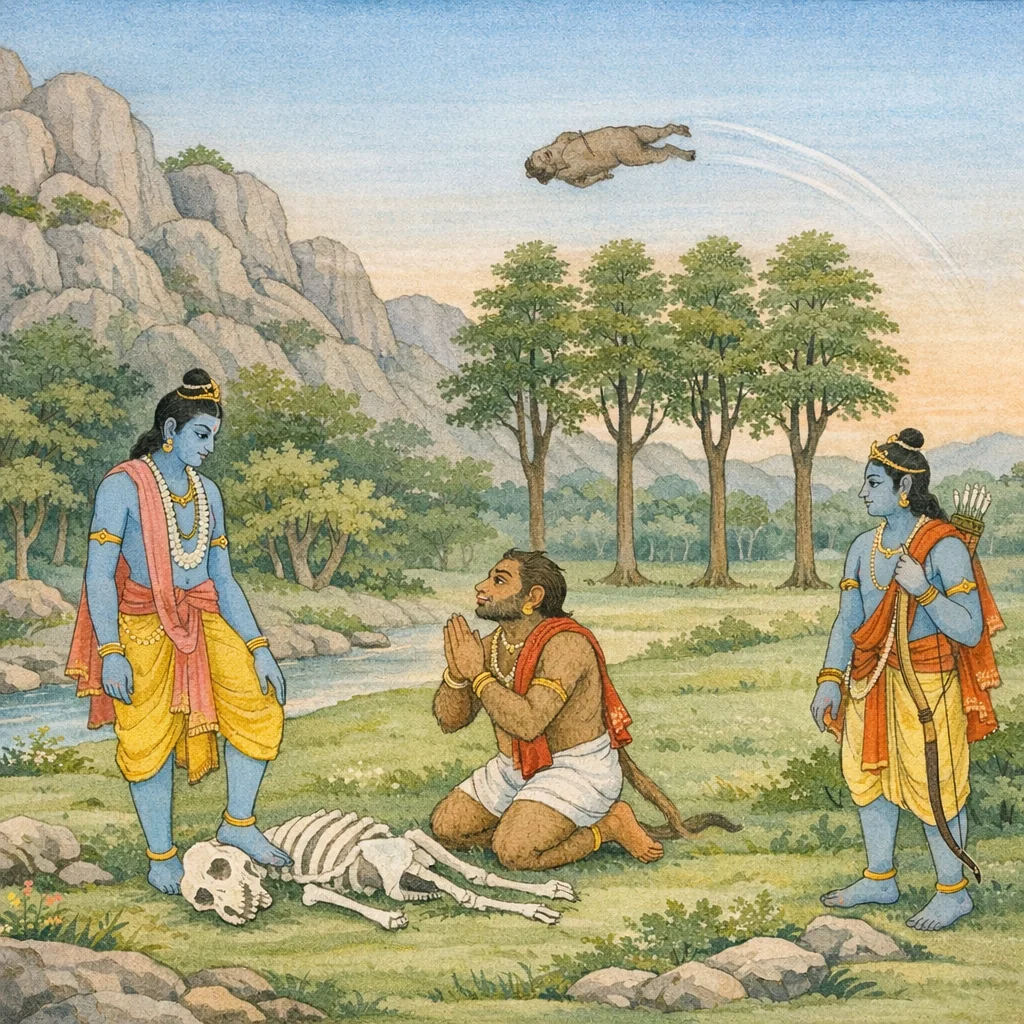
Sarga 11 frames Sugrīva’s anxiety about confronting Vāli and builds a structured “proof” discourse. After Rāma’s encouraging words, Sugrīva praises him while recounting a precedent narrative: the demon Dundubhi challenges the Ocean, is redirected to Himavān, and is finally sent toward Vāli at Kiṣkindhā. Dundubhi, in buffalo-form, blocks the city gate and provokes Vāli; a fierce duel follows, ending with Vāli killing and hurling the body. Blood drops fall at the hermitage of sage Mataṅga, who—recognizing the offender through tapas—curses Vāli: entry into the protected forest (and its yojana-radius) brings death, compelling Vāli to avoid Ṛśyamūka and enabling Sugrīva’s refuge there. Sugrīva then points to physical “map-markers” of Vāli’s strength (Dundubhi’s bone-heap; seven sāla trees) and requests verification. Rāma responds by effortlessly lifting Dundubhi’s dried body with his toe and flinging it ten yojanas, then prepares to demonstrate further by piercing a sāla tree. The chapter’s thematic lesson is epistemic and ethical: confidence in righteous action is stabilized through demonstrable capability, while violence is bounded by rules of fair combat and by sacred-protected spaces.
Shlokas
Verse 1
रामस्य वचनं श्रुत्वा हर्षपौरुषवर्धनम्।सुग्रीवः पूजयाञ्चक्रे राघवं प्रशशंस च4.11.1।।
Hearing Rāma’s words, which increased his joy and courage, Sugrīva honored Rāghava and praised him.
Verse 2
असंशयं प्रज्वलितैस्तीक्ष्णैर्मर्मातिगैश्शरैः।त्वं दहेः कुपितो लोकान्युगान्त इव भास्करः4.11.2।।
Without doubt, when angered, you would burn down the worlds with your blazing, sharp arrows that pierce the vital parts—like the Sun at the end of an age.
Verse 3
वालिनः पौरुषं यत्तद्यच्च वीर्यं धृतिश्च या।तन्ममैकमनाश्श्रुत्वा विधत्स्व यदनन्तरम्4.11.3।।
Having heard—single-mindedly—from me about Vali’s manliness, his valor, and his steadfast courage, then decide and do what should be done next.
Verse 4
समुद्रात्पश्चिमात्पूर्वं दक्षिणादपि चोत्तरम्।क्रामत्यनुदिते सूर्ये वाली व्यपगतक्लमः4.11.4।।
Before the sun has risen, Vālī—untouched by fatigue—ranges across the oceans from west to east, and also from south to north, as part of his disciplined daily observances.
Verse 5
अग्राण्यारुह्य शैलानां शिखराणि महान्त्यपि।ऊर्ध्वमुत्क्षिप्य तरसा प्रतिगृह्णाति वीर्यवान्4.11.5।।
Scaling the mountain-tops, the mighty one would swiftly spring upward and seize even the vast peaks.
Verse 6
बहवस्सारवन्तश्च वनेषु विविधा द्रुमाः।वालिना तरसा भग्ना बलं प्रथयताऽत्मनः4.11.6।।
Many diverse, sturdy trees in the forests were broken by Vali with sheer force, as he displayed his own strength.
Verse 7
महिषो दुन्दुभिर्नाम कैलासशिखरप्रभः।बलं नागसहस्रस्य धारयामास वीर्यवान्4.11.7।।
There was a buffalo named Dundubhi, radiant like the peak of Mount Kailāsa; that mighty one possessed the strength of a thousand elephants.
Verse 8
वीर्योत्सेकेन दुष्टात्मा वरदानाच्च मोहितः।जगाम सुमहाकाय स्समुद्रं सरितां पतिम्।।4.11.8।।
Wicked Dundubhi—of enormous body—intoxicated by the pride of valor and deluded by boons, went to the ocean, lord of rivers.
Verse 9
ऊर्मिमन्तमभिक्रम्य सागरं रत्नसञ्चयम्।मह्यं युद्धं प्रयच्छेति तमुवाच महार्णवम्4.11.9।।
“Approaching the ocean—waveladen and rich with gems—he addressed that vast sea: ‘Grant me battle!’”
Verse 10
ततस्समुद्रो धर्मात्मा समुत्थाय महाबलः।अब्रवीद्वचनं राजन्नसुरं कालचोदितम्4.11.10।।
Then the mighty Ocean—righteous in nature—rose up and spoke these words to the demon, who was being driven onward by fate toward death.
Verse 11
समर्थो नास्मि ते दातुं युद्धं युद्धविशारद।श्रूयतां चाभिधास्यामि यस्ते युद्धं प्रदास्यति4.11.11।।
‘O expert in war, I am not able to offer you battle; but listen—I will tell you of the one who will grant you the fight you seek.’
Verse 12
शैलराजो महारण्ये तपस्विशरणं परम्।शङ्करश्वशुरो नाम्ना हिमवानिति विश्रुतः4.11.12।।गुहाप्रस्रवणोपेतो बहुकन्दरनिर्दरः।स समर्थस्तव प्रीतिमतुलां कर्तुमाहवे4.11.13।।
In that vast wilderness stands Himavān—supreme refuge of ascetics—renowned as the king of mountains and celebrated as Śaṅkara’s (Śiva’s) father-in-law.
Verse 13
शैलराजो महारण्ये तपस्विशरणं परम्।शङ्करश्वशुरो नाम्ना हिमवानिति विश्रुतः4.11.12।।गुहाप्रस्रवणोपेतो बहुकन्दरनिर्दरः।स समर्थस्तव प्रीतिमतुलां कर्तुमाहवे4.11.13।।
Abounding in caves and waterfalls, and full of many caverns and ravines, he is mighty enough to answer—even in battle—your incomparable passion for combat.
Verse 14
तं भीत इति विज्ञाय समुद्रमसुरोत्तमः।हिमवद्वनमागच्छच्छरश्चापादिव च्युतः4.11.14।।ततस्तस्य गिरेश्श्वेता गजेन्द्रविप्रलाश्शिलाः।चिक्षेप बहुधा भूमौ दुन्दुभिर्विननाद च4.11.15।।
Knowing that the ocean was afraid of him, Dundubhi—the foremost of demons—rushed to Himavān’s forest, swift as an arrow loosed from a bow.
Verse 15
तं भीत इति विज्ञाय समुद्रमसुरोत्तमः।हिमवद्वनमागच्छच्छरश्चापादिव च्युतः4.11.14।।ततस्तस्य गिरेश्श्वेता गजेन्द्रविप्रलाश्शिलाः।चिक्षेप बहुधा भूमौ दुन्दुभिर्विननाद च4.11.15।।
Then Dundubhi tore up and hurled to the ground many huge white rocks of that mountain, massive as lordly elephants—and he roared aloud besides.
Verse 16
ततश्श्वेताम्बुदाकारः सौम्यः प्रीतिकराकृतिः।हिमवानब्रवीद्वाक्यं स्वे एव शिखरे स्थितः4.11.16।।
Then Himavān—gentle, pleasing in form, like a white cloud—stood upon his own peak and spoke these words.
Verse 17
क्लेष्टुमर्हसि मां न त्वं दुन्दुभे धर्मवत्सल।रणकर्मस्वकुशलस्तपस्विशरणं ह्यहम्4.11.17।।
O Dundubhi—lover of dharma—it is not fitting for you to trouble me. I am a refuge for ascetics, and I am not skilled in the works of war.
Verse 18
तस्य तद्वचनं श्रुत्वा गिरिराजस्य धीमतः। उवाच दुन्दुभिर्वाक्यं क्रोधात्संरक्तलोचनः4.11.18।।
Hearing those words of the wise king of mountains, Dundubhi—his eyes reddened with anger—spoke in reply.
Verse 19
यदि युद्धेऽसमर्थस्त्वं मद्भयाद्वा निरुद्यमः।समाचक्ष्व प्रदद्यान्मे योऽद्य युद्धं युयुत्सतः4.11.19।।
If you are unable to fight—or if, out of fear of me, you refrain—then tell me who, today, is willing to face me in battle and grant me a duel.
Verse 20
हिमवानब्रवीद्वाक्यं श्रुत्वा वाक्यविशारदः।अनुक्तपूर्वं धर्मात्मा क्रोधात्तमसुरोत्तमम्4.11.20।।
Hearing those unprecedented words, righteous Himavān—skilled in speech—angered, addressed that foremost of demons.
Verse 21
वाली नाम महाप्राज्ञश्शक्रतुल्य पराक्रमः।अध्यास्ते वानरश्श्रीमान् किष्किन्धामतुलप्रभाम्4.11.21।।
Vali by name—wise and possessing prowess equal to Indra—this prosperous lord among monkeys dwells in Kishkindha, a city of incomparable splendor.
Verse 22
स समर्थो महाप्राज्ञस्तव युद्धविशारदः।द्वन्द्वयुद्धं महद्दातुं नमुचेरिव वासवः4.11.22।।
He is capable, profoundly wise, and skilled in battle—able to issue a great challenge to single combat, as Indra once did to Namuchi.
Verse 23
तं शीघ्रमभिगच्छ त्वं यदि युद्धमिहेच्छसि।स हि दुर्धर्षणो नित्यं शूरस्समरकर्मणि4.11.23।।
If you truly desire battle now, go quickly to him; for he is ever hard to assail, a hero in the work of war.
Verse 24
श्रुत्वा हिमवतो वाक्यं कोधाविष्टस्स दुन्दुभिः।जगाम तां पुरीं तस्य किष्किन्धां वालिनस्तदा4.11.24।।
Hearing Himavat’s words, Dundubhi—seized with anger—then went to that city of Vali, to Kishkindha.
Verse 25
धारयन्माहिषं रूपं तीक्ष्णशृङ्गो भयावहः।प्रावृषीव महामेघस्तोयपूर्णो नभस्स्थले4.11.25।।ततस्तु द्वारमागम्य किष्किन्धाया महाबलः।ननर्द कम्पयन्भूमिं दुन्दुभिर्दुन्दुभिर्यथा4.11.26।।
Assuming the form of a buffalo—terrifying, with sharp horns—Dundubhi looked like a great rain-cloud heavy with water in the monsoon sky. Then, reaching the gate of Kishkindha, that mighty one roared like a war-drum, as though shaking the earth.
Verse 26
धारयन्माहिषं रूपं तीक्ष्णशृङ्गो भयावहः।प्रावृषीव महामेघस्तोयपूर्णो नभस्स्थले4.11.25।।ततस्तु द्वारमागम्य किष्किन्धाया महाबलः।ननर्द कम्पयन्भूमिं दुन्दुभिर्दुन्दुभिर्यथा4.11.26।।
Assuming the form of a buffalo—terrifying, with sharp horns—Dundubhi looked like a great rain-cloud heavy with water in the monsoon sky. Then, reaching the gate of Kishkindha, that mighty one roared like a war-drum, as though shaking the earth.
Verse 27
समीपस्थान्द्रुमान्भञ्जन्वसुधां दारयन्खुरैः।विषाणेनोल्लिखन् दर्पात्तद्द्वारं द्विरदो यथा4.11.27।।
Breaking the nearby trees and tearing the earth with his hooves, he gouged at that gate with his horn in arrogance, like an elephant.
Verse 28
अन्तःपुरगतो वाली श्रुत्वा शब्दममर्षणः।निष्पपात सह स्त्रीभिस्ताराभिरिव चन्द्रमाः4.11.28।।
Vali, who was within the inner apartments, heard the intolerable noise and sprang out along with the women—like the moon accompanied by stars.
Verse 29
मितं व्यक्ताक्षरपदं तमुवाचाथ दुन्दुभिम्।हरीणामीश्वरो वाली सर्वेषां वनचारिणाम्4.11.29।।
Then Vali—lord of the monkeys, of all those who roam the forests—addressed Dundubhi in few words, clear in syllable and sense.
Verse 30
किमर्थं नगरद्वारमिदं रुध्द्वा विनर्दसि।दुन्दुभे विदितो मेऽसि रक्षप्राणान्महाबल4.11.30।।
“O Dundubhi, why do you roar after blocking this city-gate? I know your might—save your life, O great-strong one.”
Verse 31
तस्य तद्वचनं श्रुत्वा वानरेन्द्रस्य धीमतः।उवाच दुन्दुभिर्वाक्यं रोषात्संरक्तलोचनः4.11.31।।
Hearing those words of the wise lord of monkeys, Dundubhi—his eyes reddened with anger—spoke in reply.
Verse 32
न त्वं स्त्रीसन्निधौ वीर वचनं वक्तुमर्हसि।मम युद्धं प्रयच्छाद्य ततो ज्ञास्यामि ते बलम्4.11.32।।
“Hero, it is not proper for you to speak such words in the presence of women. Grant me battle today—then I shall know your strength.”
Verse 33
अथवा धारयिष्यामि क्रोधमद्य निशामिमाम्।गृह्यतामुदयस्स्वैरं कामभोगेषु वानर4.11.33।।
“Or else, I shall hold back my anger for this night. Take your ease till sunrise, O monkey—enjoy your pleasures freely.”
Verse 34
दीयतां सम्प्रदानं च परिष्वज्य च वानरान्।सर्वशाखामृगेन्द्र स्त्वं संसादय सुहृज्जनान्4.11.34।।
“Give out gifts, embrace the monkeys; O lord among all branch-roaming beasts, spend time with your friends.”
Verse 35
सुदृष्टां कुरु किष्किन्धां कुरुष्वात्मसमं पुरे।क्रीडस्व च सह स्त्रीभिरहं ते दर्पनाशनः4.11.35।।
“Look well upon Kishkindha; appoint in the city someone equal to yourself. Sport with women as you please—then face me, the destroyer of your pride.”
Verse 36
यो हि मत्तं प्रमत्तं वा सुप्तं वा रहितं भृशम्।हन्यात्स भ्रूणहा लोके त्वद्विधं मदमोहितम्4.11.36।।
“Whoever kills one who is drunk, or careless, or asleep, or utterly unprepared—one stupefied by intoxication like you—he is in this world a slayer of an unborn child.”
Verse 37
स प्रहस्याब्रवीन्मन्दं क्रोधात्तमसुरोत्तमम्।विसृज्य ताः स्त्रियस्सर्वास्ताराप्रभृतिकास्तदा4.11.37।।
Then Vali, smiling slightly, sent away all the women—Tara and the rest—and, angered, spoke to that foremost of demons.
Verse 38
मत्तोऽयमिति मा मंस्था यद्यभीतोऽसि संयुगे।मदोऽयं सम्प्रहारेऽस्मिन्वीरपानं समर्थ्यताम्4.11.38।।
“Do not think I am drunk. If you are not afraid in battle, then regard this ‘intoxication’ as a warrior’s draught for this combat.”
Verse 39
तमेवमुक्त्वा सङ्कृद्धो मालामुत्क्षिप्य काञ्चनीम्।पित्रा दत्तां महेन्द्रेण युद्धाय व्यवतिष्ठत4.11.39।।
Having spoken thus, Vali—enraged—cast off the golden garland given by Mahendra (Indra), his father, and took his stance for battle.
Verse 40
विषाणयोर्गृहीत्वा तं दुन्दुभिं गिरिसन्निभम्।आविध्यत तदा वाली विनदन्कपिकुञ्जरः4.11.40।।
Then Vālī, the elephant-like lord of monkeys, seized the mountain-like Dundubhi by his horns and struck him down, roaring aloud.
Verse 41
वाली व्यापातयाञ्चक्रे ननर्द च महास्वनम्।श्रोत्राभ्यामथ रक्तं तु तस्य सुस्राव पात्यतः4.11.41।।
Vālī whirled him about and cast him down, roaring with a great sound; as he fell, blood streamed from Dundubhi’s ears.
Verse 42
तयोस्तु क्रोधसंरम्भात्परस्परजयैषिणोः।युद्धं समभवद्घोरं दुन्दुभेर्वानरस्यच4.11.42।।
Driven by furious anger and each intent on conquering the other, a terrible battle arose between Dundubhi and the monkey (Vālī).
Verse 43
अयुद्ध्यत तदा वाली शक्रतुल्यपराक्रमः।मुष्टिभिर्जानुभिश्चैव शिलाभिः पादपैस्तथा4.11.43।।
Then Vālī, whose prowess was like Indra’s, fought on—striking with fists and knees, and also with rocks and trees.
Verse 44
परस्परं घ्नतो स्तत्र वानरासुरयोस्तदा।आसीदसुरो युद्धे शक्रसूनुर्व्यवर्धत4.11.44।।
As the monkey and the demon struck each other there, the demon’s strength waned in the battle, while the son of Indra (Vālī) grew in force and spirit.
Verse 45
व्यापारवीर्यधैर्यैश्च परिक्षीणं पराक्रमैः।तं तु दुन्दुभिमुद्यम्य धरण्यामभ्यपातयत्।।4.11.45।।युद्धे प्राणहरे तस्मिन्निष्पिष्टो दुन्दुभिस्तदा।पपात च महाकायः क्षितौ पञ्चत्वमागतः4.11.46।।
When Dundubhi’s exertion, strength, courage, and prowess had been worn down, Vālī lifted him up and smashed him to the ground. In that life-taking combat, Dundubhi was crushed; the huge-bodied one fell upon the earth and met his end, returning to the five elements.
Verse 46
व्यापारवीर्यधैर्यैश्च परिक्षीणं पराक्रमैः।तं तु दुन्दुभिमुद्यम्य धरण्यामभ्यपातयत्।।4.11.45।।युद्धे प्राणहरे तस्मिन्निष्पिष्टो दुन्दुभिस्तदा।पपात च महाकायः क्षितौ पञ्चत्वमागतः4.11.46।।
When Dundubhi’s exertion, strength, courage, and prowess had been worn down, Vālī lifted him up and smashed him to the ground. In that life-taking combat, Dundubhi was crushed; the huge-bodied one fell upon the earth and met his end, returning to the five elements.
Verse 47
तं तोलयित्वा बाहुभ्यां गतसत्त्वमचेतनम्।चिक्षेप बलवान्वाली वेगेनैकेन योजनम्4.11.47।।
Powerful Vālī lifted the senseless body, its life-force gone, and with a single surge hurled it a yojana away.
Verse 48
तस्य वेगप्रविद्धस्य वक्त्रात्क्षतजबिन्दवः।प्रपेतुर्मारुतोत्क्षिप्ता मतङ्गप्याश्रमं प्रति4.11.48।।
From the mouth of that body flung with force, drops of blood—lifted and scattered by the wind—fell toward the hermitage of Matanga.
Verse 49
तान्दृष्ट्वा पतितांस्तस्य मुनिश्शोणितविप्रुषः।क्रुद्धस्तत्र महाभागश्चिन्तयामास कोन्वयम्4.11.49।।
Seeing those drops of blood fallen there, the venerable sage grew angry and began to reflect: “Who could this be?”
Verse 50
येनाहं सहसा स्पृष्टश्शोणितेन दुरात्मना। कोऽयं दुरात्मा दुर्भुदि्घरकृतात्मा च बालिशः4.11.50।।
“By whom—by what wicked person—have I been suddenly touched by blood? Who is this vile one: evil-minded, undisciplined, and foolish?”
Verse 51
इत्युक्त्वाऽथ विनिष्क्रम्य ददर्श मुनिसत्तमः।महिषं पर्वताकारं गतासुं पतितं भुवि4.11.51।।
Having spoken thus, the best of sages came out and saw a buffalo, mountain-like in form, lying dead upon the ground.
Verse 52
स तु विज्ञाय तपसा वानरेण कृतं हि तत्।उत्ससर्ज महाशापं क्षेप्तारं वालिनं प्रति4.11.52।।
Knowing through ascetic insight that this deed had been done by a monkey, he pronounced a great curse against Vāli, the one who had hurled it.
Verse 53
इह तेनाप्रवेष्टव्यं प्रविष्टस्य वधो भवेत्।वनं मत्संश्रयं येन दूषितं रुधिरस्रवैः4.11.53।।
“He who has defiled this forest under my protection with streams of blood must not enter here; if he enters, death will be his fate.”
Verse 54
सम्भग्नाः पादपाश्चैमेक्षिपतेहासुरीं तनुम्।समन्तादाद्योजनं पूर्णमाश्रमं मामकं यदि4.11.54।।आगमिष्यति दुर्बुद्धिर्व्यक्तं स न भविष्यति।
“Since these trees too have been shattered by the one who hurled the demon’s body—if that evil-minded one comes within a full yojana all around my hermitage, he will clearly not survive.”
Verse 55
ये चापि सचिवाः स्तस्य संश्रिता मामकं वनम्4.11.55।।न च तैरिह वस्तव्यं श्रुत्वा यान्तु यथासुखम्।
“And even those who are his attendants and have taken refuge in my forest should not remain here; having heard this, let them depart in safety.”
Verse 56
यदि तेऽपी ह तिष्ठन्ति शपिष्ये तानपि ध्रुवम्4.11.56।।वनेऽस्मिन्मामके नित्यं पुत्रवत्परिरक्षिते।पत्राङ्कुरविनाशाय फलमूलाभवाय च4.11.57।।
“If they still remain, I shall certainly curse them as well—in this my forest, ever protected like a son—should they destroy leaves and shoots and cause the loss of fruits and roots.”
Verse 57
यदि तेऽपी ह तिष्ठन्ति शपिष्ये तानपि ध्रुवम्4.11.56।।वनेऽस्मिन्मामके नित्यं पुत्रवत्परिरक्षिते।पत्राङ्कुरविनाशाय फलमूलाभवाय च4.11.57।।
“If they still remain, I shall certainly curse them as well—in this my forest, ever protected like a son—should they destroy leaves and shoots and cause the loss of fruits and roots.”
Verse 58
दिवसश्चास्य मर्यादा यं द्रष्टा श्वोऽस्मि वानरम्।बहुवर्षसहस्राणि स वै शैलो भविष्यति4.11.58।।
For him, this is the fixed limit of time—one day. Any monkey whom I shall see tomorrow will indeed become a mountain for many thousands of years.
Verse 59
ततस्ते वानराश्श्रुत्वा गिरं मुनिसमीरिताम्।निश्चक्रमुर्वनात्तस्मात्तान्दृष्ट्वा वालिरब्रवीत्4.11.59।।
Then those monkeys, having heard the words spoken by the sage, went out from that forest. Seeing them, Vali spoke.
Verse 60
किं भवन्तस्समस्ताश्च मतङ्गवनवासिनः।मत्समीपमनुप्राप्ता अपि स्वस्ति वनौकसाम्4.11.60।।
Why have all of you—dwellers in Matanga’s forest—come near me? And are the forest-dwellers safe?
Verse 61
ततस्ते कारणं सर्वं तदा शापं च वालिनः।शशंसुर्वानरास्सर्वे वालिने हेममालिने4.11.61।।
Then all the monkeys reported to Vali—who wore a golden garland—every cause in full, and also the curse that had been pronounced concerning him.
Verse 62
एतच्छ्रुत्वा तदा वाली वचनं वानरेरितम्।स महर्षिंतदाऽसाद्य याचते स्म कृताञ्जलिः4.11.62।।
Hearing those words spoken by the monkeys, Vali then approached the great sage and pleaded with folded hands.
Verse 63
महर्षिस्तमनादृत्य प्रविवेशाश्रमं तदा।शापधारणभीतस्तु वाली विह्वलतां गतः4.11.63।।
But the great sage, paying him no heed, entered his hermitage. Vali, terrified at having to bear the curse, fell into distress.
Verse 64
ततश्शापभयाद्भीत ऋश्यमूकं महागिरिम्।प्रवेष्टुं नेच्छति हरिर्द्रष्टुं वापि नरेश्वर4.11.64।।
Therefore, frightened by the fear of the curse, that Hari—Vali—does not wish to enter the great mountain Ṛśyamūka, O lord of men; he does not even wish to look upon it.
Verse 65
तस्याप्रवेशं ज्ञात्वाऽहमिदं राम महावनम्।विचरामि सहामात्यो विषादेन विवर्जितः4.11.65।।
Knowing that he is barred from entering, O Rama, I roam this great forest with my companions and counselors, free from anxiety.
Verse 66
एषोऽस्थिनिचयस्तस्य दुन्दुभेस्सम्प्रकाशते।वीर्योत्सेकान्निरस्तस्य गिरिकूटोपमो महान्4.11.66।।
Here shines this massive heap of bones of Dundubhi, flung away in the intoxication of valor—huge, like a mountain peak.
Verse 67
इमे च विपुलास्सालास्सप्त शाखावलम्बिनः।यत्रैकं घटते वाली निष्पत्रयितुमोजसा4.11.67।।
Behold these seven massive sāla trees, their branches interlaced with one another. Here, Vālī had the power to strip the leaves from a single sāla tree by sheer force.
Verse 68
एतदस्यासमं वीर्यं मया राम प्रकीर्तितम्।कथं तं वालिनं हन्तुं समरे शक्ष्यसे नृप4.11.68।।
Rama, I have thus described to you his unequalled might. O king, how will you be able to slay that Vālī in open combat?
Verse 69
तथा ब्रुवाणं सुग्रीवं प्रहसन् लक्ष्मणोऽब्रवीत्।कस्मिन्कर्मणि निर्वृत्ते श्रद्दध्या वालिनो वधम्4.11.69।।
As Sugrīva spoke in this manner, Lakṣmaṇa, smiling, said: “When what deed is accomplished will you truly have faith in Vālī’s killing?”
Verse 70
तमुवाचाथ सुग्रीवस्सप्त सालानिमान्पुरा।एवमेकैकशो वाली विव्याथाथ स चासकृत्। 4.11.70।।
Then Sugrīva said to him: “Formerly, Vālī pierced through these seven sāla trees—one after another—and he did so repeatedly.”
Verse 71
रामोऽपिदारयेदेषां बाणेनैकेन च द्रुमम्।वालिनं निहतं मन्ये दृष्ट्वा रामस्य विक्रमम्4.11.71।।
If Rama too can split these trees with a single arrow, then—having witnessed Rama’s prowess—I will deem Vālī as good as slain.
Verse 72
हतस्य महिषस्यास्थि पादेनैकेन लक्ष्मण।उद्यम्याथ प्रक्षिपेच्चेत्तरसा द्वे धनुश्शते4.11.72।।
O Lakṣmaṇa, if Rama can lift with a single foot the bones of that slain buffalo and hurl them swiftly to the distance of two hundred bows,
Verse 73
एवमुक्त्वा तु सुग्रीवो रामं रक्तान्तलोचनम्।ध्यात्वा मुहूर्तं काकुत्स्थं पुनरेव वचोऽब्रवीत्4.11.73।।
Having spoken thus, Sugrīva—looking at Rama whose eyes had reddened—reflected for a moment on the Kakutstha prince, and then spoke again.
Verse 74
शूरश्च शूरघाती च प्रख्यातबलपौरुषः।बलवान्वानरो वाली संयुगेष्वपराजितः4.11.74।।
Vālī is a hero and a slayer of heroes, famed for strength and manly valor; that powerful vānara has been unconquered in battles.
Verse 75
दृश्यन्ते चास्य कर्माणि दुष्कराणि सुरैरपि।यानि सञ्चिन्त्य भीतोऽहमृश्यमूकं समाश्रितः4.11.75।।
And his deeds are seen—deeds difficult even for the gods. Thinking upon them, I became afraid and took refuge on Ṛśyamūka.
Verse 76
तमजय्यमधृष्यं च वानरेन्द्रममर्षणम्।विचिन्तयन्न मुञ्चामि ऋश्यमूकमहन्विमम्4.11.76।।
Thinking of that indignant lord of the monkeys—invincible and impossible to overpower—I have not left this R̥śyamūka (mountain).
Verse 77
उद्विग्नश्शङ्कितश्चापि विचरामि महावने।अनुरक्तैः सहामात्यैर्हनुमत्प्रमुखैर्वरैः4.11.77।।
Agitated and fearful, I wander in this great forest, accompanied by loyal ministers—excellent ones led by Hanumān.
Verse 78
उपलब्धं च मे श्लाघ्यं सन्मित्रं मित्रवत्सल।त्वामहं पुरुषव्याघ्र हिमवन्तमिवाश्रितः4.11.78।।
I have gained in you a praiseworthy and true friend, O lover of friends. O tiger among men, I have taken refuge in you as one would in the Himālaya.
Verse 79
किं तु तस्य बलज्ञोऽहं दुर्भ्रातुर्बलशालिनः।अप्रत्यक्षं तु मे वीर्यं समरे तव राघव4.11.79।।
Yet I know the strength of that powerful wicked brother; but, O Rāghava, your prowess in battle has not been directly witnessed by me.
Verse 80
न खल्वहं त्वां तुलये नावमन्ये न भीषये।कर्मभिस्तस्य भीमैस्तु कातर्यं जनितं मम4.11.80।।
Truly, I do not compare you (with him), nor do I slight you, nor do I mean to frighten you; it is Vāli’s dreadful deeds that have produced this timidity in me.
Verse 81
कामं राघव ते वाणी प्रमाणं धैर्यमाकृतिः।सूचयन्ति परं तेजो भस्मच्छन्नमिवानलम्4.11.81।।
Indeed, O Rāghava, your speech, your bearing, your courage, and your very appearance indicate a supreme power—like fire hidden beneath ashes.
Verse 82
तस्य तद्वचनं श्रुत्वा सुग्रीवस्य महात्मनः।स्मितपूर्वमथो रामः प्रत्युवाच हरिं प्रभुः4.11.82।।
Hearing those words of great-souled Sugrīva, Rama—the lord—replied to the monkey with a gentle smile.
Verse 83
यदि न प्रत्ययोऽस्मासु विक्रमे तव वानर।प्रत्ययं समरे श्लाघ्यमहमुत्पादयामि ते4.11.83।।
If you do not yet have confidence in our valor, O monkey, I will produce in you a confidence—praiseworthy in battle.
Verse 84
एवमुक्त्वा तु सुग्रीवं सान्त्वं लक्ष्मणपूर्वजः।राघवो दुन्दुभेः कायं पादाङ्गुष्ठेन लीलया4.11.84।।तोलयित्वा महाबाहुश्चिक्षेप दशयोजनम्।असुरस्य तनुं शुष्कं पादाङ्गुष्ठेन वीर्यवान्4.11.85।।
Having thus spoken to Sugrīva in a soothing manner, Rāghava—the mighty elder brother of Lakṣmaṇa—playfully lifted Dundubhi’s dried body with his toe and hurled that demon’s carcass a full ten yojanas away.
Verse 85
एवमुक्त्वा तु सुग्रीवं सान्त्वं लक्ष्मणपूर्वजः।राघवो दुन्दुभेः कायं पादाङ्गुष्ठेन लीलया4.11.84।।तोलयित्वा महाबाहुश्चिक्षेप दशयोजनम्।असुरस्य तनुं शुष्कं पादाङ्गुष्ठेन वीर्यवान्4.11.85।।
Having thus spoken to Sugrīva with reassuring words, Rāghava—Lakṣmaṇa’s elder brother—effortlessly lifted Dundubhi’s dried demon-body with his toe and, the mighty-armed hero, flung it a full ten yojanas away.
Verse 86
क्षिप्तं दृष्ट्वा ततः कायं सुग्रीवः पुनरब्रवीत्।लक्ष्मणस्याग्रतो राममिदं वचनमर्थवत्4.11.86।।
Seeing the body thus hurled away, Sugrīva again spoke to Rāma—before Lakṣmaṇa—words that were weighty with purpose.
Verse 87
आर्द्रस्समांसः प्रत्यग्रः क्षिप्तः कायः पुरा सखे4.11.87।।लघुस्सम्प्रति निर्मांस स्तृणभूतश्च राघव।परिश्रान्तेन मत्तेन भ्रात्रा मे वालिना तदा4.11.88।।क्षिप्तमेवं प्रहर्षेण भवता रघुनन्दन।
“Friend, long ago this body was flung when it was fresh, wet, and full of flesh. But now, O Rāghava, it is fleshless and light—like a tuft of grass. In those days it was my brother Vāli, tired and intoxicated, who hurled it; yet you, O Joy of the Raghu line, have thrown it now almost playfully.”
Verse 88
आर्द्रस्समांसः प्रत्यग्रः क्षिप्तः कायः पुरा सखे4.11.87।।लघुस्सम्प्रति निर्मांस स्तृणभूतश्च राघव।परिश्रान्तेन मत्तेन भ्रात्रा मे वालिना तदा4.11.88।।क्षिप्तमेवं प्रहर्षेण भवता रघुनन्दन।
“Friend, long ago this body was flung when it was fresh, wet, and full of flesh. But now, O Rāghava, it is fleshless and light—like a tuft of grass. In those days it was my brother Vāli, tired and intoxicated, who hurled it; yet you, O Joy of the Raghu line, have thrown it now almost playfully.”
Verse 89
नात्र शक्यं बलं ज्ञातुं तव वा तस्य वाऽधिकम्।आर्द्रं शुष्कमिति ह्येतत्सुमहद्राघवान्तरम्4.11.89।।
“In this case it is not possible to know whose strength is greater—yours or his—for the difference between ‘wet’ and ‘dry’ is indeed immense, O Rāghava.”
Verse 90
स एव संशयस्तात तव तस्य च यद्बले4.11.90।।सालमेकं तु निर्भिद्या भवेद्व्यक्तिर्बलाबले।
“That doubt remains, dear one, about the measure of strength—yours and his. But if you can pierce a single śāla tree through, the truth of strength and weakness will become clear.”
Verse 91
कृत्वेदं कार्मुकं सज्यं हस्तिहस्त मिवाततम्4.11.91।।आकर्णपूर्णमायम्य विसृजस्व महाशरम्।
“String your bow and draw it taut like an elephant’s outstretched trunk; pulling the string back to your ear, release the great arrow.”
Verse 92
इमं हि सालं सहित स्त्वया शरोन संशयोऽत्रास्ति विदारयिष्यति।अलं विमर्शेन मम प्रियं ध्रुवंकुरुष्व राजात्मज शापितो मया4.11.92।।
“Your well-aimed arrow will surely split this śāla tree—there is no doubt of it. Enough of deliberation: do what will certainly please me, O prince; I am, as it were, constrained by my own pledge.”
Verse 93
यथा हि तेजस्सु वरस्सदा रविर्यथा हि शैलो हिमवान्महाद्रिषु।यथा चतुष्पात्सु च केसरी वरस्तथा नरणामसि विक्रमे वरः4.11.93।।
“As the Sun is ever foremost among the radiant, as Himavān is foremost among great mountains, and as the lion is foremost among four-footed beasts—so you are foremost among men in valour.”
Frequently Asked Questions
Sugrīva faces a dharma-inflected dilemma of alliance: he must request Rāma to kill Vāli, yet he also must ensure the act is feasible and not reckless. The sarga resolves this by converting fear into accountable verification—tests of prowess become a morally acceptable basis for committing to high-stakes violence.
The chapter teaches that righteous intent must be paired with demonstrable competence (pramāṇa) and restraint under maryādā: trust in leadership is strengthened through transparent proof, while sacred spaces and fairness norms limit the legitimacy of force.
Key landmarks include Kiṣkindhā’s city gate (site of Dundubhi’s challenge), Himavān (as a mythic-ascetic mountain-king), Mataṅga’s hermitage (triggering the curse), and Ṛśyamūka Mountain (rendered strategically safe because Vāli avoids it due to the curse).