Sarga 76
बालकाण्डे षट्सप्ततितमः सर्गः — Rāma Subdues Paraśurāma; the Vaiṣṇava Arrow Is Discharged
बालकाण्ड
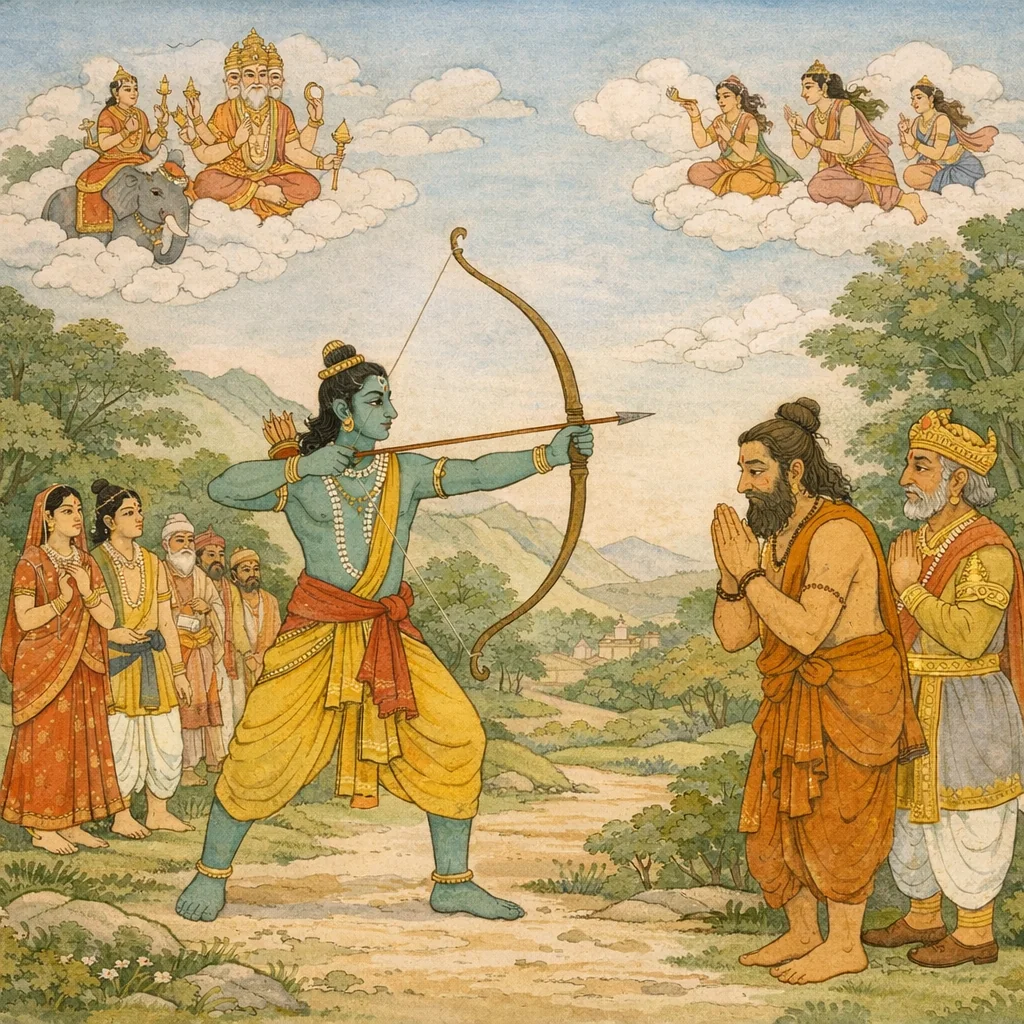
Sarga 76 presents a tightly argued dharma-inflected confrontation after Paraśurāma’s challenge. Rāma, hearing Paraśurāma’s words, deliberately curtails further escalation out of respect for his father (Daśaratha) while still answering the provocation. He asserts that Paraśurāma mistakes him as kṣatriya-incompetent, then swiftly seizes the Bhārgava bow and arrow, bends the bow, and strings it—an act that freezes the world in astonishment. Rāma explicitly refuses to kill Paraśurāma because of Paraśurāma’s brahmin status and his connection to Viśvāmitra, reframing the conflict as a choice of consequences rather than slaughter: he will either destroy Paraśurāma’s ‘mobility’ (pāda-gati) or the ascetically earned ‘worlds’ (lokas). The celestial Vaiṣṇava arrow must not fall in vain, so Paraśurāma requests that it be directed to his tapasyā-earned realms, preserving his vow to leave the earth at night after gifting it to Kaśyapa. Devas with Brahmā, along with gandharvas and other beings, assemble to witness the event. Paraśurāma recognizes Rāma as Viṣṇu, accepts defeat without shame, circumambulates Rāma, and departs to Mahendra; the directions clear of darkness as gods and sages extol Rāma’s wielding of the bow.
Shlokas
Verse 1
श्रुत्वा तज्जामदग्न्यस्य वाक्यं दाशरथिस्तदा।गौरवाद्यंन्त्रितकथ: पितू राममथाब्रवीत्।।।।
Having heard the words of Jāmadagnya (Paraśurāma), Rāma, son of Daśaratha, restraining further speech out of reverence for his father, then addressed Paraśurāma.
Verse 2
श्रुतवानस्मि यत्कर्म कृतवानसि भार्गव।अनुरुंध्यामहे ब्रह्मन् पितुरानृण्यमास्थितम्।।।।
O Bhārgava, I have heard of the deeds you have performed. O Brahman, we acknowledge and commend that you have undertaken the duty of repaying your father’s debt.
Verse 3
वीर्यहीनमिवाशक्तं क्षत्रधर्मेण भार्गव।अवजानासि मे तेज: पश्य मेऽद्य पराक्रमम्।।।।
O Bhārgava, you belittle my power as though I were without valor and unable to uphold the duties of a kṣatriya. Today, behold my energy and prowess.
Verse 4
इत्युक्त्वा राघव: क्रुद्धो भार्गवस्य शरासनम्।शरं च प्रतिजग्राह हस्ताल्लघुपराक्रम:।।।।
Having spoken thus, Rāghava—angered and swift in action—seized from Bhārgava’s hand both the bow and the arrow.
Verse 5
आरोप्य स धनू राम श्शरं सज्यं चकार ह।जामदग्न्यं ततो रामं राम: क्रुद्धोऽब्रवीद्वच:।।।।
Rāma bent the bow, set the arrow, and strung it ready. Then, in anger, Rāma spoke to Jāmadagnya (Paraśurāma).
Verse 6
ब्राह्मणोऽसीति पूज्यो मे विश्वामित्रकृतेन च।तस्माच्छक्तो न ते राम मोक्तुं प्राणहरं शरम्।।।।
“Because you are a brāhmaṇa, and also because of your connection with Viśvāmitra, you are worthy of my reverence. Therefore, O Rāma (Paraśurāma), I am not able to release this life-taking arrow against you.”
Verse 7
इमां पादगतिं राम तपोबलसमार्जिताम्।लोकानप्रतिमान्वा ते हनिष्यामि यदिच्छसि ।।।।
“But I will not let this Vaiṣṇava power be wasted: I shall destroy either your ‘foot-going’ (your capacity to move onward) earned by ascetic power, or the incomparable worlds you have gained—tell me which you choose.”
Verse 8
न ह्ययं वैष्णवो दिव्य श्शर: परपुरञ्जय:।मोघ: पतति वीर्येण बलदर्पविनाशनः।।।।
“For this celestial Vaiṣṇava arrow—conqueror of enemy strongholds, destroyer of strength and arrogance by its might—does not fall in vain.”
Verse 9
वरायुधधरं रामं द्रष्टुं सर्षिगणा स्सुरा:।पितामहं पुरस्कृत्य समेतास्तत्र सङ्घश:।।।।गन्धर्वाप्सरसश्चैव सिद्धचारणकिन्नरा:।यक्षराक्षसनागाश्च तद्द्रष्टुं महदद्भुतम्।।।।
To behold Rāma bearing that supreme weapon, the gods—together with companies of seers—assembled there in groups, placing the Grandsire Brahmā at their head. Gandharvas and Apsarases, Siddhas, Cāraṇas, Kinnaras, Yakṣas, Rākṣasas, and Nāgas also came to witness that great marvel.
Verse 10
वरायुधधरं रामं द्रष्टुं सर्षिगणा स्सुरा:।पितामहं पुरस्कृत्य समेतास्तत्र सङ्घश:।।1.76.9।।गन्धर्वाप्सरसश्चैव सिद्धचारणकिन्नरा:।यक्षराक्षसनागाश्च तद्द्रष्टुं महदद्भुतम्।।1.76.10।।
Gandharvas and Apsarases, as well as Siddhas, Cāraṇas, and Kinnaras—and Yakṣas, Rākṣasas, and Nāgas too—came to witness that great marvel.
Verse 11
जडीकृते तदाऽलोके रामे वरधनुर्धरे।निर्वीर्यो जामदग्न्योऽसौ रामो राममुदैक्षत।।।।।
When the world fell still as Rāma bore that excellent bow, Jāmadagnya (Paraśurāma), his prowess spent, looked upon Rāma.
Verse 12
तेजोभिहतवीर्यत्वाज्जामदग्न्यो जडीकृत:।रामं कमलपत्राक्षं मन्दं मन्दमुवाच ह।।।।
His valor checked by Rāma’s radiance, the motionless Jāmadagnya spoke softly—again and again gently—to lotus-petaled-eyed Rāma.
Verse 13
काश्यपाय मया दत्ता यदा पूर्वं वसुन्धरा।विषये मे न वस्तव्यमिति मां काश्यपोऽब्रवीत्।।।।
When formerly I gifted the earth to Kāśyapa, Kāśyapa told me: ‘You must not dwell within my domain.’
Verse 14
सोऽहं गुरुवच: कुर्वन् पृथिव्यां न वसे निशाम्।कृता प्रतिज्ञा काकुत्स्थ कृता भू: काश्यपस्य हि।।।।
Thus, obeying my teacher’s word, O Kakutstha, I do not dwell upon the earth at night; a vow was made, for indeed the earth has been made Kāśyapa’s.
Verse 15
तदिमां त्वं गतिं वीर हन्तुं नार्हसि राघव।मनोजवं गमिष्यामि महेन्द्रं पर्वतोत्तमम्।।।।
Therefore, O heroic Rāghava, you should not destroy this power of movement in me; I shall depart with mind-like speed to Mahendra, best of mountains.
Verse 16
लोकास्त्वप्रतिमा राम निर्जितास्तपसा मया ।जहि तान् शरमुख्येन मा भूत्कालस्य पर्यय:।।।।
O peerless Rāma, the worlds I won through austerity—strike those with this foremost arrow; let there be no delay of time.
Verse 17
अक्षय्यं मधुहन्तारं जानामि त्वां सुरेश्वरम्।धनुषोऽस्य परामर्शात् स्वस्ति तेऽस्तु परंतप।।।।
By your grasping of this bow, I know you as the imperishable slayer of Madhu—Viṣṇu, Lord of the gods. Fare well to you, O scorcher of foes.
Verse 18
एते सुरगणास्सर्वे निरीक्षन्ते समागता:।त्वामप्रतिमकर्माणमप्रतिद्वन्द्वमाहवे।।।।
All these hosts of gods, gathered here, are watching you—whose deeds are without equal, and who are without a rival in battle.
Verse 19
न चेयं मम काकुत्स्थ व्रीडा भवितुमर्हति।त्वया त्रैलोक्यनाथेन यदहं विमुखीकृत:।।।।
Nor should this bring me shame, O Kakutstha; for it is by you—the Lord of the three worlds—that I have been turned back and subdued.
Verse 20
शरमप्रतिमं राम मोक्तुमर्हसि सुव्रत।शरमोक्षे गमिष्यामि महेन्द्रं पर्वतोत्तमम्।।।।
O Rāma of steadfast vows, this arrow is unmatched; it is fitting that you release it. Once the arrow is discharged, I shall depart to Mahendra, the best of mountains.
Verse 21
तथा ब्रुवति रामे तु जामदग्नये प्रतापवान्।रामो दाशरथि श्श्रीमान् चिक्षेप शरमुत्तमम्।।।।
When Jāmadagnya (Paraśurāma) spoke thus, the mighty and illustrious Rāma, son of Daśaratha, released the excellent arrow.
Verse 22
स हतान् दृश्य रामेण स्वांल्लोकांस्तपसार्जितान्।जामदग्न्यो जगामाशु महेन्द्रं पर्वतोत्तमम्।।।।
Seeing that his own worlds—won through austerities—had been struck down by Rāma, Jāmadagnya swiftly departed for Mahendra, the foremost of mountains.
Verse 23
ततो वितिमिरास्सर्वा दिशश्चोपदिशस्तथा।सुरा स्सर्षिगणा रामं प्रशशंसुरुदायुधम्।।।।
Thereafter, all the quarters and the intermediate directions became clear of darkness; gods along with hosts of sages praised Rāma, the wielder of the mighty weapon.
Verse 24
रामं दाशरथिं रामो जामदग्न्य: प्रशस्य च।तत: प्रदक्षिणी कृत्य जगामात्मगतिं प्रभु:।।।।
Then Jāmadagnya—himself a powerful one—praised Rāma, son of Daśaratha; and, having circumambulated him in reverence, departed to his own destined abode.
Frequently Asked Questions
Rāma must respond to Paraśurāma’s aggressive challenge without violating dharma: he demonstrates superior martial capacity yet refuses lethal force because Paraśurāma is a brahmin and linked to Viśvāmitra. The dilemma is resolved by choosing a non-lethal but consequential target for the unfailing Vaiṣṇava arrow—Paraśurāma’s tapasyā-earned realms rather than his life.
Power is validated not merely by victory but by calibrated restraint and respect for social-spiritual obligations. The sarga teaches that vows (pratijñā) and moral status (brahminhood, guru-relations) shape permissible action, and that even defeat can be integrated without shame when it aligns with cosmic order.
Mahendra Mountain is named as Paraśurāma’s destination, functioning as an ascetic-geographical marker tied to his vow of not residing on earth at night. The sarga also highlights a cultural-theological landmark: the ‘Vaiṣṇava’ weapon tradition, where a divine arrow is understood as unfailing and therefore requires an ethically appropriate discharge.