Sarga 73
त्रिसप्ततितमः सर्गः (Sarga 73): Mithilā Vivāha—Kanyādāna and the Fourfold Marriage Rites
बालकाण्ड
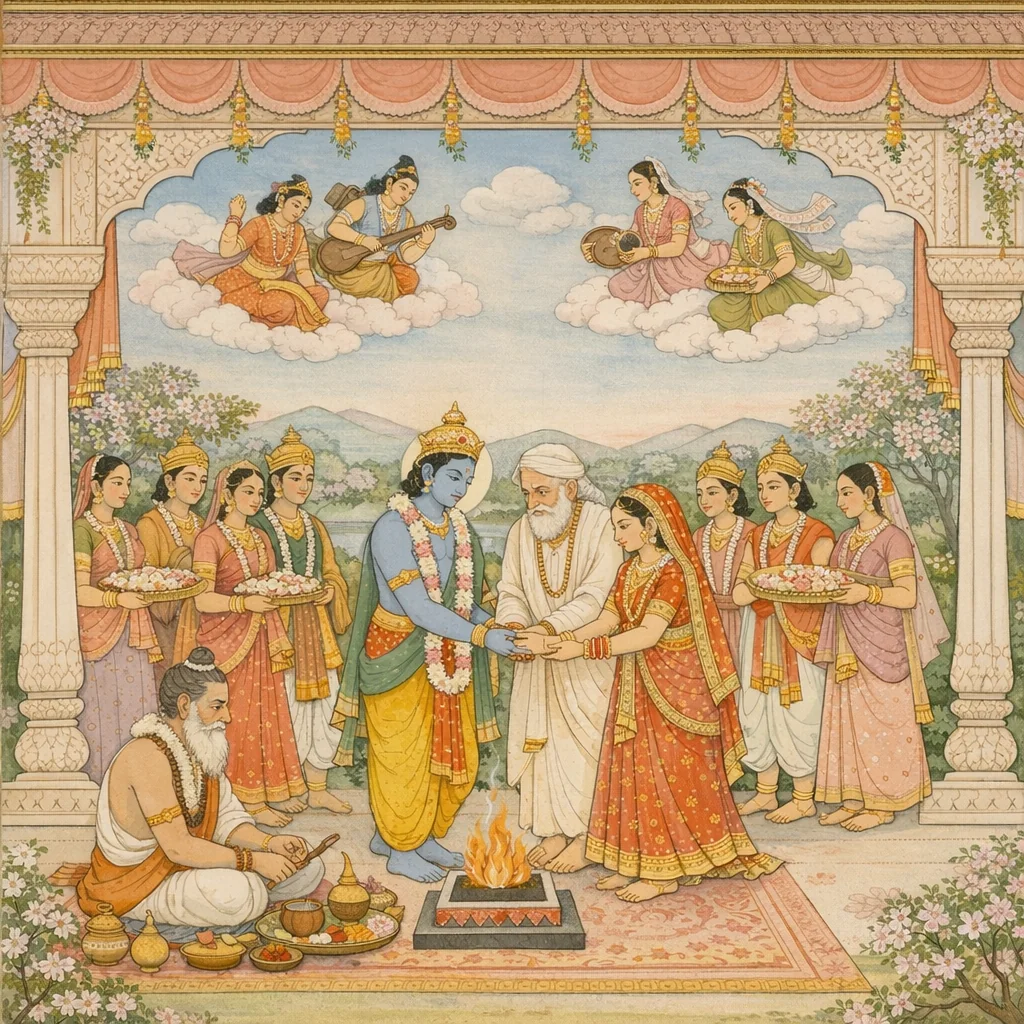
This sarga narrates the formal execution of the Mithilā marriage rites. It opens with the arrival of Yudhājit, maternal uncle of Bharata, on the same day Daśaratha performs an exemplary go-dāna (gift of cows), linking royal generosity with auspicious timing. After hospitality and morning observances, Rāma and his brothers, fully ornamented and having completed preparatory marriage rites, approach Daśaratha with Vasiṣṭha and other maharṣis leading. Vasiṣṭha requests Janaka, as bride-bestower, to proceed; Janaka replies with confident welcome, declaring no hesitation is needed in one’s own house and that his daughters stand ready at the altar. Janaka commissions Vasiṣṭha to conduct the vaivāhika kriyā; Vasiṣṭha constructs and adorns the vedi, installs fire, and performs oblations with mantra. Janaka brings Sītā before Agni and Rāma and performs kanyādāna—placing her hand into Rāma’s while declaring sahadharmacāriṇī (partner in dharma). Divine approval is marked by “sādhu” acclaim, celestial drums, and flower-rain. Janaka then bestows Ūrmilā to Lakṣmaṇa, Māṇḍavī to Bharata, and Śrutakīrti to Śatrughna; the four princes accept the four hands with Vasiṣṭha’s consent, circumambulate fire and altar, and complete the marriage as music and apsaras–gandharva celebration fills the pavilion. The sarga ends with the couples retiring to their quarters as Daśaratha, sages, and kin accompany them.
Shlokas
Verse 1
यस्मिंस्तु दिवसे राजा चक्रे गोदानमुत्तमम् ।तस्मिं स्तु दिवसे शूरो युधाजित्समुपेयिवान्।।।।
On the very day the king performed an excellent gift of cows, the heroic Yudhājit arrived.
Verse 2
पुत्र: केकयराजस्य साक्षाद्भरतमातुल:।दृष्ट्वा पृष्ट्वा च कुशलं राजानमिदमब्रवीत्।।।।
Yudhājit, son of the Kekaya king and Bharata’s maternal uncle, met King Daśaratha; after seeing him and asking of his welfare, he spoke as follows.
Verse 3
केकयाधिपती राजा स्नेहात् कुशलमब्रवीत् ।येषां कुशलकामोऽसि तेषां सम्प्रत्यनामयम् ।।।।
The king, lord of Kekaya, affectionately conveyed greetings of welfare: “Those whose well-being you desire are at present free from illness and safe.”
Verse 4
स्वस्रीयं मम राजेन्द्र द्रष्टुकामो महीपति:।तदर्थमुपयातोऽहमयोध्यां रघुनन्दन।।।।
“O best of kings, the ruler of Kekaya wished to see my sister’s son; for that reason I went to Ayodhyā, O delight of the Raghus.”
Verse 5
श्रुत्वा त्वहमयोध्यायां विवाहार्थं तवात्मजान् ।मिथिलामुपयातांस्तु त्वया सह महीपते।।।।त्वरयाभ्युपयातोऽहं द्रष्टुकाम स्स्वसुस्सुतम्।
O King, having heard at Ayodhyā that you had come to Mithilā with your sons for their marriage, I hastened here, wishing to see my sister’s son.
Verse 6
अथ राजा दशरथ: प्रियातिथिमुपस्थितम्।।।।दृष्ट्वा परमसत्कारै: पूजार्हं समपूजयत्।
Then King Daśaratha, seeing the beloved guest who had arrived, honoured him fully with the highest courtesies due to one worthy of reverence.
Verse 7
ततस्तामुषितो रात्रिं सह पुत्रैर्महात्मभि:।।।।प्रभाते पुनरुत्थाय कृत्वा कर्माणि कर्मवित् ।ऋषींस्तदा पुरस्कृत्य यज्ञवाटमुपागमत्।।।।
After spending the night with his noble sons, the king—knower of proper conduct—rose again at dawn, performed his prescribed duties, and then proceeded to the sacrificial enclosure with the seers placed in front.
Verse 8
ततस्तामुषितो रात्रिं सह पुत्रैर्महात्मभि:।।1.73.7।।प्रभाते पुनरुत्थाय कृत्वा कर्माणि कर्मवित् ।ऋषींस्तदा पुरस्कृत्य यज्ञवाटमुपागमत्।।1.73.8।।
After spending the night with his noble sons, the king—knower of proper conduct—rose at dawn, performed his prescribed duties, and went to the sacrificial enclosure, preceded by the seers.
Verse 9
युक्ते मुहूर्ते विजये सर्वाभरणभूषितै:।भ्रातृभिस्सहितो राम: कृतकौतुकमंगल:।।।।वसिष्ठं पुरत: कृत्वा महर्षीनपरानपि।पितु स्समीपमाश्रित्य तस्थौ भ्रातृभिरावृत:।।।।
At the auspicious moment called Vijaya, after the preparatory marriage rites had been completed, Rāma—adorned with every ornament and accompanied by his brothers—advanced, placing Vasiṣṭha and other great seers in front; and, reaching his father’s presence, he stood surrounded by his brothers.
Verse 10
युक्ते मुहूर्ते विजये सर्वाभरणभूषितै:।भ्रातृभिस्सहितो राम: कृतकौतुकमंगल:।।1.73.9।।वसिष्ठं पुरत: कृत्वा महर्षीनपरानपि।पितु स्समीपमाश्रित्य तस्थौ भ्रातृभिरावृत:।।1.73.10।।
At the auspicious moment called Vijaya, after the preparatory marriage rites had been completed, Rāma—adorned with every ornament and accompanied by his brothers—advanced, placing Vasiṣṭha and other great seers in front; and, reaching his father’s presence, he stood surrounded by his brothers.
Verse 11
वसिष्ठो भगवानेत्य वैदेहमिदमब्रवीत्।राजा दशरथो राजन् कृतकौतुकमङ्गलै:।।।।पुत्रैर्नरवर श्रेष्ठ दातारमभिकाङ्क्षते।
Then the venerable Vasiṣṭha approached Janaka of Videha and said: “O King, best among rulers, King Daśaratha—together with his sons, who have completed the auspicious preliminary rites—awaits the giver of the brides.”
Verse 12
दातृप्रतिग्रहीतृभ्यां सर्वार्था: प्रभवन्ति हि।।।।स्वधर्मं प्रतिपद्यस्व कृत्वा वैवाह्यमुत्तमम्।
For all rightful ends indeed arise through the giver and the receiver. Therefore, fulfill your own duty by performing this excellent marriage rite.
Verse 13
इत्युक्त: परमोदारो वसिष्ठेन महात्मना।।।।प्रत्युवाच महातेजा वाक्यं परमधर्मवित्।
Thus addressed by the great-souled Vasiṣṭha, Janaka—exceedingly generous, radiant, and supremely versed in dharma—replied in fitting words.
Verse 14
कस्स्थित: प्रतिहारो मे कस्याज्ञा सम्प्रतीक्ष्यते।।।।स्वगृहे को विचारोऽस्ति यथा राज्यमिदं तव।
“What do you stand waiting for—has any doorkeeper held you back? Whose command are you awaiting? Why hesitate in your own house? This kingdom is as though it were your own.”
Verse 15
कृतकौतुकसर्वस्वा वेदिमूलमुपागता:।।।।मम कन्या मुनिश्रेष्ठ दीप्ता वह्नेरिवार्चिष:।
“O best of sages, my daughters—having completed all the auspicious marriage-preparatory rites—have come to the foot of the altar, shining like the flames of the sacred fire.”
Verse 16
सज्जोऽहं त्वत्प्रतीक्षोऽस्मि वेद्यामस्यां प्रतिष्ठित:।।।।अविघ्नं कुरुतां राजा किमर्थमवलम्बते।
“I am prepared and stationed at this altar, awaiting you, O King. Let the rites proceed without obstruction—why do you delay?”
Verse 17
तद्वाक्यं जनकेनोक्तं श्रुत्वा दशरथस्तदा।प्रवेशयामास सुतान् सर्वानृषिगणानपि।।।।
Hearing the words spoken by Janaka, Daśaratha then led in his sons, and also all the assembled hosts of sages, into the pavilion.
Verse 18
ततो राजा विदेहानां वसिष्ठमिदमब्रवीत्।।।।कारयस्व ऋषे सर्वमृषिभि: सह धार्मिक।रामस्य लोकरामस्य क्रियां वैवाहिकीं विभो।।।।
Then Janaka, king of the Videhas, said to Vasiṣṭha: “O righteous sage, O mighty one—together with the other seers, have all the wedding rites performed for Rāma, the delight of the world.”
Verse 19
ततो राजा विदेहानां वसिष्ठमिदमब्रवीत्।।1.73.18।।कारयस्व ऋषे सर्वमृषिभि: सह धार्मिक।रामस्य लोकरामस्य क्रियां वैवाहिकीं विभो।।1.73.19।।
Then Janaka, king of the Videhas, said to Vasiṣṭha: “O righteous sage, O mighty one—together with the other seers, have all the wedding rites performed for Rāma, the delight of the world.”
Verse 20
तथेत्युक्त्वा तु जनकं वसिष्ठो भगवानृषि:।विश्वामित्रं पुरस्कृत्य शतानन्दं च धार्मिकम्।।।।प्रपामध्ये तु विधिवत्वेदिं कृत्वा महातपा: ।अलञ्चकार तां वेदिं गन्धपुष्पै स्समन्तत: ।।।।सुवर्णपालिकाभिश्च छिद्रकुम्भैश्च साङ्कुरै:।अङ्कुराढ्यैश्शरावैश्च धूपपात्रै स्सधूपकै:।।।।शङ्खपात्रै स्स्रुवै स्स्रुग्भि: पात्रैरर्घ्याभिपूरितै:।लाजपूर्णैश्च पात्रीभिरक्षतैरभिसंस्कृतै:।।।।
Having said “So be it” to Janaka, the venerable sage Vasiṣṭha—placing Viśvāmitra and the righteous Śatānanda at the fore—constructed, according to rule, an altar in the midst of the marriage pavilion. The great ascetic adorned that altar on all sides with fragrant flowers, golden vessels, perforated water-pots set with sprouts, bowls filled with sprouts, incense-holders with burning incense, conch-shaped vessels, ladles and offering-spoons, vessels filled for arghya and other offerings, and containers of parched grain and sanctified rice.
Verse 21
तथेत्युक्त्वा तु जनकं वसिष्ठो भगवानृषि:।विश्वामित्रं पुरस्कृत्य शतानन्दं च धार्मिकम्।।1.73.20।।प्रपामध्ये तु विधिवत्वेदिं कृत्वा महातपा: ।अलञ्चकार तां वेदिं गन्धपुष्पै स्समन्तत: ।।1.73.21।।सुवर्णपालिकाभिश्च छिद्रकुम्भैश्च साङ्कुरै:।अङ्कुराढ्यैश्शरावैश्च धूपपात्रै स्सधूपकै:।।1.73.22।। शङ्खपात्रै स्स्रुवै स्स्रुग्भि: पात्रैरर्घ्याभिपूरितै:।लाजपूर्णैश्च पात्रीभिरक्षतैरभिसंस्कृतै:।।1.73.23।।
Having assented to Janaka, Vasiṣṭha—venerable among sages—advanced with Viśvāmitra and the righteous Śatānanda and, in the center of the pavilion, prepared the altar in accordance with the rite, adorning it all around with flowers and the full array of consecrated vessels and offerings required for the wedding sacrifices.
Verse 22
तथेत्युक्त्वा तु जनकं वसिष्ठो भगवानृषि:।विश्वामित्रं पुरस्कृत्य शतानन्दं च धार्मिकम्।।1.73.20।।प्रपामध्ये तु विधिवत्वेदिं कृत्वा महातपा: ।अलञ्चकार तां वेदिं गन्धपुष्पै स्समन्तत: ।।1.73.21।।सुवर्णपालिकाभिश्च छिद्रकुम्भैश्च साङ्कुरै:।अङ्कुराढ्यैश्शरावैश्च धूपपात्रै स्सधूपकै:।।1.73.22।। शङ्खपात्रै स्स्रुवै स्स्रुग्भि: पात्रैरर्घ्याभिपूरितै:।लाजपूर्णैश्च पात्रीभिरक्षतैरभिसंस्कृतै:।।1.73.23।।
Vasiṣṭha further arranged the ritual space with golden bowls, perforated water-pots set with sprouts, earthen dishes rich with sprouts, and incense-holders with fragrant incense—furnishing the altar with all items required for the rite.
Verse 23
तथेत्युक्त्वा तु जनकं वसिष्ठो भगवानृषि:।विश्वामित्रं पुरस्कृत्य शतानन्दं च धार्मिकम्।।1.73.20।।प्रपामध्ये तु विधिवत्वेदिं कृत्वा महातपा: ।अलञ्चकार तां वेदिं गन्धपुष्पै स्समन्तत: ।।1.73.21।।सुवर्णपालिकाभिश्च छिद्रकुम्भैश्च साङ्कुरै:।अङ्कुराढ्यैश्शरावैश्च धूपपात्रै स्सधूपकै:।।1.73.22।। शङ्खपात्रै स्स्रुवै स्स्रुग्भि: पात्रैरर्घ्याभिपूरितै:।लाजपूर्णैश्च पात्रीभिरक्षतैरभिसंस्कृतै:।।1.73.23।।
He also set out conch-shaped vessels, ladles and offering-bowls, containers filled for arghya, vessels brimming with roasted grain, and sanctified unbroken rice—thus completing the auspicious requisites of the sacrifice.
Verse 24
दर्भैस्समैस्समास्तीर्य विधिवन्मन्त्रपूर्वकम्।अग्निमादाय वेद्यां तु विधिमन्त्रपुरस्कृतम्।।।।जुहावाग्नौ महातेजा वसिष्ठो भगवानृषि:।
Having evenly strewn darbha grass in due form and with mantras, the venerable and radiant sage Vasiṣṭha established the fire upon the altar; then, guided by the prescribed mantras, he offered oblations into that fire.
Verse 25
ततस्सीतां समानीय सर्वाभरणभूषिताम्।।।।समक्षमग्ने स्संस्थाप्य राघवाभिमुखे तदा।अब्रवीज्जनको राजा कौसल्यानन्दवर्धनम्।।।।
Then King Janaka brought Sītā, adorned with every ornament, and placed her before the sacred fire, facing Rāghava; at that moment he addressed Rāma, the increaser of Kauśalyā’s joy.
Verse 26
ततस्सीतां समानीय सर्वाभरणभूषिताम्।।1.73.25।।समक्षमग्ने स्संस्थाप्य राघवाभिमुखे तदा।अब्रवीज्जनको राजा कौसल्यानन्दवर्धनम्।।1.73.26।।
Then King Janaka brought Sītā, adorned with every ornament, and placed her before the sacred fire, facing Rāghava; at that moment he addressed Rāma, the increaser of Kauśalyā’s joy.
Verse 27
इयं सीता मम सुता सहधर्मचरी तव।प्रतीच्छ चैनां भद्रं ते पाणिं गृह्णीष्व पाणिना।।।।
“This is Sītā, my daughter—she shall be your companion in dharma. Receive her; may auspiciousness be yours. Take her hand with your hand.”
Verse 28
पतिव्रता महाभागा छायेवानुगता सदा।इत्युक्त्वा प्राक्षिपद्राजा मन्त्रपूतं जलं तदा।।।।
“A devoted wife, greatly blessed, she will ever follow you like a shadow.” Having said this, the king then sprinkled water sanctified by mantras.
Verse 29
साधु साध्विति देवाना मृषीणां वदतां तदा ।देवदुन्दुभिर्निर्घोष: पुष्पवर्षो महानभूत्।।।।
Then the gods and sages cried, “Well done, well done!” Celestial kettle-drums resounded, and a great shower of flowers fell.
Verse 30
एवं दत्त्वा तदा सीतां मन्त्रोदकपुरस्कृताम् ।अब्रवीज्जनको राजा हर्षेणाभिपरिप्लुत:।।।।
Thus, having given Sītā with the rite preceded by mantra-sanctified water, King Janaka—overwhelmed with joy—spoke again.
Verse 31
लक्ष्मणागच्छ भद्रं ते ऊर्मिलामुद्यतां मया।प्रतीच्छ पाणिं गृह्णीष्व माभूत्कालस्य पर्यय:।।।।
“Lakṣmaṇa, come—may good be yours. Accept Urmilā, whom I have made ready to be given to you. Take her hand; let there be no delay of time.”
Verse 32
तमेवमुक्त्वा जनको भरतं चाभ्यभाषत।गृहाण पाणिं माण्डव्या: पाणिना रघुनन्दन ।।।।
Having spoken thus (to Lakṣmaṇa), Janaka then addressed Bharata: “O joy of the Raghus, take Māṇḍavī’s hand with your own.”
Verse 33
शत्रुघ्नं चापि धर्मात्मा अब्रवीज्जनकेश्वर:।श्रुतकीर्त्या महाबाहो पाणिं गृह्णीष्व पाणिना।।।।
And the righteous lord Janaka spoke to Śatrughna as well: “O mighty-armed one, take Śrutakīrti’s hand with your own.”
Verse 34
सर्वे भवन्तस्सौम्याश्च सर्वे सुचरितव्रता:।पत्नीभिस्सन्तु काकुत्स्था माभूत्कालस्य पर्यय:।।।।
“All of you are gentle, and all are steadfast in good conduct and vows. Be united with your wives, O Kakutsthas; let there be no delay of time.”
Verse 35
जनकस्य वच श्शृत्वा पाणीन् पाणिभिरास्पृशन्।चत्वारस्ते चतसृ़णां वसिष्ठस्य मते स्थिता:।।।।
Hearing Janaka’s words, the four princes—acting in accordance with Vasiṣṭha’s counsel—touched the hands of the four sisters with their own hands (in acceptance).
Verse 36
अग्निं प्रदक्षिणीकृत्य वेदिं राजानमेव च।ऋषींश्चैव महात्मानस्सभार्या रघुसत्तमा:।।।।यथोक्तेन तदा चक्रुर्विवाहं विधिपूर्वकम्।
Then the great princes of the Raghu line, accompanied by their wives, circumambulated the sacred fire, the altar, the king, and the venerable sages; and, exactly as instructed, they performed the marriage rites in full accordance with rule and scripture.
Verse 37
काकुत्स्थैश्च गृहीतेषु ललितेषु च पाणिषु।।।।पुष्पवृष्टिर्महत्यासीदन्तरिक्षात्सुभास्वरा।
When the Kakutsthas took the delicate hands (of the brides), a great and radiant shower of flowers fell from the sky.
Verse 38
दिव्यदुन्दुभिनिर्घोषैर्गीतवादित्रनिस्वनै:।।।।ननृतुश्चाप्सरस्सङ्घा गन्धर्वाश्च जगु: कलम्।विवाहे रघुमुख्यानां तदद्भुतमदृश्यत।।।।
Amid the booming of celestial kettledrums and the resonance of song and instruments, hosts of Apsarases danced and Gandharvas sang in exquisite melody. At the marriage of the foremost of the Raghus, a wondrous spectacle was seen.
Verse 39
यस्मिंस्तु दिवसे राजा चक्रे गोदानमुत्तमम् ।तस्मिं स्तु दिवसे शूरो युधाजित्समुपेयिवान्।।1.73.1।।
On the very day the king performed an excellent gift of cows, the heroic Yudhājit arrived that same day.
Verse 40
ईदृशे वर्तमाने तु तूर्योद्घुष्टनिनादिते।त्रिरग्निं ते परिक्रम्य ऊहुर्भार्यां महौजस:।।।।
As the celebration continued amid the blare of wind-instruments, those radiant princes circumambulated the sacred fire three times with their brides, thus completing the wedding rite.
Verse 41
अथोपकार्यां जग्मुस्ते सभार्या रघुनन्दना:।राजाऽप्यनुययौ पश्यंत्सर्षिसंघ स्सबान्धव:।।।।
Then the sons of Raghu, accompanied by their wives, went toward their assigned quarters; and the king too followed, looking on—together with assemblies of seers and with his kinsmen.
Frequently Asked Questions
The pivotal action is the lawful transfer of responsibility through kanyādāna: Janaka, as dātā (giver), and Rāma, as pratigrahītā (receiver), complete a public, Veda-grounded act that frames marriage as an ethical institution rather than a private preference.
The sarga teaches that social bonds attain stability through dharma and rite: generosity (go-dāna), truthful consent (Vasiṣṭha’s sanction), and the declaration of sahadharmacāriṇī position marriage as a joint vocation of righteousness, not merely companionship.
Culturally central are the Mithilā marriage pavilion (yajñavāṭa/prapā), the vedi and Agni as witnesses, and the ritual objects (darbha, arghya vessels, akṣata, lāja) that map the Vedic wedding procedure; geographically, Ayodhyā–Mithilā and Kekaya are referenced through Yudhājit’s arrival and kinship ties.