Sarga 72
वैवाहिकसंबन्ध-निश्चयः / Fixing the Mithila–Ayodhya Marital Alliance
बालकाण्ड
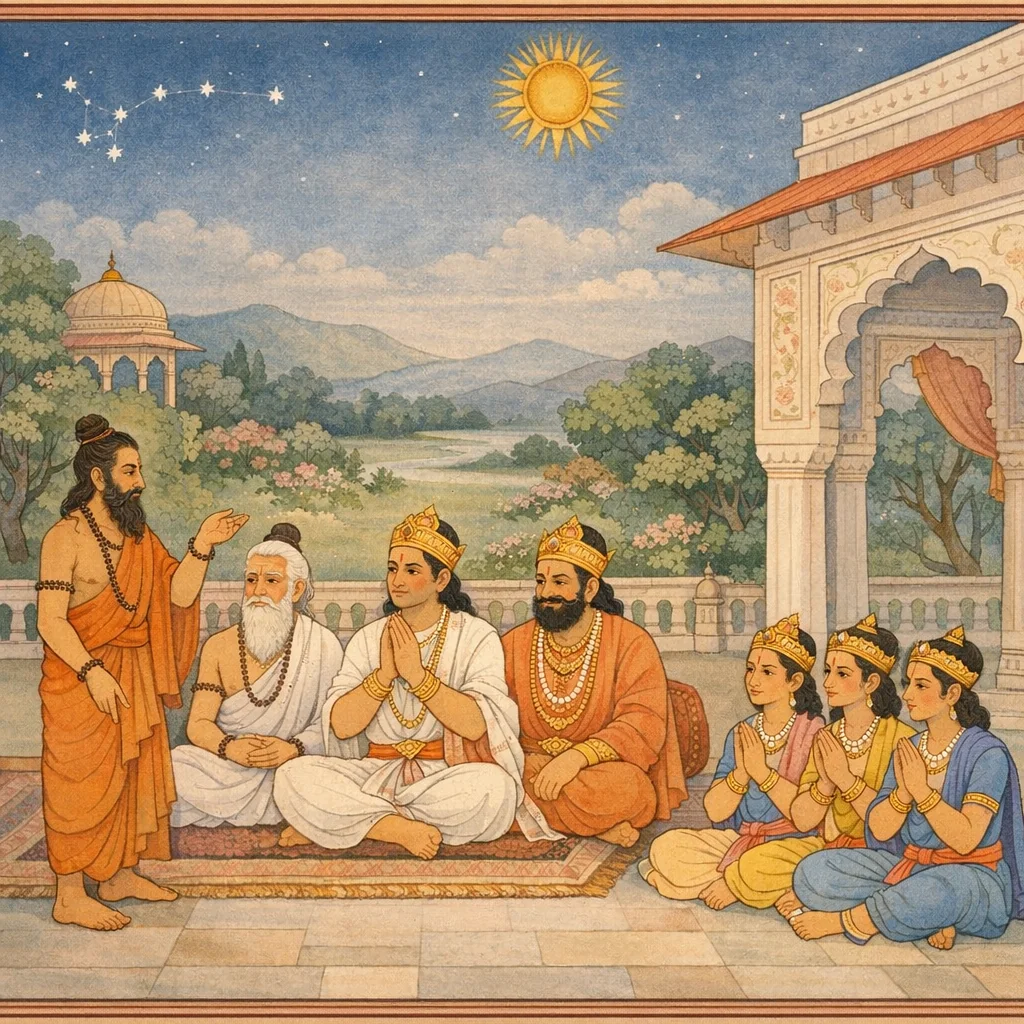
Sarga 72 formalizes the dynastic alliance between the Ikṣvāku princes and the Videha household through a sequence of courtly dialogue and ritual preparation. After Janaka’s genealogical account, Viśvāmitra—supported by Vasiṣṭha—frames the Ikṣvāku and Videha lineages as incomparable in glory and recommends a ‘sadṛśa’ (befitting) union: Sītā with Rāma and Ūrmilā with Lakṣmaṇa, alongside the proposal that Kuśadhvaja’s daughters be given to Bharata and Śatrughna. Janaka, with folded hands, accepts the counsel, declares his lineage blessed, and fixes the marriages to occur on an astrologically praised time associated with the Phalgunī asterisms and Bhaga as Prajāpati. He honors the sages with seats and affirms parity of royal authority between Mithilā and Ayodhyā, inviting appropriate governance of proceedings. Daśaratha responds with gratitude and praise, then withdraws to perform śrāddha rites and initiatory go-dāna on behalf of his sons, donating vast numbers of cows with ceremonial adornments and valuables to brāhmaṇas. The sarga closes with Daśaratha depicted as radiant, surrounded by his sons, like Prajāpati among the lokapālas—an image that sacralizes the political alliance through ritual generosity.
Shlokas
Verse 1
तमुक्तवन्तं वैदेहं विश्वामित्रो महामुनि:।उवाच वचनं वीरं वसिष्ठसहितो नृपम्।।।।
When the valiant king of Videha had thus spoken, the great sage Viśvāmitra—accompanied by Vasiṣṭha—addressed the king with fitting words.
Verse 2
अचिन्त्यान्यप्रमेयानि कुलानि नरपुङ्गव।इक्ष्वाकूणां विदेहानां नैषां तुल्योऽस्ति कश्चन।।।।
O best of men, the royal lineages of the Ikṣvākus and the Videhas are beyond imagining and beyond measure; no one is equal to these houses.
Verse 3
सदृशो धर्मसम्बन्ध: सदृशो रूपसम्पदा।रामलक्ष्मणयो राजन् सीता चोर्मिलया सह।।।।
O King, for Rāma and Lakṣmaṇa, with Sītā and also with Ūrmilā, the marital bond is well-matched—well-suited in dharma, and well-suited in beauty and excellence.
Verse 4
वक्तव्यं च नरश्रेष्ठ श्रूयतां वचनं मम।भ्राता यवीयान् धर्मज्ञ एष राजा कुशध्वज:।।।।
O best of men, hear my words, for they ought to be spoken: this is my younger brother, King Kuśadhvaja, a knower of righteousness.
Verse 5
अस्य धर्मात्मनो राजन् रूपेणाप्रतिमं भुवि ।सुताद्वयं नरश्रेष्ठ पत्न्यर्थं वरयामहे।।।।
O King, O best of men: for this virtuous one—whose beauty is unmatched on earth—we seek his two daughters as brides.
Verse 6
भरतस्य कुमारस्य शत्रुघ्नस्य च धीमत:।वरयामस्सुते राजन् तयोरर्थे महात्मनो:।।।।
O King, we choose those daughters for the sake of the two great-souled princes—young Bharata and wise Śatrughna.
Verse 7
पुत्रा दशरथस्येमे रूपयौवनशालिन:।लोकपालोपमास्सर्वे देवतुल्यपराक्रमा:।।।।
These sons of Daśaratha, radiant with beauty and youth, all resemble the world-guardians in their protective stature and are godlike in valor.
Verse 8
उभयोरपि राजेन्द्र सम्बन्धेनानुबध्यताम्।इक्ष्वाको: कुलमव्यग्रं भवत:पुण्यकर्मण:।।।।
O king among kings, let the two lineages be firmly bound by this relationship—your pious house and the dynasty of Ikṣvāku—without discord.
Verse 9
विश्वामित्रवच श्शृत्वा वसिष्ठस्य मते तदा।जनक: प्रांजलिर्वाक्यमुवाच मुनिपुङ्गवौ।।।।
Having heard Viśvāmitra’s words—consonant with Vasiṣṭha’s counsel—Janaka, with folded hands, addressed the foremost of sages.
Verse 10
कुलं धन्यमिदं मन्ये येषां नो मुनिपुङ्गवौ ।सदृशं कुलसम्बन्धं यदाज्ञापयथ: स्वयम्।।।।
“I deem this lineage blessed—since you two foremost sages yourselves have directed a fitting alliance between our two royal houses.”
Verse 11
एवं भवतु भद्रं व: कुशध्वजसुते इमे।पत्न्यौ भजेतां सहितौ शत्रुघ्नभरतावुभौ।।।।
“So be it—may prosperity attend you. Let these two daughters of Kuśadhvaja become the wives of Bharata and Śatrughna, and together may they share the duties of household life.”
Verse 12
एकाह्ना राजपुत्रीणां चतसृणां महामुने।पाणीन् गृह्णन्तु चत्वारो राजपुत्रा महाबला:।।।।
“O great sage, let the four mighty princes take the hands of the four princesses—all on a single day.”
Verse 13
उत्तरे दिवसे ब्रह्मन् फल्गुनीभ्यां मनीषिण:।वैवाहिकं प्रशंसन्ति भगो यत्र प्रजापति:।।।।
“O Brahmin, the wise praise the marriage-rite as auspicious on the later day connected with the two Phalgunī stars—when Bhaga presides as Prajāpati.”
Verse 14
एवमुक्त्वा वचस्सौम्यं प्रत्युत्थाय कृताञ्जलि:।उभौ मुनिवरौ राजा जनको वाक्यमब्रवीत्।।।।
Having spoken these gentle words, King Janaka rose, folded his hands, and addressed both of the eminent sages.
Verse 15
परो धर्म: कृतो मह्यं शिष्योऽस्मिभवतो सदा।इमान्यासनमुख्यानि आसातां मुनिपुङ्गवौ।।।।
“A supreme act of dharma has been done for me. I am ever your disciple; O foremost among sages, be seated upon these excellent seats.”
Verse 16
यथा दशरथस्येयं तथाऽयोध्या पुरी मम।प्रभुत्वे नास्ति सन्देहो यथार्हं कर्तुमर्हथ।।।।
“As this city is Daśaratha’s, so Ayodhyā is mine—there is no doubt about rightful authority. Therefore, do what is fitting, as you deem proper.”
Verse 17
तथा ब्रुवति वैदेहे जनके रघुनन्दन:।राजा दशरथो हृष्ट: प्रत्युवाच महीपतिम्।।।।
As Janaka of Videha spoke thus, King Daśaratha—delighted, the joy of Raghu’s line—replied to the lord of the earth (Janaka).
Verse 18
युवामसङ्ख्येयगुणौ भ्रातरौ मिथिलेश्वरौ।ऋषयो राजसङ्घाश्च भवद्भ्यामभिपूजिता:।।।।
You two brothers, the lords of Mithilā, possess countless virtues; by you, sages and assemblies of kings have been duly honored.
Verse 19
स्वस्ति प्राप्नुहि भद्रं ते गमिष्यामि स्वमालयम्।श्राद्धकर्माणि सर्वाणि विधास्यामीति चाब्रवीत्।।।।
“May you attain well-being; may prosperity be yours. I shall return to my residence and perform all the śrāddha rites,” he said.
Verse 20
तमापृष्ट्वा नरपतिं राजा दशरथस्तदा।मुनीन्द्रौ तौ पुरस्कृत्य जगामाशु महायशा:।।।।
Then the renowned King Daśaratha, having taken leave of that lord of men, departed at once, placing the two foremost sages before him.
Verse 21
स गत्वा निलयं राजा श्राद्धं कृत्वा विधानत:।प्रभाते काल्यमुत्थाय चक्रे गोदानमुत्तमम्।।।।
Having returned to his residence, the king performed the śrāddha according to rule; at dawn, rising at the proper time, he carried out an excellent gift of cows.
Verse 22
गवां शतसहस्राणि ब्राह्मणेभ्यो नराधिप:।एकैकशो ददौ राजा पुत्रानुद्दिश्य धर्मत:।।।।
The lord of men—the king—bestowed a hundred thousand cows upon the brāhmaṇas, assigning them one by one in the names of his sons, in accordance with dharma.
Verse 23
सुवर्णश्रुङ्गा स्सम्पन्ना स्सवत्सा: कांस्यदोहना:।गवां शतसहस्राणि चत्वारि पुरुषर्षभ:।।।।वित्तमन्यच्च सुबहुद्विजेभ्यो रघुनन्दन:।ददौ गोदानमुद्दिश्य पुत्राणां पुत्रवत्सल:।।।।
That bull among men, the delight of the Raghus—affectionate toward his sons—gave, in their names, a gift of four hundred thousand cows to the twice-born. The cows were well-provisioned, with calves, their horns adorned with gold, and with bronze vessels for milking; and he also bestowed abundant additional wealth upon the brāhmaṇas.
Verse 24
सुवर्णश्रुङ्गा स्सम्पन्ना स्सवत्सा: कांस्यदोहना:।गवां शतसहस्राणि चत्वारि पुरुषर्षभ:।।1.72.23।।वित्तमन्यच्च सुबहुद्विजेभ्यो रघुनन्दन:।ददौ गोदानमुद्दिश्य पुत्राणां पुत्रवत्सल:।।1.72.24।।
That bull among men, the delight of the Raghus—affectionate toward his sons—gave, in their names, a gift of four hundred thousand cows to the twice-born. The cows were well-provisioned, with calves, their horns adorned with gold, and with bronze vessels for milking; and he also bestowed abundant additional wealth upon the brāhmaṇas.
Verse 25
स सुतै: कृतगोदानैर्वृतस्तु नृपतिस्तदा।लोकपालैरिवाभाति वृत: स्सौम्य: प्रजापति:।।।।
Then the king, surrounded by his sons for whom the gift of cows had been completed, shone forth—gentle and radiant—like Prajāpati encircled by the guardians of the worlds.
Frequently Asked Questions
The pivotal action is the dharmic authorization of inter-dynastic marriage: Janaka must publicly accept the sages’ recommendation that the alliances are ‘sadṛśa’ (properly matched) and then bind political intent to ritual correctness through auspicious timing and sanctioned gifts.
Legitimate power is shown as counsel-responsive and rite-grounded: kings act within an ethical framework where lineage prestige alone is insufficient unless confirmed by humility before sages, correct muhurta selection, and charitable redistribution (go-dāna) that anchors prosperity in dharma.
Geographically, Mithilā (Videha) and Ayodhyā are paired as equal royal spheres; culturally, the sarga highlights nakṣatra-based wedding timing (Pūrva/Uttara Phalgunī with Bhaga as Prajāpati), śrāddha observance, and the go-dāna ceremony with ritually described cattle and vessels.