Sarga 71
जनककुलवर्णनम् तथा सीतोर्मिलादानम् (Janaka’s Genealogy and the Bestowal of Sita and Urmila)
बालकाण्ड
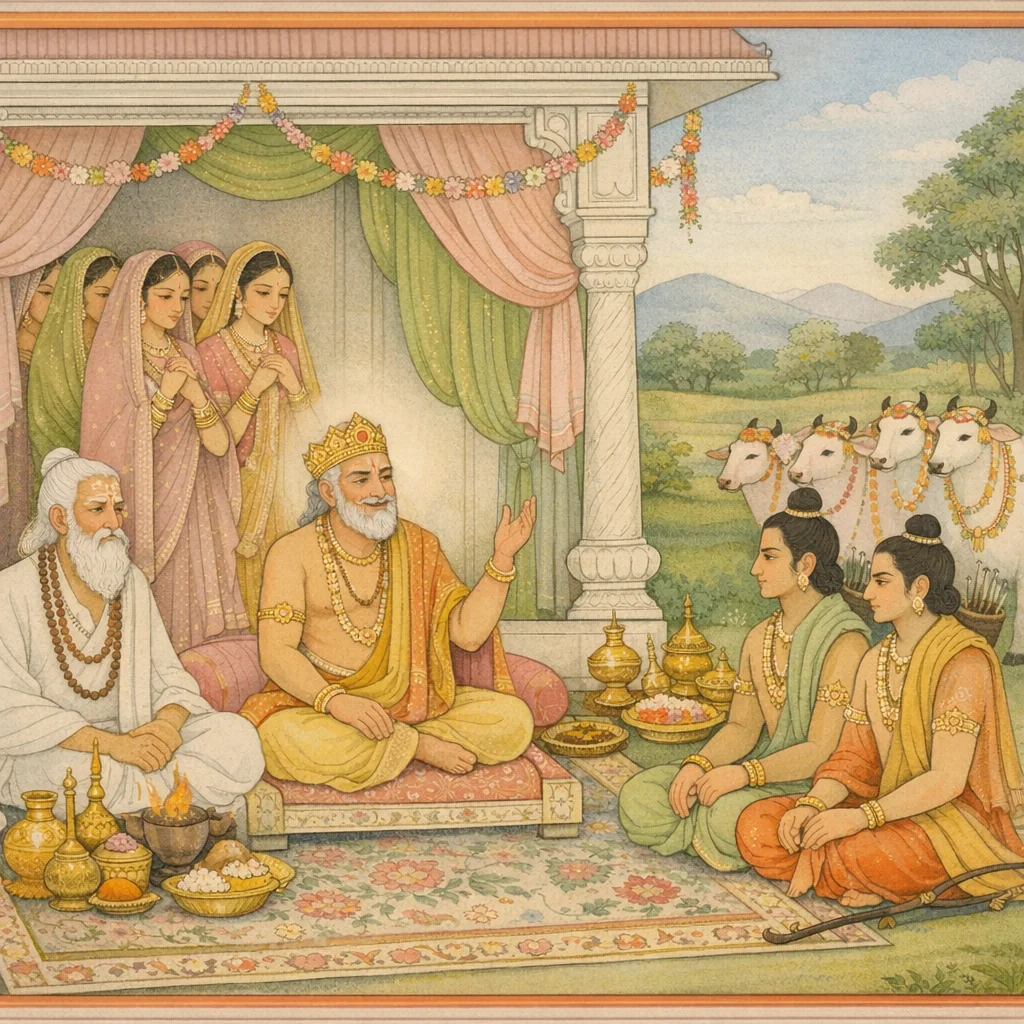
Sarga 71 is a formal, courtly exchange in which King Janaka responds to Vasiṣṭha after hearing the Ikṣvāku genealogy. Janaka states a normative principle of marriage-giving (kanyā-pradāna): a noble house should recite its lineage fully at the time of bestowal. He then narrates the Videha line beginning with the renowned king Nimi, followed by Mithi (builder of Mithilā), and a succession of Janakas culminating in Hrasvaroma, whose sons are Janaka (the speaker) and his younger brother Kuśadhvaja. Janaka explains his accession, his father’s retirement to the forest, and his righteous governance with affectionate guardianship of Kuśadhvaja. A political crisis follows: Sudhanvā of Sāṅkāśya demands the Śaiva bow and Sītā; Janaka refuses, defeats and kills him in battle, and installs Kuśadhvaja as ruler in Sāṅkāśya. The chapter culminates in the public declaration of marriage: Janaka joyfully gives Sītā to Rāma and Ūrmilā to Lakṣmaṇa, proclaims the gift thrice for legal-ritual certainty, and instructs Daśaratha regarding go-dāna and pitṛ rites, specifying an auspicious timing (Makha rising; marriage on the third day under Uttara-Phalgunī).
Shlokas
Verse 1
एवं ब्रुवाणं जनक: प्रत्युवाच कृताञ्जलि:।श्रोतुमर्हसि भद्रं ते कुलं न: परिकीर्तितम्।।।।
As he spoke thus, Janaka replied with folded hands: “Welfare be to you. It is fitting that you now hear the genealogy of our house as it is recounted.”
Verse 2
प्रदाने हि मुनिश्रेष्ठ कुलं निरवशेषत:।वक्तव्यं कुलजातेन तन्निबोध महामुने।।।।
O best of sages, at the time of giving a daughter in marriage, one born into a noble line should declare the family lineage in full—please hear it, O great sage.
Verse 3
राजाऽभूत् त्रिषु लोकेषु विश्रुत स्स्वेन कर्मणा।निमि: परमधर्मात्मा सर्वसत्त्ववतां वर:।।।।
There was a king named Nimi, renowned in the three worlds for his own deeds—supremely righteous in spirit and the foremost among those endowed with strength and excellence.
Verse 4
तस्य पुत्रोमिथिर्नाम मिथिला येन निर्मिता।प्रथमो जनको नाम जनकादप्युदावसु:।।।।
His son was named Mithi, by whom Mithilā was founded. He was the first to bear the title ‘Janaka’; and from that Janaka was born Udāvasu.
Verse 5
उदावसोस्तु धर्मात्मा जातो वै नन्दिवर्धन:।नन्दिवर्धनपुत्रस्तु सुकेतुर्नाम नामत:।।।।
From Udāvasu was born the righteous Nandivardhana; and Nandivardhana’s son was Suketu, so named.
Verse 6
सुकेतोरपि धर्मात्मा देवरातो महाबल:।देवरातस्य राजर्षेर्बृहद्रथ इति स्मृत:।।।।
From Suketu too was born the righteous and mighty Devarāta; and of that royal sage Devarāta, the son remembered was Bṛhadratha.
Verse 7
बृहद्रथस्य शूरोऽभून्महावीर: प्रतापवान्।महावीरस्य धृतिमान् सुधृतिस्सत्यविक्रम:।।।।
Bṛhadratha’s son was the heroic Mahāvīra, radiant with prowess. From Mahāvīra was born Sudhṛti—steadfast in resolve, whose valor stood firm in truth.
Verse 8
सुधृतेरपि धर्मात्मा दृष्टकेतुस्सुधार्मिक:।दृष्टकेतोस्तु राजर्षेर्हर्यश्व इति विश्रुत:।।।।
From Sudhṛti too was born Dṛṣṭaketu, righteous in soul and firmly devoted to dharma. And from the royal sage Dṛṣṭaketu was born the famed Haryaśva.
Verse 9
हर्यश्वस्य मरु: पुत्रो मरो: पुत्र: प्रतिन्धक:।प्रतिंधकस्य धर्मात्मा राजा कीर्तिरथस्सुत:।।।।
Haryaśva’s son was Maru; Maru’s son was Pratindhaka. And Pratindhaka’s son was the righteous king Kīrtiratha.
Verse 10
पुत्र: कीर्तिरथस्यापि देवमीढ इति स्मृत:।देवमीढस्य विबुधो विबुधस्य महीध्रक:।।।।
Kīrtiratha’s son was renowned as Devamīḍha; Devamīḍha’s son was Vibudha; and Vibudha’s son was Mahīdhraka.
Verse 11
महीध्रकसुतो राजा कीर्तिरातो महाबल:।कीर्तिरातस्य राजर्षेर्महारोमा व्यजायत।।।।
From Mahīdhraka was born the mighty king Kīrtirāta; and to that royal seer Kīrtirāta was born Mahāromā.
Verse 12
महारोम्णस्तु धर्मात्मा स्वर्णरोमा व्यजायत।स्वर्णरोम्णस्तु राजर्षेर्ह्रस्वरोमा व्यजायत।।।।
From Mahāromā was born the righteous Swarnaromā; and from Swarnaromā, that royal seer, was born Hrasvaromā.
Verse 13
तस्य पुत्रद्वयं जज्ञे धर्मज्ञस्य महात्मन:।ज्येष्ठोऽहमनुजो भ्राता मम वीर: कुशध्वज:।।।।
To that great-souled king—knower of dharma—two sons were born: I am the elder, and my younger brother is the valiant Kuśadhvaja.
Verse 14
मां तु ज्येष्ठं पिता राज्ये सोऽभिषिच्य नराधिप:।कुशध्वजं समावेश्य भारं मयि वनं गत:।।।।
My father, the king, anointed me—the elder—over the kingdom; entrusting Kuśadhvaja and the burden of responsibility to me, he departed for the forest.
Verse 15
वृद्धे पितरि स्वर्याते धर्मेण धुरमावहम्।भ्रातरं देवसङ्काशं स्नेहात्पश्यन् कुशध्वजम्।।।।
When my aged father had gone to heaven, I bore the burden of rule in accordance with dharma, and lovingly cared for my brother Kuśadhvaja, radiant like a god.
Verse 16
कस्य चित्त्वथकालस्य साङ्काश्यादगमत्पुरात्।सुधन्वा वीर्यवान्राजा मिथिलामवरोधक:।।।।
After some time, the mighty king Sudhanvā set out from the city of Sāṅkāśyā, intent on besieging Mithilā.
Verse 17
स च मे प्रेषयामास शैवं धनुरनुत्तमम्।सीता कन्या च पद्माक्षी मह्यं वै दीयतामिति।।।।
He sent me a demand: “Let the unsurpassed bow of Śiva be given to me—and also Sītā, the lotus-eyed maiden.”
Verse 18
तस्याप्रदानाद्ब्रह्मर्षे युद्धमासीन्मया सह।स हतोऽभिमुखो राजा सुधन्वा तु मया रणे।।।।
O Brahmarṣi, because I would not give them, war broke out between him and me; and in battle, facing me, King Sudhanvā was slain by my hand.
Verse 19
निहत्य तं मुनिश्रेष्ठ सुधन्वानं नराधिपम्।साङ्काश्ये भ्रातरं वीरमभ्यषिञ्चं कुशध्वजम्।।।।
O best of sages, after slaying that king Sudhanvā, I anointed my heroic brother Kuśadhvaja as ruler in Sāṅkāśyā.
Verse 20
कनीयानेष मे भ्राता अहं ज्येष्ठो महामुने।ददामि परमप्रीतो वध्वौ ते मुनिपुङ्गव।।।।सीतां रामाय भद्रं ते ऊर्मिला लक्ष्मणाय च।
O great sage, this is my younger brother and I am the elder. O foremost of sages, with great joy I give these two brides: Sītā to Rāma—may auspiciousness be yours—and Ūrmilā to Lakṣmaṇa as well.
Verse 21
वीर्यशुल्कां मम सुतां सीतां सुरसुतोपमाम् ।।।।द्वितीयामूर्मिलां चैव त्रिर्ददामि न संशय:।
As the bride-price won by valor, I bestow my daughter Sītā—like a daughter of the gods; and also my second daughter Ūrmilā. I declare it three times, leaving no room for doubt.
Verse 22
ददामि परमप्रीतो वध्वौ ते रघुनन्दन।।।।रामलक्ष्मणयो राजन् गोदानं कारयस्व ह।पितृकार्यं च भद्रं ते ततो वैवाहिकं कुरु।।।।
With great joy, O delight of the Raghu line, I give these two brides to you for Rāma and Lakṣmaṇa. O King, have the gift of cows performed, and the rites owed to the ancestors as well—may auspiciousness attend you. Thereafter, conduct the wedding ceremonies.
Verse 23
ददामि परमप्रीतो वध्वौ ते रघुनन्दन।।1.71.22।।रामलक्ष्मणयो राजन् गोदानं कारयस्व ह।पितृकार्यं च भद्रं ते ततो वैवाहिकं कुरु।।1.71.23।।
From Udāvasu was born the righteous Nandivardhana; and Nandivardhana’s son was Suketu, so named.
Verse 24
मखा ह्यद्य महाबाहो तृतीये दिवसे प्रभो।फल्गुन्यामुत्तरे राजंस्तस्मिन्वैवाहिकं कुरु।।।।रामलक्ष्मणयो राजन् दानं कार्यं सुखोदयम् ।।
Today the constellation Maghā is ascendant. O mighty-armed lord, O King—on the third day from now, under Uttara-Phālgunī, perform the wedding rites. And, O King, let gifts be given for the joyful welfare of Rāma and Lakṣmaṇa.
Frequently Asked Questions
Janaka faces an extortionate demand from King Sudhanvā—hand over the Śaiva bow and Sītā. Janaka refuses (protecting custodial dharma over sacred property and his daughter’s agency within lawful marriage), accepts the consequences of conflict, defeats Sudhanvā, and then restores political order by crowning Kuśadhvaja in Sāṅkāśya.
The chapter teaches that social acts like marriage are not private transactions but dhārmic institutions requiring transparency (genealogy), public certainty (thrice-proclaimed gift), and ritual completeness (go-dāna and pitṛ rites). It also models kingship as restraint: power is exercised to defend sacred trust and civic order, not to gratify coercive claims.
Mithilā is highlighted as the dynastic capital founded by Mithi and governed by Janaka’s line; Sāṅkāśya appears as Sudhanvā’s city and later Kuśadhvaja’s seat after coronation. Culturally, the Sarga emphasizes kanyā-pradāna customs, go-dāna, pitṛ rites, and nakṣatra-based election of an auspicious wedding time (Makha and Uttara-Phalgunī).