Sarga 65
विश्वामित्रस्य ब्राह्मर्षित्वप्राप्तिः — Viśvāmitra Attains Brahmarṣi Status
बालकाण्ड
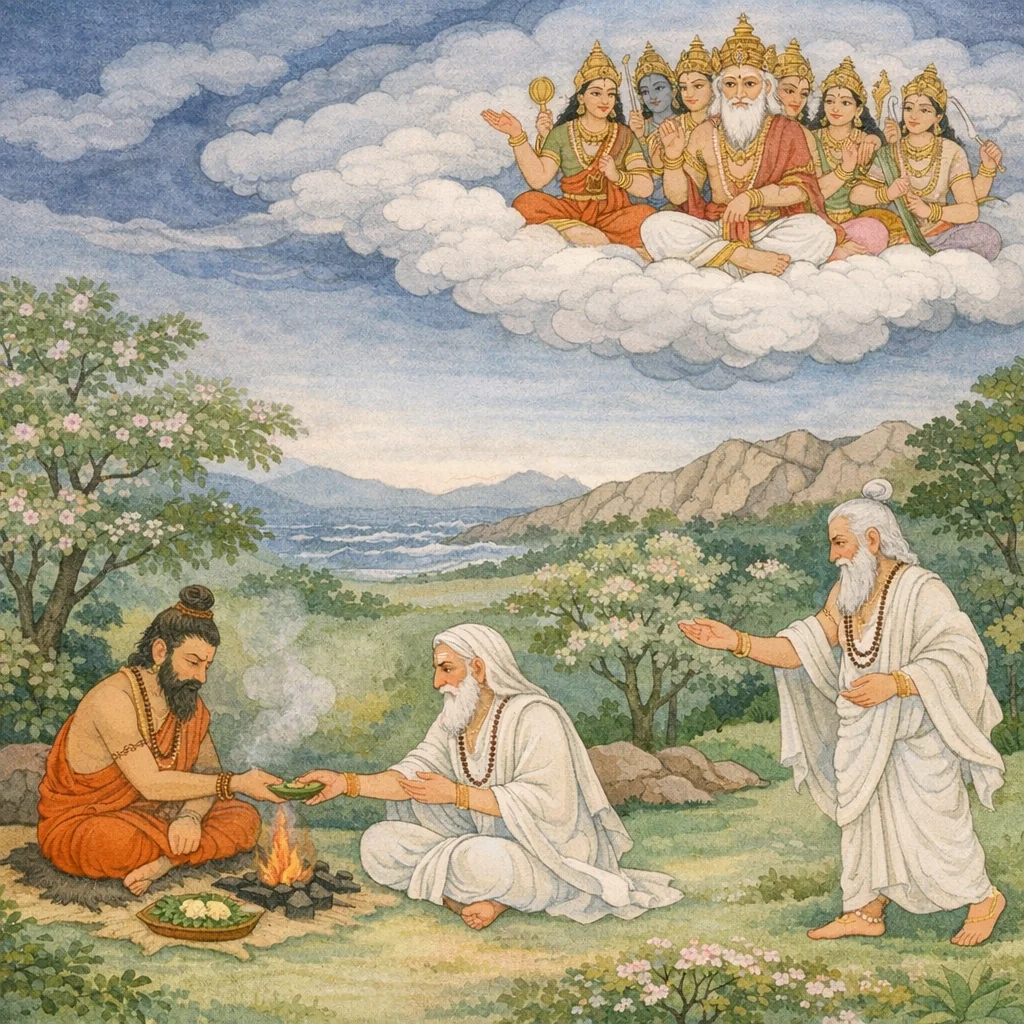
This sarga presents Śatānanda’s learned account of Viśvāmitra’s final ascent from kṣatriya-ascetic to Brahmarṣi, emphasizing the mechanics of tapas, temptation, and cosmic consequence. Viśvāmitra leaves the Himavat region and undertakes severe austerities in the eastern quarter, including an extraordinary thousand-year vow of silence. When the vow concludes, Indra tests him by appearing as a brahmin and requesting the prepared food; Viśvāmitra gives it all without speech and resumes an even harsher regimen—another thousand years with breath suspended—causing smoke to rise from his head and unsettling the three worlds (darkness, trembling earth, agitated oceans, cracking mountains, and dimmed solar brilliance). Alarmed, the gods led by Brahmā resolve to appease him before his will turns destructive. They welcome him, declare their satisfaction, and acknowledge that he has attained brāhmaṇya through intense tapas. Viśvāmitra requests formal recognition by Vasiṣṭha; Vasiṣṭha, persuaded by the gods, affirms him as Brahmarṣi and establishes friendship. The frame returns to Mithilā: Śatānanda concludes; King Janaka, with folded hands before Rāma and Lakṣmaṇa, expresses gratitude to Viśvāmitra and requests leave for evening rites, after which the parties retire respectfully.
Shlokas
Verse 1
अथ हैमवतीं राम दिशं त्यक्त्वा महामुनि:।पूर्वां दिशमनुप्राप्य तपस्तेपे सुदारुणम्।।।।
Then, O Rāma, the great sage, leaving the Himavat region, reached the eastern quarter and performed exceedingly rigorous austerities.
Verse 2
मौनं वर्षसहस्रस्य कृत्वा व्रतमनुत्तमम्।चकाराप्रतिमं राम तप: परमदुष्करम्।।।।
Having undertaken an unsurpassed vow of silence for a thousand years, O Rāma, he performed unparalleled austerities—exceedingly difficult to accomplish.
Verse 3
पूर्णे वर्षसहस्रे तु काष्ठभूतं महामुनिम्।विघ्नैर्बहुभिराधूतं क्रोधो नान्तर आविशत्।।।।स कृत्वा निश्चयं राम तप आतिष्टदव्ययम्।
When a full thousand years had passed, the great sage remained motionless like a piece of wood; though assailed by many obstacles, anger did not enter his heart. Having formed a firm resolve, O Rāma, he undertook unwearied austerity.
Verse 4
तस्य वर्षसहस्रस्य व्रते पूर्णे महाव्रत:।।।।भोक्तुमारब्धवानन्नं तस्मिन् काले रघूत्तम।इन्द्रो द्विजातिर्भूत्वा तं सिद्धमन्नमयाचत।।।।
O best of the Raghus, when his thousand-year vow was completed, that great observer of vows began to eat his prepared food. At that very moment Indra, taking the guise of a brāhmaṇa, begged from him that food which was ready.
Verse 5
तस्य वर्षसहस्रस्य व्रते पूर्णे महाव्रत:।।1.65.4।।भोक्तुमारब्धवानन्नं तस्मिन् काले रघूत्तम। इन्द्रो द्विजातिर्भूत्वा तं सिद्धमन्नमयाचत।।1.65.5।।
O best of the Raghus, when his thousand-year vow was completed, that great observer of vows began to eat his prepared food; at that moment Indra, disguised as a brāhmaṇa, begged that ready food from him.
Verse 6
तस्मै दत्वा तदा सिद्धं सर्वं विप्राय निश्चित:।निश्शेषितेऽन्ने भगवानभुक्तैव महातपा:।।।।न किञ्चिदवदद्विप्रं मौनव्रतमुपस्थित:।अथ वर्षसहस्रं वै नोच्छ्वसन्मुनिपुङ्गव:।।।।
Resolute, he then gave all the prepared food to that brāhmaṇa. When the food was entirely consumed, the revered great ascetic remained unfed; adopting a vow of silence, he spoke not a word to the brāhmaṇa. Thereafter, that foremost of sages undertook austerities for another thousand years, suspending his breath.
Verse 7
तस्मै दत्वा तदा सिद्धं सर्वं विप्राय निश्चित:।निश्शेषितेऽन्ने भगवानभुक्तैव महातपा:।।1.65.6।।न किञ्चिदवदद्विप्रं मौनव्रतमुपस्थित:।अथ वर्षसहस्रं वै नोच्छ्वसन्मुनिपुङ्गव:।।1.65.7।।
Resolved, he gave all the prepared food to the brāhmaṇa; when it was completely eaten, the great ascetic remained without food. Observing silence, he spoke nothing, and then continued austerities for another thousand years, suspending his breath.
Verse 8
तस्यानुच्छ्वसमानस्य मूर्ध्नि धूमो व्यजायत।त्रैलोक्यं येन सम्भ्रान्तमादीपितमिवाभवत्।।।।
As he held back his breath, smoke arose from the crown of his head; by it the three worlds were thrown into alarm, as though they had been set ablaze.
Verse 9
ततो देवास्सगन्धर्वा: पन्नगोरगराक्षसा:।मोहितास्तेजसा तस्य तपसा मन्दरश्मय:।।।।कश्मलोपहता स्सर्वे पितामहमथाब्रुवन्।
Then the gods—together with gandharvas, serpents, and rākṣasas—were bewildered by the radiance born of his austerity, their own splendor dimmed. Stricken with distress, they approached the Grandsire (Brahmā) and spoke.
Verse 10
बहुभि: कारणैर्देव विश्वामित्रो महामुनि:।।।।लोभित: क्रोधितश्चैव तपसा चाभिवर्धते।
O Lord, the great sage Viśvāmitra has been tempted and provoked in many ways; yet his ascetic power only continues to increase.
Verse 11
न ह्यस्य वृजिनं किञ्चिद्दृश्यते सूक्ष्ममप्यथ।।।।न दीयते यदि त्वस्य मनसा यदभीप्सितम्।विनाशयति त्रैलोक्यं तपसा सचराचरम्।।।।
No fault in him can be seen— not even the slightest. If what he desires in his mind is not granted, he can, by his austerity, destroy the three worlds along with all that moves and does not move.
Verse 12
न ह्यस्य वृजिनं किञ्चिद्दृश्यते सूक्ष्ममप्यथ।।1.65.11।।न दीयते यदि त्वस्य मनसा यदभीप्सितम्।विनाशयति त्रैलोक्यं तपसा सचराचरम्।।1.65.12।।
No fault in him can be found— not even the smallest. If what he longs for is not given, he can, by the force of his austerities, destroy the three worlds together with all beings, moving and unmoving.
Verse 13
व्याकुलाश्च दिशस्सर्वा न च किञ्चित्प्रकाशते।सागरा: क्षुभितास्सर्वे विशीर्यन्ते च पर्वता:।।।।
All directions are thrown into turmoil, and nothing seems to shine. The oceans are churned, and the mountains split apart.
Verse 14
प्रकम्पते च पृथिवी वायुर्वाति भृशाकुल:।बृह्मन्न प्रतिजानीमोनास्तिको जायते जन:।।।।
The earth trembles and the wind blows in violent agitation. O Brahman, we do not know what to do—people are turning into unbelievers.
Verse 15
सम्मूढमिव त्रैलोक्यं सम्प्रक्षुभितमानसम्।भास्करो निष्प्रभश्चैव महर्षेस्तस्य तेजसा।।।।
The three worlds seem dazed, their minds in turmoil; even the Sun appears dim before the radiance of that great seer.
Verse 16
बुद्धिं न कुरुते यावन्नाशे देव महामुनि:।तावत्प्रसाद्यो भगवा नग्निरूपोमहाद्युति:।।।।
O Lord, before that mighty sage—venerable, fire-like, and intensely radiant—turns his resolve toward destruction, he must be appeased.
Verse 17
कालाग्निना यथापूर्वं त्रैलोक्यं दह्यतेऽखिलम्।देवराज्यं चिकीर्षेत दीयतामस्य यन्मतम्।।।।
All the three worlds are burning, as though by the fire of cosmic dissolution. Even if he desires the sovereignty of the gods, let what he intends be granted to him.
Verse 18
ततस्सुरगणास्सर्वे पितामहपुरोगमा:।विश्वामित्रं महात्मानं मधुरं वाक्यमब्रुवन्।।।।
Then all the hosts of gods, with Pitāmaha (Brahmā) at their head, addressed the great-souled Viśvāmitra with gentle words.
Verse 19
ब्रह्मर्षे स्वागतं तेऽस्तु तपसा स्म सुतोषिता:।ब्राह्मण्यं तपसोग्रेण प्राप्तवानसि कौशिक ।।।।
O Brahmarṣi, welcome to you! We are greatly pleased by your austerities. O Kauśika, through intense penance you have attained the status of brahminhood.
Verse 20
दीर्घमायुश्च ते ब्रह्मन् ददामि समरुद्गण:।स्वस्ति प्राप्नुहि भद्रं ते गच्छ सौम्य यथासुखम्।।।।
O Brahmin, I—together with the hosts of Maruts—grant you long life. Attain well-being and prosperity; gentle one, go now in peace and happiness.
Verse 21
पितामहवचश्शृत्वा सर्वेषां च दिवौकसाम्।कृत्वा प्रणामं मुदितो व्याजहार महामुनि:।।।।
Hearing the words of the Grandsire and of all the gods, the great sage—delighted—bowed in reverence and then spoke.
Verse 22
ब्राह्मण्यं यदि मे प्राप्तं दीर्घमायुस्तथैव च।ओङ्कारश्च वषट्कारो वेदाश्च वरयन्तु माम्।।।।
If brahminhood has indeed been attained by me—and long life as well—then let Om, the vaṣaṭ-call, and the Vedas themselves acknowledge and accept me.
Verse 23
क्षत्रवेदविदां श्रेष्ठो ब्रह्मवेदविदामपि।ब्रह्मपुत्रो वसिष्ठो मामेवं वदतु देवता:।।।।यद्ययं परम: काम: कृतो यान्तु सुरर्षभा:।
O gods, let Vasiṣṭha—the son of Brahmā, foremost among those who know the kṣatriya-veda as well as among those who know the brahma-veda—address me in this way. If this highest desire is fulfilled, then, O best of the gods, you may depart.
Verse 24
तत: प्रसादितो देवैर्वसिष्ठो जपतां वर:।।।।सख्यं चकार ब्रह्मर्षिरेवमस्त्विति चाब्रवीत्।
Then Vasiṣṭha—best among those who recite sacred formulas—being propitiated by the gods, entered into friendship and declared: “So be it; you are a Brahmarṣi.”
Verse 25
ब्रह्मर्षिस्त्वं न सन्देहस्सर्वं सम्पत्स्यते तव।।।।इत्युक्त्वा देवताश्चापि सर्वा जग्मुर्यथागतम्।
“You are a Brahmarṣi—there is no doubt; all will be accomplished for you.” Having said this, all the gods too departed, returning as they had come.
Verse 26
विश्वामित्रोऽपि धर्मात्मा लब्ध्वा ब्राह्मण्यमुत्तमम्।।।।पूजयामास ब्रह्मर्षिं वसिष्ठं जपतां वरम्।
And Viśvāmitra too—righteous-souled—having attained excellent brahminhood, honored Vasiṣṭha, the Brahmarṣi, the foremost among mantra-reciters.
Verse 27
कृतकामो महीं सर्वां चचार तपसि स्थित:।।।।एवं त्वनेन ब्राह्मण्यं प्राप्तं राम महात्मना।
His purpose fulfilled, steadfast in austerity, he wandered over the whole earth. Thus, O Rāma, brahminhood was attained by that great-souled one.
Verse 28
एष राम मुनिश्रेष्ठ एष विग्रहवांस्तप:।।।।एष धर्मपरो नित्यं वीर्यस्यैष परायणम्।
This man, O Rāma, is the foremost of sages; he is austerity embodied. Ever devoted to dharma, he is the very summit and refuge of spiritual power.
Verse 29
एवमुक्त्वा महातेजा विरराम द्विजोत्तम:।।।।शतानन्दवच: श्रुत्वा रामलक्ष्मणसन्निधौ।जनक: प्राञ्जलिर्वाक्यमुवाच कुशिकात्मजम्।।।।
Having spoken thus, the radiant one—best among the twice-born—fell silent.
Verse 30
एवमुक्त्वा महातेजा विरराम द्विजोत्तम:।।1.65.29।।शतानन्दवच: श्रुत्वा रामलक्ष्मणसन्निधौ।जनक: प्राञ्जलिर्वाक्यमुवाच कुशिकात्मजम्।।1.65.30।।
Having heard Śatānanda’s words, with Rāma and Lakṣmaṇa present, Janaka—hands folded in reverence—spoke to Kuśika’s son (Viśvāmitra).
Verse 31
धन्योऽस्म्यनुगृहीतोऽस्मि यस्य मे मुनिपुङ्गव।यज्ञं काकुत्स्थसहित: प्राप्तवानसि धार्मिक।।।।
“I am blessed; I am greatly favoured, O foremost of sages, because you—O righteous one—have come to my sacrifice accompanied by the scions of Kakutstha (Rāma and Lakṣmaṇa).”
Verse 32
पावितोऽहं त्वया ब्रह्मन् दर्शनेन महामुने।गुणा बहुविधा: प्राप्तास्तव सन्दर्शनान्मया।।।।
“O Brahman, O great sage, I am purified by your very sight; through your visit I have gained many kinds of blessings and excellences.”
Verse 33
विस्तरेण च ते ब्रह्मन् कीर्त्यमानं महत्तप:।श्रुतं मया महातेजो रामेण च महात्मना।।।।
“O Brahman, O mighty one, your great austerities—recounted in detail—have been heard by me, and also by high-souled Rāma.”
Verse 34
सदस्यै: प्राप्य च सद: श्रुतास्ते बहवो गुणा:।अप्रमेयं तपस्तुभ्यमप्रमेयं च ते बलम्।।।।अप्रमेया गुणाश्चैव नित्यं ते कुशिकात्मज ।
“Having come to this sacrificial hall, the assembled elders have heard of your many virtues. Your austerity is beyond measure, and so is your power; immeasurable indeed are your virtues always, O son of Kuśika.”
Verse 35
तृप्तिराश्चर्यभूतानां कथानां नास्ति मे विभो।।।।कर्मकालो मुनिश्रेष्ठ लम्बते रविमण्डलम्।
“O lord, I find no satiety in hearing these wondrous accounts. Yet, O best of sages, the time for ritual duties has arrived—the sun’s disc is sinking.”
Verse 36
श्व: प्रभाते महातेजो द्रष्टुमर्हसि मां पुन:।।।।स्वागतं तपतां श्रेष्ठ मामनुज्ञातुमर्हसि।
“O radiant sage, you should see me again tomorrow at dawn. O best among ascetics, welcome—now you ought to grant me leave to depart (for my duties).”
Verse 37
एवमुक्तो मुनिवर: प्रशस्य पुरुषर्षभम्।।।।विससर्जाशु जनकं प्रीतं प्रीतमनास्तदा।
Thus addressed, the excellent sage—pleased at heart—praised Janaka, best of men, and promptly gave the gratified king leave to depart.
Verse 38
एवमुक्त्वा मुनिश्रेष्ठं वैदेहो मिथिलाधिप:।।।।प्रदक्षिणं चकाराशु सोपाध्यायस्सबान्धव:।
Having spoken thus to the foremost sage, Janaka—the king of Videha and lord of Mithilā—promptly circumambulated Viśvāmitra, accompanied by his preceptors and his kinsmen.
Verse 39
विश्वामित्रोऽपि धर्मात्मा सहरामस्सलक्ष्मण:।।।।स्ववाटमभिचक्राम पूज्यमानो महर्षिभि:।
Viśvāmitra too—steadfast in righteousness—departed for his own dwelling, accompanied by Rāma and Lakṣmaṇa, while being honored by the great seers.
Frequently Asked Questions
Viśvāmitra’s pivotal action is disciplined non-attachment under divine testing: when Indra (in brahmin guise) asks for his prepared food at the end of a long vow, he donates it entirely without breaking silence, choosing dharma and self-mastery over bodily need.
Tapas becomes spiritually authoritative only when joined to restraint and social legitimacy: the sarga shows that inner purity (absence of even subtle sin), endurance under provocation, and formal recognition by realized authorities (Vasiṣṭha, Brahmā, the gods) together constitute true attainment.
The narrative marks movement from the Himavat region to the eastern quarter for austerities, then returns to Mithilā and Janaka’s yajña-assembly; it also highlights Vedic-cultural markers such as Oṁkāra, Vaṣaṭkāra, sandhyā timing (sunset), and the authority to interpret Veda linked to Brahmarṣi status.