Sarga 60
त्रिशङ्कुस्वर्गारोহণम् — Trishanku’s Bodily Ascent and the New Constellations
बालकाण्ड
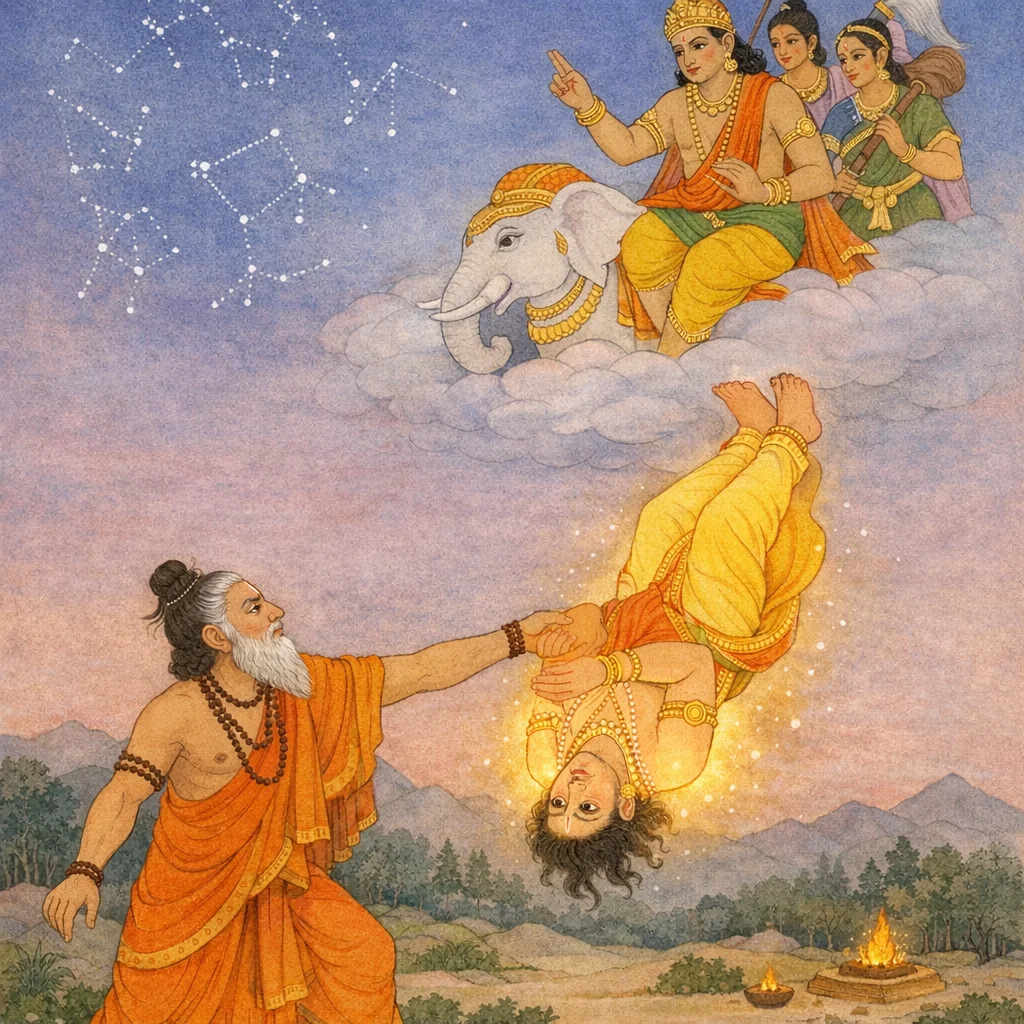
Sarga 60 presents a tightly argued ritual-cosmological episode centered on Viśvāmitra’s ascetic potency (tapas) and the contested legitimacy of Trīśaṅku’s desire to reach heaven with a physical body. After earlier hostilities with the Vasiṣṭhas are recalled, Viśvāmitra conducts a sacrifice and formally invokes the devas for their oblations; when they refuse to appear, he redirects the ritual’s force through a vow to his client-king. He orders Trīśaṅku to ascend bodily; Indra rejects him as unfit due to the guru’s curse and commands him to fall head-down. Trīśaṅku appeals mid-fall, and Viśvāmitra halts him, then—angered—creates an alternate stellar order: new Saptarṣis in the southern quarter and additional star-garlands, even threatening to create a new Indra. Alarmed, assemblies of ṛṣis, suras, and asuras negotiate a settlement: Trīśaṅku will remain suspended, luminous yet inverted, within Viśvāmitra’s newly created celestial region, and the stars will endure as long as the worlds last. The chapter thus maps a moral tension between priestly curse, divine gatekeeping, and the binding power of a rishi’s pledged word.
Shlokas
Verse 1
तपोबलहतान् कृत्वा वासिष्ठान् समहोदयान्।ऋषिमध्ये महातेजा विश्वामित्रोऽभ्यभाषत।।।।
Having struck down the sons of Vasiṣṭha—along with Mahodaya—by the force of his austerities, the radiant Viśvāmitra spoke in the midst of the sages.
Verse 2
अयमिक्ष्वाकुदायादस्त्रिशंकुरिति विश्रुत:।धर्मिष्ठश्च वदान्यश्च मां चैव शरणं गत:।।।।तेनानेन शरीरेण देवलोकजिगीषया।
This Triśaṅku—renowned as a descendant of Ikṣvāku, virtuous and generous—has sought refuge in me, desiring to reach the world of the gods with this very body.
Verse 3
यथाऽयं स्वशरीरेण स्वर्गलोकं गमिष्यति।।।।तथा प्रवर्त्यतां यज्ञे भवद्भिश्च मया सह।
“Join with me in setting this sacrifice in motion in such a way that he may go to the world of heaven in his own body.”
Verse 4
विश्वामित्रवच श्श्रुत्वा सर्व एव महर्षय:।।।।ऊचुस्समेत्य सहिता धर्मज्ञा धर्मसंहितम्।
Having heard Viśvāmitra’s words, all the great seers—knowers of dharma and steadfast in righteousness—came together in concord and spoke in agreement with what is proper.
Verse 5
अयं कुशिकदायादो मुनि: परमकोपन:।।।।यदाह वचनं सम्यगेतत्कार्यं न संशय:।अग्निकल्पो हि भगवान् शापं दास्यति रोषित:।।।।
“This sage—descended from Kuśika—is fiercely quick to anger. Whatever he declares must be carried out exactly; there is no doubt. For the venerable one is like fire, and if provoked he will surely utter a curse.”
Verse 6
अयं कुशिकदायादो मुनि: परमकोपन:।।1.60.5।।यदाह वचनं सम्यगेतत्कार्यं न संशय:।अग्निकल्पो हि भगवान् शापं दास्यति रोषित:।।1.60.6।।
This entry repeats the same admonition: Viśvāmitra, the Kuśika-descended sage, is fiercely irascible; his words must be executed precisely, for if angered the fire-like venerable one will pronounce a curse.
Verse 7
तस्मात्प्रवर्त्यतां यज्ञ स्सशरीरो यथा दिवम्।गच्छेदिक्ष्वाकुदायादो विश्वामित्रस्य तेजसा।।।।तथा प्रवर्त्यतां यज्ञ स्सर्वे समधितिष्ठत।
“Therefore let the sacrifice be set in motion in such a way that the Ikṣvāku-descended king may go to heaven with his very body through Viśvāmitra’s spiritual radiance. So let the rite proceed—let all of you take your stations and begin.”
Verse 8
एवमुक्त्वा महर्षयः चक्रुस्तास्ता:क्रियास्तदा।।।।याजकश्च महातेजा विश्वामित्रोऽभवत्क्रतौ।
Having thus agreed, the great sages then carried out their respective ritual duties; and in that sacrifice the radiant Viśvāmitra served as the chief officiating priest.
Verse 9
ऋत्विजश्चानुपूर्व्येण मन्त्रवन्मन्त्रकोविदा:।।।।चक्रु: कर्माणि सर्वाणि यथाकल्पं यथाविधि।
The officiating priests—skilled in mantras—performed every rite in proper sequence, exactly as laid down in the ritual manuals and as prescribed by rule.
Verse 10
तत: कालेन महता विश्वामित्रो महातपा:।।।।चकारावाहनं तत्र भागार्थं सर्वदेवता:।
Then, after a long time, the great ascetic Viśvāmitra there performed an invocation, calling all the gods to receive their due share.
Verse 11
नाभ्यागमंस्तदाहूता भागार्थं सर्वदेवता:।।।।तत: क्रोधसमाविष्टो विश्वामित्रो महामुनि:।स्रुवमुद्यम्य सक्रोधस्त्रिशङ्कुमिदमब्रवीत्।।।।
But the gods, though invited then to claim their share, did not come. Thereupon the great sage Viśvāmitra, seized by anger, lifted the sacrificial ladle and spoke these words to Triśaṅku.
Verse 12
नाभ्यागमंस्तदाहूता भागार्थं सर्वदेवता:।।1.60.11।।तत: क्रोधसमाविष्टो विश्वामित्रो महामुनि:।स्रुवमुद्यम्य सक्रोधस्त्रिशङ्कुमिदमब्रवीत्।।1.60.12।।
When the gods, though invited for their portion, did not come, Viśvāmitra the great sage—angered—raised the ladle and spoke to Triśaṅku.
Verse 13
पश्य मे तपसो वीर्यं स्वार्जितस्य नरेश्वर ।एष त्वां सशरीरेण नयामि स्वर्गमोजसा।।।।दुष्प्रापं सशरीरेण दिवं गच्छ नराधिप।
“O king, behold the might of my self-won austerity. By my power I shall convey you to heaven with your very body. Go, O ruler of men, to that heaven—an embodied ascent that is exceedingly hard to attain.”
Verse 14
स्वार्जितं किञ्चिदप्यस्ति मया हि तपस:फलम्।।।।राजन् स्वतेजसा तस्य सशरीरो दिवं व्रज।
O King, a little fruit of austerity earned by me still remains; by the power of that merit, go to heaven in this very body.
Verse 15
उक्तवाक्ये मुनौ तस्मिन् सशरीरो नरेश्वर:।।।।दिवं जगाम काकुत्स्थ मुनीनां पश्यतां तदा।
When that sage had spoken thus, the king rose to heaven with his body—while the sages looked on, O Rāma of Kakutstha’s line.
Verse 16
देवलोकगतं दृष्ट्वा त्रिशङ्कुं पाकशासन:।।।।सह सर्वैस्सुरगणैरिदं वचनमब्रवीत्।
Seeing Triśaṅku entering the world of the gods, Indra—slayer of Pāka—spoke these words, surrounded by all the hosts of deities.
Verse 17
त्रिशङ्को गच्छ भूयस्त्वं नासि स्वर्गकृतालय:।।।।गुरुशापहतो मूढ पत भूमिमवाक्छिरा:।
‘Triśaṅku, go back again—you are not fit to dwell in heaven. Struck by your guru’s curse, O fool, fall to the earth headlong!’
Verse 18
एवमुक्तो महेन्द्रेण त्रिशङ्कुरपतत्पुन:।।।।विक्रोशमानस्त्राहीति विश्वामित्रं तपोधनम्।
Thus addressed by great Indra, Triśaṅku began to fall again, crying out, ‘Save me!’ to Viśvāmitra, whose wealth was austerity.
Verse 19
तच्छ्रुत्वा वचनं तस्य क्रोशमानस्य कौशिक:।।।।रोषमाहारयत्तीव्रं तिष्ठ तिष्ठेति चाब्रवीत्।
Hearing his cry, Kauśika (Viśvāmitra) was seized by fierce anger and said, ‘Stay! Stay!’
Verse 20
ऋषिमध्ये स तेजस्स्वी प्रजापतिरिवापर:।।।।सृजन् दक्षिणमार्गस्थान् सप्तर्षीनपरान् पुन:।नक्षत्रमालामपरामसृजत्क्रोधमूर्च्छित:।।।।दक्षिणां दिशमास्थाय मुनिमध्ये महायशा:।
In the midst of the sages, that radiant ascetic—like a second Prajāpati—created other Seven Ṛṣis set upon the southern path; and, overcome by anger, the illustrious one established yet another garland of stars, turning to the southern quarter among the seers.
Verse 21
ऋषिमध्ये स तेजस्स्वी प्रजापतिरिवापर:।।1.60.20।।सृजन् दक्षिणमार्गस्थान् सप्तर्षीनपरान् पुन:।नक्षत्रमालामपरामसृजत्क्रोधमूर्च्छित:।।1.60.21।।दक्षिणां दिशमास्थाय मुनिमध्ये महायशा:।
In the midst of sages he shone like a second Creator; creating new Seven Sages on the southern course, he—overpowered by anger—brought forth another cluster of stars, turning to the southern quarter among the seers.
Verse 22
सृष्ट्वा नक्षत्रवंशं च क्रोधेन कलुषीकृत:।।।।अन्यमिन्द्रं करिष्यामि लोको वा स्यादनिन्द्रक:।दैवतान्यपि स क्रोधा त्स्रष्टुं समुपचक्रमे।।।।
After creating a new lineage of stars, his mind clouded by wrath, he declared: ‘I shall make another Indra—or else let the world be without Indra!’ And, in anger, he even began to create new gods.
Verse 23
सृष्ट्वा नक्षत्रवंशं च क्रोधेन कलुषीकृत:।।1.60.22।।अन्यमिन्द्रं करिष्यामि लोको वा स्यादनिन्द्रक:।दैवतान्यपि स क्रोधा त्स्रष्टुं समुपचक्रमे।।1.60.23।।
Blinded by wrath, he declared, “I shall create another Indra—else let this world be without Indra,” and in anger he even set about creating new gods.
Verse 24
तत: परमसम्भ्रान्तास्सर्षिसङ्घास्सुरासुरा:।विश्वामित्रं महात्मानमूचु: सानुनयं वच:।।।।
Then, utterly shaken, the assembled hosts of seers—together with gods and asuras—addressed the great-souled Viśvāmitra in conciliatory words.
Verse 25
अयं राजा महाभाग गुरुशापपरिक्षत: ।सशरीरो दिवं यातुं नार्हत्येव तपोधन ।।।।
“O illustrious one, this king—struck by his guru’s curse—is not at all fit to ascend to heaven in his very body, O treasure of austerity.”
Verse 26
तेषां तद्वचनं श्रुत्वा देवानां मुनिपुङ्गव: ।अब्रवीत्सुमहद्वाक्यं कौशिक: सर्वदेवता:।।।।
Hearing those words of the gods, Kauśika—foremost among sages—spoke a weighty reply to all the deities.
Verse 27
सशरीरस्य भद्रं वस्त्रिशङ्कोरस्य भूपते:।आरोहणं प्रतिज्ञाय नानृतं कर्तुमुत्सहे।।।।
“May welfare be yours. Having promised this king Triśaṅku ascent to heaven in his very body, I cannot bring myself to make my word false.”
Verse 28
स्वर्गोऽस्तु सशरीरस्य त्रिशङ्कोरस्य शाश्वत:।नक्षत्राणि च सर्वाणि मामकानि ध्रुवाण्यथ।।।।यावल्लोका धरिष्यन्ति तिष्ठन्त्वेतानि सर्वश:।मत्कृतानि सुरा स्सर्वे तदनुज्ञातुमर्हथ।।।।
“Let there be an everlasting heaven for this Triśaṅku in bodily form. And let all these stars created by me remain firm; as long as the worlds endure, let them stand everywhere. O gods, you should grant consent to what I have created.”
Verse 29
स्वर्गोऽस्तु सशरीरस्य त्रिशङ्कोरस्य शाश्वत:।नक्षत्राणि च सर्वाणि मामकानि ध्रुवाण्यथ।।1.60.28।।यावल्लोका धरिष्यन्ति तिष्ठन्त्वेतानि सर्वश:।मत्कृतानि सुरा स्सर्वे तदनुज्ञातुमर्हथ।।1.60.29।।
“Join with me in setting this sacrifice in motion in such a way that he may go to the world of heaven in his own body.”
Verse 30
एवमुक्ता: सुरास्सर्वे प्रत्यूचुर्मुनिपुङ्गवम्।एवं भवतु भद्रं ते तिष्ठन्त्वेतानि सर्वश:।।।।गगने तान्यनेकानि वैश्वानरपथाद्बहि:।नक्षत्राणि मुनिश्रेष्ठ तेषु ज्योतिष्षु जाज्वलन्।।।।अवाक्छिरास्त्रिशङ्कुश्च तिष्ठत्वमरसन्निभ:।
Thus addressed, all the gods replied to the foremost sage: “So be it; blessings upon you—let these remain everywhere. In the sky, many stars shall stand outside the path of Vaiśvānara. O best of sages, among those lights, Triśaṅku too shall remain—shining, like an immortal—yet with his head downward.”
Verse 31
एवमुक्ता: सुरास्सर्वे प्रत्यूचुर्मुनिपुङ्गवम्।एवं भवतु भद्रं ते तिष्ठन्त्वेतानि सर्वश:।।1.60.30।। गगने तान्यनेकानि वैश्वानरपथाद्बहि:।नक्षत्राणि मुनिश्रेष्ठ तेषु ज्योतिष्षु जाज्वलन्।।1.60.31।।अवाक्छिरास्त्रिशङ्कुश्च तिष्ठत्वमरसन्निभ:।
In the sky, many stars—outside the path of Vaiśvānara—shall remain (fixed) on every side, O best of sages. And among those luminaries, Triśaṅku too, shining brightly like an immortal, shall remain—his head turned downward.
Verse 32
अनुयास्यन्ति चैतानि ज्योतींषि नृपसत्तमम्।।।।कृतार्थं कीर्तिमन्तं च स्वर्गलोकगतं यथा।
These very stars shall follow the best of kings—now successful in his aim and made illustrious—just as though he had truly reached the world of heaven.
Verse 33
विश्वामित्रस्तु धर्मात्मा सर्वदेवैरभिष्टुत:।।।।ऋषिभिश्च महातेजा बाढमित्याह देवता:।
Then righteous-souled Viśvāmitra, praised by all the gods and also by the seers, the great radiant one, said to the deities: “So be it.”
Verse 34
ततो देवा महात्मानो मुनयश्च तपोधना:।जग्मुर्यथाऽऽगतं सर्वे यज्ञस्यान्ते नरोत्तम।।।।
Then, O best of men, at the close of the sacrifice, all the magnanimous gods and the sages—whose wealth is austerity—departed, returning by the very way they had come.
Frequently Asked Questions
The dilemma is whether a rishi’s pledged promise to a king (Trīśaṅku’s bodily ascent) can be upheld when divine authorities deny eligibility due to a guru’s curse; Viśvāmitra chooses vow-keeping and uses tapas to establish an alternate celestial arrangement.
The episode teaches that satya and sankalpa (truthful resolve) carry binding force in epic ethics, yet must contend with competing jurisdictions—guru authority, divine order, and ritual law—often resolved through negotiated cosmic reconfiguration rather than simple victory.
Key landmarks are the yajña setting (Vedic sacrificial culture), the southern quarter (dakṣiṇā diś) where new stars are placed, and the Vaiśvānara-patha (zodiacal path) used as a cosmological reference for locating the newly created nakṣatras and Trīśaṅku’s suspended position.